


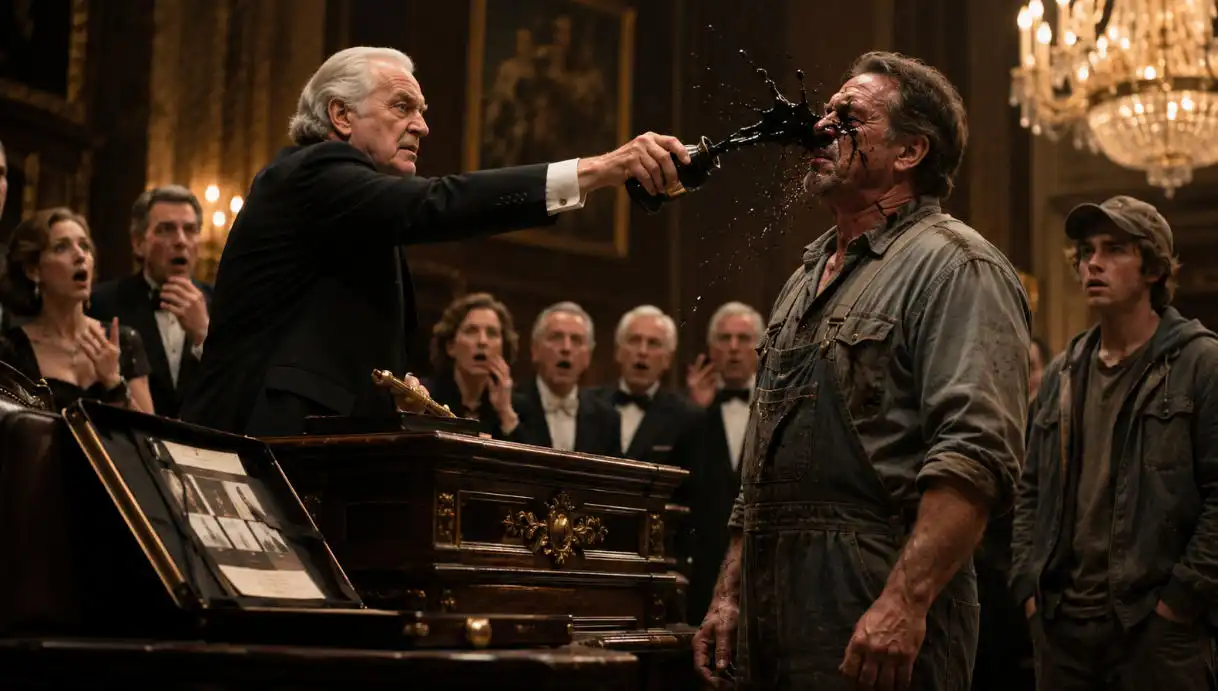
I opened the leather folder, placed one document on the podium, and said the first word—
“Inventory.”
Not loud.
Not angry.
Just clear enough for the microphone to catch it.
The sound of that word moved through the ballroom like a cold draft.
Reginald still had black ink on his fingers.
My face was wet with it.
My shirt hung torn across my shoulder.
Three hundred people were staring at me like I had just stopped the world from turning.
Reginald laughed once, but it came out thin.
“Inventory?” he said. “What is that supposed to mean?”
I looked at the headmistress.
She would not meet my eyes.
The school attorney stood halfway up from his table, frozen with a cloth napkin still in his hand.
My son, Caleb, was standing near the second row, pale and shaking.
I gave him the smallest nod I could.
Sit down, son.
He understood.
He sat.
That was the hardest part of the whole night.
Not the slap.
Not the ink.
Not being shoved onto polished marble while strangers recorded me like I was a street fight.
It was watching my boy learn, in real time, how adults with money can act when they think nobody important is watching.
Reginald leaned toward me, trying to recover his stage voice.
“Sir, you have already caused enough disruption.”
I smiled.
That seemed to bother him more than if I had yelled.
“I caused disruption?”
I lifted the paper.
“You assaulted the owner of the auction inventory.”
Nobody moved.
Even the waiters stopped walking.
Reginald blinked.
“What?”
I turned the document so the room could see the signature page, though not close enough to read everything.
“This is the master loan agreement for tonight’s auction items.”
The headmistress whispered, “Oscar…”
Reginald looked back at her.
For the first time all night, he looked unsure.
I kept my voice steady.
“Every painting, watch, sculpture, antique book, signed jersey, and historic item in this room was placed here on loan.”
A woman in pearls whispered, “Loan?”
I nodded.
“From me.”
The room changed.
You could feel it.
One second, I was the dirty working man who did not belong.
The next, I was the man whose property was sitting under every spotlight in the ballroom.
Reginald’s mouth opened.
No words came out.
I pointed to the largest item at the front of the stage.
The one he had been bragging about for twenty minutes.
A rare early American silver service set, appraised at over $800,000.
“That one belonged to my grandmother’s estate.”
Then I pointed to the portrait.
“That was purchased by my late wife at a charity sale twenty years ago.”
Then the watch display.
“Those came from my business partner’s private collection, held in trust by my foundation.”
A father in a navy tuxedo stood up slowly.
“Foundation?”
I looked at him.
“Yes.”
I turned back to Reginald.
“The school knows me as Oscar Bell. Most contractors know me as Oscar from Bell Restoration. You might know the donor name better.”
The attorney closed his eyes.
I said it.
“Bell Family Educational Trust.”
The room erupted.
Not loud at first.
More like a hundred people trying to breathe at the same time.
Someone whispered, “Oh my God.”
Someone else said, “That’s the new science wing.”
Another parent said, “He paid for the scholarship dorm.”
Reginald stepped back from the podium.
His heel hit the stage riser.
For three years, my trust had funded that school quietly.
Quietly because my late wife, Miriam, believed charity should not be a billboard.
She had grown up in a row house with a father who fixed boilers and a mother who cleaned offices at night.
When we made money, real money, she made me promise one thing:
“Never let giving become a performance, Oscar.”
So I gave anonymously.
Library upgrades.
Scholarships.
A new accessibility elevator.
Teacher grants.
Emergency tuition for families who got hit by layoffs, illness, or divorce.
The kind of gifts that kept a school’s reputation polished while pretending they were self-made.
But I still wore my work clothes.
Because Bell Restoration was mine before the trust was.
Because I still liked job sites better than boardrooms.
Because my son knew his mother loved honest work.
And because no school that takes money from working families should teach children to despise working people.
That was why I came that night dressed exactly as I did.
Not to test anyone.
Not at first.
I had spent the afternoon at a restoration site near Georgetown.
A pipe burst in a historic property, and I was under a crawlspace until 5:40 p.m.
I could have gone home.
Changed.
Put on a suit.
Pretended to be the kind of man Reginald respected.
But Caleb had asked me to come.
He was a scholarship student there, though the school never announced whose scholarship paid for half the children in his program.
He had been nervous all week.
“Dad,” he said, “some parents act weird when they find out what you do.”
I asked him, “What do they say?”
He shrugged.
That shrug hurt.
It told me enough.
So I came as myself.
A father.
A worker.
A donor.
In that order.
Reginald had been hired from a high-end auction house in New York for the evening.
The school wanted polish.
Prestige.
A man who could make wealthy parents open their wallets while feeling noble.
He had silver hair, a velvet jacket, and the kind of voice that made insults sound like etiquette.
The first time he saw me at check-in, his eyes went straight to my boots.
Not my face.
My boots.
“Vendors check in through the rear,” he said.
I told him I was a guest.
He laughed.
Not loudly.
Worse.
Privately.
Like I was too small to offend him.
At the registration table, a young staff member found my name.
Oscar Bell.
She looked surprised, then nervous.
Reginald leaned over her shoulder.
“That can’t be right,” he said.
I heard him.
Everyone nearby heard him.
He lowered his voice, but not enough.
“Seat him in the back. We don’t need the optics.”
The optics.
That was the first clue that the night was going to teach someone something.
I said nothing.
I took the paddle.
Number 17.
I walked in.
The ballroom looked like old money had thrown perfume on itself.
Crystal chandeliers.
White roses.
Violin music.
Parents in black dresses and tailored suits.
People discussing legacy admissions and summer houses while student volunteers carried trays of sparkling water.
I saw Caleb near the student section.
He smiled when he saw me.
Then his smile tightened when he noticed people looking.
I gave him a thumbs-up.
I sat near the aisle.
The whispers began immediately.
“Who is that?”
“Is he lost?”
“Maybe a contractor.”
“Why would they let him sit there?”
A man at the next table moved his wife’s purse away from the edge.
As if poverty was contagious.
I kept my hands folded.
I counted the exits.
Old habit from job sites.
Always know where the exits are.
The auction started.
Reginald was charming at first.
He teased parents about their vacation homes.
Praised the school’s “culture of excellence.”
Called donors “the backbone of tradition.”
Then the signed portrait came up.
It was not the most expensive item, but it mattered to me.
Miriam had loved it.
A portrait of a schoolteacher from the 1940s, signed by the artist on the back.
She used to say it looked like her mother.
Opening bid: $10,000.
I raised my paddle.
That was the moment Reginald decided I needed to be taught my place.
He paused.
Smiled.
Looked around the room like he was inviting everyone into the joke.
“Sir,” he said, “do you understand the minimum bid?”
A few people laughed.
I said, “Yes.”
He tapped the microphone.
“This is not a raffle.”
More laughter.
I raised the paddle again.
“Ten thousand.”
The smile left his face.
He glanced at the headmistress.
She looked down.
That mattered.
I noticed.
Reginald leaned forward.
“And how will you be securing that bid?”
A parent behind me muttered, “With overtime?”
The table laughed.
Caleb stood halfway up.
I turned my head just enough.
“Sit.”
He sat.
I looked back at Reginald.
“The same way everyone else does.”
Reginald’s nostrils flared.
He had built a room around hierarchy, and I had refused to stand at the bottom.
That made him reckless.
He pointed toward security.
“Please remove this gentleman.”
The guard hesitated.
He was a young man, maybe twenty-five.
He looked at my paddle.
Then at the headmistress.
Then at Reginald.
I did not blame him.
People with titles make ordinary workers do ugly things all the time.
Reginald came down himself.
The applause had stopped.
The violinist lowered her bow.
Reginald stood in front of me.
Up close, his cologne was sharp enough to sting.
“Give me the paddle,” he said.
“No.”
“You are embarrassing yourself.”
“No,” I said. “You are.”
That was when he snapped.
He grabbed the paddle from my hand.
Ink from his fountain pen spilled across his fingers.
Maybe he meant only to snatch.
Maybe he meant exactly what happened next.
Either way, he flicked his hand, and black ink splashed across my face.
The room gasped.
Someone said, “Oh!”
I stood.
He slapped me.
Hard enough that the microphone picked up the sound.
A woman screamed.
Then he grabbed at my hair, shoved me backward, and I hit the floor near the podium steps.
My shirt tore when he twisted the front of it.
Buttons scattered across the marble like coins.
For one second, I saw the chandelier upside down.
Then I saw Caleb.
My son’s face was red.
Not with fear anymore.
With rage.
He started forward.
I said, “Stay seated.”
My voice sounded rough.
But he heard me.
Reginald stood over me, breathing hard.
“Learn some respect,” he said.
And that was the sentence that sealed his future.
Because by then, half the room had phones out.
The school’s own event cameras were running.
The insurance representative was in the room.
The attorney had watched it happen.
And my leather folder was under my chair, exactly where I had left it.
I stood slowly.
I picked up the torn piece of my shirt.
I wiped my face.
I asked him, “Are you absolutely sure you want this on camera?”
He smirked.
“Who do you think you are?”
That question followed him into court.
But before court came silence.
The kind of silence money cannot buy its way out of.
Back in the ballroom, after I said “Bell Family Educational Trust,” Reginald looked at the headmistress.
“Is this true?”
The headmistress finally spoke.
“Yes.”
Her voice was barely there.
“He is the school’s largest private donor.”
I added, “And the legal owner or authorized trustee of every item you handled tonight.”
The attorney stepped forward.
“Oscar, we should discuss this privately.”
I looked at him.
“No.”
One word.
The whole room heard it.
“You had privacy when your auctioneer mocked my clothing. You had privacy when your guests laughed at my son’s father. You lost privacy when he put his hands on me.”
Nobody argued.
Reginald’s knees seemed to loosen.
He grabbed the podium like the floor had tilted.
I laid out the documents one by one.
Loan agreement.
Insurance rider.
Auction house conduct clause.
Damage liability schedule.
Security incident protocol.
The event contract with Reginald’s signature.
Every page mattered.
Because Miriam had taught me something else.
Kindness without paperwork is just hope.
Paperwork is protection.
The conduct clause was simple.
Any intentional damage, mishandling, or public misconduct involving loaned property triggered immediate removal of the auctioneer, termination of sale authority, full liability review, and mandatory reporting to the licensing board.
The torn shirt mattered too.
Not because it was expensive.
It wasn’t.
It was a Bell Restoration uniform.
Company-issued.
Part of a registered brand used in active commercial operations.
He had damaged my property on video while acting as a licensed professional at a contracted event.
The ink mattered.
The shove mattered.
The slap mattered.
The witnesses mattered.
And the rare portrait he had jerked aside during the struggle?
Its frame hit the stage rail.
A hairline crack ran through the original gilding.
The insurance appraiser saw it before I even pointed.
That crack was not just a crack.
It was a number with commas in it.
Reginald whispered, “I didn’t know.”
I looked at him for a long moment.
“That is the problem.”
His face went gray.
“You didn’t know who I was, so you thought it was safe to be cruel.”
A few parents looked down at their laps.
Good.
Some shame should be heavy.
Then the headmistress tried to save the evening.
“We can pause,” she said. “We can regroup. Oscar, I am so sorry. Perhaps we can—”
I raised my hand.
Respectfully.
But firmly.
“No.”
I turned to the room.
“This auction is suspended pending legal review.”
Gasps.
Parents sat up.
Reginald made a sound like a cough.
The attorney rubbed his forehead.
I continued.
“Any bids already recorded are void. No transfer of property will occur tonight.”
A man near the front stood.
“You can’t do that.”
I looked at him.
“I can. It is in the agreement your school signed.”
He sat down.
Then came the part nobody expected.
I walked to the student section.
Caleb was still shaking.
Beside him sat a girl named Emma.
I knew her because she had written me a thank-you letter two years earlier.
Not knowing it was me.
Her father was a postal worker.
Her mother worked nights at a rehab clinic.
Emma had won a school art prize, but at events like this, she always seemed to fold herself smaller.
Like the room charged rent for confidence.
She had been staring at the portrait all night.
Miriam’s portrait.
I asked her, “Do you like that painting?”
Emma looked terrified to be spoken to.
“Yes, sir.”
“Why?”
She swallowed.
“It looks like my grandmother. She was a teacher.”
My throat tightened.
I looked at Caleb.
He understood before I said a word.
I returned to the podium and lifted the portrait carefully.
Reginald flinched, as if the frame itself might testify against him.
I checked the damage.
The portrait was safe.
The frame would need restoration, but that was my business.
I turned back to Emma.
“Then I am selling this item.”
The attorney blinked.
“Oscar—”
“For one dollar.”
The room went dead silent again.
“To Emma Hart, if she wants it.”
Emma’s eyes filled with tears.
“I don’t have—”
Caleb reached into his pocket and pulled out a dollar bill.
He walked it to her.
The whole ballroom watched a scholarship kid hand another scholarship kid one dollar while people wearing diamonds sat speechless.
Emma brought it to me with trembling fingers.
I took it.
“Sold.”
No gavel.
No performance.
Just a father honoring his wife in a room that had forgotten what dignity looked like.
That was when Reginald broke.
He sank forward onto the podium, both hands shaking.
His forehead nearly touched the wood.
“I’m sorry,” he whispered.
But he was not looking at me.
He was looking at the cameras.
That told me what kind of sorry it was.
The aftermath was not instant.
Real consequences rarely are.
They arrive with emails, affidavits, hearings, letters from attorneys, and people suddenly claiming they “never approved that behavior.”
The school placed Reginald’s firm under review before midnight.
By morning, three parent videos had spread through private school circles in D.C.
By noon, the auction house suspended him.
By Friday, the licensing board had received the incident report, the video, the contract, and the damage estimate.
His auctioneer license was later revoked.
The civil case was worse.
The damaged frame, the suspended event, the mishandled inventory, the reputational harm, the breach of contract, the assault complaint, and the insurance claim built a wall around him brick by brick.
He faced millions in liability.
And yes, the criminal charge moved forward too.
Not because I wanted revenge for a slap.
Because people who use public humiliation as a weapon usually have a history.
Within weeks, two former assistants came forward.
Then a junior cataloguer.
Then another donor.
Stories about shouting.
Threats.
“Accidental” damage blamed on staff.
A pattern.
That is what ended him.
Not me.
The truth did.
As for the school, the board asked to meet privately.
I refused the first invitation.
Then I accepted the second, with conditions.
Caleb came with me.
So did Emma’s parents.
So did the young security guard who had hesitated instead of grabbing me.
I told the board exactly what I wanted.
Not my name on a building.
Not a plaque.
Not a dinner.
A workers’ dignity policy.
Mandatory conduct training for all vendors and staff.
Clear protection for scholarship families.
A parent code of conduct at school events.
And a student fund in Miriam’s name for children whose parents worked with their hands.
The headmistress resigned before the end of the term.
The board chair apologized publicly.
Not perfectly.
But publicly.
That mattered.
A year later, the school opened the Miriam Bell Workshop.
Not a marble hall.
A real workshop.
Wood benches.
Tools.
Drafting tables.
A restoration lab.
A place where students learned that intelligence does not only wear a blazer.
Sometimes it wears work gloves.
Emma hung Miriam’s portrait in the entrance.
With a small card underneath:
“Never confuse polish with character.”
I cried when I saw it.
I tried not to.
Failed.
Caleb pretended not to notice.
Good boy.
He is taller now.
Still stubborn.
Still kind.
He works part-time with me on weekends, though I told him he doesn’t have to.
He says he likes fixing things because broken does not mean worthless.
That came from his mother.
Not me.
The last time I saw Reginald was outside a courthouse.
He looked smaller without a microphone.
No velvet jacket.
No crowd.
No parents laughing behind him.
He did not speak to me.
I did not speak to him.
There was nothing left to say.
But I did think about the question he asked me that night.
“Who do you think you are?”
I know the answer now.
I am a father.
I am a worker.
I am a widower who kept a promise.
I am a man who learned that staying calm is not weakness when the truth is sitting in a folder.
And I am the man who sold the most valuable item in that room for one dollar to a child who saw beauty before she saw price.
That was the real victory.
Not his license.
Not the lawsuit.
Not the apology.
The victory was my son watching me stand up without becoming cruel.
Because the world already has enough cruel people in expensive clothes.
So pick a side:
Was I right to shut down the entire auction after they humiliated me in front of everyone…
Or should I have accepted the apology and let the night continue? ⚖️
Disclaimer: Mention of any brand or trademark is for identification only and does not imply partnership or endorsement
Maggie Was Covered In Shampoo, Slapped, And Laughed At In Front Of Rich Parents… Until One Quiet Phone Call Changed EVERYTHING

A Palm Beach Tennis Star HUMILIATED a Quiet Older Man in Front of the Whole Club… Then He Saw What Norman’s Attorney Filed That Morning
Chase Slapped the “Poor Old Man” at His Luxury Open House… Then Learned the Terrifying Truth Too Late