
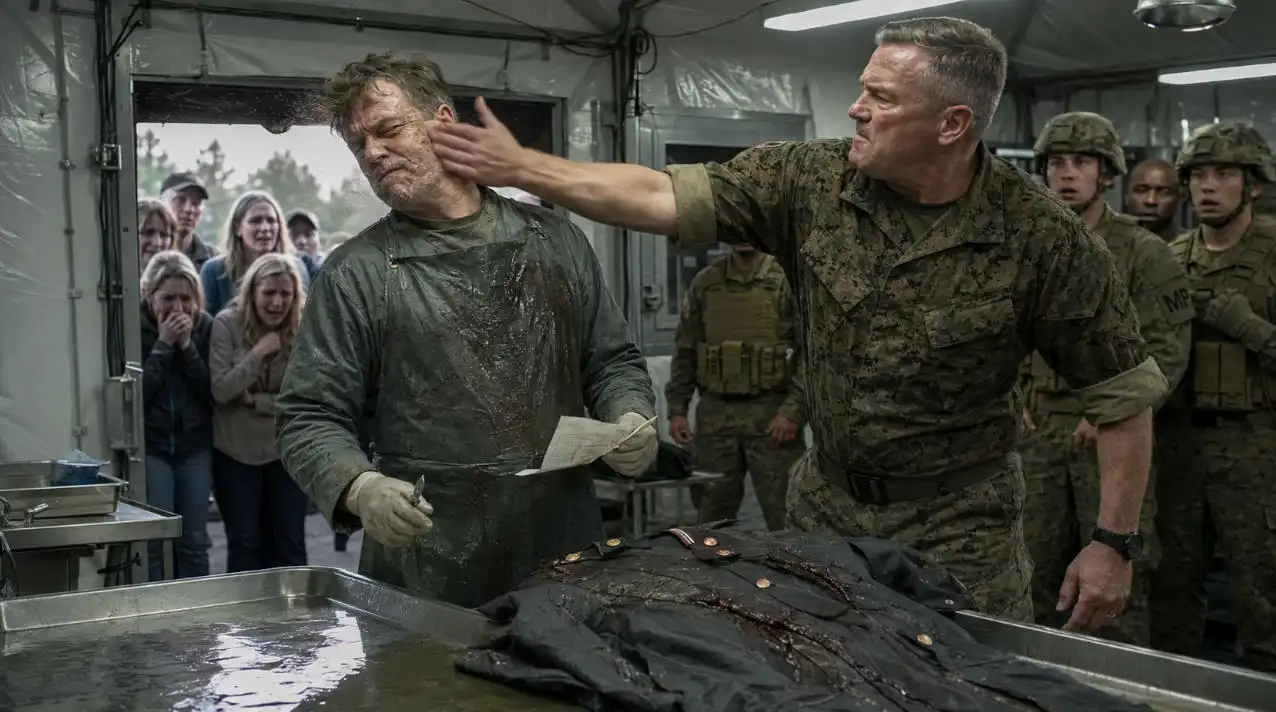
The stitch was so small most men would have missed it.
But Logan did not move like most men.
He stood there with formalin dripping from his coat, one cheek red from the slap, and a scalpel resting lightly between his fingers.
Lieutenant Colonel Craine had been smiling ten seconds earlier.
Now he was staring at that tiny thread like it had just spoken his name.
The temporary morgue was nothing more than a converted supply room behind the medical tent.
Cold lights.
Metal table.
Plastic curtains.
A grieving family outside the door.
Two military police officers stood shoulder to shoulder, blocking the parents from seeing their son.
His mother kept whispering, “Please. Please don’t take him away yet.”
His father had one hand flat against the doorframe.
He wasn’t shouting.
That made it worse.
He looked like a man trying not to break.
Inside the room, Craine acted like he owned the air.
Pressed uniform.
Clean boots.
Voice polished enough for briefings.
He had the kind of face that expected younger men to step aside before he even spoke.
“Assistant,” he said to Logan, “bag the body and prepare transport.”
Logan looked up.
“Transport where?”
Craine’s jaw tightened.
“Cremation.”
One of the young MPs blinked.
“Sir, the family requested—”
Craine cut him off.
“The family doesn’t run this base.”
Then he turned back to Logan.
“You people always think grief gives civilians authority.”
Logan said nothing.
That silence offended Craine more than any insult could have.
He stepped closer.
“Did you hear me?”
“I heard you,” Logan said.
His voice was calm.
Almost tired.
Craine pointed at the body on the table.
“This was a training accident. The paperwork is done. The Army has spoken.”
Logan glanced at the recruit’s uniform.
It had been placed too neatly.
Too perfectly.
The shirt had already been washed in one place.
The fabric near the chest had a small repaired seam that didn’t match the rest of the garment.
A sloppy cover for someone who had never expected a real forensic examiner to look.
Craine saw Logan’s eyes pause there.
And that was when his confidence turned mean.
He grabbed a brown bottle from the counter.
Formalin.
Sharp.
Chemical.
Ugly.
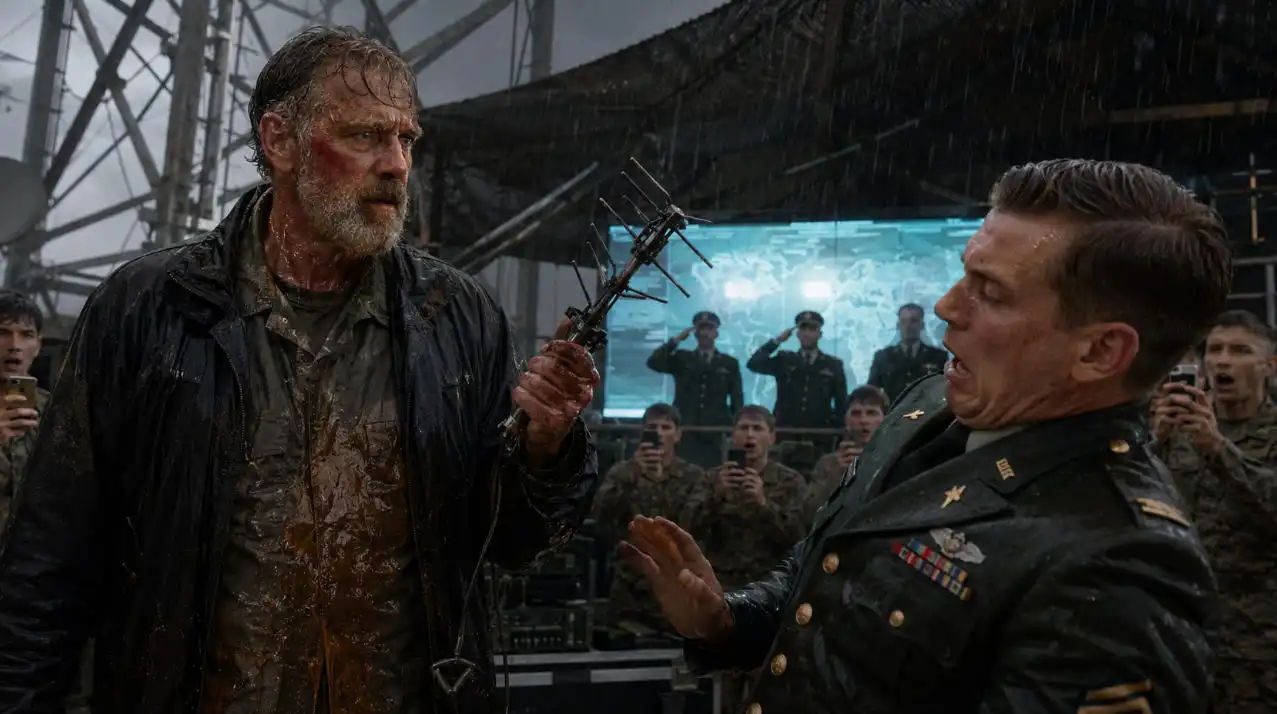
Before anyone could stop him, he dumped it across Logan’s shoulder and chest.
The room gasped.
Then Craine slapped him.
Hard.
The sound cracked against the steel walls.
Outside, the mother screamed.
“Do not touch him!” the father shouted.
But the MPs kept blocking the door.
Craine leaned close to Logan.
“You are an assistant in my morgue. You will not question me in front of my men.”
Logan slowly picked up his glasses.
Cleaned one lens with a corner of his soaked coat.
Put them back on.
Then he said, “This is not your morgue.”
Craine laughed.
“Excuse me?”
Logan reached into his inside pocket and removed a folded document sealed in a clear plastic sleeve.
He placed it on the table.
Craine barely glanced at it.
“I don’t care what form you think you have.”
“It is not a form.”
Logan unfolded it.
The first MP leaned forward.
His face changed when he saw the header.
United States District Court.
Signed order.
Mandatory independent forensic examination.
Craine’s laugh died.
Logan looked at the MPs.
“Move away from the door.”
Nobody moved.
Craine snapped, “Stand your ground.”
Logan did not raise his voice.
“Gentlemen, you are now obstructing a federal court order in a death investigation.”
That did it.
The younger MP stepped aside first.
The second followed.
The recruit’s parents stumbled into the room, but Logan lifted one hand gently.
“Please stay behind me. You deserve the truth. But I’m going to keep your son’s dignity intact.”
The mother covered her mouth.
The father nodded once.
Craine tried to recover.
“This is absurd. That boy died during a live-fire training error. Ricochet. Everyone knows it.”
Logan looked at him.
“Everyone who signed your report, maybe.”
The room went silent.
Logan picked up the scalpel.
Not dramatic.
Not angry.
Precise.
He cut through the recruit’s uniform seam, not the body beneath it.
The little repaired patch opened.
Under it was a dark, round tear in the original fabric.
Too clean.
Too direct.
Not a ricochet pattern.
Not shrapnel.
Not the kind of damage described in Craine’s report.
Logan pointed to the hole.
“This is the first lie.”
Craine’s mouth opened, but nothing came out.
Logan continued.
“The report says the recruit was facing downrange when a ricochet struck him from the side.”
He lifted the fabric carefully.
“But the uniform damage shows a direct entry line from the front.”
The mother made a broken sound.
The father closed his eyes.
Logan’s voice softened.
“I’m sorry.”
Then he turned back to Craine.
“The second lie is the stitching. Someone repaired the uniform after death to hide the original bullet path.”
Craine barked, “You cannot prove who—”
Logan cut him off.
“I can prove timing.”
He pointed to the thread.
“This thread is surgical nylon from the base medical kit. Not uniform repair thread. It was used after the body arrived here.”
One of the medics at the back looked like he might faint.
Logan turned to him.
“Private Ellis. Did someone order you to stitch this?”
The young medic’s lips trembled.
Craine’s eyes went cold.
“Do not answer that.”
Logan slid the federal order closer.
“You are under protection if you tell the truth.”
Private Ellis looked at the grieving parents.
Then at the dead recruit.
Then his face collapsed.
“He told me it was only for the family viewing,” Ellis whispered. “He said if they saw the hole, they’d start asking why the angle didn’t match the range report.”
The room erupted.
The father stepped forward, shaking.
“You knew?”
Craine pointed at Ellis.
“That man is unstable.”
Logan opened a black evidence folder.
That was when everyone understood.
He had not walked in blind.
He had been silent because he had already been working.
Inside the folder were range photos.
Witness statements.
Ballistic calculations.
A copy of Craine’s revised incident timeline.
And one page that made the whole room freeze.
A radio transcript.
Logan read it aloud.
“Cease-fire requested at 1421 due to recruits crossing the flagged lane.”
He looked at Craine.
“You denied the cease-fire.”
The young MP whispered, “Oh my God.”
Logan turned another page.
“Three instructors reported the lane was unsafe. You overruled them because a visiting general was watching the exercise and you didn’t want the demonstration delayed.”
Craine’s polished face had gone gray.
The truth was not a freak accident.
It was arrogance.
A commander wanted his training demonstration to look flawless.
A recruit entered a danger zone after a signal confusion.
Instructors called for a pause.
Craine refused.
A live round was fired while the recruit was still exposed.
Then Craine changed the range log.
Pressured medics.
Blocked the family.
And tried to rush cremation before an independent autopsy could expose the angle of the wound.
All because a dead young man was easier to manage than a public scandal.
Logan looked at the parents.
“Your son did not die because he was careless.”
The mother broke down.
The father put both hands over his face.
Logan’s voice stayed steady.
“He died because men in authority ignored warnings. And then someone tried to erase him.”
Craine suddenly stepped toward the table.
Maybe he wanted the folder.
Maybe he wanted the court order.
He never reached either.
Two federal investigators entered through the side door.
They had been waiting in the adjoining records room the whole time.
One of them held up a badge.
“Lieutenant Colonel Craine, step away from the evidence.”
Craine tried one last performance.
“This is a military matter.”
The investigator answered, “Not anymore.”
That was the moment the room shifted.
The man who had slapped a quiet “assistant” now had two agents reading him his rights in front of the parents he had tried to silence.
The MPs who had blocked the door looked sick with shame.
Private Ellis gave a full statement before sunset.
So did two range instructors.
So did the medic who had been ordered to alter the uniform.
By morning, Craine was removed from command.
By the end of the week, the official report was withdrawn.
The recruit’s family received the truth in writing.
Not a rumor.
Not a whispered apology.
A signed federal finding.
Craine was later convicted for negligent homicide, obstruction, falsifying records, and conspiracy to conceal evidence.
The same man who had ordered a body burned to protect his career was escorted in handcuffs to federal prison.
No clean uniform.
No polished voice.
No men blocking the door for him.
Just silence.
And consequences. ⚖️
Months later, the recruit’s parents stood at a memorial ceremony on base.
Their son’s name was carved into stone.
Not hidden in a file.
Not reduced to “training accident.”
Logan stood at the back in a plain dark suit.
He did not want applause.
He never had.
The mother found him anyway.
She took his hands and said, “You gave us our boy back.”
Logan shook his head.
“No, ma’am. Your son gave the truth one last chance. I only listened.”
For the first time since the morgue, the father cried openly.
Not from confusion.
Not from helplessness.
From relief.
Because grief is heavy enough.
No family should have to carry a lie with it.
And that is why Logan’s name spread far beyond the base.
Not as a hero who shouted.
Not as a man who fought with fists.
But as the forensic doctor who stood soaked, slapped, and silent…
Until the truth was sharper than any blade in the room.
Some people think rank makes them untouchable.
But rules exist for the powerless too.
And when a good man knows how to use them, even the highest voice in the room can be forced to answer.
So choose a side:
Was Logan right to stay silent until the legal trap closed…
Or should he have exposed Craine the second he walked in? 👇
Disclaimer: Mention of any brand or trademark is for identification only and does not imply partnership or endorsement
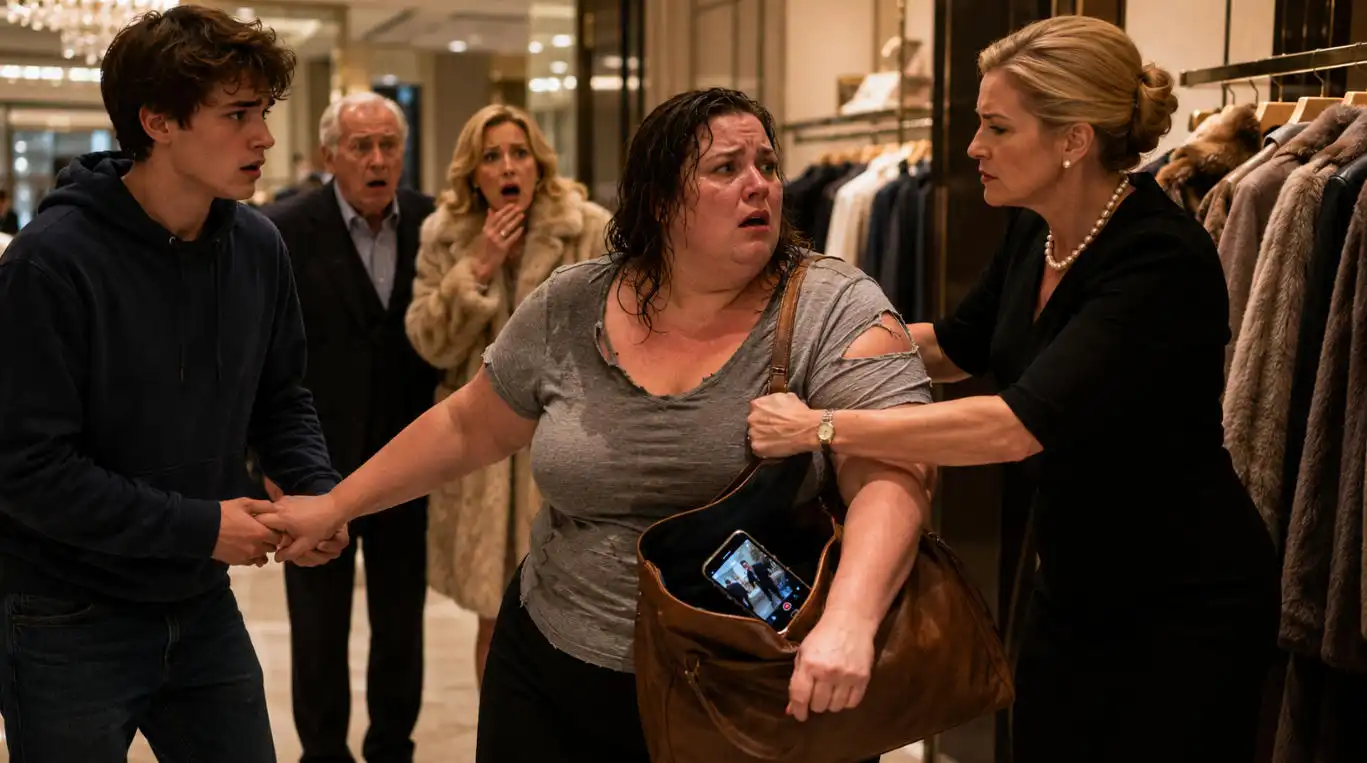
Maggie Was Covered In Shampoo, Slapped, And Laughed At In Front Of Rich Parents… Until One Quiet Phone Call Changed EVERYTHING
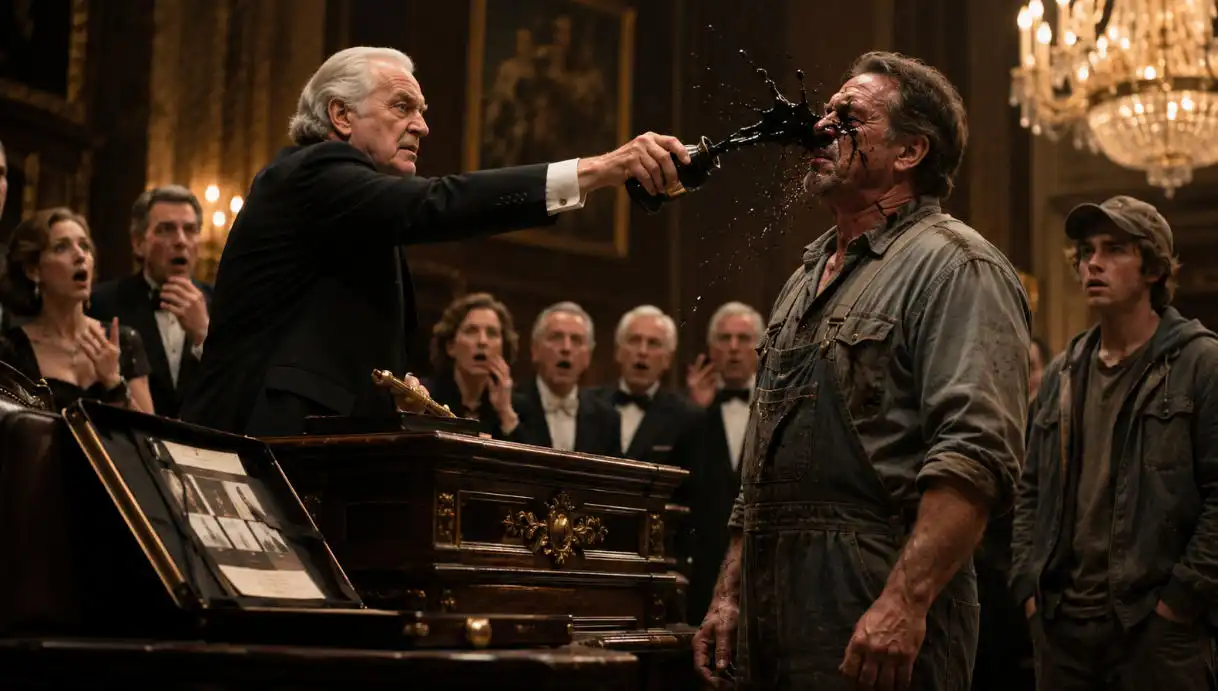
A Blue-Collar Dad Was DRAGGED Out Of A D.C. Private School Auction By A Snobby Auctioneer… But They Had NO IDEA Who He Really Was 😳
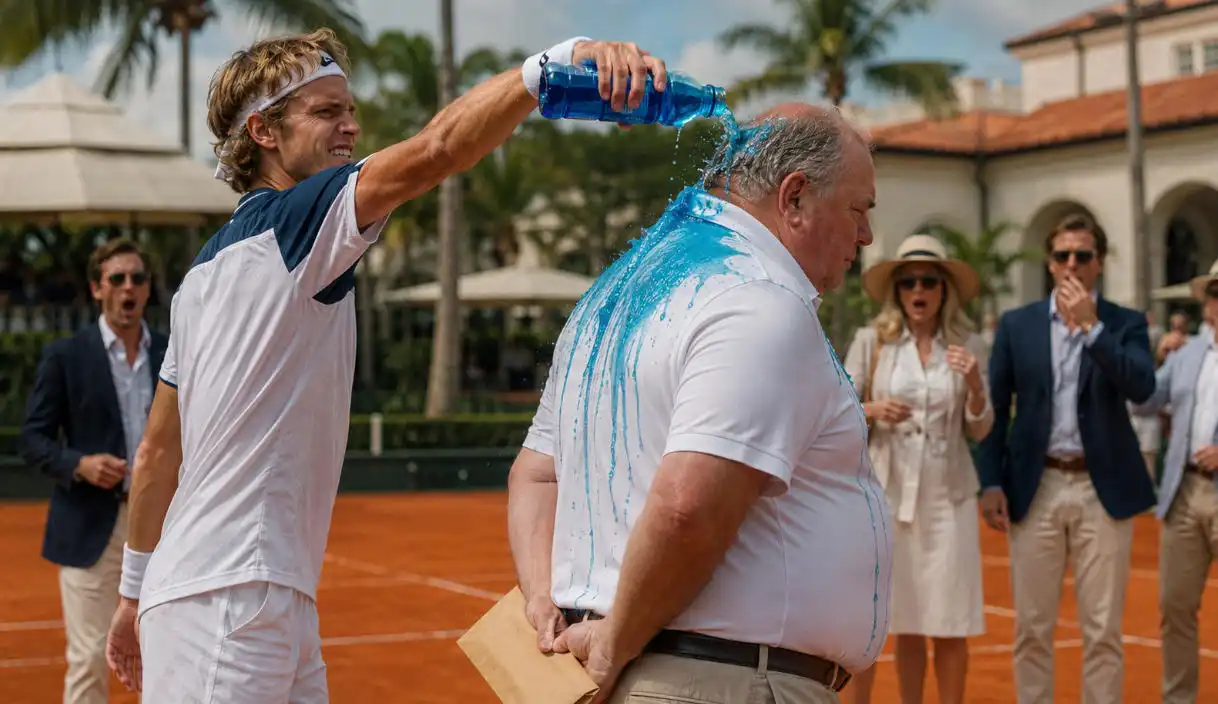
A Palm Beach Tennis Star HUMILIATED a Quiet Older Man in Front of the Whole Club… Then He Saw What Norman’s Attorney Filed That Morning