
“—right in front of you.”
That was the end of the sentence Vivienne never expected to hear.
For one second, the whole boutique froze.
The rich parents stopped whispering.
The woman who had been recording with her phone slowly lowered it.
And Vivienne, who had just poured shampoo down my face like I was some kind of stray animal, stared at the attorney as if he had spoken in another language.
I was still on the floor.
My T-shirt was torn at the shoulder.
My son, Noah, was crying so hard his little chest kept hiccuping.
And Vivienne still had a strand of my hair caught in her manicured fingers.
The attorney looked at her hand.
Then at me.
Then back at Vivienne.
“Ms. Carlisle,” he said, coldly, “let go of her hair.”
Vivienne released it like it had burned her.
I pulled Noah into my arms and held him tight.
“It’s okay,” I whispered.
But it wasn’t okay.
Not yet.
Because five minutes earlier, Vivienne had decided I was too poor to stand inside her luxury children’s clothing store.
Too round.
Too tired-looking.
Too “wrong” for her perfect little world of imported cashmere sweaters and $900 toddler coats.
I had come to the boutique because Noah had an interview for a scholarship program the next morning.
He was seven.
He had been through more than most adults.
His father left when he was three.
I worked two jobs for years.
I packed lunches.
I clipped coupons.
I wore the same sneakers until the soles cracked.
But Noah had earned that interview with perfect reading scores and a heart so sweet it made strangers smile.
He asked me that morning, “Mom, can I look nice tomorrow? Like the other kids?”
So I brought him to the nicest children’s boutique in the city.
I wanted him to feel proud.
Not rich.
Not better than anybody.
Just proud.
The boutique sat inside one of the most expensive malls on Chicago’s Magnificent Mile.
Marble floors.
Glass elevators.
Soft music.
People who looked like they had never worried about a bill in their lives.
I knew what they saw when I walked in.
A tired single mom.
A curvy woman in a faded blue T-shirt.
A little boy in worn sneakers.
But what they didn’t see was the folder in my tote bag.
What they didn’t know was that my late aunt had left me a controlling interest in a private real estate trust.
And that trust had spent the past year quietly negotiating to buy the entire shopping center.
Not one store.
Not one floor.
The entire mall.
The final closing papers had been signed that morning.
I hadn’t told anyone.
I didn’t dress differently.
I didn’t act differently.
Because money does not change how you should treat people.
But it does reveal who people really are.
Vivienne revealed herself the moment she saw us.
She stepped out from behind the counter with a smile that never reached her eyes.
“Can I help you find the exit?” she asked.
I blinked.
“I’m sorry?”
She looked at Noah’s shoes.
Then at my shirt.
Then at the other parents shopping nearby.
“Our seasonal collection is quite selective,” she said. “Most items begin in the four figures.”
“I can read price tags,” I said.
One father near the stroller section smirked.
A blonde woman in yoga clothes whispered loudly, “This is why they need security at the doors.”
Noah squeezed my hand.
“Mom, we can go.”
And that broke something in me.
Not with anger.
With sadness.
Because my child had already learned to shrink so adults could feel comfortable.
I knelt beside him.
“No,” I said softly. “You belong anywhere you behave with respect.”
Vivienne laughed.
Not a loud laugh.
Worse.
A polished little laugh meant for people like her.
“Respect is exactly the issue,” she said. “Our clients bring their children here to avoid certain environments.”
“Certain environments?” I asked.
She looked me right in the face.
“You know what I mean.”
The room went quiet enough to hear the hangers clicking on the rack.
I reached into my purse and turned my phone recorder on.
I didn’t wave it around.
I didn’t announce it.
I had learned a long time ago that arrogant people perform best when they think nobody important is listening.
I said, “Please explain what you mean.”
Vivienne crossed her arms.
“I mean, your son is upsetting our atmosphere.”
Noah looked down at his sneakers.
My heart cracked.
“He hasn’t touched anything,” I said.
“He doesn’t have to,” she snapped. “Look at him.”
That was when another mother pulled her daughter away from Noah like he was contagious.
“Come here, Ava,” she whispered. “Don’t stand too close.”
Noah heard it.
Of course he heard it.
Children always hear the cruel parts.
I stood.
“We’re going to buy an outfit,” I said. “Then we’re leaving.”
Vivienne blocked the aisle.
“No, you’re leaving now.”
I took one step around her.
She grabbed a bottle from the display.
It was some imported children’s shampoo in a crystal-looking bottle.
Fifty-two dollars.
I remember that because after everything happened, the price tag was still stuck to the side.
Vivienne popped it open.
Before I could move, she poured it over my head.
Cold liquid ran down my forehead, into my eyes, across my lips.
Someone gasped.
Someone else laughed.
Noah screamed, “Stop!”
Vivienne leaned close and said, “There. Now at least you smell like you can afford the room.”
I wiped my eyes.
My hands were shaking.
Not because I was scared.
Because my son was watching.
And I knew that whatever I did next would teach him something.
If I screamed, he would learn that cruelty controls the room.
If I hit back, he would learn that humiliation gets to choose your character.
So I stayed still.
“Don’t touch me again,” I said.
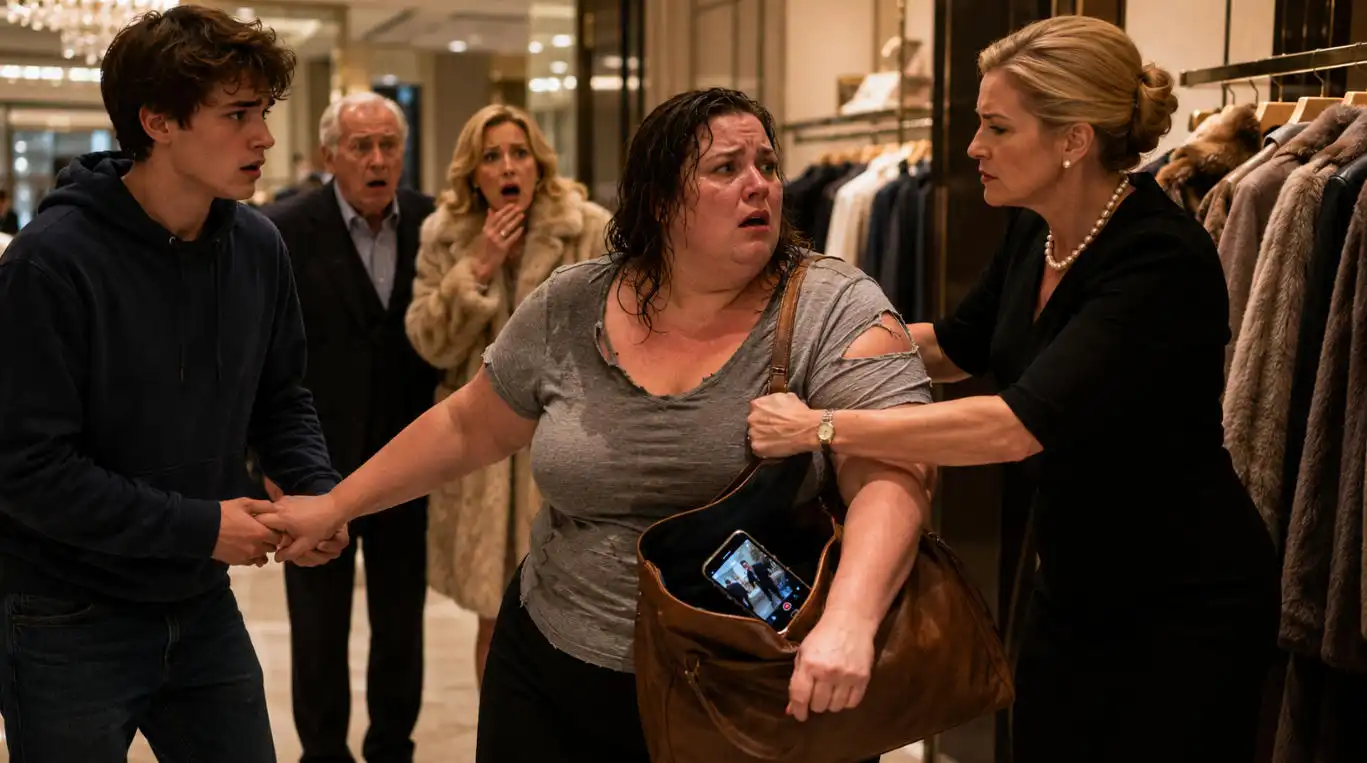
Vivienne slapped me.
Hard enough that my cheek burned.
Noah lunged toward me.
She shoved him back with her hip, not enough to hurt him badly, but enough to make him stumble.
That was the only moment I almost lost control.
I grabbed his hand.
“Do not touch my child.”
Vivienne grabbed my hair near the shoulder and yanked.
The pain shot across my scalp.
Then she shoved me backward.
I crashed into a rack of tiny velvet blazers.
The rack tipped.
Hangers scattered.
My shirt ripped against a sharp metal edge as I went down.
The floor was cold.
The boutique was silent.
Then came the phones.
Not helping.
Recording.
A man muttered, “This is insane.”
A woman said, “She should have just left.”
Vivienne stood over me, breathing hard, her pearls rising and falling at her throat.
“Security will remove you,” she said. “And I’ll make sure you never step foot in this mall again.”
I looked up at her through shampoo and tears.
“No,” I said.
She laughed.
“No?”
“No.”
Because while she was performing for her audience, my phone had captured every word.
Every insult.
Every touch.
Every threat.
And just outside the boutique, walking across the marble floor, was Mr. Daniel Avery, the real estate attorney who had handled the closing.
He was supposed to meet me at the management office upstairs.
Instead, he had come looking for me.
He entered the store in a dark suit, holding the black folder.
Vivienne’s face changed immediately.
She knew him.
Of course she did.
Every store manager in the mall knew the attorney representing the new ownership group.
“Mr. Avery,” she said, suddenly breathless. “Thank goodness. We have a disturbance.”
He looked at the floor.
At the shampoo bottle.
At Noah’s wet little hands clutching mine.
At my torn shirt.
Then he looked at Vivienne.
“The disturbance appears to be assault,” he said.
Her smile twitched.
“I was managing a safety issue.”
Mr. Avery opened the folder.
“No. You were attacking the majority owner of the property your store leases from.”
The boutique went so quiet I could hear Noah sniffle.
Vivienne blinked.
“What?”
He turned one page around.
At the top was the name of the acquisition company.
Below that was my legal signature.
Margaret Elaine Whitaker.
Maggie.
Me.
Vivienne’s mouth opened.
Nothing came out.
The blonde mother who had pulled her daughter away whispered, “Oh my God.”
Mr. Avery continued, “As of 9:13 this morning, Ms. Whitaker’s trust became the controlling owner of this entire shopping center.”
Vivienne took a step back.
Then another.
Her heel hit the base of the display table.
The shampoo bottle rolled off and landed near her foot.
For the first time, she looked at me like I was a person.
Not because she had grown a conscience.
Because she had found out I had power.
That is not the same thing.
“I didn’t know,” she whispered.
I stood slowly, still holding Noah.
“No,” I said. “You didn’t.”
She looked around at the parents.
At the employees.
At the cameras in the corners.
At the attorney.
Then her face crumpled.
“Ms. Whitaker, please,” she said. “This is a misunderstanding.”
Mr. Avery’s voice stayed calm.
“The mall has security footage. Ms. Whitaker has audio. Several witnesses recorded video. There is no misunderstanding.”
Vivienne turned toward me.
The arrogance was gone.
Now she looked small.
Not humble.
Small.
“I’m so sorry,” she said. “I was under pressure. Corporate expects a certain image. This store has standards.”
“Standards?” I asked.
She swallowed.
“I didn’t mean—”
“You meant every word.”
Her eyes filled with tears.
Then she did something I will never forget.
She dropped to her knees in front of the fitting rooms.
Right there on the polished boutique floor.
In front of the same parents she had been trying to impress.
“Please,” she sobbed. “Please don’t ruin my life.”
Noah pressed closer to me.
I looked at him.
His face was wet.
His eyes were scared.
And I realized the moment was bigger than revenge.
My child needed to see justice.
Not cruelty.
Not rage.
Justice.
So I knelt down beside him.
“Baby,” I said, “what happened to us was wrong.”
He nodded.
“Are we going to be mean back?”
I shook my head.
“No. We’re going to tell the truth and let the rules do their job.”
Mr. Avery called mall security.
Then he called Chicago police.
Then he contacted the leasing director.
Vivienne kept crying.
But the crying did not erase what she had done.
Security reviewed the footage.
The video showed everything.
The shampoo.
The slap.
The hair pull.
The shove.
The torn shirt.
The moment she pushed Noah back.
By the time officers arrived, three parents had already offered their recordings.
Funny how bravery shows up after power enters the room.
The police took statements.
Vivienne was escorted out of the boutique.
Not in handcuffs in front of the children.
I asked them not to do that unless necessary.
But she was removed.
Her employment was terminated that same day.
The store’s corporate office tried to call it a “personnel matter.”
Mr. Avery corrected them.
It was a lease matter.
Their boutique had strict conduct clauses.
Assaulting a customer violated them.
Discriminatory treatment violated them.
Creating a public safety incident violated them.
And because I owned the property, the mall had every legal right to demand corrective action before allowing the store to continue operating.
Vivienne was fired immediately.
The company suspended the assistant manager who had watched without intervening.
The blonde mother who had pulled her daughter away from Noah later tried to apologize in the hallway.
She said, “I didn’t realize who you were.”
That sentence told me everything.
I said, “That was never the point.”
She looked ashamed.
Good.
Shame can be useful when it teaches.
Vivienne’s problems did not end with losing her job.
She faced a police complaint for assault.
My attorney filed a civil claim for damages, medical expenses, emotional distress, and the public humiliation of my child.
I did not ask for some ridiculous number.
I asked for accountability.
The settlement, when it came, included a written apology, full payment for counseling for Noah, and a mandatory donation to a children’s charity that served families in crisis.
But the part people talked about most happened thirty minutes after Vivienne was escorted out.
I walked back into the boutique.
My hair was still sticky.
My cheek still hurt.
My shirt was still torn.
Every employee froze.
I said, “I need shopping bags.”
One young sales associate, a girl who looked barely twenty, started crying.
“I’m sorry,” she said. “I wanted to help you, but I was scared she’d fire me.”
I believed her.
Fear makes people quiet.
But it does not make them innocent forever.
I said, “Then help me now.”
She nodded.
I pointed to the most expensive racks in the store.
The velvet blazers.
The wool coats.
The holiday dresses.
The tiny leather shoes.
The cashmere sweaters.
“All of it,” I said.
The associate stared.
“All of it?”
“All of it.”
Mr. Avery looked at me like he already knew.
Noah whispered, “Mom?”
I smiled at him.
“We’re buying clothes for kids who need to feel proud too.”
By closing time, we had purchased every high-end children’s outfit in the boutique.
Not for Noah alone.
For the children at a local orphanage and family shelter my aunt had supported for years.
Coats.
Shoes.
Dresses.
Suits.
Pajamas.
Everything.
The store had never seen a sale like it.
But this time, nobody was allowed to treat it like a victory for the boutique.
Mr. Avery made sure the receipt documented the donation.
The next morning, Noah wore a navy blazer from a different store.
He went to his interview.
He was nervous.
So was I.
Before we went inside, he looked up at me and asked, “Do I belong here?”
I crouched down and fixed his collar.
“You belong anywhere your heart and your character take you.”
He got the scholarship.
Two weeks later, we delivered the boutique clothes to the shelter.
A little girl put on a red velvet dress and spun in a circle until she got dizzy.
A boy about Noah’s age tried on a coat and kept rubbing the sleeve like he could not believe it was his.
One of the shelter workers cried.
Noah handed a pair of tiny dress shoes to a toddler and said, “These are for when you need to feel brave.”
That was the moment I finally cried.
Not in the boutique.
Not when I was slapped.
Not when I was shoved.
I cried when my son turned humiliation into kindness.
Vivienne sent one final letter through her attorney.
It said she was “deeply regretful.”
Maybe she was.
Maybe she only regretted being caught.
That part is between her and God.
But I know this:
She lost her title.
She lost her place in that store.
She lost the power she used to hurt people.
And she learned, in the most public way possible, that dignity does not come with a price tag.
As for me?
I kept the torn T-shirt.
Not because I wanted to remember the pain.
Because one day, when Noah is older, I want to show him proof.
Proof that staying calm is not weakness.
Proof that money does not make you worthy.
Proof that the way you treat someone when you think they have nothing is the clearest picture of who you really are.
So choose a side:
Was Maggie right to make Vivienne face the law and lose her job — or should she have forgiven her after the apology? Share this if you believe children should never be taught to feel small. ⚖️
Disclaimer: Mention of any brand or trademark is for identification only and does not imply partnership or endorsement
A Blue-Collar Dad Was DRAGGED Out Of A D.C. Private School Auction By A Snobby Auctioneer… But They Had NO IDEA Who He Really Was 😳

A Palm Beach Tennis Star HUMILIATED a Quiet Older Man in Front of the Whole Club… Then He Saw What Norman’s Attorney Filed That Morning
Chase Slapped the “Poor Old Man” at His Luxury Open House… Then Learned the Terrifying Truth Too Late