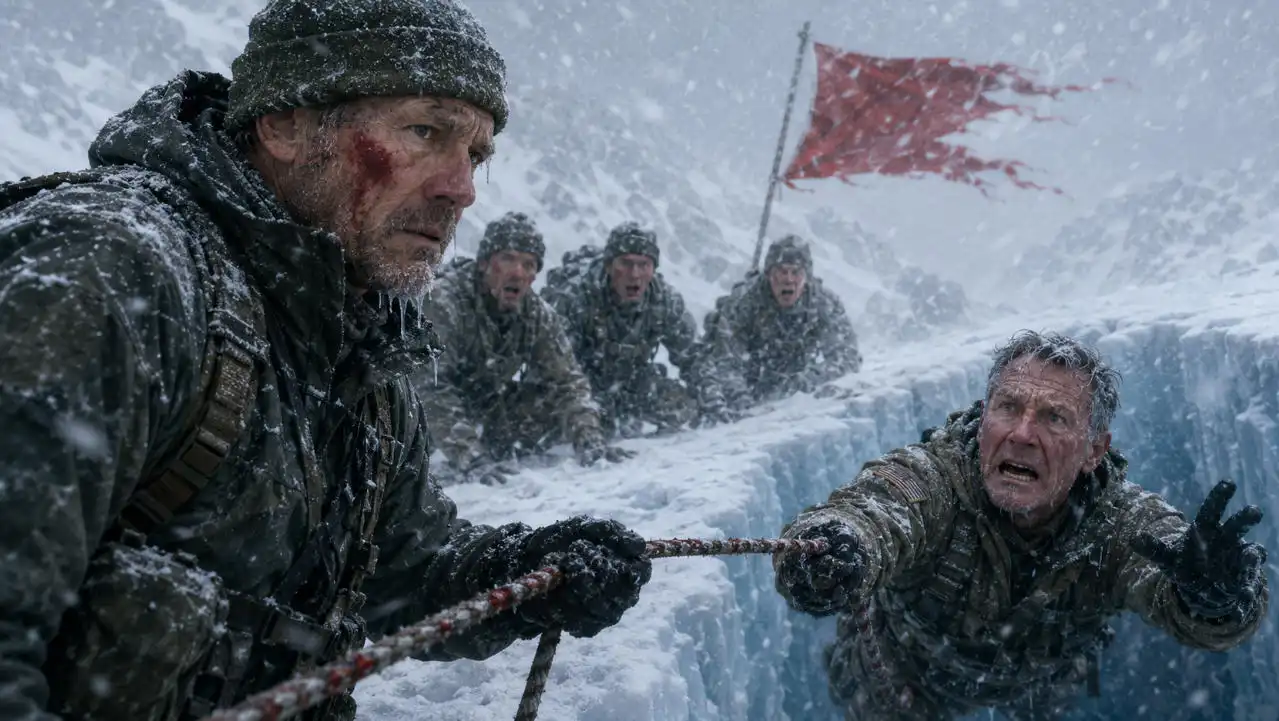
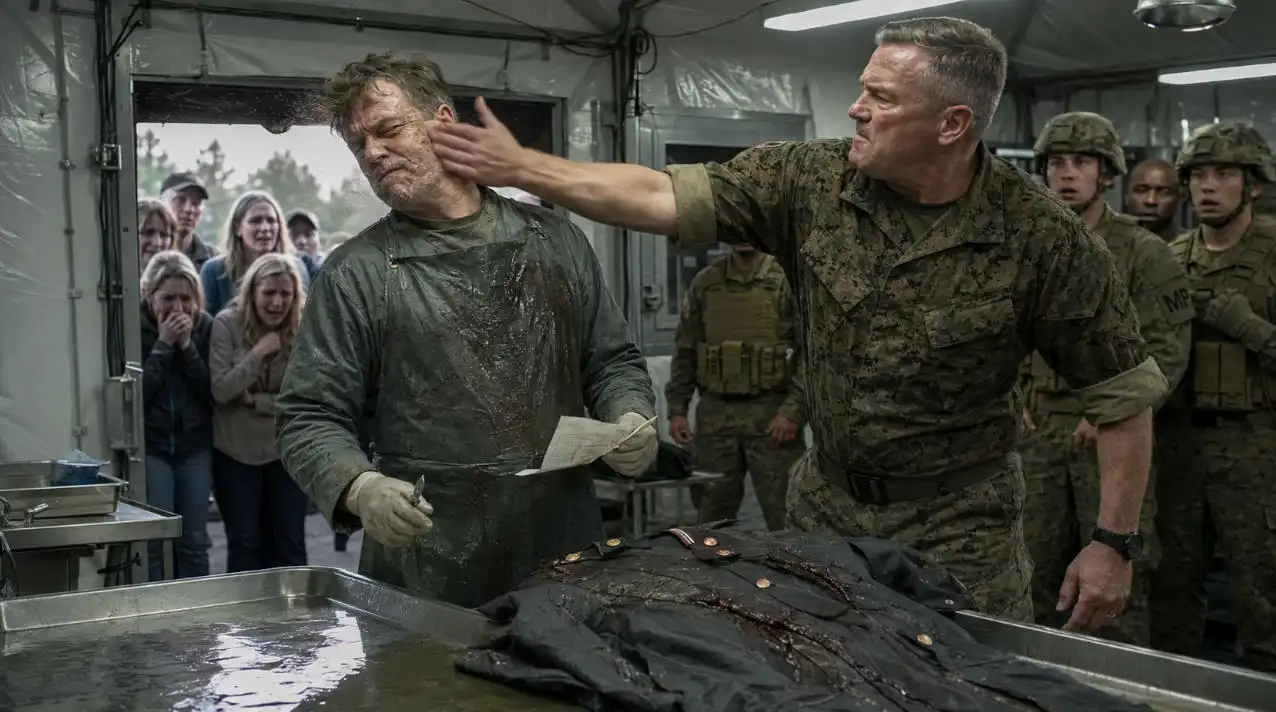
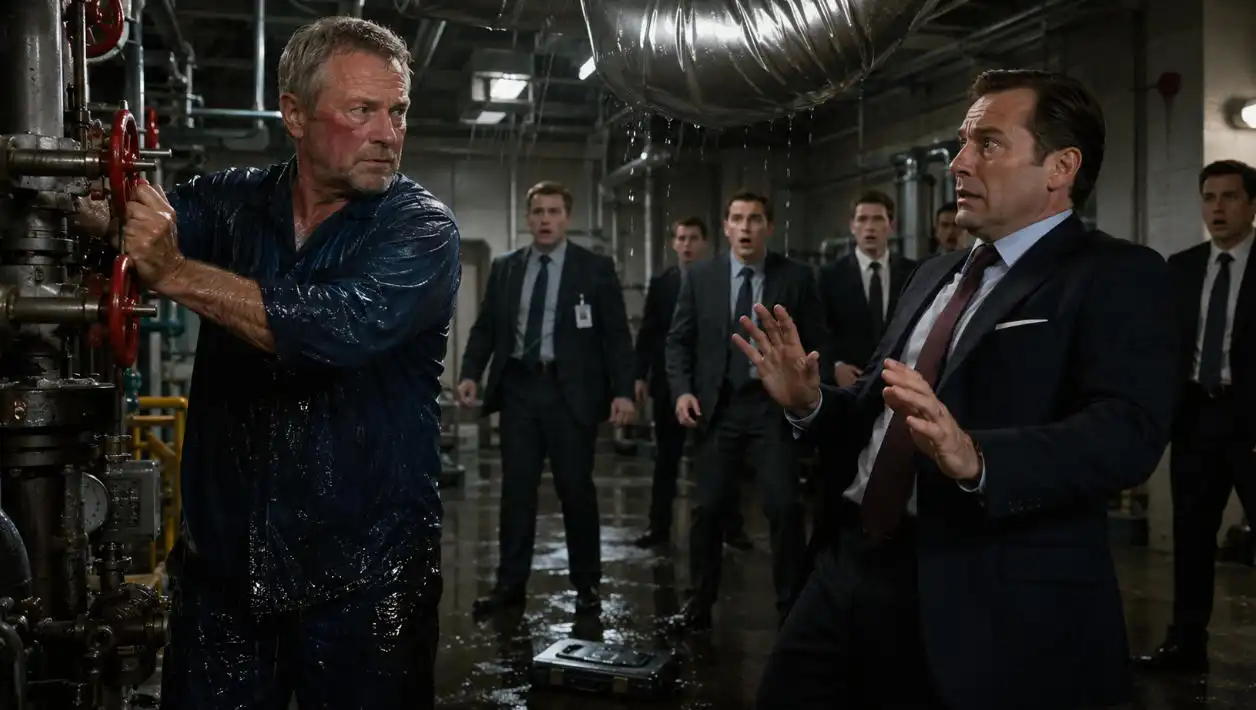

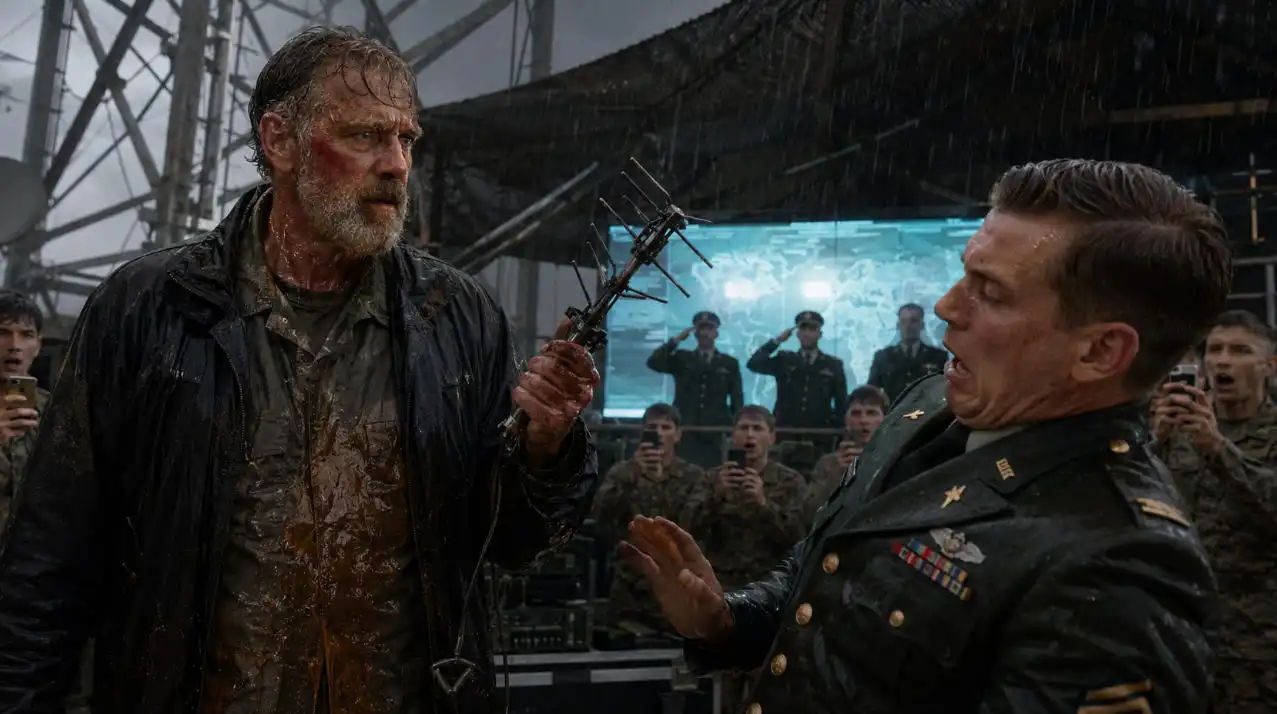
The first thing Captain Lucas saw was not the Pentagon seal.
It was the Supreme Commander’s hand rising on the screen.
Slowly.
Deliberately.
A salute.
And in that frozen second, every person inside the communications trailer understood one thing.
The old man Lucas had just slapped was not just a “wire-pulling waste.”
Garrett stood outside in the storm, fifty meters above the mud, one hand gripping the wet iron tower, the other holding a battered relay microphone clipped to a strip of scavenged antenna wire.
Rain ran down his face.
Coffee still stained his collar.
Blood still marked the corner of his mouth.
But his voice came through the speakers clean.
“Emergency field relay established. Pentagon secure channel restored. Authentication pending.”
No one breathed.
The whole command trailer had been chaos ten minutes earlier.
Now it was silent enough to hear the rain ticking against the steel roof.
Captain Lucas stood in the center aisle with his mouth half open, his polished boots planted beside the coffee cup he had thrown at Garrett’s face.
The same coffee cup everyone had seen.
The same slap everyone had heard.
The same humiliation half the recruits outside had recorded on their phones.
General Halvorsen, the base commander, stared at the screen.
The Supreme Commander on the video feed did not smile.
He did not ask for a report.
He looked past the camera, as if checking names on a document.
Then he said, “Identify the field engineer who restored this line.”
Lucas moved first.
“Sir,” he barked, stepping toward the console. “Captain Lucas Varrick, Intelligence Operations. I supervised the—”
“Not you.”
Two words.
Flat.
Cold.
Lucas stopped like he had hit a wall.
The Supreme Commander’s eyes remained fixed on the feed.
“I asked for the engineer.”
A young communications private swallowed and looked toward the open door, where wind pushed rain into the trailer.
“Sir,” the private said carefully, “that’s Mr. Garrett Hale. Department of Defense special relay contractor.”
Lucas whipped around.
“Private, shut your mouth.”
The private flinched.
But this time, nobody looked away.
The generals had seen enough.
The sergeants had seen enough.
Even the recruits outside, soaked under their hoods, kept their phones pointed toward Lucas.
The old power in the room had shifted.
Not loudly.
Not dramatically.
Just completely.
Garrett’s voice crackled through the speaker again.
“Authentication code transmitted. Manual relay holding at forty percent stability. Storm load increasing.”
General Halvorsen grabbed the console.
“Mr. Hale, can you maintain Pentagon contact?”
Garrett took one breath.
Rain hammered the metal around him.
“I can hold it long enough for command traffic.”
Lucas laughed once.
It was an ugly, desperate sound.
“With junk? He climbed a tower with junk and you’re all applauding? Sir, with respect, this is unsafe. That man violated my communications protocol.”
Garrett did not answer.
That was what bothered Lucas most.
Garrett had not insulted him.
Had not threatened him.
Had not begged.
He simply kept working.
Lucas turned back to the generals.
“You cannot reward a civilian technician for bypassing intelligence command during an interference event. I am the ranking signal authority in this trailer.”
A gray-haired colonel near the rear said, “No, Captain. You were the ranking officer who failed to restore contact.”
Lucas’s face tightened.
“Colonel, I was managing a satellite-level disruption.”
Garrett’s voice came through again.
“Correction.”
Everyone looked at the speaker.
Garrett continued, calm as a man reading a grocery list.
“The disruption was not satellite-level. The interference was localized, directional, and avoidable. I reported it three times before total blackout.”
Lucas went still.
General Halvorsen slowly turned his head.
“You reported it?”
Garrett said, “Yes, sir.”
Lucas snapped, “He made vague complaints.”
Garrett said nothing for two seconds.
Then the old relay man added, “I logged them.”
A murmur moved through the trailer.
Lucas’s jaw clenched.
Outside, a recruit whispered, “Oh, man.”
Garrett’s voice remained steady.
“First warning at 1840 hours. Second at 1915. Third at 1947. Captain Lucas dismissed all three and ordered the emergency tower crew to stand down.”
“That is a lie,” Lucas said.
The private at the console looked terrified.
Then he raised his hand.
“Sir… the warnings are in the maintenance log.”
Lucas stared at him.
“Private Dunn, choose your next words carefully.”
The boy’s voice trembled.
But he said them anyway.
“And the camera above the north console records audio.”
No one moved.
That was the moment Lucas understood the trailer had eyes.
Not just witnesses.
Records.
Logs.
Video.
Duty reports.
Everything he had thought was just “discipline” had become evidence.
General Halvorsen stepped closer to Lucas.
“Captain, did you order Mr. Hale away from the emergency relay equipment?”
Lucas’s nostrils flared.
“I ordered an unqualified contractor away from sensitive systems.”
The Supreme Commander’s voice cut through the screen.
“Unqualified?”
It was not a question.
It was a warning.
Lucas straightened.
“Sir, I was not briefed on his full background.”
Garrett’s image appeared on a side feed from a rain-smeared tower camera. His face was pale under the tower lights, but his eyes were clear.
He did not look angry.
That made it worse.
The Supreme Commander leaned toward his camera.
“Captain Lucas Varrick, Garrett Hale designed three of the emergency battlefield relay systems your satellite network falls back on when it fails.”
The trailer went silent again.
A sergeant muttered, “Lord have mercy.”
Lucas blinked.
The Supreme Commander continued.
“He has restored communications under hurricane conditions, desert blackout conditions, and contested electromagnetic environments you have only read about in sanitized briefings.”
Lucas’s face drained.
Garrett adjusted a clamp above the tower platform.
Lightning flashed far behind him.
The screen flickered.
He tightened the cable and the image stabilized.
The Supreme Commander did not take his eyes off Lucas.
“He was not assigned to your training camp as a laborer. He was assigned as a Department of Defense top-level radio signal relay installation expert.”
A low sound moved through the trailer.
Not cheering.
Not yet.
It was the sound of shame landing where it belonged.
Lucas glanced toward the open door.
The recruits were still filming.
One of them had tears in his eyes.
Because they had all watched Garrett get treated like dirt for a week.
They had watched him carry cable reels through mud while Lucas joked that “old men and old tools belong in museums.”
They had watched him eat alone in the mess hall.
They had heard Lucas call him “grandpa frequency.”
And ten minutes ago, they had watched the same captain throw hot coffee in his face.
Garrett had never answered back.
Not once.
He had simply taken notes.
Checked tower bolts.
Inspected backup crates.
Marked wind direction.
Tested discarded antennas.
Collected the truth.
That was Garrett’s way.
He came from an older school.
The kind of men who believed that when a thing breaks, you fix the thing first.
Then you deal with the fool who broke it.
The Supreme Commander’s face hardened.
“General Halvorsen, secure Captain Lucas.”
Lucas stepped backward.
“Sir?”
General Halvorsen nodded to two military police officers standing near the rear hatch.
They moved forward.
Lucas held up one hand.
“Wait. This is being blown out of proportion. I made a command decision under pressure.”
The colonel said, “You struck a special technical expert during an active communications crisis.”
Lucas’s voice rose.
“He was undermining me.”
Garrett’s voice came through the speaker again.
“No, Captain.”
Everyone turned toward the console.
Garrett’s breathing was heavier now. The climb and storm were taking their toll, but his voice did not shake.
“I was trying to keep soldiers alive.”
That sentence hit harder than any slap.
Lucas looked away first.
General Halvorsen spoke into the tower channel.
“Mr. Hale, descend when safe.”
Garrett answered, “Not yet, sir. The relay needs a human hand on the tension line until the main signal package transfers.”
The Supreme Commander said, “How long?”
Garrett checked something above him.
“Four minutes.”
Lucas laughed again, but this time there was panic in it.
“You hear that? He’s improvising. This is reckless. If that connection drops, we lose everything.”
The Supreme Commander said, “Captain, we already lost everything when you refused to listen.”
The military police reached Lucas.
One took his sidearm.
The other removed his access badge.
That small plastic click sounded louder than thunder.
Lucas stared down at his empty belt.
“You can’t do this in front of enlisted personnel.”
General Halvorsen’s voice was quiet.
“You did what you did in front of enlisted personnel.”
The words settled over him like a sentence.
Lucas looked toward the young private he had threatened.
“Dunn. Tell them I was maintaining order.”
Private Dunn’s eyes were wet.
“No, sir.”
Lucas’s face twisted.
“You little—”
“Enough,” General Halvorsen snapped.
The room shook with it.
For the first time all night, Lucas shut his mouth.
On the screen, the Pentagon feed stabilized fully.
A second window opened.
A legal officer appeared beside the Supreme Commander, wearing a dark uniform and holding a folder.
Lucas saw the folder and swallowed.
That folder was not theater.
It was procedure.
It meant someone had already started documenting.
The legal officer spoke.
“Preliminary review has confirmed three logged warnings, one unauthorized stand-down order, one physical assault allegation, and a delay in emergency relay activation during a classified readiness operation.”
Lucas shook his head.
“No. No, this is a training exercise.”
The legal officer looked directly at him.
“A readiness operation is not a playground, Captain.”
Garrett’s voice returned.
“Transfer complete.”
The command screens brightened.
One by one, the dead systems came alive.
Encrypted status boards.
Base-to-Pentagon channel.
Emergency command traffic.
Weather overlays.
Signal integrity.
All restored.
All through a relay built from equipment Lucas had called junk.
Then Garrett began climbing down.
Nobody spoke while he descended.
The camera showed his boots finding the rungs.
His fingers stiff from the cold.
His shoulders soaked through.
At twenty meters, the wind slammed him sideways.
A few recruits gasped.
At ten meters, two sergeants rushed out to spot him.
At the bottom, he stepped into the mud like a man twice his age.
For a second, he leaned against the tower.
Then he straightened.
He picked up his old tool bag.
And he walked back into the communications trailer.
The room parted for him.
Not because he demanded it.
Because he had earned it.
Coffee still marked his face.
The red slap mark had darkened along his cheek.
His hands were scraped.
His jacket was torn at the sleeve.
But when he entered, every officer in the room stood straighter.
Private Dunn wiped his eyes.
The Supreme Commander remained on the screen.
Garrett stopped in front of the main console.
“Sir,” Garrett said.
The Supreme Commander raised his hand again.
This time, every officer in the trailer followed.
Then the enlisted men.
Then the recruits outside.
One by one, they saluted the soaked old relay man Lucas had mocked.
Garrett did not smile.
He just nodded once.
“Line is stable, sir.”
The Supreme Commander said, “Mr. Hale, the Department owes you more than thanks.”
Lucas, standing between the MPs, whispered, “This is absurd.”
Garrett finally looked at him.
Not with hatred.
Not with triumph.
With disappointment.
That was worse.
Garrett said, “Captain, I spent thirty-two years building ways for commanders to hear the truth when everything else goes dark.”
Lucas stared at him.
Garrett continued, “Tonight, the equipment worked.”
Then he looked at the shattered coffee cup on the floor.
“But the leadership failed.”
No one rescued Lucas from that sentence.
No one softened it.
No one laughed.
The legal officer on the screen spoke again.
“Captain Lucas Varrick, effective immediately, you are relieved of duty pending formal court-martial proceedings for dereliction of duty, obstruction of emergency communications, abuse of a protected technical specialist, and conduct unbecoming an officer.”
Lucas’s knees seemed to weaken.
“Court-martial?”
General Halvorsen answered, “Yes.”
Lucas turned to him.
“General, my father served with senators. My record—”
“Your record is about to include the truth,” the general said.
Lucas’s face went white.
The MPs led him toward the rear hatch.
As he passed Garrett, he tried one last time.
“Tell them I didn’t know who you were.”
Garrett looked at him for a long moment.
Then he said, “You knew I was a man.”
Lucas had no answer.
The MPs took him out into the rain.
The door shut behind him.
For a few seconds, the trailer remained silent.
Then the Supreme Commander spoke.
“Mr. Hale, remain on site for debrief. Medical staff will examine your injuries. Your relay method will be preserved for review.”
Garrett nodded.
“Yes, sir.”
“And Mr. Hale?”
“Sir?”
The Supreme Commander’s expression softened just slightly.
“Outstanding work.”
That was when the room changed.
Not into chaos.
Into respect.
The kind that does not need cheering.
Private Dunn stepped forward first.
“Mr. Hale… I’m sorry I didn’t speak up sooner.”
Garrett placed a hand on the young man’s shoulder.
“You spoke up when it mattered.”
The private looked down.
“He scared us.”
Garrett nodded.
“Then remember how that felt. Never become him.”
Those words traveled farther than the relay.
By morning, the whole camp knew.
Not because Garrett bragged.
He never did.
But because people had seen the video.
They had seen the coffee.
The slap.
The tower.
The Pentagon screen.
The salute.
And the moment Lucas’s badge came off.
The official investigation moved fast.
The maintenance logs showed Garrett had warned Lucas three times that the satellite network was vulnerable under directional interference.
The north console camera captured Lucas dismissing him.
The trailer audio captured Lucas calling him a “wire-pulling waste.”
The door camera captured the coffee thrown into Garrett’s face.
Six witnesses confirmed the slap.
Three commanders confirmed Lucas delayed the emergency relay because he refused to let an “old analog man” touch his network.
The most damning evidence was not emotional.
It was timing.
The blackout lasted twenty-seven minutes longer than it needed to.
During that delay, two field units lost command confirmation.
An evacuation simulation had to be frozen.
A medical transport drill failed its timing window.
In a real operation, the legal officer said, Lucas’s arrogance could have cost lives.
Lucas tried every defense.
He said he was stressed.
He said Garrett was unclear.
He said the slap was “a corrective gesture.”
That phrase destroyed him.
The court did not like it.
The enlisted witnesses liked it even less.
Private Dunn testified in a shaking voice.
“He made us afraid to report problems. Mr. Hale kept trying to fix it. Captain Lucas kept trying to protect his image.”
General Halvorsen testified too.
He did not shout.
He did not exaggerate.
He simply read the timeline.
Every warning.
Every dismissal.
Every minute lost.
Every rule broken.
Garrett testified last.
He wore a clean dark suit.
The bruise on his cheek had faded, but not completely.
Lucas sat at the defense table, smaller than anyone remembered.
Garrett was asked whether he believed Lucas understood the danger.
Garrett paused.
Then he said, “Yes.”
Lucas looked up sharply.
Garrett continued, “He understood enough to be afraid of being blamed. He did not understand enough to care about the people depending on the line.”
That sentence ended the room.
The verdict came after two days.
Guilty.
Dereliction of duty.
Abuse of authority.
Obstruction during a critical readiness event.
Conduct unbecoming.
Lucas was sentenced to fifteen years in military prison.
His commission was stripped.
His security clearance was revoked.
The polished career he had protected so fiercely became a cautionary briefing for every officer who confused rank with wisdom.
But the story did not end with Lucas.
That mattered to Garrett.
Punishment was not enough.
A broken culture had to be repaired.
Three weeks later, the camp held a formation at the central communications tower.
The same tower.
The rain was gone.
The sky was clear.
Every communications soldier stood in dress uniform.
Recruits lined the parade ground.
Commanders stood near the platform.
And Garrett, who hated ceremonies, stood beside the old crate of discarded antennas.
General Halvorsen stepped up with a medal case.
“Mr. Garrett Hale,” he said, “for restoring secure command communication under extreme interference, for preserving operational continuity under personal injury, and for demonstrating the highest standard of technical courage, the Department awards you the Distinguished Technical Merit Medal.”
Garrett looked uncomfortable.
The recruits loved him for it.
The general pinned the medal on his jacket.
For a second, Garrett looked at the tower instead of the crowd.
Maybe he was remembering the rain.
Maybe the slap.
Maybe all the years quiet people had been told they were invisible until everything broke and suddenly everyone needed them.
Private Dunn began clapping first.
Then the entire formation joined.
Not wild.
Not messy.
A steady thunder of respect.
Garrett’s eyes shone, but he held himself together.
When the applause faded, he stepped to the microphone.
He unfolded no speech.
He needed none.
“I’m not a hero,” he said.
A few people shook their heads, disagreeing.
Garrett raised one hand.
“I mean that. I’m a relay man. My job is to connect people when distance, weather, fear, or pride gets in the way.”
He looked at the young communications soldiers.
“Tools matter. Training matters. New systems matter. But never let shiny equipment make you deaf to an experienced voice.”
Several older sergeants nodded.
Garrett continued.
“And never let rank make you cruel.”
That line stayed with the camp longer than the medal.
After the ceremony, recruits surrounded him.
Not for selfies at first.
For questions.
Real ones.
“How did you know the interference was directional?”
“How did you stay calm?”
“Were you scared on the tower?”
Garrett answered each one.
Patiently.
Plainly.
Without making himself bigger.
When one young soldier asked if the old antenna was going in a museum, Garrett smiled for the first time.
“No,” he said. “It’s going in your classroom.”
And it did.
The crate of “junk” became the centerpiece of a new training module.
They called it Hale Relay Day.
Once a month, every communications class had to restore a dead line using limited equipment, bad weather simulation, and incomplete information.
The rule was simple.
Listen before you dismiss.
Verify before you blame.
Fix before you posture.
Garrett taught the first class himself.
He walked in with the same battered tool bag Lucas had mocked.
This time, when he set it on the table, the room went quiet with reverence.
Private Dunn, now promoted, stood in the back.
He watched Garrett draw a simple line across the board.
“Communication,” Garrett said, “is not about machines talking. It’s about people refusing to abandon each other.”
Nobody forgot that.
Months later, a letter arrived from the Pentagon.
Garrett read it alone at first.
Then he folded it carefully and put it in his pocket.
General Halvorsen found him near the tower.
“Good news?”
Garrett shrugged.
“Retirement offer got delayed again.”
The general smiled.
“Promotion?”
“Advisory appointment.”
“To what?”
Garrett looked up at the tower.
“Emergency relay doctrine.”
The general laughed softly.
“Seems right.”
Garrett nodded.
Then he said, “Only if Dunn joins the pilot program.”
The general raised an eyebrow.
“You’re choosing the private who contradicted a captain on a live command floor?”
Garrett smiled.
“I’m choosing the soldier who learned the right lesson.”
That was Garrett’s victory.
Not Lucas in prison.
Not the medal.
Not the salute.
It was the fact that the next frightened young technician might speak sooner.
The next arrogant officer might think twice.
The next dead screen might not stay dead because pride blocked the repair.
As for Lucas, his name disappeared from the camp walls.
Not erased.
Archived.
The incident became a mandatory ethics case.
Cadets studied it every year.
They debated the technical failure.
The leadership failure.
The abuse of authority.
But the instructors always ended with Garrett’s answer when Lucas begged him to say he “didn’t know who he was.”
You knew I was a man.
That was the whole lesson.
You do not need to know someone’s résumé to treat them with dignity.
You do not need to see a medal to listen.
You do not need a Pentagon screen to prove an old craftsman matters.
On the first anniversary of the blackout, the communications soldiers gathered under the tower again.
No ceremony.
No cameras.
Just coffee in paper cups and a small brass plaque bolted to the tower base.
It read:
“WHEN EVERYTHING WENT DARK, A RELAY MAN BROUGHT THE LINE HOME.”
Garrett stood with his hands in his coat pockets.
Private Dunn handed him a fresh cup of coffee.
Garrett looked at it, then at Dunn.
“Trying to make me nervous?”
Dunn grinned.
“Never, sir.”
Garrett took the cup.
Around them, the young soldiers laughed.
Not at him.
With him.
That was healing.
That was justice.
Not loud revenge.
Not cruelty returned for cruelty.
Just truth, witnessed by everyone, written into the rules, and passed down to people who would do better.
So pick a side.
Stand with Garrett, the quiet craftsman who saved the line.
Or stand with Lucas, the proud officer who thought a title made him untouchable.
Share this if you believe dignity should never depend on rank. ⚡
Disclaimer: Mention of any brand or trademark is for identification only and does not imply partnership or endorsement
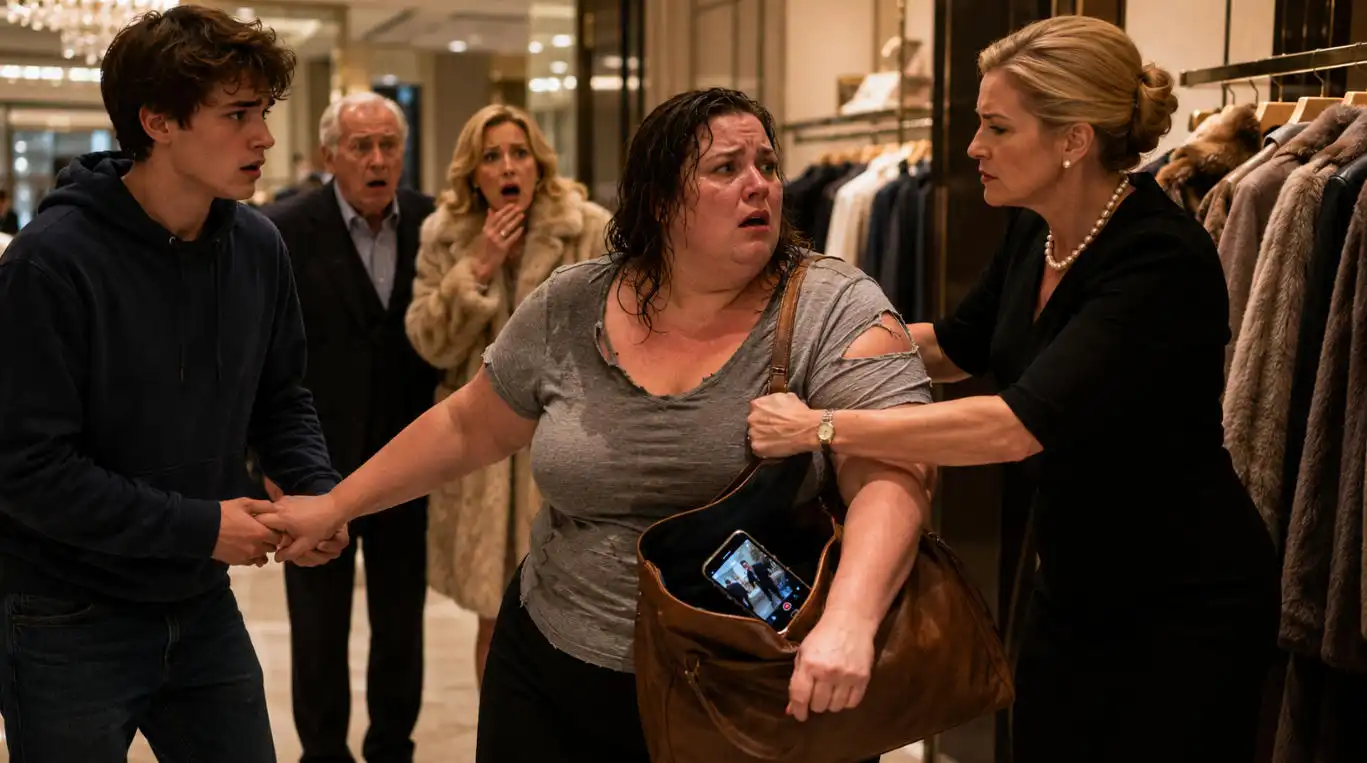
Maggie Was Covered In Shampoo, Slapped, And Laughed At In Front Of Rich Parents… Until One Quiet Phone Call Changed EVERYTHING
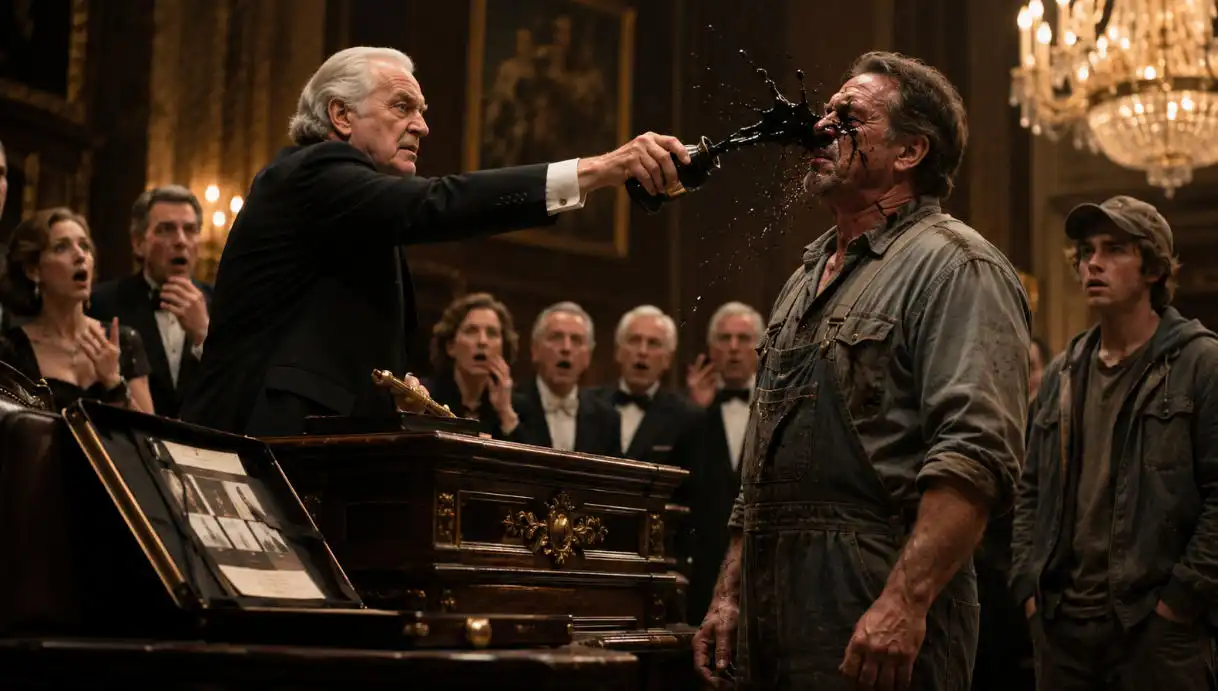
A Blue-Collar Dad Was DRAGGED Out Of A D.C. Private School Auction By A Snobby Auctioneer… But They Had NO IDEA Who He Really Was 😳
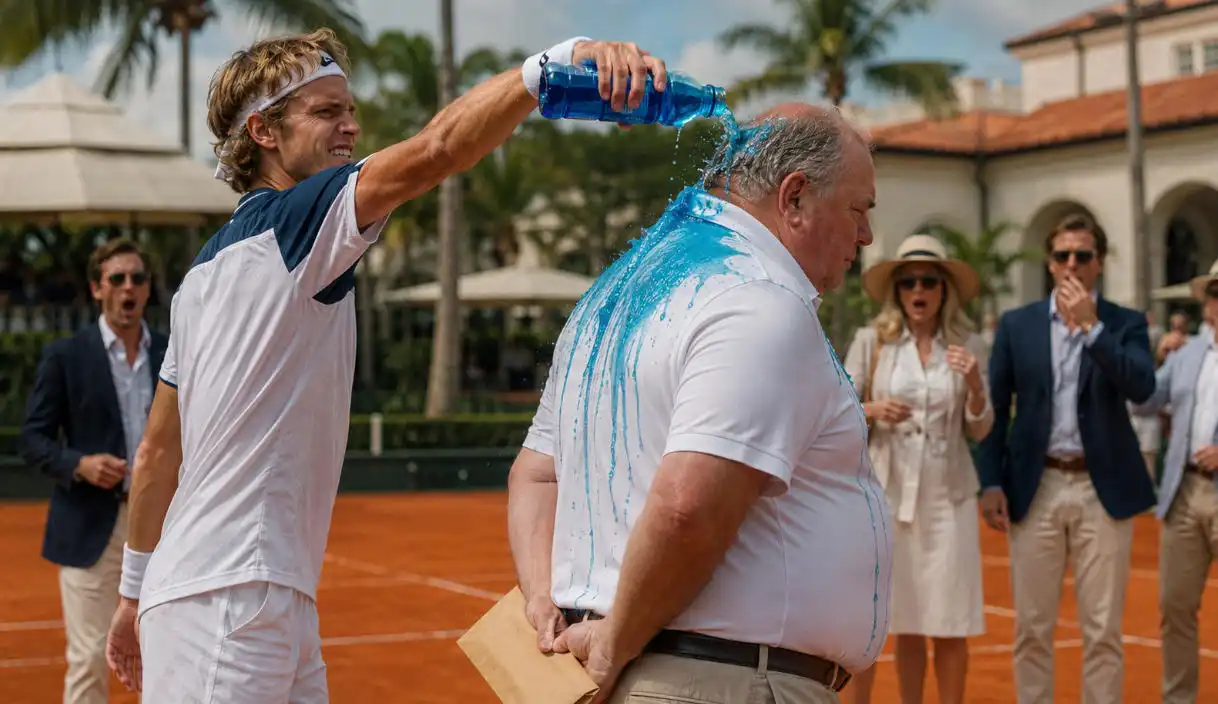
A Palm Beach Tennis Star HUMILIATED a Quiet Older Man in Front of the Whole Club… Then He Saw What Norman’s Attorney Filed That Morning