


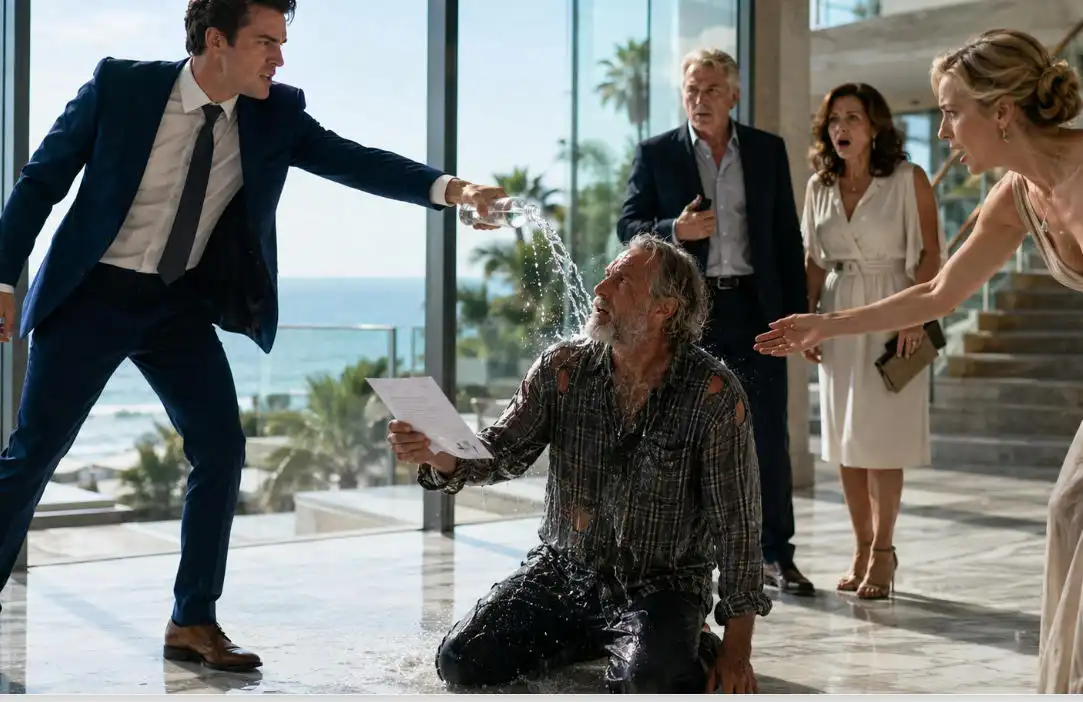
The woman by the staircase unfolded the envelope.
Chase was still smirking.
Harold was still on the marble floor, water dripping from his chin onto his torn plaid shirt.
And every wealthy buyer in that Malibu mansion leaned in like the room itself had stopped breathing.
The first line changed everything.
But Harold didn’t let her read it yet.
He raised one hand and said, “Please. Start with the date.”
Chase rolled his eyes.
“Oh, now we’re doing paperwork?” he said, brushing invisible dust from his sleeve. “Sir, you are trespassing at a private showing.”
That word made Harold look up.
Trespassing.
The man who had just been slapped in front of strangers smiled like a teacher hearing a student make one last mistake before the final exam.
“I was hoping you’d say that,” Harold said quietly.
Chase turned to the crowd.
“Do you see what I deal with?” he said. “Every open house brings dreamers, time-wasters, and people who think ocean views come with charity.”
A man in a linen jacket laughed under his breath.
Another woman lifted her phone.
Someone whispered, “Is he recording this?”
He was.
So were three other people.
The room was full of money, perfume, polished watches, and people pretending not to enjoy the cruelty.
Harold looked like the only person who didn’t belong.
His shoes were scuffed.
His belly pushed against his shirt.
His glasses were fogged with water.
He looked like a retired schoolteacher who had wandered into a world built to reject him.
Chase looked perfect.
Tailored suit.
White smile.
Gold watch.
A real estate badge clipped to his lapel.
He had the kind of confidence some men get when they believe every room belongs to them.
“Get him up,” Chase ordered the assistant near the kitchen. “And get him out before he scares off serious buyers.”
Harold did not move.
He placed one palm on the marble and slowly stood.
The torn fabric of his shirt hung open at the chest.
Nobody helped him.
Not one person.
That was the part he remembered later.
Not the slap.
Not the water.
Not even the hair pull.
It was the silence.
Harold wiped his face with his sleeve and looked at the guests who had stepped aside as if he carried a disease.
“I taught high school history for thirty-six years,” he said. “I know exactly what silence looks like when people are choosing comfort over courage.”
The room shifted.
Chase scoffed.
“Beautiful speech,” he said. “Wrong address.”
Then he pointed toward the glass front doors.
“Out.”
Harold nodded toward the woman holding the envelope.
Her name was Marianne Cole.
Most people there assumed she was another buyer.
She was not.
She was the senior compliance officer for Pacific Crown Developments.
Chase did not recognize her because Chase had only joined the brokerage six weeks earlier.
He had been chasing luxury commissions so hard that he never bothered to study who actually owned the listings he was selling.
Marianne cleared her throat.
“Mr. Chase Landon,” she said, reading from the envelope, “this property is held under Seabright Legacy Holdings, registered as part of the Stone Harbor Coastal Development Trust.”
Chase blinked.
“Okay,” he said. “And?”
Marianne looked at Harold.
Harold gave one small nod.
She continued.
“The controlling developer and managing partner of Stone Harbor Coastal Development Trust is Harold Whitaker.”
The silence became physical.
Chase’s mouth opened.
No sound came out.
The man in the linen jacket stopped laughing.
The woman filming lowered her phone, then raised it again.
Harold stood there dripping on the marble floor of a mansion he had built.
Not with a hammer.
Not with inherited money.
With forty years of quiet investments, land deals, zoning battles, and one promise he had made to his late wife.
Harold Whitaker had started as a teacher.
That part was true.
He had taught public school until he retired.
But during summer breaks, he bought neglected lots near the coast.
Small parcels nobody wanted.
Storm-damaged houses.
Ugly hillside land.
Legal headaches.
He studied permits at night.
He partnered with veterans who knew construction.
He hired honest builders when everyone told him he was too soft for the business.
And over three decades, Harold became the developer behind some of the most valuable coastal properties in Malibu.
He just never dressed like it.
His wife, Ruth, used to tease him.
“Harold, you could own the whole street and still look like you came to fix the copier.”
He would always answer, “Good. Then I’ll know how people treat the man, not the money.”
That morning, Harold had come to the open house for one reason.
Not to surprise anyone.
Not to test anyone.
He had come because complaints had been piling up.
Three older couples said Chase ignored them.
A disabled veteran said Chase told him to “try a cheaper zip code.”
A widowed nurse said Chase laughed when she asked about financing.
Harold did not believe in ruining a man over one bad rumor.
So he came in person.
Plain clothes.
No driver.
No assistant.
Just Harold.
And Chase had given him everything on camera.
Chase took one step back.
“Mr. Whitaker,” he said, suddenly soft. “There’s been a misunderstanding.”
Harold looked at his wet shirt.
“Which part?”
Chase swallowed.
“The security situation. I thought—”
“You thought I was poor,” Harold said.
Chase shook his head too quickly.
“No, sir. I thought you were disrupting the showing.”
Harold turned to the crowd.
“Did I disrupt anything before he poured water on me?”
No one answered.
That silence was different.
This time, it was shame.
Marianne reached into her leather folder and removed another document.
“Mr. Landon,” she said, “as of this moment, you are removed from representation of this property pending formal review.”
Chase’s face went pale.
“You can’t do that here.”
Harold tilted his head.
“This is my property.”
Chase looked around for support.
The rich buyers who had laughed earlier looked away.
The assistant near the kitchen stared at the floor.
The man in the linen jacket suddenly became very interested in the ocean view.
Chase lowered his voice.
“Sir, please. This listing is worth millions. My entire year is riding on this.”
Harold said nothing.
Marianne kept reading.
“Your brokerage agreement includes a dignity and conduct clause, a public conduct clause, a nondiscrimination clause, and a client assault termination clause.”
Chase whispered, “Assault?”
Harold touched the red mark on his cheek.
“You slapped me in front of witnesses.”
Chase’s knees softened.
“I barely touched you.”
A woman near the fireplace spoke up.
“You pulled his hair.”
Another man said, “You shoved him.”
Someone else added, “I have it on video.”
That was when Chase truly understood.
He was not dealing with a poor old man.
He was dealing with the owner.
In his own listing.
On camera.
In front of buyers.
With a contract that had already trapped him.
Harold removed a small recorder from his shirt pocket.
The corner of it had cracked when he fell.
But the red light was still blinking.
“California is a two-party consent state,” Chase said quickly, desperate to sound smart.
Harold nodded.
“That is correct. Which is why I told you at the entrance that I was recording my tour for review purposes. You said, ‘Record whatever you want, old man, just don’t touch the furniture.’”
Several people turned toward Chase.
He remembered saying it.
He remembered laughing when he said it.
Marianne added, “The security system also captured the common areas. Notices are posted at the gate, foyer, and kitchen entrance.”
Chase looked toward the ceiling.
There it was.
A small black camera.
Then another.
Then another.
His arrogance had been recorded from every angle.
The water.
The slap.
The torn shirt.
The shove.
The laughter.
The command to remove Harold.
Every word.
Chase suddenly dropped to his knees on the marble.
“Mr. Whitaker, please,” he said, his voice cracking. “I made a mistake.”
Harold stepped back.
“Stand up.”
But Chase panicked.
He slapped his own face once.
Then again.
“Please,” he said. “Please, I’m sorry. I’ll apologize publicly. I’ll pay for the shirt. I’ll do anything.”
The room looked horrified.
Harold did not smile.
He did not enjoy it.
That surprised people.
They expected revenge to look loud.
Harold’s revenge looked like paperwork.
“Stop hitting yourself,” Harold said. “That doesn’t make you sorry. It makes you scared.”
Chase froze.
Harold turned to Marianne.
“Begin termination.”
Marianne nodded.
“Already drafted.”
Chase staggered to his feet.
“You’re destroying my life over one bad moment?”
Harold’s voice stayed calm.
“No. You built this moment yourself. I only walked into it.”
By sunset, Chase’s brokerage had suspended him.
By the next morning, the state licensing board had received the footage, witness statements, and formal complaints from previous visitors.
Within weeks, Chase’s real estate license was revoked.
His brokerage faced a massive breach-of-contract claim.
Then the developers filed suit for damages tied to reputational harm, canceled offers, and violated conduct provisions on multiple luxury listings.
The number was so large that Chase’s attorney went quiet when he saw it.
Millions.
Not because Harold wanted money.
Because contracts matter.
Conduct matters.
And when your job is to represent someone else’s property, you do not get to treat human beings like trash on their marble floor.
Chase tried to spin the story online.
He claimed Harold had “provoked” him.
Then the videos came out.
Not one clip.
All of them.
The entrance.
The comments.
The guests stepping aside.
The water.
The slap.
The shove.
Harold’s quiet warning.
“You should’ve read page one before you touched me.”
The internet did what the room had failed to do.
It stood up.
Veterans groups shared it.
Teachers shared it.
Parents shared it.
Realtors shared it with one sentence:
“This is how you lose everything.”
Chase’s clients disappeared.
His investors stopped answering.
His luxury apartment went up for lease.
The man who once judged people by shoes could no longer afford his own office.
But Harold was not finished.
One month later, he invited the press back to the same Malibu mansion.
This time, Chase was not there.
The marble had been polished.
The torn shirt had been framed.
Not as a trophy.
As a reminder.
Harold stood in the foyer beside a group of older veterans, several of them wearing jackets with faded unit patches.
Marianne placed a fresh stack of documents on the table.
A reporter asked, “Mr. Whitaker, are you relisting the property?”
Harold shook his head.
“No.”
“Are you moving in?”
“No.”
“Then what happens to the house?”
Harold looked out at the ocean.
“My wife Ruth believed every beautiful view should eventually become a place of healing,” he said. “This home was built as a luxury listing. But after what happened here, I realized it needed a better purpose.”
He picked up a pen.
Then he signed the mansion over to a nonprofit housing association for homeless veterans.
The room went silent again.
But this time, it was not fear.
It was reverence.
The Malibu mansion became transitional housing for veterans recovering from hardship, job loss, and injury.
The wine cellar became a counseling room.
The theater became a job-training classroom.
The guest suites became bedrooms for men and women who had once slept in cars, shelters, and parking lots.
And the marble foyer where Harold had been humiliated became the place where veterans were welcomed by name.
On the first day, an older Marine named Daniel stood at the entrance and looked at Harold.
“You really gave this place away?”
Harold smiled.
“No,” he said. “I gave it back.”
Daniel looked around at the ocean view.
“Why us?”
Harold’s eyes softened.
“Because my father came home from Korea and nobody knew what to do with him. My wife never forgot that. Neither did I.”
A few people wiped their eyes.
Harold touched the framed plaid shirt hanging near the entrance.
“I don’t want anyone walking through these doors to feel like they don’t belong.”
Then he added the only rule posted inside the house:
Every person who enters here will be treated with dignity. No exceptions.
Months later, Harold received a letter.
No return address.
Inside was a short note from Chase.
It said:
“I lost my license. I lost my money. I lost the people who only liked me when I looked successful. I keep replaying that day. I don’t expect forgiveness. But I finally understand that I didn’t attack a poor man. I attacked a human being.”
Harold read it twice.
Then he folded it and placed it in a drawer.
He did not answer.
Forgiveness, he believed, was not a performance.
Neither was justice.
The next morning, Harold stood on the balcony of the former mansion and watched three veterans drink coffee as the sun rose over the Pacific.
One of them was laughing.
One was calling his daughter.
One was simply sitting in peace.
That was the ending Ruth would have wanted.
Not Chase begging on the floor.
Not the lawsuit.
Not the viral video.
This.
A house built for status had become a home built for dignity.
And Harold, the retired teacher in the torn plaid shirt, had taught Malibu one final lesson:
Never confuse expensive clothes with value.
Never confuse silence with weakness.
And never, ever mistake kindness for powerlessness. ⚖️
Disclaimer: Mention of any brand or trademark is for identification only and does not imply partnership or endorsement
Maggie Was Covered In Shampoo, Slapped, And Laughed At In Front Of Rich Parents… Until One Quiet Phone Call Changed EVERYTHING
A Blue-Collar Dad Was DRAGGED Out Of A D.C. Private School Auction By A Snobby Auctioneer… But They Had NO IDEA Who He Really Was 😳
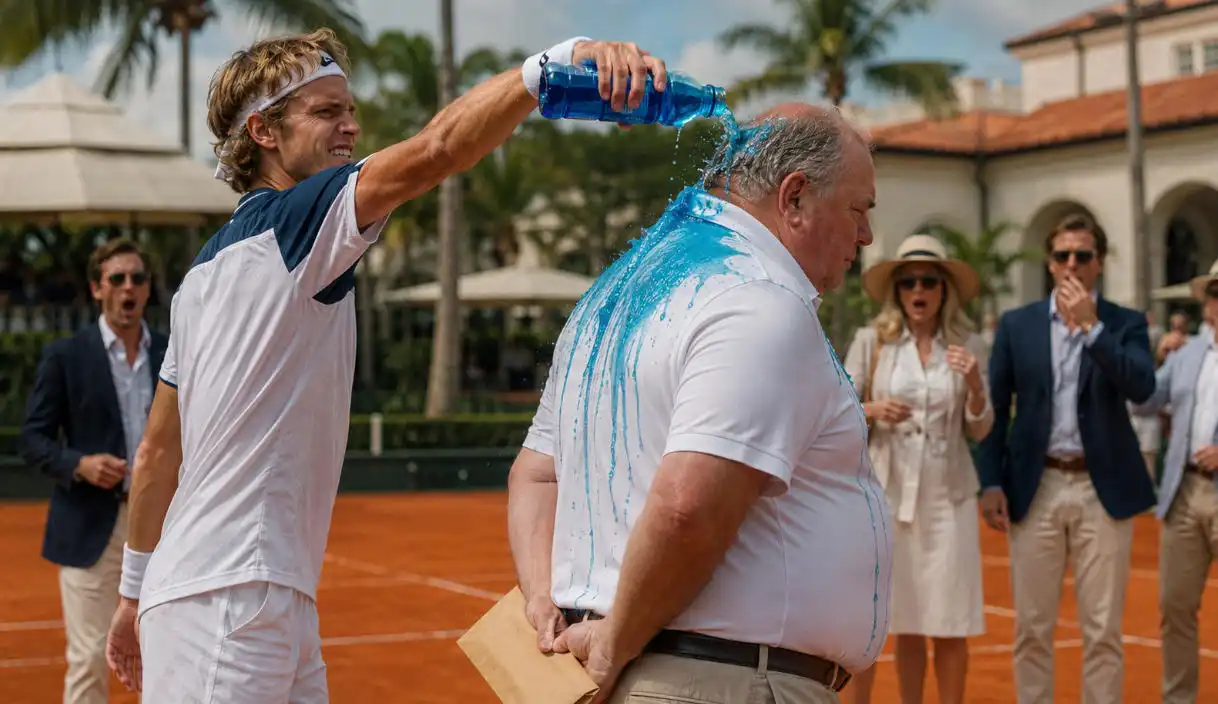
A Palm Beach Tennis Star HUMILIATED a Quiet Older Man in Front of the Whole Club… Then He Saw What Norman’s Attorney Filed That Morning