


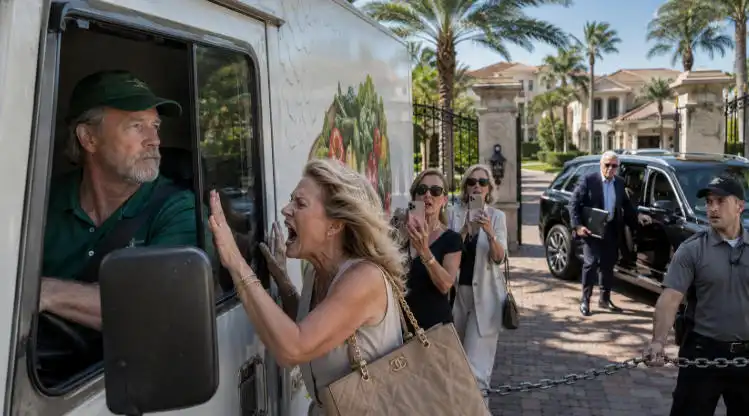
“Martha, before you say one more word, you need to understand who this man is… and what clause you signed when you bought this house.”
That was what Mr. Alden said.
Not loudly.
Not dramatically.
But the whole street heard it.
Even the sprinkler heads seemed to stop clicking.
Martha Whitcomb still had one hand raised toward my delivery truck window, like she might slap the glass again.
Two minutes earlier, she had been screaming like she owned the pavement, the palm trees, the guardhouse, and every breath inside Magnolia Crest.
Now her face had gone stiff.
“Mr. Alden,” she said, trying to laugh. “There’s no need to make this uncomfortable.”
He looked at her.
“It became uncomfortable when you threatened to imprison a working man for doing his job.”
Her two friends stopped filming.
One of them lowered her phone.
The other whispered, “Martha…”
But Martha was not the kind of woman who could read a room unless the room was bowing to her.
She lifted her chin.
“With respect, this man blocked my driveway.”
I glanced at the curb.
My truck was not in her driveway.
It was beside it.
The back wheels were still on the service shoulder.
The hazard lights were blinking.
The insulated grocery bags were sealed.
The delivery app still showed I had arrived thirty-two seconds before she started hitting my window.
Mr. Alden looked down at the ground, then at my truck, then at the security guard holding the chain.
“Carl,” he said, “why is that chain in your hand?”
Carl swallowed.
“M-Mrs. Whitcomb told me to lock his truck inside the gate.”
“She told you to detain him?”
Carl looked miserable.
“Yes, sir.”
Martha snapped, “I told him to secure the neighborhood.”
“No,” Mr. Alden said. “You told him to abuse his position because you were angry a grocery van appeared near your roses.”
A few neighbors had come out onto their porches by then.
Magnolia Crest was the kind of place where people pretended not to stare.
But they always stared.
A man in a golf shirt stood barefoot on his front walk.
A woman with a tiny white dog held the leash so tightly the dog coughed.
Two landscaping workers stopped near a hedge, watching silently.
A teenage boy kept his phone up, recording everything.
Martha saw the audience and tried to perform for it.
She smoothed her pearl necklace.
“Everyone here knows I maintain standards. That is why this community is valuable.”
Mr. Alden’s eyes hardened.
“Standards?”
“Yes,” Martha said. “Security. Appearance. Order. People pay to live here because I make sure the wrong elements don’t drift in.”
The words hung there.
Thick.
Ugly.
I had heard words like that before.
Not always the same words.
But the same tone.
The same clean smile wrapped around a dirty thought.
I stayed in the driver’s seat.
I kept both hands visible.
Years of job sites had taught me something simple.
When powerful people want you to explode, calm is the only thing they cannot use against you.
Martha pointed at me through the glass.
“He refused to follow community protocol.”
I finally spoke.
“Ma’am, I followed the delivery instructions.”
She spun toward me.
“No one asked you.”
Mr. Alden did not blink.
“I did.”
The street went quiet again.
I reached into the cup holder and held up my phone.
Not high.
Just enough.
“The customer note says, ‘Use main gate. Leave fresh order with housekeeper at side porch. HOA approved vendor access.’”
Carl nodded quickly.
“That’s true, sir. The vendor list has Fresh Harvest Market on it.”
Martha glared at him.
Carl looked down.
Mr. Alden turned a page in his folder.
“Martha, when exactly did you decide this man was a threat?”
She gave a thin smile.
“When he ignored my request to leave.”
“You mean after you hit his window?”
Her mouth tightened.
“I tapped it.”
The teenage boy across the street called out, “No, you didn’t.”
His mother hissed, “Evan!”
But Evan kept recording.
“She hit it like six times.”
One of Martha’s friends whispered, “That boy is exaggerating.”
Evan looked at her.
“I got it on video.”
That changed the air.
Martha’s eyes darted from phone to phone.
For the first time, she realized this was not her private HOA meeting.
This was the street.
This was evidence.
Mr. Alden took a breath.
“Carl, does the gate camera record audio?”
Carl nodded.
“Yes, sir. Front gate and Magnolia Lane pole camera. Full audio. Per the new security policy.”
“Good.”
Martha’s lips parted.
“That policy is for criminals.”
Mr. Alden said, “No. It is for accountability.”
I watched his hand tighten around the black folder.
There was a gold emblem on it.
Alden Coastal Development.
I had not seen that logo in years.
Not since it was painted on a plywood sign outside a half-built office park during a recession that nearly swallowed every man on that crew.
Back then, nobody called him Mr. Alden.
He was just Thomas.
A tired young developer with unpaid invoices, a pregnant wife, and banks that stopped returning his calls.
I was a foreman then.
Concrete.
Drainage.
Framing.
Whatever needed doing.
I had a crew of men who trusted me to make sure their checks cleared.
One Friday, Thomas Alden came to the site with red eyes and empty hands.
He told me the project was dead.
He said the bank froze his line.
He said he could not pay us until Monday.
Maybe Tuesday.
Maybe never.
The men were furious.
I was too.
But I had seen fear before.
His was real.
So I did something my own wife called either stupid or holy.
I gathered my savings.
Not rich-man savings.
Working-man savings.
Money from overtime.
Money from skipping vacations.
Money I had planned to use to fix our roof.
I gave Thomas Alden enough to cover payroll and keep the crew from walking.
No contract.
No speech.
Just a handshake and one sentence.
“Pay the men first. Pay me when you can.”
He did pay me back.
Every penny.
With interest I refused twice before my wife told me not to be an idiot.
Then life moved on.
My wife got sick.
I left construction to take care of her.
After she passed, I needed motion.
So I took the grocery delivery job.
Not because I was helpless.
Because sitting alone in a quiet house was worse.
Fresh Harvest gave me a route, faces, porches, names on bags.
It gave my hands something useful to do.
And that was enough.
I never told customers my history.
No one needed it.
A man should not have to present a résumé to be treated like a human being.
But Martha Whitcomb was determined to make me prove I belonged on asphalt her dues did not even pay for.
Mr. Alden opened the folder wider.
“Martha,” he said, “I came today for the south parcel inspection. I did not expect to find the HOA president detaining a vendor.”
She crossed her arms.
“I was protecting property values.”
“You were creating legal exposure.”
“For asking a suspicious man to leave?”
“For harassing an approved vendor, directing security to detain him without cause, and making statements that violate the community conduct covenant.”
Her friends stepped back.
Not much.
Just enough to show survival instinct.
Martha laughed once.
Sharp and fake.
“Conduct covenant? Thomas, please. I helped write those rules.”
“Yes,” he said. “That’s why you should have read the enforcement section.”
He removed one sheet from the folder.
The paper was cream-colored.
Official.
The kind people sign quickly at closings because the kitchen has marble and the pool looks blue.
Mr. Alden handed it to Carl.
“Read section 14-C.”
Carl’s eyes widened.
“Sir?”
“Out loud.”
Martha took a step forward.
“Absolutely not.”
Mr. Alden’s voice went cold.
“Carl.”
The guard looked at the paper and began.
“Section 14-C. Conduct and Community Integrity. Any owner, officer, or resident who uses HOA authority to harass, threaten, unlawfully detain, discriminate against, or interfere with approved workers, vendors, guests, or residents may be subject to immediate suspension of privileges, removal from HOA office, civil assessment, and developer-option repurchase under the Community Preservation Addendum.”
A sound moved through the crowd.
Not a gasp.
More like every person inhaled the same dangerous thought.
Martha looked at the paper like it had betrayed her.
“That clause is for serious misconduct.”
Mr. Alden pointed toward my truck.
“You told a guard to lock a working man inside a gated community while you called the police.”
“I was going to report trespassing.”
“He was invited by a resident and approved at the gate.”
“He was parked near my driveway.”
“For thirty seconds.”
“He was rude.”
I smiled a little.
That was the first time I smiled all day.
Mr. Alden saw it.
“Ben,” he said gently, “were you rude?”
“No, sir.”
“What did you say to Mrs. Whitcomb before I arrived?”
“I said good afternoon. Then I said I had a delivery. Then I asked if the gate camera recorded audio.”
Evan called out, “That’s exactly what happened.”
Martha snapped at him.
“Stop recording me, young man.”
Evan’s mother finally stepped forward.
“No, Martha. He can record from our property. You taught us that last year when you filmed my husband putting out trash cans twenty minutes early.”
The crowd shifted.
That was the thing about people like Martha.
Everyone had a story.
They just needed permission to say it.
The woman with the white dog raised her hand slightly.
“She fined me eight hundred dollars because my wreath had blue ribbon.”
A man near the mailbox added, “She tried to tow my daughter’s nurse because her car had a dent.”
One of the landscaping workers said quietly, “She calls us ‘outside people.’”
Martha spun in circles, losing ground with every voice.
“That is not relevant!”
Mr. Alden said, “It is now.”
Then he turned to his assistant, a younger woman in a navy blazer.
“Pull the HOA officer file.”
She tapped on her tablet.
Martha’s confidence flickered.
Mr. Alden looked at Carl.
“Unlock the truck path.”
Carl dropped the chain immediately.
“Yes, sir.”
Then Mr. Alden stepped closer to my window.
“Ben, would you mind stepping out?”
I hesitated.
Not because I was afraid.
Because my left knee was bad and climbing out of that old truck made me look older than I felt.
Mr. Alden noticed.
He opened the door himself.
That small act did more damage to Martha than any shouting could have.
The developer of the entire community opened a delivery man’s door in front of everyone.
I stepped down slowly.
The heat hit my face.
So did a dozen camera lenses.
Mr. Alden held out his hand.
I took it.
He did not shake it like a polite stranger.
He gripped it with both hands.
“This man,” he said, turning to the crowd, “kept my first company alive when I had nothing but debt and a half-built foundation.”
Martha went pale.
“He was my crew foreman. He paid my workers out of his own pocket when the bank failed me. If Ben Harper had not trusted me when I did not deserve it, Magnolia Crest would not exist.”
No one spoke.
Even the sprinklers seemed embarrassed.
Martha whispered, “I didn’t know.”
I looked at her.
“That was never the problem.”
Her mouth opened.
Closed.
Opened again.
“You should have said something.”
That one got to me.
Not because it hurt.
Because it proved she had learned nothing.
I looked at the neighbors.
Then at her.
“Ma’am, I told you I was delivering groceries. That should’ve been enough.”
A few people nodded.
One of the tennis-skirt women stared at the pavement.
The other pretended to check her phone.
Mr. Alden’s assistant handed him the tablet.
He read silently for a moment.
Then his expression changed from angry to final.
“Martha Whitcomb, as majority developer and holder of declarant rights under the Magnolia Crest preservation documents, I am removing you as interim HOA president effective immediately.”
Her head jerked back.
“You can’t do that.”
“I can.”
“I was elected.”
“Under developer-controlled transition rules. The election was conditional. Your authority is suspended pending review.”
She looked around for support.
None came.
Not even from her friends.
Mr. Alden continued.
“Your gate privileges are suspended except for access to your own property. Your clubhouse access is suspended. Your board access is suspended. Your private security priority status is revoked. All fines issued under your signature in the last eighteen months will be audited.”
A neighbor actually whispered, “Thank God.”
Martha heard it.
Her face twisted.
“You people are enjoying this?”
Mr. Alden said, “Careful.”
She turned on him.
“No, you be careful. I have friends. Lawyers. Buyers. Donors. You think you can humiliate me on my own street?”
He lifted the paper again.
“This is not your street.”
Then came the hammer.
Not loud.
Not cruel.
Just legal.
“Under the Community Preservation Addendum, your conduct today triggers a developer-option repurchase review. Because this incident involved misuse of HOA authority, attempted unlawful detention of an approved vendor, and recorded hostile conduct in a common access area, I am exercising preliminary notice.”
Martha froze.
Her friends looked confused.
One of them whispered, “What does that mean?”
Martha knew.
You could see it in her eyes.
Alden Coastal still held a rare clause in Magnolia Crest.
Most residents forgot about it.
Some never understood it.
But Martha had signed it.
Everyone signed it.
If an owner used HOA power in a way that exposed the community to major liability or reputational harm, the developer could force a buyback at contract formula value, not fantasy resale value.
It was meant to stop fraud, violent nuisance, and board corruption.
Martha had treated it like decoration.
Mr. Alden said, “You will receive formal notice today. You have twenty-four hours to vacate pending closing arrangements, subject to counsel review.”
Martha’s knees seemed to soften.
“Twenty-four hours?”
“Yes.”
“You’re throwing me out over a delivery man?”
Mr. Alden’s face darkened.
“I am enforcing a contract because you weaponized a gate against the wrong person.”
She pointed at me again, but her finger shook now.
“He set me up.”
I almost laughed.
“I brought lettuce, salmon, strawberries, and oat milk.”
Evan snorted.
Even Carl smiled before he caught himself.
Mr. Alden’s assistant stepped forward.
“Mr. Alden, the gate audio has been preserved. The lane camera footage is also saved. Multiple residents have already emailed videos to community compliance.”
Martha’s eyes widened.
Her own kingdom had turned into a courtroom.
Mr. Alden nodded.
“Good. Carl, make a community announcement.”
Carl blinked.
“Sir?”
“You heard me.”
Martha gasped.
“No.”
Mr. Alden looked at her.
“For years, residents have told my office they were afraid of retaliation. Today, that ends publicly.”
Carl walked to the guard cart with the radio microphone.
His hand trembled.
The speakers mounted along Magnolia Lane crackled.
Every porch heard it.
Every open window heard it.
“Attention Magnolia Crest residents,” Carl said, voice shaky at first. “This is security. HOA president Martha Whitcomb has been suspended effective immediately for misconduct involving an approved delivery vendor. Residents are asked to preserve any relevant video and direct concerns to Alden Coastal Compliance. No resident or worker may be blocked, threatened, or detained without lawful cause.”
He stopped.
Looked at Mr. Alden.
Mr. Alden nodded once.
Carl added, stronger now, “All vendor access remains valid. Treat workers and guests with respect.”
The speaker clicked off.
That was when Martha broke.
Not crying.
Not yet.
First came disbelief.
She looked at the houses, the lawns, the perfect windows.
She had spent years making people afraid of her clipboard.
Now the whole community had heard her name read like a warning.
“You ruined me,” she whispered.
Mr. Alden said, “No. You were recorded being yourself.”
That line traveled faster than the security announcement.
By sunset, everyone in Magnolia Crest knew.
By dinner, the residents’ group chat had exploded.
By morning, three former contractors had sent complaints.
A hospice nurse wrote that Martha once denied her gate entry during a rainstorm because her car “looked temporary.”
A retired teacher reported that Martha had fined her for letting a moving crew eat sandwiches on the curb.
A delivery driver from another company sent dashcam footage of Martha standing in front of his van, refusing to move until he apologized for “lowering the tone of the block.”
The audit grew teeth.
And I was just trying to finish my route.
After the announcement, I told Mr. Alden I still had groceries to deliver.
He stared at me.
“Ben, you just got publicly harassed, and you’re worried about frozen salmon?”
“It’ll thaw.”
He laughed once, but his eyes were wet.
“Same old Ben.”
I delivered the order to 18 Magnolia Court.
The housekeeper met me at the side porch and said, “Sir, I’m sorry.”
She was not the one who owed me an apology.
But I thanked her anyway.
When I came back to the truck, Mr. Alden was waiting.
“Come by the sales office before you leave,” he said.
“I’ve got six more stops.”
“I know. After.”
So I finished the route.
Because that is what working people do.
We finish the route.
At 5:40 p.m., I walked into the Magnolia Crest sales office with sweat on my collar and a receipt printer jam in my pocket.
Mr. Alden had coffee waiting.
Real coffee.
Not the tiny machine kind.
He sat across from me and pushed a set of keys across the desk.
I did not touch them.
“What’s that?”
“Villa Seven.”
I shook my head.
“No.”
He smiled.
“You haven’t even heard the offer.”
“I know rich men’s offers. They usually come with plaque ceremonies.”
“No ceremony.”
“No interviews.”
“No charity photos.”
“No photos.”
I narrowed my eyes.
“What then?”
He leaned back.
“You once gave me a place to stand when I was about to lose everything. I own a furnished villa that has been sitting empty for investor tours. Five bedrooms. Lake view. One-level living. Maintenance included.”
“Thomas—”
“Live there.”
“No.”
“Then lease it for one dollar a year.”
“No.”
“Then be the community resident liaison for worker access and vendor dignity, and accept housing as compensation.”
That made me pause.
He knew it would.
I had spent my life protecting crews from men in clean shoes who thought hard hats made people invisible.
A role like that was not charity.
It was work.
Useful work.
“What does that mean?” I asked.
“It means every worker entering Magnolia Crest has one person inside the gate who knows what respect looks like. You help rewrite vendor rules. You train security. You review complaints. You tell me when someone acts like Martha.”
I looked through the glass wall toward the palm-lined road.
The same road where Martha had called me a problem.
“You’re serious.”
“I should have done it years ago.”
I picked up the keys.
They were heavier than they looked.
“What about my grocery job?”
“Keep it if you want.”
“I do.”
He smiled.
“Then keep it.”
Martha’s formal notice arrived that night.
By the next afternoon, movers were at her house.
No dramatic police scene.
No screaming on the lawn.
Just boxes.
A woman who had treated everyone like they were beneath her now watched strangers carry out her velvet chairs while neighbors pretended not to stare.
Her friends did not come help.
The tennis-skirt women who had laughed behind her were suddenly “out of town.”
Carl told me later Martha tried to demand the front gate block the moving truck from entering.
He said, “Mrs. Whitcomb, I don’t take orders from you anymore.”
I wish I had seen her face.
The buyback did not make her homeless.
That matters.
This was not revenge by cruelty.
It was consequence by contract.
She got what the documents allowed.
Less than the inflated market number she bragged about at wine nights.
More than enough to live.
But not enough to stay queen.
That was the part that broke her.
Three weeks later, I saw her again.
Not at Magnolia Crest.
At a motel off Highway 19.
I had stopped for gas after a delivery run.
She was standing near a vending machine in oversized sunglasses, arguing with a man about a room deposit.
For one second, she saw me.
Her face changed.
Not anger.
Not even shame.
Fear.
She thought I might laugh.
I did not.
I nodded once.
Then I walked inside and paid for my coffee.
When I came out, she was still there.
“Ben,” she said.
I stopped.
Her voice was smaller than I remembered.
“I didn’t know who you were.”
I looked at her for a long moment.
Then I said, “Martha, that was the least important thing about me.”
She looked down.
I drove away before she could answer.
Villa Seven became my home by fall.
It had a porch that caught the morning sun and a kitchen too fancy for a man who mostly made soup.
The first night there, I sat in the living room with my wife’s framed photo on the mantel.
I told her, “You would have hated the chandeliers.”
Then I cried so hard I scared myself.
Not because of Martha.
Because for the first time in years, the house did not feel empty.
Workers waved at me when they passed through the gate.
Carl started greeting every delivery driver by name.
The community board was replaced with residents who actually listened.
The audit erased thousands of dollars in petty fines.
The hospice nurse got a written apology.
The moving crews got a shaded rest area near the service road.
And every new resident orientation ended with one sentence printed at the bottom of the handbook:
“Dignity is not a privilege granted by wealth.”
Mr. Alden wanted that line in gold.
I told him black ink was fine.
As for me, I still delivered groceries twice a week.
People asked why.
I said, “Because old ladies need bananas, and I know which ones bruise.”
That usually ended the conversation.
But sometimes, when a new driver came through the gate nervous and stiff, I would meet them by the guardhouse.
I would point down Magnolia Lane.
“Stay on the service shoulder. Hazard lights on. Don’t block driveways. And if anyone gives you trouble, ask if the cameras record audio.”
They always laughed.
I always smiled.
Because now they knew.
The cameras recorded everything.
But more importantly, people finally did too.
So choose a side:
Martha believed status gave her the right to humiliate a working man.
Ben believed basic respect should come before anyone knows your bank account.
I know which side I’m on. ⚖️
Disclaimer: Mention of any brand or trademark is for identification only and does not imply partnership or endorsement
Maggie Was Covered In Shampoo, Slapped, And Laughed At In Front Of Rich Parents… Until One Quiet Phone Call Changed EVERYTHING
A Blue-Collar Dad Was DRAGGED Out Of A D.C. Private School Auction By A Snobby Auctioneer… But They Had NO IDEA Who He Really Was 😳

A Palm Beach Tennis Star HUMILIATED a Quiet Older Man in Front of the Whole Club… Then He Saw What Norman’s Attorney Filed That Morning