
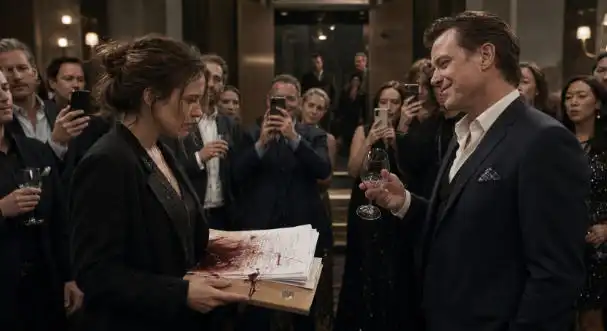
The doors flew open so hard the silver handles hit the walls.
Nobody screamed.
That was the strangest part.
The same people who had laughed while Victor Dane poured wine over my script suddenly forgot how to breathe.
I turned slowly, my fingers still pressed against the ruined pages.
Red wine slid down the table, dripping onto the polished floor of the Sundance private lounge like something bleeding out.
Victor still had the empty glass in his hand.
His security guard was halfway toward me.
And the man standing in the doorway looked at none of them first.
He looked at me.
Then at the soaked script.
Then at Victor.
His voice was calm.
Too calm.
“Step away from her.”
Victor blinked once, then forced out a laugh.
“Oh, this is adorable,” he said. “Did the little director bring backup?”
A few people chuckled, but it died quickly.
Because the man in the doorway didn’t move like backup.
He moved like ownership.
His black coat was dusted with snow from outside. His hair was windblown. His expression was controlled in that dangerous way men get when anger has already passed the shouting stage.
I knew that look.
I had seen it once before.
The night I told him everything.
The stolen scenes.
The threats.
The fake contracts.
The calls at midnight.
The day Victor’s lawyer told me I would “spend my whole life paying legal fees” if I tried to fight.
My name is Clara Vale.
For six years, I made a film called The Last Orchard.
I shot half of it in borrowed barns.
I edited scenes in laundromats.
I paid actors late and apologized more times than I can count.
I slept on friends’ couches during festival season.
I sold my grandmother’s ring to finish sound mixing.
And when the film finally got attention, Victor Dane appeared like a shark who smelled blood.
He called himself a “rescuer.”
He said my movie was too small without him.
He said I needed a man with “real relationships” to take it across the finish line.
At first, he was charming.
That’s how men like Victor survive.
They never start with cruelty.
They start with compliments.
“You have vision, Clara.”
“You remind me of the old-school auteurs.”
“You’re too talented to stay poor.”
Then came the papers.
Then came the pressure.
Then came the changes.
He wanted executive producer credit.
Then final cut approval.
Then international distribution control.
Then ownership of the script.
I said no.
That was when the smiles stopped.
Victor began calling distributors before I did.
He told them I was unstable.
He told them I had no chain of title.
He told them the script belonged to his company because he had “developed” it.
That was a lie.
A clean, expensive, professionally typed lie.
And people believed him because he had money.
Or worse.
They didn’t believe him, but they were afraid of him.
At the Sundance party, every major buyer in the room knew what was happening.
They knew he had cornered me.
They knew he had blocked two offers already.
They knew I was standing there alone because no one wanted to be seen helping me.
That’s what power looks like sometimes.
Not one monster.
A whole room of decent people choosing silence.
Victor lifted his chin toward the man at the door.
“And you are?”
The man stepped fully into the lounge.
“Ethan Royce.”
That name hit the room harder than the door had.
A woman from Northstar Distribution lowered her phone.
A man from Atlas Features whispered something I couldn’t hear.
Victor’s face twitched, but only for half a second.
He recovered fast.
“Royce,” he said. “As in Royce Media?”
Ethan didn’t answer.
Victor smiled wider, pretending he was still in control.
“Well, Mr. Royce, this is a private industry event. I’m handling a contractual dispute with a very emotional filmmaker.”
I almost laughed.
Emotional.
That was his favorite word for women who kept receipts.
Ethan walked toward the table.
Every step made the room quieter.
He stopped beside me, but he did not touch me.
Not yet.
He knew I hated being made to look helpless.
Instead, he picked up the top page of my soaked script.
The wine had blurred the ink, but the title was still readable.
The Last Orchard.
Written and directed by Clara Vale.
Ethan looked at Victor.
“You poured wine on copyrighted material during a recorded industry event?”
Victor rolled his eyes.
“Please. It’s a script. She’ll print another copy.”
“No,” Ethan said. “It’s evidence.”
That word changed the air.
Evidence.
People love drama until it starts sounding like a deposition.
Victor set the empty glass on the table with a sharp click.
“You’re out of your depth.”
Ethan finally smiled.
Just a little.
“Am I?”
Victor stepped closer to him.
I could smell the wine on his breath.
“I know your father,” Victor said. “And I know how this industry works. Your family buys newspapers and TV stations. Cute. I make careers. I end careers. Ask anyone in this room.”
Nobody spoke.
Victor turned, spreading his arms.
“Tell him.”
The room stayed silent.
That silence was the first crack in Victor’s kingdom.
His jaw tightened.
He pointed at me.
“This woman signed with my company. She owes me her film. She owes me gratitude. Instead, she ran around town accusing me of theft because she didn’t understand business.”
I opened my mouth.
Ethan placed one finger lightly on the table.
Not on me.
On the ruined script.
A quiet reminder.
Wait.
So I did.
For months, I had wanted to scream.
I had imagined standing in a room like this and telling everyone exactly what Victor had done.
But Ethan had warned me.
“Don’t fight him with emotion,” he said.
“Fight him with paper.”
So I had.
I saved every email.
Every draft.
Every redline.
Every voicemail.
Every “accidental” threat.
Every text from his assistant asking me to backdate documents.
Every calendar invite for meetings Victor later claimed never happened.
I registered my script with the Copyright Office before Victor ever read it.
I filed my production company documents under a name he didn’t know.
I kept the original investor agreements.
And when Victor’s people sent me a contract with a fake attachment claiming I had signed away sequel rights, I noticed something stupid.
The PDF metadata had been created three months after the date on the signature page.
That was when Ethan got very quiet.
Ethan wasn’t just my fiancé.
He was the oldest son of Warren Royce, the man whose media group owned newspapers, streaming platforms, cable networks, and enough legal departments to make a bully sweat.
But that was not the detail Victor missed.
The detail Victor missed was financial.
Victor’s company, DaneHouse Pictures, looked rich from the outside.
Huge offices.
Red carpets.
Private jets.
Parties with champagne towers.
But behind it?
Debt.
Massive debt.
A failed superhero franchise.
Three lawsuits quietly settled.
Two investors demanding repayment.
Bridge loans secured against his Beverly Hills home, his Malibu house, and a ranch in Montana he liked to brag about.
For years, Victor survived by bullying artists into signing over valuable rights, then using those rights as collateral for new loans.
He didn’t build.
He extracted.
And three weeks before Sundance, Royce Media quietly purchased the senior debt on DaneHouse Pictures.
Not the company.
Not yet.
The debt.
Which meant if Victor defaulted, the lender could take control of pledged assets.
Including his company shares.
Including certain property collateral.
Including unfinished film assets he had illegally claimed as his.
Victor didn’t know that.
He thought he was threatening a woman with no money.
He did not realize he had spent months insulting the future daughter-in-law of the man holding his financial leash.
Ethan turned slightly toward the room.
“Is Mr. Dane correct?” he asked. “Does anyone here believe Clara Vale assigned copyright ownership of The Last Orchard to DaneHouse Pictures?”
No one answered.
Victor laughed, but it sounded thinner now.
“My legal team has documents.”
Ethan nodded.
“I know.”
Victor froze.
Ethan reached inside his coat and removed a folder.
Not dramatic.
Not flashy.
Just a plain black folder with a silver clip.
He placed it on the table beside my wine-soaked script.
“Your legal team also has a problem.”
Victor’s face hardened.
“I don’t know what game you think you’re playing.”
“It’s not a game,” Ethan said. “It’s a notice.”
Victor glanced at the folder but didn’t touch it.
The security guard had stopped moving.
One of the distributors whispered, “Oh my God.”
Victor snapped, “Shut up.”
That was the second crack.
Because bullies can fake charm.
They can fake confidence.
They cannot fake control once panic starts showing.
Ethan opened the folder.
“DaneHouse Pictures defaulted on its senior secured loan at 9:00 a.m. this morning.”
Victor’s smile vanished.
Ethan continued.
“Royce Media Holdings acquired the note from Crestline Capital two weeks ago. As of this afternoon, we have exercised our rights under the default provision.”
Victor took one step back.
“No.”
“Yes.”
“You can’t do that.”
“We did.”
Victor looked around the room like someone might rescue him.
Nobody moved.
The people who had laughed with him minutes ago suddenly found the carpet fascinating.
Ethan slid one document across the table.
“Effective immediately, Royce Media Holdings controls DaneHouse Pictures’ voting interest, pending final court approval. You are removed from all operational authority.”
Victor stared at the paper.
Then he looked at me.
For the first time that night, he looked afraid.
Not sorry.
Afraid.
There is a difference.
“You planned this,” he said.
I finally spoke.
“No, Victor. You earned it.”
His face flushed red.
“You little—”
Ethan stepped between us.
“Finish that sentence carefully.”
Victor swallowed the rest.
The room was dead silent now.
Only the low music from the party speakers kept playing, soft and ridiculous, like the soundtrack had wandered into the wrong movie.
Ethan turned to the security guard.
“Who hired you?”
The guard looked uncomfortable.
“DaneHouse event staff.”
“Then you report to the company,” Ethan said. “And Mr. Dane no longer speaks for the company.”
The guard lowered his hand.
Victor’s mouth opened.
Nothing came out.
Ethan pointed to the wine-soaked script.
“That is Clara Vale’s property. The copyright registration predates all DaneHouse involvement by nineteen months.”
Then he turned to the distributors.
“Every person in this room who received a warning from Victor Dane that this film had title problems should preserve those communications. My attorneys will be requesting them.”
Phones went down fast.
Not because people wanted privacy.
Because they realized they had become witnesses.
Victor grabbed the folder.
His hands shook just enough for me to notice.
“This is theatrical,” he said. “You think you can humiliate me at Sundance and walk away?”
Ethan’s voice stayed even.
“No. I think you humiliated Clara at Sundance. I’m just correcting the record where you chose to create it.”
That line landed.
A woman in the back whispered, “Good.”
Victor heard her.
He spun around.
“You want to be next?”
Nobody laughed this time.
That was the third crack.
A man from Atlas Features stepped forward.
“I received an email from Victor’s office stating Clara’s script was under litigation. If that wasn’t true, I’ll cooperate.”
Victor glared at him.
“Coward.”
Another voice spoke.
A producer I barely knew.
“He told us she was mentally unstable.”
A publicist near the bar said, “He told me to bury her press screening.”
Then another.
And another.
It was like watching people remember they had spines.
Not all at once.
Not bravely.
But enough.
Victor looked smaller with every sentence.
That’s the thing about men who build power on fear.
When the fear leaves the room, there is not much left.
Ethan picked up another document.
“Mr. Dane, there’s also the matter of collateral.”
Victor went pale.
“No,” he whispered.
“Yes,” Ethan said. “Your Beverly Hills residence, Malibu property, Montana ranch, and two investment condos were pledged against the defaulted loans. Our counsel has already filed to secure them.”
Victor slammed his hand on the table.
Wine splashed.
“You can’t take my homes!”
Ethan looked at the glass.
Then at the ruined script.
“You were comfortable destroying what Clara built.”
He paused.
“Now the contract is destroying what you borrowed against.”
Victor’s face twisted.
For a second, I thought he might throw the folder.
Instead, he turned on me.
“You think he loves you?” he spat. “You think this prince is saving you? You’re still nothing without his last name.”
That one hurt.
I hated that it hurt.
Because part of me had feared it too.
I had spent years fighting to be more than somebody’s girlfriend, somebody’s fiancée, somebody’s future wife.
I did not want my victory handed to me by a powerful man.
I wanted my work to stand.
Ethan knew that.
He didn’t answer Victor.
He looked at me.
“Clara,” he said softly. “Do you want to tell them?”
The room turned back to me.
My throat tightened.
The ruined script lay in front of me.
Red-stained.
Wrinkled.
Humiliated.
But not erased.
I reached into my bag and pulled out a small hard drive.
Victor’s eyes locked on it.
Good.
He recognized it.
He should have.
It contained the first cut of The Last Orchard.
The one he told people did not exist.
The one he said I couldn’t legally show.
The one his assistant had tried to buy from my editor for cash.
I held it up.
“This is my film,” I said.
My voice shook at first.
Then steadied.
“Not Victor’s. Not DaneHouse’s. Mine.”
Nobody interrupted.
So I kept going.
“I wrote the script in 2018. Registered it in 2019. Shot the proof-of-concept in 2020. Raised independent financing in 2021. Principal photography wrapped before Victor Dane ever saw a frame.”
Victor said, “That’s not—”
“Don’t,” I said.
It surprised both of us.
I had never spoken to him like that before.
I opened my bag again and pulled out a second folder.
Copies.
Always copies.
“The emails are here. The copyright registration is here. The investor agreements are here. The metadata from the forged contract is here. The recorded call where Victor’s attorney tells me to ‘be smart’ before accusing him publicly is here.”
A murmur rolled through the lounge.
Victor’s lips parted.
“You recorded my attorney?”
“One-party consent state,” I said. “You taught me to check the law before speaking.”
That was the first time I saw someone in the room smile.
Not a cruel smile.
A relieved one.
Ethan stepped back.
He let the moment be mine.
And that mattered more than I can explain.
I turned to the distributors.
“Victor told you I was difficult because I said no.”
Then I looked at the women in the room.
Some looked away.
Some didn’t.
“He told you I was unstable because I kept records.”
I turned back to Victor.
“And he told everyone he owned my work because he thought nobody would ever read the fine print.”
Victor’s face went flat.
Cold.
Ugly.
“You’ll never work again,” he said.
But the sentence had no teeth left.
Ethan closed the black folder.
“Actually, she will.”
The door opened again.
This time, three people entered.
An older woman with silver hair and a sharp navy suit.
A younger man carrying a tablet.
And a lawyer I recognized from Royce Media’s entertainment division.
Victor recognized her too.
His knees almost buckled.
“Margaret,” he said.
Margaret Shaw didn’t greet him.
She looked at me instead.
“Ms. Vale, Royce Global Distribution would like to make a formal offer to acquire worldwide distribution rights to The Last Orchard, contingent on your approval and independent counsel review.”
I stared at her.
The room blurred for half a second.
Not because I was weak.
Because sometimes survival makes you numb, and then safety hits like a wave.
Victor whispered, “You can’t.”
Margaret finally looked at him.
“You are no longer authorized to speak for DaneHouse.”
The lounge erupted.
Not cheering.
Not yet.
But noise.
Whispers.
Gasps.
People moving.
Messages being sent.
Careers being recalculated in real time.
Victor backed away from the table.
“You’re all making a mistake,” he said.
No one followed him.
No one defended him.
No one laughed at his jokes.
His phone started ringing.
Then another phone.
Then another.
He looked at the screen and went gray.
I found out later what happened in those minutes.
His CFO had resigned.
His general counsel had refused to certify company statements.
Two lenders demanded immediate review.
A former assistant sent documents to a journalist.
And three women who had been silent for years contacted the same attorney within the hour.
Victor walked toward the exit.
Ethan said, “One more thing.”
Victor stopped.
Ethan gestured toward the soaked script.
“You owe her an apology.”
Victor laughed once.
A broken little sound.
“I don’t owe her anything.”
I stepped forward.
My shoes stuck slightly to the wine on the floor.
“No,” I said. “You owe me six years. You owe my crew late nights. You owe every actor you scared away. You owe every young filmmaker you bullied into signing something they didn’t understand.”
My voice did not shake now.
“But I don’t need your apology to be free.”
Victor’s mouth tightened.
For a moment, I thought he understood.
Then he proved he didn’t.
“You’ll regret this.”
Margaret nodded to security.
“Escort Mr. Dane out.”
The same guard Victor had ordered to remove me now walked toward him.
That was the moment the room fully shifted.
Victor looked at the guard.
Then at the guests.
Then at me.
And finally, people raised their phones again.
Not to film my humiliation.
To film his exit.
Victor Dane, the man who said he was the law in Hollywood, was escorted out of his own Sundance party while red wine from my ruined script stained the floor behind him.
I did not smile.
Not then.
I was too tired.
Too angry.
Too relieved.
Ethan came beside me.
“Are you okay?”
I looked at the script.
The pages were ruined.
But the story wasn’t.
“No,” I said honestly.
Then I looked at the hard drive in my hand.
“But I will be.”
The next morning, the industry woke up to the headline.
DANEHOUSE CONTROL SEIZED AFTER DEBT DEFAULT; VICTOR DANE REMOVED FROM OPERATIONS
By noon, the video from the party had spread everywhere.
Not the whole story.
Just enough.
Victor pouring wine.
Victor saying, “I am the law.”
Ethan entering.
Me holding up the hard drive.
People online did what people online do.
Some were cruel.
Some were kind.
Some said I had trapped him.
Some said I should have spoken sooner.
Some said Ethan only helped because I was engaged to him.
That last one used to bother me.
But my grandmother once told me, “A locked door doesn’t care whether you kick it open yourself or someone hands you the key. What matters is who walks through.”
I walked through.
With my own film.
My own copyright.
My own evidence.
My own name.
Within a week, five former assistants came forward.
Then two actresses.
Then a screenwriter who had lost a project the same way I almost did.
The lawsuits started civilly.
Then prosecutors began asking questions about forged documents, coercive contracts, fraudulent collateral statements, and investor misrepresentations.
Victor’s empire did not collapse in one dramatic explosion.
It collapsed like rotten wood.
One beam at a time.
His Beverly Hills home was seized during the debt proceedings.
The Malibu property went next.
The ranch he loved to show off in interviews was sold to satisfy creditors.
His company’s library was audited.
Several projects were frozen.
And when investigators found a pattern of forged rights assignments tied to multiple filmmakers, the case became much bigger than me.
Victor eventually took a plea on financial fraud charges connected to falsified documents and investor statements.
The civil suits from the artists continued.
He lost his producer’s guild membership.
His name was stripped from projects he had not truly built.
People who once called him “visionary” quietly deleted old photos with him.
That is not justice in a movie sense.
It is not a lightning bolt.
It is paperwork.
Depositions.
Court orders.
Asset sales.
Emails read aloud by lawyers in rooms with bad coffee.
But sometimes, the most satisfying revenge is not screaming.
It is watching a bully get trapped inside the same rules he used to scare everyone else.
As for The Last Orchard?
We finished the final cut under my production company.
My crew got paid first.
Not eventually.
First.
Every intern.
Every actor.
Every sound assistant.
Every grip who carried equipment through mud at 3 a.m.
Their names stayed in the credits exactly where they belonged.
At the premiere, I wore a simple black dress.
Nothing designer.
Nothing borrowed from a studio.
In my clutch, I carried one dried page from the wine-stained script.
The title page.
Ruined but readable.
Before the film started, I stood in front of the audience and looked out at faces I once begged to take my calls.
I didn’t mention Victor’s name.
I didn’t need to.
I said, “This film belongs to everyone who was told to be grateful while someone was stealing from them.”
The room stood up before I finished.
I cried then.
Not pretty tears.
Not movie tears.
Real ones.
The kind you wipe with both hands because mascara has already lost the war.
Ethan sat in the second row.
Not beside me onstage.
Not in front of cameras.
Exactly where I asked him to sit.
When the applause ended, he mouthed, “You did it.”
And for the first time in years, I believed it.
The film won the Grand Jury Prize.
Then an audience award.
Then it expanded.
Then it broke records no independent film like ours was supposed to touch.
People said it was because of the scandal.
Maybe some of it was.
But scandals get people to watch once.
Truth gets them to tell their friends.
The movie became bigger than my pain.
That was the healing part.
Not Victor losing everything.
Not the headlines.
Not the viral clip.
The healing was sitting in a theater months later, behind an older woman who did not know me, and hearing her whisper to her husband, “She put her whole heart in this.”
Yes.
I did.
And no one stole it.
A year after Sundance, I visited my grandmother’s grave with the first award the film ever won.
I placed it beside the flowers.
“I got the ring back,” I told her.
Because I did.
Not the same one.
That one had been sold to finish sound mixing.
But Ethan found the jeweler who bought it, tracked the stone, and had it reset in a plain gold band.
When he gave it to me, I told him, “You know I would have married you without this.”
He said, “I know. This wasn’t for marriage.”
“What was it for?”
“For the girl who sold her last beautiful thing and still finished the movie.”
I wore it to every festival after that.
Not as proof I belonged to someone.
As proof I had survived myself.
People still ask whether I regret letting Victor be destroyed in public.
The honest answer?
No.
He chose the stage.
He chose the audience.
He chose the wine.
He chose to turn my humiliation into a warning for every artist in that room.
All I did was let the truth arrive before he could leave.
So here’s my line in the sand:
A man who ruins people in private deserves to answer in public.
And a woman who keeps the receipts is not “difficult.”
She is dangerous to liars.
Share this if you believe Victor got exactly what he deserved — or comment “TOO FAR” if you think I should have warned him first. 🎬
Disclaimer: Mention of any brand or trademark is for identification only and does not imply partnership or endorsement
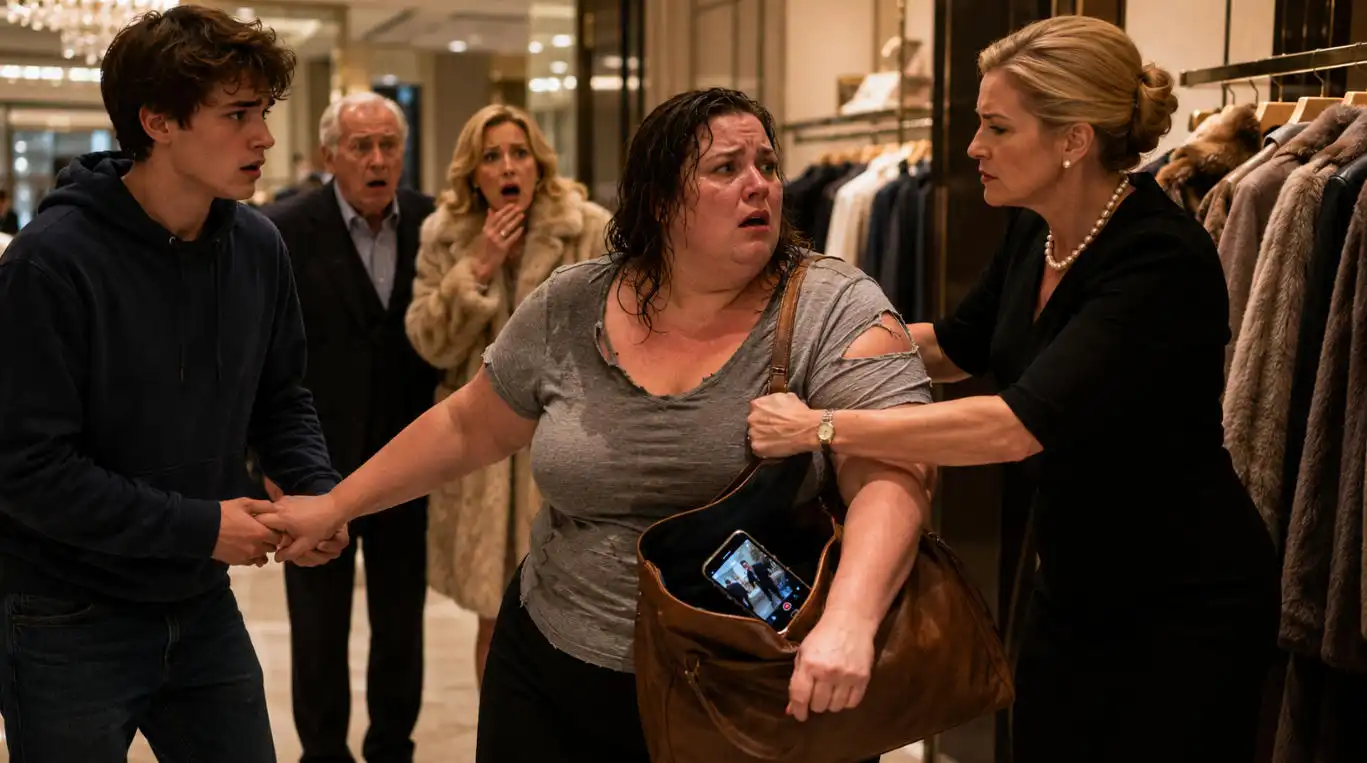
Maggie Was Covered In Shampoo, Slapped, And Laughed At In Front Of Rich Parents… Until One Quiet Phone Call Changed EVERYTHING
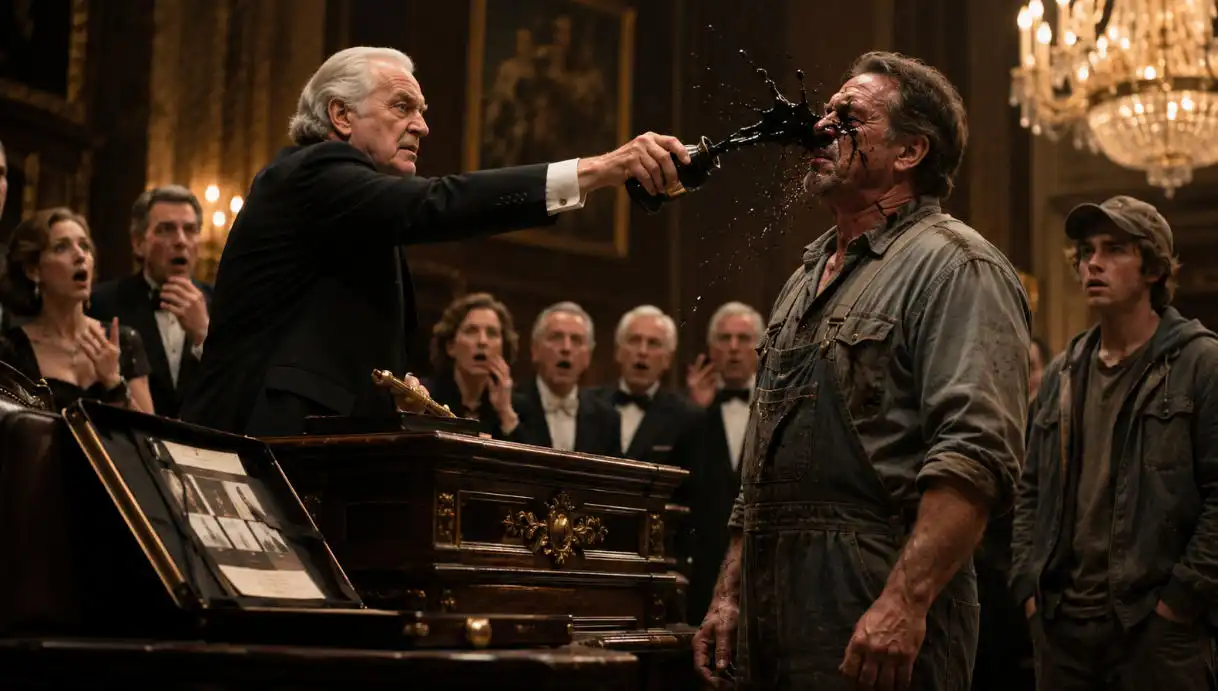
A Blue-Collar Dad Was DRAGGED Out Of A D.C. Private School Auction By A Snobby Auctioneer… But They Had NO IDEA Who He Really Was 😳
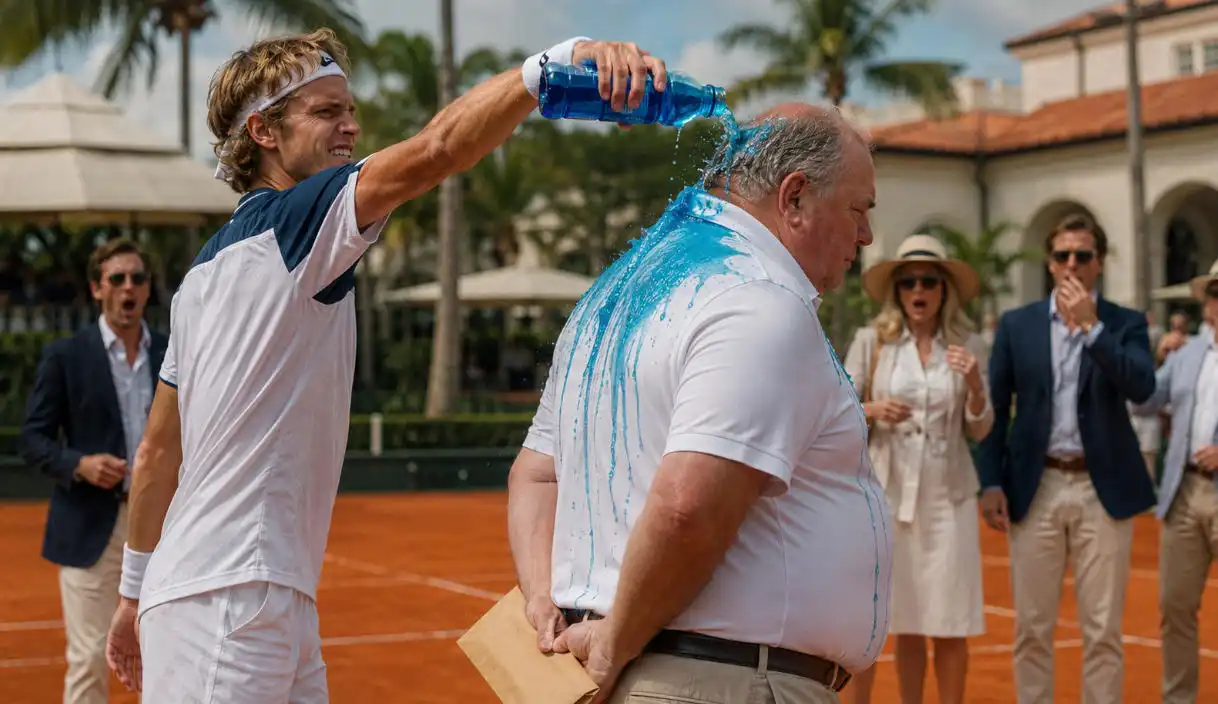
A Palm Beach Tennis Star HUMILIATED a Quiet Older Man in Front of the Whole Club… Then He Saw What Norman’s Attorney Filed That Morning