


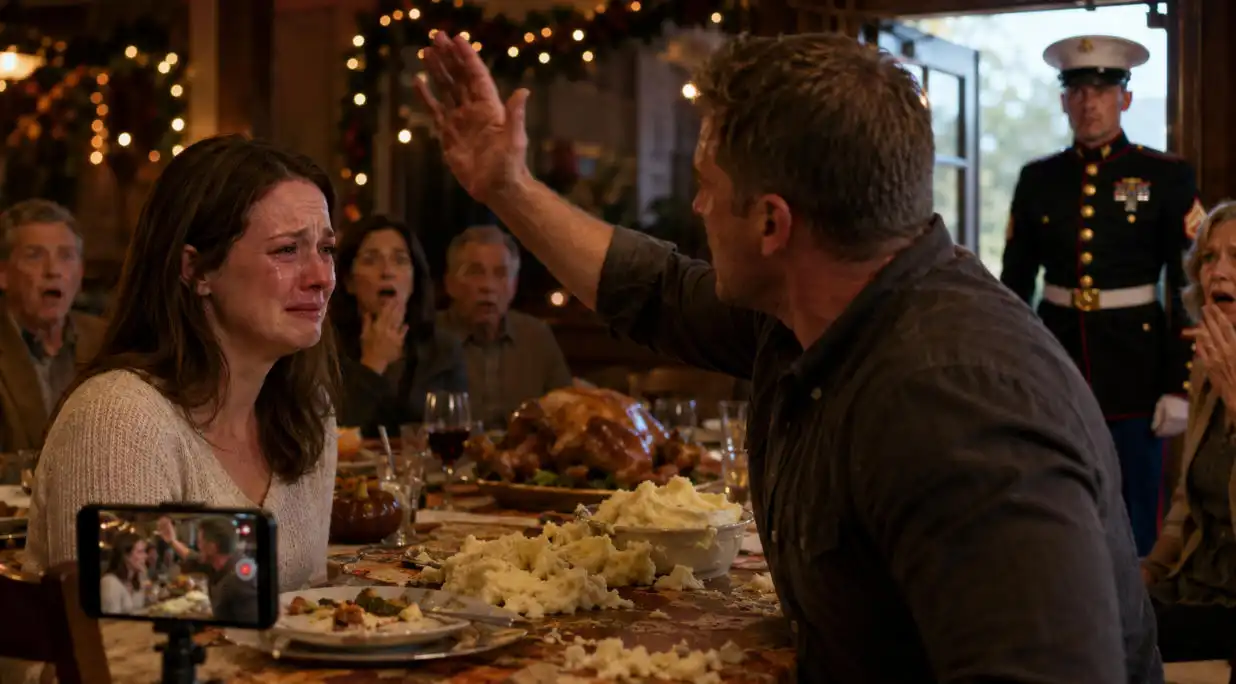
The room did not breathe after my brother said it.
“Tell me you didn’t just put your hands on my sister.”
Travis stood at the head of the Thanksgiving table with bourbon on his breath, rage in his eyes, and gravy spilled down the front of his expensive sweater like a stain he did not yet understand.
My cheek was still burning.
The mashed potatoes were cooling on the floor.
And for the first time in twelve years of marriage, my husband looked afraid of someone other than his own temper.
My name is Claire Whitaker, and until that Thanksgiving evening, most of my family thought I was simply a quiet wife.
The kind who said, “It’s fine,” before anyone asked.
The kind who refilled glasses before sitting down.
The kind who apologized when someone else broke something.
My husband, Travis, liked it that way.
In public, he was charming.
He sold insurance, wore polished shoes, donated to local school fundraisers, and shook hands like he had been born in a country club lobby.
At church, he held doors open for widows.
At work, he called women “ma’am.”
At home, he called me useless if dinner was late.
He called me ungrateful if I cried.
He called me dramatic when I flinched.
And on Thanksgiving, in front of eighteen relatives seated around our dining room table, he slapped me because the mashed potatoes were not hot enough.
Not spoiled.
Not burned.
Not missing.
Just cold.
The sound cracked through the room so sharply that our youngest daughter, Lily, dropped her fork.
My son Noah pushed his chair back.
“Dad!” he cried.
Travis pointed at him.
“Sit down.”
Noah froze.
That was what my children had learned to do.
Freeze first.
Speak later.
Maybe never.
Travis looked around the table, daring anyone to challenge him.
His mother, Patricia, pressed her lips together and stared into her wineglass.
His sister Brooke lifted her phone, then lowered it when Travis glared at her.
His cousin Kyle muttered, “Come on, man,” but not loud enough to be brave.
Everyone had seen it.
Everyone knew it was wrong.
But nobody wanted to be the person who “ruined Thanksgiving.”
That is how men like Travis survive.
They count on everyone loving peace more than justice.
He turned back to me, his face flushed.
“You embarrassed me,” he said.
I could feel the heat rising under my skin.
My cheek throbbed.
My hands shook.
But I did not answer.
That silence made him angrier.
“You think standing there looking pitiful makes me the bad guy?” he snapped. “You had one job today. One. I pay for this house. I pay for this food. I pay for the clothes on your back. And you can’t even keep mashed potatoes warm?”
A chair scraped at the far end of the table.
My father-in-law, George, looked like he wanted to stand.
Patricia gripped his wrist.
“Don’t,” she whispered.
I heard her.
So did Travis.
He smiled.
That smile was worse than the slap.
It told me he knew exactly how much power he had in that room.
Then he lifted his hand again.
Not high.
Not fast.
Just enough to remind me.
Just enough to remind everyone.
And that was when the front door opened.
Cold November air swept into the house.
A suitcase wheel bumped over the entryway threshold.
Then my older brother Mark stepped into the dining room wearing his Marine Corps dress uniform.
I had not seen him in eleven months.
He was supposed to be overseas until December.
He was supposed to miss Thanksgiving again.
But there he was.
Tall.
Still.
Eyes locked on my face.
For one second, he did not move.
He just took in the room.
The spilled potatoes.
The silent relatives.
My children crying.
Travis’s raised hand.
Then Mark set his suitcase down.
Very gently.
That scared Travis more than if he had shouted.
“Claire,” Mark said, his voice low, “come here.”
Travis laughed, but it cracked in the middle.
“Oh, this is perfect,” he said. “Captain America shows up and thinks he owns my house?”
Mark did not look at him.
“Claire,” he repeated.
I took one step.
Travis grabbed my wrist.
It was not hard enough to break anything.
It was hard enough to prove he believed I belonged to him.
Mark saw it.
His jaw tightened.
“Let go of her.”
Travis smirked.
“Or what?”
The room seemed to shrink around those two words.
Mark moved so fast that half the table gasped before anyone understood what had happened.
He did not punch Travis.
He did not throw him into furniture.
He did not lose control.
He simply stepped in, peeled Travis’s fingers off my wrist, turned his arm behind his back, and guided him down to the floor with the calm precision of a man trained to stop violence without becoming it.
Travis hit the hardwood on one knee, then both.
“Get off me!” he screamed.
Mark held him there.
“You’re done putting hands on my sister.”
The relatives erupted.
Patricia stood up.
“Mark, please, don’t make this worse!”
He turned his head just enough to look at her.
“With respect, ma’am, you already did.”
That shut her mouth.
Brooke began crying.
Kyle had his phone out now.
Noah ran to me and wrapped both arms around my waist.
Lily hid behind my skirt, shaking.
“Mommy,” she whispered, “is Uncle Mark taking Dad away?”
I knelt and pulled both my children close.
“I don’t know yet,” I told her.
But I did know.
Not because Mark had arrived.
Not because Travis was on the floor.
Because three weeks earlier, I had finally stopped pretending.
I had called a family lawyer named Denise Harris from the parking lot of a grocery store.
I had used a prepaid phone I kept under the spare tire cover in my trunk.
I had cried so hard on that first call that she had to tell me to breathe.
“Claire,” she said, “I need you to understand something. Silence protects him, not you.”
So I started documenting.
Not dramatically.
Not recklessly.
Carefully.
I photographed bruises beside that day’s newspaper.
I saved threatening voicemails.
I copied bank statements.
I took screenshots of texts where Travis called me a parasite, a burden, a stupid woman who would leave with nothing if she ever tried.
I wrote down dates.
Times.
Witnesses.
And when Travis broke a cabinet door because Noah spilled juice, I saved the repair invoice.
When he shoved me into the laundry room wall after a church picnic, I went to urgent care and told the truth for the first time.
When the nurse asked, “Do you feel safe at home?” I shook my head.
That record mattered.
Denise told me it would.
“Judges don’t need perfect victims,” she said. “They need facts.”
So by Thanksgiving, the facts were already in motion.
A temporary filing had been prepared.
Emergency custody paperwork was ready.
A petition for a protective order sat in Denise’s office, waiting for the final incident that would prove imminent danger.
I had prayed there would not be one.
I had prayed Thanksgiving would pass quietly.
But men like Travis always mistake patience for permission.
From the floor, Travis shouted, “Claire, tell him to stop!”
I looked at him.
For years, those words would have worked.
Tell him to stop.
Fix this.
Calm him down.
Protect his image.
Absorb the damage.
Smile afterward.
But my brother had not come to save a helpless woman.
He had come because I had finally asked for help.
So I stood behind my children and said, “No.”
Travis twisted under Mark’s grip.
“You’ll regret this,” he spat. “You think you can take my house? My money? My kids?”
That was the moment the room changed.
Because everyone heard it.
Not “Are you okay?”
Not “I’m sorry.”
Not even “I lost control.”
His first concern was ownership.
My house.
My money.
My kids.
Denise had warned me he would say something like that eventually.
She had told me entitled men often reveal themselves when they think power is slipping.
And Travis, drunk and furious, kept talking.
“You don’t have a dime without me,” he snarled. “You’ll be begging to come back by Christmas.”
I almost laughed.
Not because it was funny.
Because for the first time, his threats sounded small.
Mark looked at Kyle.
“Call 911.”
Kyle hesitated.
Travis screamed, “Do not call anyone!”
Kyle looked at me.
I nodded.
He dialed.
Patricia started sobbing.
“This is family business,” she said. “We can handle it privately.”
I turned to her, still holding my children.
“You watched your son slap me.”
Her face crumpled.
She tried to speak.
Nothing came out.
Brooke whispered, “Claire, I didn’t know it was this bad.”
I wanted to believe her.
Maybe she truly did not know the details.
But she knew enough.
People usually do.
They know the room gets quieter when he enters.
They know the wife laughs too quickly.
They know the children watch his hands.
They know.
They just hope someone else will be responsible for naming it.
Police arrived nine minutes later.
Nine minutes is a long time when the man who hit you is kneeling on your dining room floor, still trying to bargain with the world.
By then, Mark had released the arm restraint and stepped back after the officers entered.
Travis tried to stand with dignity, but his knees wobbled.
Officer Ramirez, a woman with calm eyes and a body camera clipped to her uniform, looked around the dining room.
She saw my cheek.
She saw the spilled food.
She saw my children.
She saw twelve adults suddenly eager to explain that things had gotten “out of hand.”
“What happened?” she asked.
Travis spoke first.
“She’s exaggerating. We had an argument. Her brother attacked me.”
Mark folded his hands behind his back.
“I restrained him after he struck my sister and grabbed her wrist.”
Travis barked, “You weren’t even here!”
“No,” Mark said. “But half this table was.”
That silence returned.
Heavy.
Cowardly.
Officer Ramirez looked at me.
“Ma’am?”
I had rehearsed this.
Denise had told me I might freeze.
She told me to keep it simple.
Facts.
Not feelings.
Not excuses.
Not his childhood.
Not the stress at work.
Facts.
“My husband slapped me in front of the table because he said the mashed potatoes were cold,” I said. “Then he raised his hand again. My brother walked in and told him to stop. Travis grabbed my wrist when I tried to move away.”
Officer Ramirez asked if anyone had video.
For one awful second, nobody moved.
Then Brooke raised her trembling hand.
“I do,” she whispered.
Travis turned on her.
“You recorded me?”
Brooke flinched.
That told the officer plenty.
She handed over her phone.
The video was short.
Only twenty-three seconds.
But it was enough.
Travis’s voice filled the dining room from the tiny speaker.
“You had ONE job, Claire.”
Then the slap.
Then my children crying.
Then Travis raising his hand again.
Nobody spoke while it played.
The humiliation of hearing it back was almost unbearable.
But the shame was no longer mine.
It moved across the room and landed where it belonged.
On him.
Officer Ramirez asked me if I wanted medical attention.
I said yes.
That word nearly broke me.
Yes.
Such a small word.
I had said no so many times.
No, I’m fine.
No, it was an accident.
No, he didn’t mean it.
No, the kids didn’t see.
No, I don’t need help.
But that night, I said yes.
Yes to medical attention.
Yes to a police report.
Yes to pressing charges.
Yes to letting the truth become official.
Travis was arrested before the pumpkin pie was cut.
He shouted the entire way to the patrol car.
“This is my house!”
“You’ll get nothing!”
“You turned my family against me!”
But the neighbors were outside by then.
Porch lights on.
Phones raised.
The same man who cared so much about appearing respectable was led down his own front steps in handcuffs while half the cul-de-sac watched.
He had always terrified me with public shame.
That night, public shame finally found him.
Mark stood beside me on the porch after the patrol car pulled away.
His uniform jacket was still perfect.
His face was not.
He looked like he was holding back years of anger.
“I should have known,” he said.
I shook my head.
“No. I got very good at hiding it.”
He looked at Noah and Lily through the window.
“They shouldn’t have had to see that.”
“I know.”
Then he said the words I did not expect.
“But maybe they needed to see it end.”
I cried then.
Not pretty crying.
Not movie crying.
The kind that bends your ribs.
Mark wrapped one arm around my shoulders like we were children again and whispered, “You’re not going back.”
The legal hammer came down faster than Travis expected.
The next morning, Denise filed the emergency protective order.
By Monday, we had a temporary custody hearing.
The police report, Brooke’s video, the urgent care records, the photographs, the threatening texts, and the bank statements all went into one thick folder.
Travis arrived at court in a gray suit, freshly shaved, playing the wounded husband.
He told the judge I was unstable.
He told the judge Mark was aggressive.
He told the judge Thanksgiving had been “a misunderstanding fueled by family tension.”
Then Denise played the video.
The courtroom heard his voice.
“You sit home all day and you can’t even serve hot potatoes?”
The judge’s expression did not change.
That was somehow more satisfying than outrage.
Professional disgust is quiet.
Denise then submitted the medical record from that same night.
Visible redness and swelling to left cheek.
Wrist tenderness consistent with forceful grip.
Emotional distress observed.
Then came the texts.
You leave, you leave with nothing.
No judge will give kids to a woman with no job.
Everything is in my name because you’re too stupid to manage money.
The judge looked at Travis.
“Mr. Whitaker, did you send these messages?”
Travis said, “I was angry.”
The judge said, “That was not my question.”
He swallowed.
“Yes.”
Denise also revealed the financial part Travis had hidden for years.
He had been moving money from our joint account into a private business account under his cousin’s LLC.
He had opened a credit card in my name.
He had delayed mortgage payments while telling me we were “fine.”
He had drained the children’s college savings for what he called “investment opportunities,” which turned out to be sports betting debts and bar tabs.
The man who claimed I could not handle money had been quietly burning our family down.
Travis’s lawyer asked for a recess.
The judge granted the protective order.
Temporary full custody went to me.
Travis was ordered out of the house.
He was prohibited from contacting me except through counsel and a parenting app approved by the court.
He had to surrender firearms he owned.
He had to attend supervised visitation only if the children’s therapist recommended it later.
When the judge finished, Travis turned in his chair and looked at me like he still expected me to apologize.
I did not lower my eyes.
That may have been the first victory.
Not the order.
Not the custody.
Not even the video.
Just the fact that I met his stare and felt nothing but distance.
The criminal case moved separately.
Travis was charged with domestic assault.
Because the incident happened in front of children and because there was documentation of prior injuries, the prosecutor treated it seriously.
He took a plea months later.
Probation.
Mandatory counseling.
A no-contact order.
Community service.
Court costs.
A permanent mark on the reputation he worshiped more than his family.
But the financial consequences hit him harder.
Denise found every hidden account.
Every transfer.
Every debt.
The court froze the accounts Travis had been using to conceal marital funds.
His wages were garnished for temporary support.
His business partners distanced themselves.
His employer put him on leave after the arrest became known, and later he resigned before they could terminate him.
For a man who built his identity on control, it was devastating.
For me, it was oxygen.
I will not pretend leaving was instantly beautiful.
It was paperwork.
Locks changed.
Therapy appointments.
Nightmares.
Children asking impossible questions.
Lily asked if Daddy hated mashed potatoes.
Noah asked if he should have stopped him sooner.
That question broke me.
I held my son’s face and said, “No. Adults protect children. Children do not protect adults.”
We said that often after that.
In therapy.
At bedtime.
In the car.
Adults protect children.
Children do not protect adults.
Mark stayed for two weeks.
He fixed the broken cabinet door Travis had left hanging crooked for months.
He taught Noah how to change a tire.
He let Lily pin paper medals on his uniform jacket and called her “General Lily.”
But the most important thing he did was not dramatic.
He sat at our kitchen table while I called the bank.
He sat beside me when I opened a checking account in my own name.
He sat across from me while I made a resume for the first time in thirteen years.
“You were never weak,” he said one night.
I laughed bitterly.
“I stayed.”
“You survived,” he corrected.
There is a difference.
A year later, Thanksgiving looked different.
Smaller.
Quieter.
Better.
We held it in the same house because I refused to let one terrible memory own every wall.
The dining room table had a scratch near the head where Travis’s chair had fallen.
I kept it.
Not because I wanted pain.
Because I wanted proof.
Proof that something ended there.
Denise came for dinner with her wife.
Mark came home again, this time with no surprise entrance and no need to restrain anyone.
Brooke came too.
She had apologized.
Not once.
Many times.
She told me she watched that video over and over after Thanksgiving.
“I kept asking myself why I recorded instead of helping,” she said.
I told her the truth.
“You helped when you handed it over.”
Patricia was not invited.
George sent a card.
It said, “I’m sorry I stayed seated.”
I did not know yet if I could forgive him.
But I appreciated that he finally named what he had done.
Noah mashed the potatoes himself that year.
He made them too garlicky.
Lily declared them perfect.
Mark took one bite and said, “These are the most American potatoes I’ve ever tasted.”
We all laughed.
Real laughter.
The kind that does not check the hallway first.
Before dinner, Noah asked if he could say grace.
He was ten then.
Still too serious sometimes.
Still healing.
He folded his hands and said, “Thank you that our house is safe now. Thank you that Mom doesn’t cry in the laundry room anymore. Thank you that Uncle Mark came home. And thank you for mashed potatoes, even if they’re cold.”
I covered my mouth.
Mark looked at the ceiling.
Denise wiped her eyes.
The potatoes were warm, actually.
But nobody cared.
After dinner, I stood alone in the kitchen for a moment.
No yelling.
No slammed cabinet.
No footsteps making my stomach tighten.
Just dishes in the sink, children laughing in the next room, and my brother telling a ridiculous story about airport coffee.
That was when I realized justice is not always loud.
Sometimes justice is a quiet kitchen where nobody is afraid.
Travis did not lose everything because my brother was strong.
He lost everything because he believed my silence meant he owned the truth.
He lost his home because he put his hands on me.
He lost access to our children because they deserved safety more than he deserved control.
He lost the money he hid because documents speak louder than threats.
And he lost his reputation because finally, everyone saw what I had been living with.
As for me, I got the house in the divorce settlement.
Full custody.
A fair share of the marital assets.
Court-ordered child support.
And eventually, something I had not felt in years.
Peace.
I started working part-time for a local nonprofit that helps women rebuild after crisis.
The first time I deposited my own paycheck, I sat in my car and cried.
Not because it was a lot of money.
Because it had my name on it.
My children are not “over it.”
Neither am I.
That is not how healing works.
But Noah laughs more now.
Lily sings in the bathtub again.
And every Thanksgiving, we make mashed potatoes together.
Sometimes they are hot.
Sometimes they are cold.
Nobody gets slapped.
Nobody gets screamed at.
Nobody has to earn basic dignity by serving dinner correctly.
So if you ask me whether my brother “went too far” by putting Travis on the floor in front of the whole family, my answer is no.
He did not go too far.
He stopped what everyone else was too afraid to stop.
And if you ask whether I regret calling the police, pressing charges, freezing the accounts, and taking full custody, my answer is also no.
I regret only one thing.
That I ever believed keeping the peace was more important than protecting myself and my children.
Choose a side: was Mark right to restrain Travis in front of the whole family, or should everyone have stayed seated and “kept Thanksgiving peaceful”?
Share this with someone who needs to remember: silence is not peace when someone is being hurt. ⚖️
Disclaimer: Mention of any brand or trademark is for identification only and does not imply partnership or endorsement
Maggie Was Covered In Shampoo, Slapped, And Laughed At In Front Of Rich Parents… Until One Quiet Phone Call Changed EVERYTHING
A Blue-Collar Dad Was DRAGGED Out Of A D.C. Private School Auction By A Snobby Auctioneer… But They Had NO IDEA Who He Really Was 😳

A Palm Beach Tennis Star HUMILIATED a Quiet Older Man in Front of the Whole Club… Then He Saw What Norman’s Attorney Filed That Morning