
The six words were not loud.
They didn’t need to be.
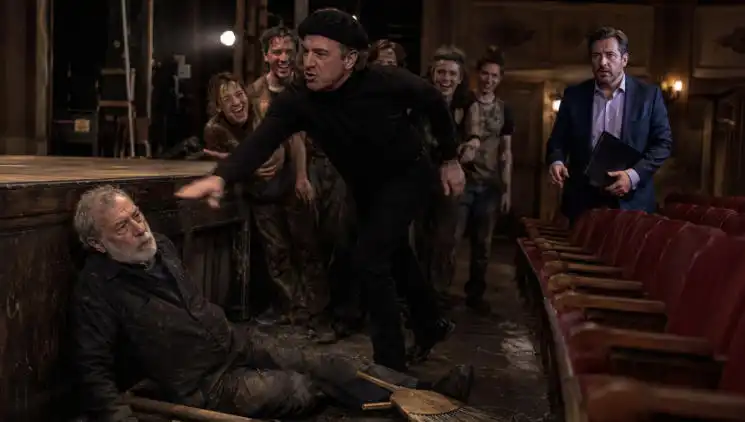
The sweating producer knelt beside Elijah like the old man had a crown hidden under his dust cap.
“Sir… we need your investment.”
The entire theater went so still, you could hear the broken broom handle rolling across the floor.
Damian Voss stood on the stage with one hand still raised, as if his own body had not caught up with what his eyes had just seen.
Thirty seconds earlier, he had shoved Elijah off that stage like the old man was garbage.
Now a top Hollywood producer was kneeling beside him.
And the president of the national actors’ union was standing behind him, pale, out of breath, clutching a sealed black folder against his chest like it contained someone’s future.
Because it did.
Several futures, actually.
Damian’s.
The young actors’.
The theater’s.
And Elijah’s, though he did not look surprised at all.
He simply sat up slowly, pressed one hand against his shoulder, and said, “I told you I understood contracts.”
Nobody laughed this time.
Not the girl with muddy boots.
Not the tall boy who had stomped on the stage.
Not the assistant director who had been pretending not to see anything.
Even the people in the back rows stopped whispering.
Phones stayed raised.
Camera lights blinked.
Damian cleared his throat.
“Is this some kind of joke?” he said.
His voice had changed.
The sharp New York confidence was still there, but something underneath it had cracked.
The producer looked up at him.
His name was Martin Kell.
People in Hollywood called him the man who could make a studio greenlight a movie before lunch and kill it before dinner.
He stared at Damian with sweat on his forehead and panic in his eyes.
“No,” Martin said. “The joke was you thinking you had power in this room.”
That sentence landed harder than the shove.
Damian stepped down from the stage.
“Martin,” he said, forcing a laugh. “You should’ve called first. I’m in the middle of auditions.”
Martin stood.
“So were we.”
Damian frowned.
“What does that mean?”
The union president, a gray-haired man named Howard Leary, finally spoke.
“It means Mr. Reed asked us not to interrupt.”
Everyone turned toward Elijah.
Mr. Reed.
Not “janitor.”
Not “old man.”
Not “Grandpa.”
Mr. Reed.
Elijah slowly got to his feet before anyone could help him. He brushed dust off the front of his faded work shirt. His shoulder hurt. His hip hurt. But his face stayed calm.
He looked at the broken broom.
Then at the muddy prints on the stage.
Then at the young actors who had laughed.
“This theater has been here eighty-one years,” Elijah said. “My wife played Juliet on that stage when she was seventeen.”
Nobody moved.
“My son learned to stop stuttering under those lights.”
The old red curtains shifted slightly in the draft from the open back doors.
“My grandson built sets here before he ever touched a movie camera.”
Damian folded his arms.
“So you’re sentimental. Wonderful. That doesn’t make you important.”
A woman in the third row whispered, “Oh my God, stop talking.”
Damian didn’t hear her.
Or worse, he did and ignored her.
That had always been his gift.
He mistook silence for permission.
Elijah reached into his jacket and pulled out the small black card he had touched earlier.
He held it between two fingers.
It was not flashy.
No gold.
No logo.
Just a private access card with embossed initials.
Martin’s face tightened the second he saw it.
Howard lowered his eyes.
Damian stared at the card, annoyed.
“What is that supposed to be?”
Elijah said, “The reason your next three films exist.”
The room inhaled.
One breath.
All at once.
Damian blinked.
Martin closed the folder in his hands and turned toward the audience.
“I think everybody here deserves to understand what happened today.”
Elijah raised one finger.
“Not yet.”
Martin stopped immediately.
That was when the balance of power truly became visible.
Not when the producer entered.
Not when the union president ran in.
But when Elijah lifted one finger, and two of the most powerful men in entertainment obeyed him without question.
Damian saw it too.
His mouth went dry.
Elijah looked back at the stage.
“Mr. Voss,” he said, “you came into a community theater and treated everyone here like they were beneath you.”
Damian forced a smile.
“I’m demanding. That’s different.”
“You called children amateurs.”
“They are.”
“You told a retired music teacher she had ‘local-market energy.’”
Damian shrugged.
“I was being honest.”
“You made a nineteen-year-old cry because her shoes were not ‘coastal enough.’”
The girl in the second row wiped her face.
Damian rolled his eyes.
“Oh, please.”
Elijah’s voice stayed soft.
“And when you saw an old man sweeping a stage, you decided he was safe to humiliate.”
That finally got under Damian’s skin.
“You were in the way.”
“I was working.”
“You were cleaning.”
“That is work.”
A few people nodded.
One older man in the back said, “Damn right.”
Damian snapped his head toward him.
Elijah continued.
“I didn’t interrupt you. I didn’t disrespect your process. I didn’t even complain when your actors dragged mud across fresh boards.”
The young actors looked down.
One girl pulled her feet under her chair.
Elijah looked directly at them.
“That stage is not famous. But it has held more honest dreams than most rooms in Los Angeles.”
The theater stayed silent.
Damian scoffed.
“You people are ridiculous. This is why real artists leave towns like this.”
Elijah looked at Martin.
“Now.”
Martin opened the sealed black folder.
The sound of the paper seal tearing seemed to echo.
Inside were printed agreements.
Studio letters.
Private financing schedules.
Equity commitments.
Termination clauses.
Damian’s expression shifted from irritation to calculation.
He was trying to understand whether he should apologize, attack, or run.
Martin pulled out the top page.
“Damian Voss currently has three active production packages tied to Reed Meridian Capital,” he said.
A murmur spread through the theater.
Damian’s face went white.
“No.”
Howard added, “Two stage-to-screen adaptations and one limited streaming series.”
Martin nodded.
“All dependent on private bridge financing.”
Damian pointed at Elijah.
“Him?”
Martin looked almost offended.
“Yes. Him.”
The producer turned fully toward Damian.
“Elijah Reed is the largest individual venture investor behind our studio-side slate this year.”
A woman dropped her phone into her lap.
The tall boy with muddy boots whispered, “No way.”
Elijah looked at him.
“Yes way.”
That little sentence should not have been funny.
But after all the cruelty, after all the silence, after watching Damian stand over a fallen old man like a king standing over a servant, the theater needed one human sound.
A few people laughed.
Not at Elijah.
At the sudden collapse of Damian’s world.
Damian lifted both hands.
“Okay. Fine. Fine. There’s been a misunderstanding.”
Elijah said nothing.
Damian turned toward him with a smile so fake it almost hurt to watch.
“Mr. Reed. I had no idea.”
Elijah replied, “That was the problem.”
The room went quiet again.
Damian swallowed.
“I mean, obviously, if I had known you were—”
“Worth money?”
Damian froze.
Elijah stepped closer.
“If you had known I was worth money, you would have treated me like a human being?”
Nobody moved.
That question hung in the theater like a verdict.
Damian looked around and realized the phones were still recording.
The young actors were not laughing anymore.
The town was watching.
The internet would be watching soon.
And for the first time all day, Damian understood what public pressure felt like when he wasn’t the one controlling it.
“I was under stress,” he said.
Elijah nodded.
“So you broke my broom.”
Damian’s jaw tightened.
“It was a prop.”
“It was mine.”
“You fell.”
“You pushed me.”
Damian’s eyes flicked to the phones.
“That’s not—”
A teenage boy in the front row lifted his phone higher.
“I got it,” he said.
Then a retired woman in the aisle raised hers.
“So did I.”
Another person said, “From the side.”
A stagehand near the curtain said, “The lobby camera caught it too.”
Damian’s face hardened.
“You’re all making a huge mistake.”
Howard finally stepped forward.
“No, Damian. You made it when you put hands on a worker in front of witnesses.”
Damian jabbed a finger at him.
“You can’t ban me from theater.”
Howard’s voice went cold.
“I can recommend disciplinary review, notify producing partners, and advise members not to work under unsafe conditions.”
Martin held up the financing papers.
“And I can make three calls.”
Damian laughed, but it came out thin.
“Three calls? You think three calls can end me?”
Elijah looked at the broken broom again.
“Make them.”
Martin already had his phone out.
The first call went to a studio finance executive.
He put it on speaker.
“This is Martin Kell. Reed Meridian Capital is withdrawing bridge support from the Voss package effective immediately under the conduct clause.”
A tinny voice on the other end said, “All three?”
Martin looked at Elijah.
Elijah nodded once.
“All three,” Martin said.
Damian lunged toward him.
“You can’t do that!”
Howard stepped between them.
A local stage manager, a woman in her sixties with silver hair and steel in her eyes, moved to block Damian’s path too.
The same people who had frozen when Elijah fell were not frozen anymore.
That mattered.
Cowards grow in silence.
But decency can spread just as fast when one person finally moves.
Martin ended the first call.
Then he made the second.
A streaming platform.
“Terminate development hold.”
Then the third.
A Broadway investment group.
“Remove Voss from attachment. Safety and conduct issue. Documentation forthcoming.”
With each call, Damian seemed to shrink.
Not physically.
He was still tall.
Still dressed like a man who expected velvet ropes to open for him.
But the authority leaked out of him.
His shoulders sagged.
His eyes darted.
His mouth opened and closed as if trying to find the perfect insult that would save him.
There wasn’t one.
The sealed black folder had become an open wound.
Howard took out his own phone.
“I’m sending a formal notice to the national committee,” he said. “Pending review, our members will be advised of a hostile and unsafe rehearsal environment.”
Damian stared at him.
“You’re blacklisting me?”
Howard shook his head.
“No. Your behavior is notifying the industry. I’m just putting it in writing.”
That was the legal hammer.
No shouting.
No revenge fantasy.
No secret beating in an alley.
Just contracts.
Conduct clauses.
Investor rights.
Union safety notices.
Witness statements.
Camera footage.
Rules Damian loved when they protected him, now closing around him when they protected someone else.
Damian turned to the young actors.
“You,” he snapped. “Tell them I didn’t push him.”
The tall boy looked sick.
The girl with muddy boots started crying.
Damian’s eyes widened.
“Say it!”
She shook her head.
“You did push him.”
The room turned toward her.
She swallowed hard.
“And we laughed.”
Her voice broke.
“I’m sorry.”
Elijah looked at her for a long moment.
Then he nodded.
“Apology heard.”
Not accepted.
Not erased.
Heard.
There is a difference.
The tall boy stepped forward next.
“I stepped on the stage after he cleaned it,” he said. “On purpose.”
Damian hissed, “Shut up.”
The boy ignored him.
“I wanted Mr. Voss to think I was bold.”
Elijah said, “Cruel isn’t bold.”
The boy lowered his head.
“No, sir.”
Damian spun toward Martin.
“You’re really going to tank millions because an old janitor got embarrassed?”
Elijah answered before Martin could.
“No.”
He picked up the broken broom handle.
“Because a man who cannot be trusted with powerless people should not be trusted with powerful money.”
That sentence ended him.
Not legally.
Not completely.
Not yet.
But in that room, the performance was over.
Damian had played genius.
He had played tyrant.
He had played gatekeeper.
And now everyone could see the costume seams.
Martin’s phone buzzed.
He looked down.
Then he looked at Elijah.
“First studio confirms withdrawal.”
Damian’s knees bent slightly.
A second buzz.
“Streaming partner confirms removal.”
A third.
“Stage investors are out.”
The room did not cheer.
That was what made it worse.
There was no cartoon victory.
No dancing.
No wild applause.
Just the sound of a powerful bully realizing that consequences are quieter than applause and much harder to escape.
Damian backed toward the stage stairs.
“You’ll regret this,” he said.
Elijah looked at him.
“I already regretted letting you use this theater.”
Damian grabbed his leather bag.
“You think this town matters? You think this dusty little building matters?”
Elijah turned toward the seats.
He looked at the retired teacher.
The teenage boy.
The crying actress.
The stage manager.
The parents near the lobby.
The kids peeking through the side door, too young to understand contracts but old enough to recognize meanness.
“Yes,” Elijah said. “I do.”
Damian stormed up the aisle.
At the back doors, he stopped.
Maybe he expected someone to chase him.
Maybe he expected one last chance to make a speech.
Nobody moved.
So he left alone.
The door slammed behind him.
For several seconds, nobody spoke.
Then the little theater seemed to exhale.
The stage manager walked over to Elijah.
“Your shoulder,” she said. “We should call someone.”
“Elena,” Elijah said gently, “you always worry before you breathe.”
“You fell off my stage.”
“Our stage.”
She looked at him, and her eyes filled.
“Our stage,” she repeated.
Martin closed the black folder.
“Mr. Reed, we still need to discuss the financing window.”
Elijah looked at him.
“Not here.”
Martin nodded quickly.
“Of course.”
Elijah pointed toward the lobby.
“You and Howard can wait by the old ticket booth.”
Howard looked humbled.
“Yes, sir.”
Before they walked away, Martin glanced at the broken broom.
“I’m sorry,” he said.
Elijah studied him.
“For what?”
“For not getting here sooner.”
Elijah’s face softened just a little.
“Most men with money arrive late. Try arriving right next time.”
Martin accepted that like a sentence.
After the two industry men stepped into the lobby, the young actors remained in the theater like children waiting outside a principal’s office.
The girl with muddy boots approached first.
Her mascara had run.
“I really am sorry,” she said. “I thought if I impressed him, maybe I’d get out of here.”
Elijah leaned on the broken broom handle.
“Out of here?”
She nodded.
“Out of this town.”
Elijah looked around the dusty theater.
“People always think leaving is the only proof they were talented.”
She wiped her cheek.
“Isn’t it?”
“No,” he said. “Sometimes staying and building something decent takes more talent than running toward people who treat you badly.”
The tall boy looked up.
“Are we banned?”
Elijah almost smiled.
“From being cruel? I hope so.”
He turned toward the stage.
“But from auditioning? No.”
They stared at him.
Elijah said, “You’ll clean the stage first.”
The tall boy nodded fast.
“Yes, sir.”
“All of it.”
“Yes, sir.”
“With toothbrushes if Elena says so.”
The stage manager folded her arms.
“Oh, I say so.”
A small laugh moved through the room.
A real one this time.
Not cruel.
Relieved.
The next morning, Damian’s name started disappearing.
First from a studio production memo.
Then from a streaming trade notice.
Then from a theater development slate.
By lunchtime, entertainment blogs were running the headline:
“Director Damian Voss Removed From Multiple Projects After Community Theater Incident.”
They did not need to exaggerate.
The video did enough.
There was Damian calling a janitor dust.
Damian snapping the broom.
Damian shoving Elijah.
Damian laughing.
Then the producer kneeling.
Then the black folder opening.
Within twenty-four hours, two cast members publicly withdrew from Damian’s projects.
Within forty-eight hours, his agency announced they were “reviewing representation.”
Within a week, the review was over.
He was dropped.
The union safety notice became formal.
The production insurers asked questions.
The investors asked louder ones.
Damian tried to apologize online.
Not to Elijah.
To “anyone who may have misinterpreted a tense creative moment.”
That made things worse.
Elijah did not respond.
He had no interest in feeding a man who mistook attention for oxygen.
Three weeks later, Damian left New York for a “private retreat.”
That was what his people called it.
The truth was uglier.
He had borrowed against future directing fees that no longer existed.
He owed legal retainers.
Apartment payments.
Lifestyle debts.
He had built a throne out of promised money.
And Elijah had removed the promises.
The throne collapsed.
But the better part of the story happened quietly.
One Friday evening, the community theater board gathered in the lobby.
They expected Elijah to resign.
Or donate a new broom.
Or maybe fund repairs.
Instead, he placed a purchase agreement on the old ticket counter.
Elena read the first page twice.
Then she covered her mouth.
“Elijah.”
He nodded.
“I bought the building.”
The board stared at him.
“You bought the theater?”
“Yes.”
The retired music teacher started crying before anyone else understood.
Elijah pulled another folder from his coat.
Not black.
Brown.
Plain.
The kind of folder a small-town accountant might use.
“This is the new operating charter,” he said. “No child in this county pays to audition. No child pays to attend acting, music, set design, or lighting classes. If they can get here, they get in.”
Elena sat down slowly.
“Elijah, that would cost—”
“I know what it costs.”
He looked toward the stage doors.
“For years, I invested in movies that made strangers rich.”
His voice grew softer.
“My wife loved this stage before Hollywood ever knew my name. My son found his voice here. My grandson built his first fake castle out of plywood here.”
He touched the old ticket counter.
“I should have done this sooner.”
That night, they hung no giant banner.
No press conference.
No ribbon cutting.
Just Elijah standing on the same stage where he had been shoved, holding a new broom while twenty-seven kids sat in the front rows.
He told them the truth.
Not about money.
Not about Damian.
About dignity.
“Some people will walk into your life wearing expensive shoes,” he said, “and they will try to convince you their shoes make them taller.”
The kids listened.
“Do not believe them.”
A little boy in the front row raised his hand.
“What if they’re famous?”
Elijah smiled.
“Especially then.”
The room laughed.
Elena wiped her eyes near the curtain.
Martin Kell came back too.
No cameras.
No assistant.
No shiny speech.
He sat in the back and watched the children rehearse.
Howard Leary helped arrange visiting teachers.
Real actors.
Patient ones.
Union ones.
People who knew the difference between discipline and humiliation.
The girl with the muddy boots came every Saturday to help clean.
For months, she did not audition.
She swept.
Mopped.
Stacked chairs.
Learned lighting cues.
One evening, Elijah found her alone onstage.
She was standing in the center, looking at the seats.
“Do you still want to leave?” he asked.
She thought about it.
“Yes,” she said. “But not because I hate this place.”
Elijah nodded.
“That’s a better reason.”
The tall boy built new stairs for the stage edge.
He sanded them smooth.
Painted them black.
Then added grip tape so nobody would slip.
When he finished, he stood beside Elijah and said, “I keep thinking about that day.”
Elijah said, “Good.”
The boy looked ashamed.
“I hate who I was.”
Elijah shook his head.
“Hate the choice. Build a better pattern.”
That became the theater’s unofficial motto.
Build a better pattern.
By winter, the place had changed.
Fresh lights.
Repaired seats.
Clean curtains.
A scholarship wall in the lobby.
No donor names in giant letters.
Just photographs of kids performing.
A child playing a tree.
A teenager running a spotlight.
A shy girl singing for the first time with both hands shaking but her voice steady.
And in the corner, mounted inside a small glass case, was the broken broom.
Under it, a little brass plaque read:
Respect the work before you judge the worker.
Elijah almost refused the plaque.
Elena insisted.
“You don’t get to be humble about everything,” she told him.
He said, “Watch me.”
She said, “I have for thirty years. It’s exhausting.”
On opening night of the first free community production, every seat was filled.
Parents stood in the aisles.
Grandparents brought flowers from grocery stores.
Kids peeked from behind the curtains with terrified, shining faces.
Elijah sat in the third row.
Not front row.
He said front rows were for families.
When the lights dimmed, a small girl walked onto the stage and forgot her first line.
The whole room held its breath.
Then from somewhere behind the curtain, another child whispered it.
The girl found her voice.
The audience applauded like she had won an Oscar.
Elijah looked down at his hands.
Old hands.
Hands that had signed financing papers powerful men chased.
Hands that had swept floors nobody noticed.
Hands that had held his wife’s playbills, his son’s programs, his grandson’s plywood sketches.
For the first time since she died, he felt like he had given the theater back to her.
At intermission, Martin leaned over.
“You know,” he said, “Hollywood would kill for this kind of sincerity.”
Elijah kept watching the children.
“Then tell Hollywood to stop killing it.”
Martin nodded.
He had learned when to be quiet.
After the final bow, the kids dragged Elijah onto the stage.
He protested.
They ignored him.
The audience stood.
Not because he was rich.
Most still did not fully understand how rich he was.
They stood because a man who could have used power to humiliate had used it to protect.
That is the part Damian never understood.
Power does not reveal character when people praise you.
It reveals character when someone “beneath” you is in your way.
Damian saw a broom and thought he saw a nobody.
The children saw the same broom and learned what dignity looks like.
So choose a side:
The director who thought status gave him the right to crush an old worker…
Or the old janitor who waited, let the room show its character, and then used the rules to save the stage for every kid after him. 🎭
Share this if you believe the way someone treats workers tells you exactly who they are.
Disclaimer: Mention of any brand or trademark is for identification only and does not imply partnership or endorsement
Maggie Was Covered In Shampoo, Slapped, And Laughed At In Front Of Rich Parents… Until One Quiet Phone Call Changed EVERYTHING
A Blue-Collar Dad Was DRAGGED Out Of A D.C. Private School Auction By A Snobby Auctioneer… But They Had NO IDEA Who He Really Was 😳

A Palm Beach Tennis Star HUMILIATED a Quiet Older Man in Front of the Whole Club… Then He Saw What Norman’s Attorney Filed That Morning