
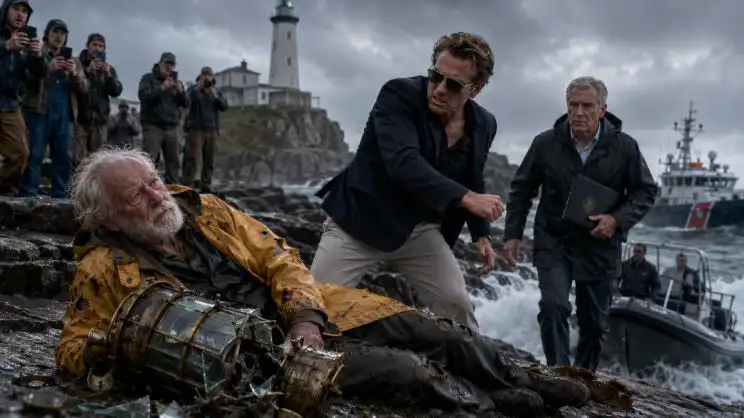
“Mr. Vale, you might want to read whose water he’s standing in.”
The harbor director’s voice cut through the wind.
For the first time all morning, Logan Pierce stopped smiling.
The bodyguards stopped laughing.
Even the demolition crew lowered their tools.
Silas Vale stayed on one knee on the wet rocks, one hand pressed against the place where Logan’s fist had split his mouth.
The old brass navigation lamp lay broken beside him.
Its glass was scattered across the stones like ice.
The tide kept reaching for it.
Logan looked at the sealed black folder in the harbor director’s hands and gave a nervous laugh.
“I don’t know what kind of little local-theater performance this is,” he said. “But I bought this land.”
The harbor director did not blink.
“You bought upland parcels from a holding company.”
Logan jabbed a finger toward the lighthouse.
“I bought the access road. I bought the beach frontage. I bought every rotten shack within two miles.”
Silas slowly stood.
His knees shook, but his eyes did not.
Logan saw that and hated him more for it.
“You’re done,” Logan snapped. “Old men like you don’t get to stand in front of progress.”
Silas wiped the blood from his mouth with the back of his sleeve.
“You keep using that word,” he said quietly. “Progress.”
Logan stepped closer again, trying to regain the audience.
There were workers behind him.
Surveyors.
Two security guards.
A real estate photographer.
Three tourists near the dunes.
A fisherman by the tide line.
And now half of them had phones pointed at him.
That bothered Logan more than the cruiser.
“Get those cameras down,” he barked.
Nobody moved.
The Coast Guard horn sounded again.
Low.
Heavy.
Final.
Logan turned toward the cruiser and shouted, “You people can’t just block my site.”
A Coast Guard officer stepped onto the dock.
“We can when your barges are anchored illegally in a protected navigation channel.”
Logan’s mouth tightened.
“My permits are filed.”
The harbor director opened the folder.
“Filed, yes. Approved, no.”
A few workers looked at one another.
One of Logan’s guards whispered, “Boss…”
“Shut up,” Logan hissed.
Then he turned back to Silas.
“You did this,” Logan said. “You sad old relic. You made some calls because you can’t accept that nobody needs your little light anymore.”
Silas looked toward the tower.
The lighthouse stood behind him, white paint peeling, iron balcony rusted, storm glass dark in the gray morning.
It looked old.
It looked tired.
But it did not look dead.
“No,” Silas said. “The ships still need it.”
Logan laughed too loudly.
“What ships? Nobody navigates by fairy-tale lanterns now.”
The fisherman by the tide line spoke up.
“My brother does.”
Logan spun on him.
“Did I ask you?”
The fisherman lowered his phone but kept recording.
“My brother pilots cargo through this channel. Fog comes in wrong, that light still matters.”
Logan sneered.
“Blue-collar superstition.”
That was when Silas finally bent down and picked up the broken lamp handle.
His hand was weathered.
Scarred.
Steady.
“This lamp belonged to my father,” he said.
Logan rolled his eyes.
“Here comes the sad story.”
Silas looked at the bodyguard who had smashed it.
“That lamp burned the night forty-two men came home from a hurricane because this tower stayed lit.”
The guard looked away.
Logan clapped slowly.
“How touching. Put that on a plaque in the lobby of my private club.”
Silas’s face did not change.
That calmness made the whole place feel colder.
The harbor director stepped between them.
“Mr. Pierce, this is no longer a private construction matter.”
Logan pointed at Silas.
“He’s trespassing.”
“No,” the harbor director said. “You are.”
The word landed hard.
Logan blinked.
“What did you say?”
The director held up the first page.
“The lighthouse foundation, the surrounding reef, the submerged approach channel, the working easement, the emergency navigation lane, and the water rights tied to this point are held under a permanent coastal title.”
Logan looked annoyed.
Then impatient.
Then less certain.
“By the state?”
“No.”
Logan laughed again, but this time it cracked.
“By some charity?”
“No.”
The director turned the folder slightly so Logan could see the name.
Marlowe Atlantic Maritime Trust.
Logan stared at it.
For a second, it meant nothing to him.
Then one of his project managers went pale.
“Logan,” the man whispered.
Logan snapped, “What?”
The project manager swallowed.
“Marlowe Atlantic owns the dredging leases. The pier rights. Most of the private tug contracts from Maine down to Charleston.”
Logan’s face stiffened.
“So?”
The harbor director looked at Silas.
Silas said nothing.
The director continued.
“Marlowe Atlantic also owns the holding company that leased you the fill barges currently sitting in the channel.”
Logan’s sunglasses slipped slightly down his nose.
He pushed them back up.
“That’s impossible.”
“No,” the director said. “It’s contractual.”
A woman near the dunes whispered, “Oh my God.”
Logan looked from the folder to Silas.
Then back again.
“You?”
Silas held the broken lamp handle at his side.
Logan’s voice dropped.
“You’re Marlowe?”
Silas said, “My mother’s name.”
The wind moved through the grass.
Nobody spoke.
For twenty years, people on that coast had seen Silas Vale as the lonely old lighthouse keeper.
He bought his own coffee at the bait shop.
Fixed the steps himself.
Patched the roof himself.
Carried storm lanterns through rain like any stubborn old man who refused to leave the past behind.
Most locals knew he had money somewhere.
Nobody knew how much.
Nobody knew that when his father died, Silas inherited a broken shipping line, rebuilt it quietly, bought distressed docks during recessions, saved three harbor towns from bankruptcy, then placed almost everything under his mother’s old family name.
Marlowe Atlantic did not need billboards.
It moved freight.
It owned slips.
It held channel rights.
It leased tugboats.
It controlled enough East Coast maritime infrastructure that port executives returned its calls before lunch.
Silas never cared about the boardroom.
He cared about the lighthouse.
Because on a winter night in 1968, that light had brought his father home.
And because his wife, Eleanor, had asked him one thing before she died:
“Keep it burning for the ones still out there.”
So he did.
Every night.
Even when automation came.
Even when developers circled.
Even when Logan Pierce arrived with glossy renderings of infinity pools, cigar lounges, and a members-only dock called “The Beacon Club.”
Logan had never seen a lighthouse.
He saw a brand.
A backdrop.
A way to sell rich men the feeling that history belonged to them.
Three months before the punch, Logan’s company had sent letters.
First polite.
Then threatening.
Then cruel.
“Vacate within ten days.”
“Remove personal property.”
“Failure to comply may result in forced removal.”
Silas read every letter at the kitchen table under a yellow lamp.
He did not answer any of them.
Instead, he handed copies to his coastal attorney.
Then to the harbor authority.
Then to the environmental office.
Then to the Coast Guard liaison who still called him “sir” because Silas had once paid for search-and-rescue upgrades after a storm took two boats.
Logan thought silence meant weakness.
That morning, he arrived ready to make a show of power.
He wanted cameras there.
His own photographer had been told to capture the “before” moment.
The old keeper walking away.
The tower marked for demolition.
The first swing of the hammer.
Logan had even brought champagne in the trunk of his sports car.
“What people need to understand,” he told his crew before Silas appeared, “is that resistance is mostly theater. You humiliate one holdout, and the rest fold.”
Then Silas came down the lighthouse steps in his torn raincoat.
The raincoat was older than half the men there.
Logan smiled at him like a man greeting a stain on his carpet.
“Pack up.”
Silas said, “No.”
That was all.
No speech.
No drama.
Just no.
Logan’s jaw tightened.
“You are standing in the way of a $90 million coastal redevelopment.”
Silas looked at the ocean.
“You are standing in the way of a shipping channel.”
Logan laughed.
Then he gave a little nod.
His guard moved first.
He knocked the old lamp from Silas’s hand.
When it hit the rocks and shattered, something changed in the air.
The tourists stopped murmuring.
The crew stopped pretending not to watch.
Silas stared at the broken lamp like the body of an old friend.
Logan mistook grief for surrender.
So he stepped forward and punched him.
Now, with the cruiser in the water and the black folder open, that punch lived on every phone around them.
The harbor director turned to Logan.
“Your demolition activity is suspended immediately.”
Logan’s eyes flashed.
“You can’t suspend a private project.”
The director nodded toward the environmental officer climbing from the second boat.
“She can.”
A woman in a navy jacket stepped onto the rocks with a tablet in her hand.
“Logan Pierce?”
Logan’s mouth twitched.
“Who are you?”
“Regional Environmental Compliance.”
She looked at the smashed lamp, the oil streak in the tide pool, then at the equipment staged near the protected reef.
“We have an emergency stop-work order.”
Logan scoffed.
“For a broken lamp?”
“For illegal staging of heavy machinery on protected coastal rock, unpermitted runoff discharge, falsified sediment controls, and attempting to alter a navigational shoreline without final authorization.”
His project manager closed his eyes.
Logan turned on him.
“You said we were clear.”
The man whispered, “You told us to start before the final review.”
Logan’s face went red.
“Not here.”
The environmental officer continued.
“Also, your temporary outflow pipe behind the dunes has been tested.”
Logan froze.
Silas looked up.
The harbor director’s expression hardened.
The officer said, “High levels of concrete slurry, fuel residue, and construction solvent were found entering the marsh inlet.”
A tourist gasped.
The fisherman said, “That’s where the kids crab.”
Logan pointed at him again.
“Shut your mouth.”
The officer looked at Logan’s finger.
“Add witness intimidation to the report if you’d like.”
That finally quieted him.
Then the Coast Guard officer spoke.
“Your barges are to remain anchored. No movement until inspected.”
Logan snapped, “Those barges are mine.”
Silas shook his head.
“No, Mr. Pierce.”
Logan slowly turned.
Silas’s voice stayed gentle.
“You leased them through Harborline Equipment LLC.”
“So?”
Silas looked at the folder.
“I own Harborline.”
The silence after that was almost beautiful.
Then one of Logan’s guards muttered, “Oh, man.”
Logan’s lips parted.
Silas continued.
“Your lease has an environmental compliance clause. Any unlawful discharge, unauthorized channel obstruction, or use connected to unpermitted demolition triggers immediate default.”
The harbor director handed Logan a second document.
“Notice of default.”
Logan did not take it.
The paper flapped in the wind.
The director held it there anyway.
“Your equipment access is terminated. Your security deposit is forfeited. Your company is responsible for inspection, recovery, and remediation.”
Logan’s face had gone from red to gray.
“You can’t do that.”
Silas said, “You signed it.”
A worker behind Logan whispered, “We all told him not to rush this.”
Logan spun around.
“You’re fired.”
The worker laughed once, bitterly.
“Company’s probably dead by lunch.”
That made Logan move.
He grabbed the folder from the harbor director’s hand.
The Coast Guard officer stepped in immediately.
“Careful.”
Logan looked at the phones.
So many phones.
The humiliation he had planned for Silas had turned around and found him.
“Everybody stop recording!” he shouted.
Nobody stopped.
Silas stepped toward the smashed lamp.
Logan saw him and lunged.
Maybe he wanted to grab him.
Maybe he wanted to scare him.
Maybe he could not stand seeing the old man still upright.
The Coast Guard officer blocked him.
“Mr. Pierce, step back.”
Logan’s voice broke.
“He baited me.”
Silas looked at him.
“No. You arrived with men, machines, threats, and a camera.”
The fisherman said, “And you punched him.”
The woman near the dunes added, “We all saw it.”
One of Logan’s own photographer’s hands trembled around the camera.
Logan pointed at him.
“Delete everything.”
The photographer said, “No.”
Logan stared at him.
“What?”
The young man swallowed.
“I’m not catching a charge for you.”
That was the exact moment Logan understood the crowd had shifted.
Not just against him.
Away from him.
People like Logan survive because others keep pretending not to see.
But everyone had seen.
The shove.
The smashed lamp.
The punch.
The threats.
The illegal pipe.
The folded permits that were not permits at all.
The environmental officer handed Logan another paper.
“Civil penalties will be calculated after full assessment. Based on current evidence, exposure may exceed eight figures.”
The project manager sat down on a rock.
Logan whispered, “Eight figures?”
“And criminal referral is possible if falsified filings are confirmed.”
Logan looked at Silas with naked hatred.
“You ruined me.”
Silas’s face softened, but not with pity.
“No,” he said. “I gave you three months of letters from my attorney. You ignored them.”
“You hid behind shell companies!”
“I protected working harbors from men like you.”
Logan laughed, desperate now.
“You think you’re noble? You’re just another rich man.”
Silas nodded once.
“I am.”
That answer surprised everyone.
Silas looked at the lighthouse.
“I have been rich for a long time. Rich enough to know money does not make a man important.”
Then he looked back at Logan.
“You thought money gave you permission to strike an old man.”
Logan said nothing.
Silas lifted the broken lamp handle.
“This gave better guidance than you ever will.”
The harbor director’s jaw tightened.
“Mr. Vale, do you wish to file a formal complaint for assault and property destruction?”
Logan’s eyes widened.
“Assault? Come on.”
Silas touched his split lip.
“Does it look imaginary?”
One of the guards took a step backward.
The other stared at the ground.
The Coast Guard officer said, “Local police are on the way.”
Logan suddenly tried charm.
“Silas. Listen.”
The old man looked at him.
Logan forced a smile.
“We got heated. I respect history. I do. We can work this out privately.”
A few people laughed.
Not loudly.
But enough.
Logan heard it.
His face tightened again.
“You people have no idea what I can do.”
The harbor director said, “At the moment, Mr. Pierce, you can cooperate.”
Within twenty minutes, two sheriff’s vehicles rolled down the access road.
By then the story had already left the rocks.
The fisherman’s video had been uploaded.
The tourist’s clip had been shared.
The photographer had sent raw footage to his own cloud account before Logan could threaten him again.
By noon, Logan Pierce’s investors were calling.
By two, his largest lender froze the next draw.
By five, the environmental agency announced an indefinite stop-work order pending investigation.
By the next morning, three creditors filed emergency motions.
By the end of the week, Logan’s resort company was not “pausing development.”
It was collapsing.
The fines came first.
Then the lawsuits.
Then the canceled contracts.
Then the discovery that his team had moved equipment at night to avoid inspection.
Then the emails.
There are always emails.
One email said, “Start dumping before the marsh people notice.”
Another said, “Old keeper has no legal leverage. Push him hard.”
Another, from Logan himself, said, “Make him look unstable if he resists.”
That one ended his public sympathy.
His partners ran.
His board resigned.
His luxury office emptied in two days.
His red sports car disappeared from the marina, then appeared three weeks later in a creditor’s storage lot.
Logan tried to claim he was the victim of a coastal old-boys network.
But the videos ruined him.
America has a soft spot for old men who keep lights burning in storms.
It has far less patience for rich men who punch them over a private club.
The assault case moved quietly.
The environmental case did not.
That one became a warning.
The state used Logan’s project as an example of what happens when developers treat protected shorelines like blank paper.
His company entered bankruptcy.
The private club never broke ground.
The dunes were fenced off for restoration.
The illegal pipe was removed.
The marsh began to heal.
As for Silas, he spent two nights in the hospital because his daughter insisted.
He hated every minute.
“They gave me socks with rubber dots,” he told the nurse, offended.
His daughter, Rebecca, stood beside the bed with her arms crossed.
“You got punched by a man half your age.”
Silas looked out the window.
“He had poor form.”
She tried not to smile.
“Dad.”
“He led with anger. That makes a man sloppy.”
“You are not allowed to turn an assault into a boxing lesson.”
Silas sighed.
“I’m fine.”
“No,” she said. “You are stubborn.”
He looked at her then.
She had her mother’s eyes.
That could still quiet him.
Rebecca touched the cracked lamp handle on the bedside table.
“They broke Grandpa’s lamp.”
Silas nodded.
For the first time, his face looked old.
“Only the glass.”
After he came home, something unexpected happened.
People started arriving at the lighthouse.
Not crowds.
Just one or two at a time.
A retired deckhand brought a coil of new rope.
A schoolteacher brought her class and had them write thank-you notes.
The fisherman brought a restored lantern lens he had found at an estate sale.
A Coast Guard officer came off duty with a coffee and said, “My father followed that light in ’92.”
Silas accepted every visit awkwardly.
He was not a man built for praise.
He preferred engines, tide charts, quiet weather, and black coffee.
But on the first Friday after the stop-work order, the harbor held a small ceremony at dusk.
Not fancy.
No stage.
No ribbon.
Just people standing below the tower with coats zipped against the wind.
The harbor director handed Silas a new brass lamp housing, made from salvaged metal from an old pilot boat.
Silas ran his thumb along the polished edge.
Someone had engraved Eleanor’s name on the inside.
He had to look away.
Rebecca slipped her hand into his.
“You okay?”
“No,” he said.
She squeezed his hand.
“That’s allowed.”
At sunset, Silas climbed the lighthouse stairs.
Slowly.
The whole crowd watched the windows as his shadow moved upward.
At the top, he opened the old lantern room door.
The wind tried to push him back.
It always did.
He set the restored lamp in place.
For a moment, he rested one hand on the frame.
He thought of his father.
He thought of Eleanor.
He thought of every captain who had ever watched for that beam through fog and fear.
Then he lit it.
The lighthouse glowed.
Soft at first.
Then stronger.
The beam swept across the water, over the reef, past the channel markers, and out toward the darkening Atlantic.
Down below, the crowd cheered.
Silas did not wave.
He simply stood in the lantern room with wet eyes and let the light do what it was made to do.
Months later, Logan Pierce was seen in a different state, leaving a courthouse through a side door while creditors waited outside.
No sunglasses.
No sports car.
No bodyguards laughing behind him.
Just a man trying not to be recognized.
The Beacon Club existed only as a dead rendering on an abandoned website.
The lighthouse still stands.
Ships still pass.
And every night, when fog rolls in low and thick, Silas Vale climbs the stairs and lights the tower.
Not because he has to.
Because some things should not be sold to the loudest man in the room.
Some men think owning land means owning history.
Some men think money gives them the right to push old people aside.
But sometimes the quiet man in the torn raincoat is the one who owns the tide beneath your feet. ⚓
So pick a side:
Logan got exactly what he deserved.
Silas should have crushed him even harder.
Disclaimer: Mention of any brand or trademark is for identification only and does not imply partnership or endorsement
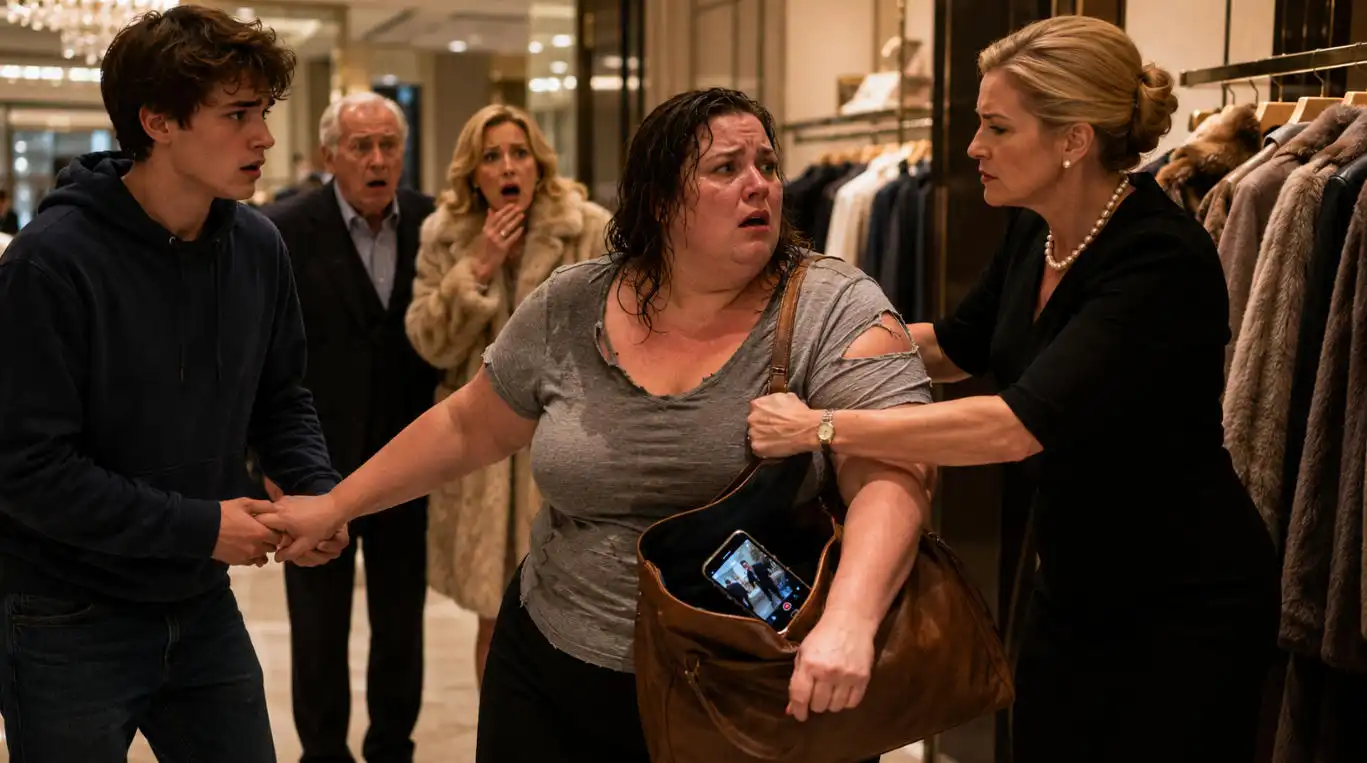
Maggie Was Covered In Shampoo, Slapped, And Laughed At In Front Of Rich Parents… Until One Quiet Phone Call Changed EVERYTHING
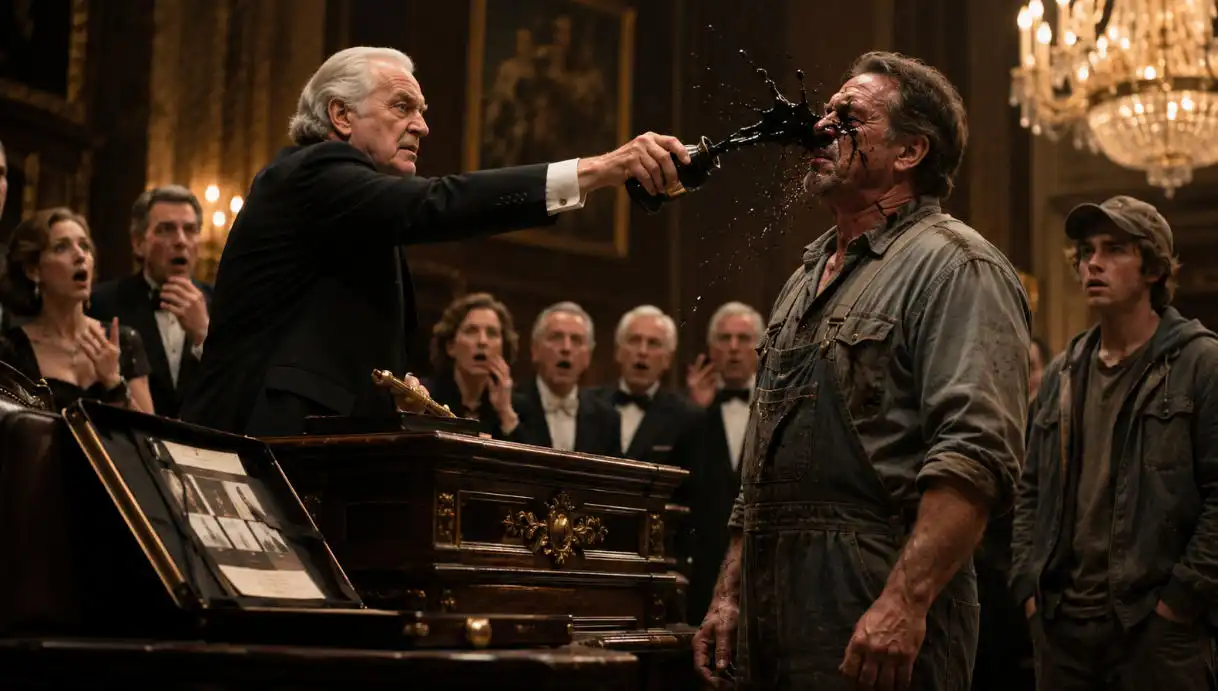
A Blue-Collar Dad Was DRAGGED Out Of A D.C. Private School Auction By A Snobby Auctioneer… But They Had NO IDEA Who He Really Was 😳

A Palm Beach Tennis Star HUMILIATED a Quiet Older Man in Front of the Whole Club… Then He Saw What Norman’s Attorney Filed That Morning