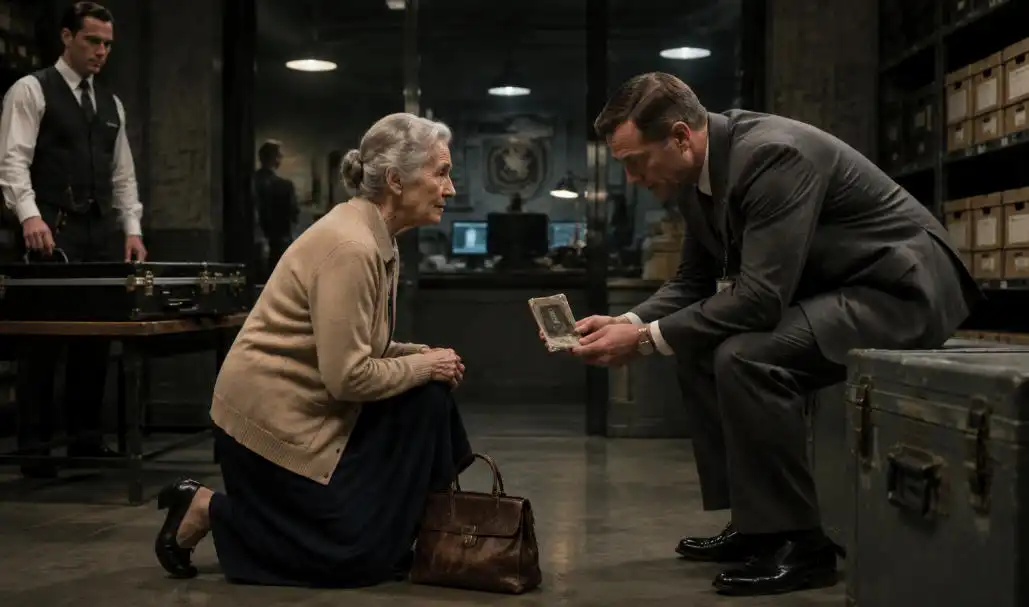
Daniel straightened, kept the damaged photograph secured in both hands, turned his NSA badge toward Martin, and ordered him to step away from the polished black document case.
Martin snapped the case shut instead.
“This is a routine deaccession,” he said. “Those materials were approved for disposal. I can show you the paperwork.”
“Step away from the case.”
“You’re interrupting an authorized transfer.”
Daniel did not raise his voice.
“Then the authorization will be easy to verify.”
Eleanor remained on her knees beside her worn leather handbag. The cracked sleeve around Thomas’s photograph trembled slightly in Daniel’s hands, but he held it as carefully as if it were a folded flag.
Martin glanced toward the glass monitoring office.
Then he looked down at Eleanor.
“This is what happens when civilians wander into restricted work,” he said. “She brought trash into an active inventory review.”
Eleanor felt the words land almost as hard as his shoe had.
For fifty years, every office had given her a different version of the same answer.
Missing file.
Closed record.
No confirmed recovery.
Nothing further available.
But Martin was the first man whose job was to protect those records who had looked directly at Thomas’s face before grinding it into the floor.
Daniel shifted the photograph into his left hand and pressed a control beside the monitoring-office door.
The red light stopped blinking and remained solid.
A lock clicked somewhere behind Martin.
“What did you just do?” Martin asked.
“Preserved the room and the security system.”
Martin’s mouth tightened.
“You don’t have authority over this archive.”
Daniel held up his badge again.
“I’m conducting a classified-material security inspection. Until the chain of custody is established, nobody removes anything.”
The private collector near the gray military crate slowly lifted both hands and stepped away from the open container.
Martin pointed at him.
“Stay where you are.”
That was the first moment Eleanor saw the room stop belonging to Martin.
Daniel pointed toward the glass office.
“Sir, remain beside the crate. Martin, place your keys on the desk.”
Martin gave a short laugh.
“You’re treating an administrative mix-up like espionage.”
“No,” Daniel said. “I’m treating an unlogged case of military records like an unlogged case of military records.”
He motioned for Eleanor to stand, but her legs would not cooperate. Daniel moved no closer until she nodded. Then he offered his forearm without letting go of the photograph.
She rose slowly.
Up close, she could see the damage clearly. Thomas’s face was creased through one cheek. The plastic sleeve had split. The torn corner exposed the narrow black seam she had never noticed before.
Daniel followed her eyes.
“Did you know that was there?”
“No.”
“Has anyone opened the backing?”
“No.”
Martin scoffed.
“It’s old mounting paper. She probably repaired it herself and forgot.”
Eleanor turned toward him.
“My husband sent me that photograph three days before his last flight.”
Martin’s expression did not change, but his fingers curled around the handle of the black case.
Daniel noticed.
“Hands off.”
Martin released it.
Eleanor looked at the metal shelves surrounding them. Rows of labeled boxes. Flight logs. Unit photographs. Letters from men who had not known which words would be their last.
“My husband trusted this place to remember him,” she said.
Martin answered without looking at her.
“My job is to manage records, not comfort widows.”
Daniel’s face hardened.
Eleanor finally understood why the insult hurt more than all the unanswered letters she had mailed over the years. Martin had not merely refused to help.
He had used the authority of remembrance to decide that Thomas’s life was worthless.
Daniel guided her to a wooden chair beside the central desk.
“Mrs. Whitaker, I need to verify one thing before anyone touches that seam.”
He entered the glass office, keeping the photograph visible through the wall. Eleanor watched him sign in to a secure terminal, open the archive movement registry, and type the number printed on the seal attached to the black case.
A warning box appeared on the screen.
Even from the chair, she could see the red bar.
Daniel returned to the doorway.
“There is no approved deaccession order for that case.”
Martin immediately reached for a clipboard.
“The registry hasn’t updated. We had a system outage.”
Daniel looked at the papers without taking them.
“The authorization number is not pending. It does not exist.”
The collector took another step away from Martin.
Martin looked from the man to the secured front entrance.
Daniel returned to the terminal and selected the preserved camera feed.
On the monitor, Martin appeared from twenty minutes earlier, unlocking the gray military crate. He removed several sealed file packets, placed them in the polished black case, and turned their labels away from the camera.
The collector handed him a thick envelope.
Daniel froze the image.
That did not explain the seam inside Thomas’s photograph. It did not tell Eleanor where her husband had fallen.
But it proved the first truth.
Martin had not been clearing worthless duplicates.
He had been trying to move military records out of the archive without authorization.
Daniel used the wall phone.
“Base security, seal the archive entrances. One individual is to be detained pending transfer of evidence. Preserve all access logs from today.”
Martin’s face drained of color.
Then, just as quickly, his posture changed.
He lifted his hands.
“All right,” he said. “Let’s not turn this into theater. My disposal paperwork is in the rear records room. I’ll get the original copy.”
Daniel blocked the central aisle.
“You’ll stay here.”
“You just said you wanted verification.”
“I said I wanted the records verified. Not retrieved by you.”
Martin looked toward the collector, toward Eleanor, and finally toward the rear service corridor.
A buzzer sounded at the front entrance as base security arrived.
Martin moved.
He shoved the rolling archive ladder into the aisle. It struck a metal shelf and blocked Daniel’s path for half a second.
That was enough for Martin to run.
He cut behind the gray crate and sprinted for the rear door, his key ring already in his hand.
Eleanor heard Daniel shout, “Stop!”
The rear handle turned once.
Then the door lock engaged with a heavy mechanical snap.
Martin pulled again. He jammed one key after another into the plate, but the security light above the door had turned red.
Two base security officers entered from the front and crossed the room. Martin tried to tell them Daniel had exceeded his authority.
Neither officer argued.
They removed the key ring from his hand and led him away from the exit.
As he passed Eleanor, Martin looked at the photograph.
“That thing is nothing,” he said. “You’re destroying your own memories over a piece of damaged film.”
Daniel answered before Eleanor could.
“No one said it was film.”
Martin stopped walking.
The officers tightened their hold and continued toward the front.
Eleanor stared at him until he disappeared beyond the shelves.
Then she looked at Daniel.
“Is it film?”
“I don’t know yet,” he said. “And I won’t pretend I do.”
That answer made her trust him more than certainty would have.
He set a clean evidence mat on the central desk and placed the cracked sleeve on it.
“Your husband’s name appeared in a partial mission index recovered during an archive review,” Daniel said. “The entry referred to an ‘image carrier’ connected to his final flight. The carrier itself was never found.”
Eleanor touched the edge of the desk.
“Then why did no one come to me?”
“The index was classified, incomplete, and filed under a mission number that did not match the public loss report. It was only connected to Captain Whitaker recently.”
“Fifty years recently.”
Daniel lowered his eyes.
“Yes, ma’am.”
She had imagined this moment so many times.
Someone in uniform would arrive with a clean answer. A location. A date. A final sentence.
Instead, she stood in a dim archive beside a ruined photograph while a stranger told her that the government had lost not only her husband, but the clue he had sent home.
Daniel pointed to the writing on the back.
“May I read it?”
Eleanor nodded.
He turned the photograph over without removing it from the cracked sleeve. Beneath the faded date, Thomas’s handwriting remained steady:
Keep this safe until the right person asks.
Below it sat a string of tiny marks Eleanor had always believed were damage from the mail.
Daniel leaned closer.
“That is not random.”
“What is it?”
“A recognition sequence. I can verify the format, not the contents.”
He looked at the black seam.
“To learn more, the backing must be opened.”
Eleanor’s throat tightened.
“Can you do it without tearing the picture?”
“Possibly. But the adhesive is fifty years old, and Martin’s heel fractured the corner. A conservator might save more of it, but moving it now could compromise whatever is inside. The safest evidence procedure is to open it here, under camera, with you present.”
“Safest for the evidence,” she said.
Daniel did not avoid the question.
“Yes.”
“And the photograph?”
“I can’t promise.”
For half a century, Thomas had remained twenty-nine years old in that picture.
His cap sat slightly crooked. One eyebrow lifted as if Eleanor had just said something that amused him.
Their last argument had been about a broken kitchen window. Their last phone call had ended too quickly because he was due at briefing.
She had spent fifty years wishing she could recover one more ordinary minute.
Now the last clear image of him stood between memory and truth.
Daniel placed a small evidence tool beside the mat but did not touch it.
“The choice is yours.”
Eleanor picked up the photograph.
The cracked sleeve made a soft sound in her hands.
She remembered the day it arrived. She had kissed Thomas’s face through the plastic. She had carried it through three moves, two hurricanes, and every anniversary no one else remembered.
Martin’s shoe had already split the corner.
But Thomas had not written, Keep this perfect.
He had written, Keep this safe.
Eleanor slid one fingernail beneath the loosened seam.
Daniel said, “Mrs. Whitaker, once you begin, I’ll record that you opened it voluntarily.”
She looked at him.
“He protected this for fifty years.”
“Yes.”
“Then I won’t make him wait another day.”
She tore the backing.
The sound was small.
It felt enormous.
Inside lay a narrow strip of dark microfilm wrapped in a thin protective layer. Beside it was a tiny paper band marked with the same recognition sequence written on the back of the photograph.
Daniel did not touch either item with his bare hands. He called one of the security officers back, stated the time aloud, and had the officer witness as he placed the film and paper band into separate evidence sleeves.
Eleanor held what remained of the photograph.
Thomas’s face was creased, but still visible.
Daniel studied the paper band through the clear sleeve.
“This prefix matches the mission index.”
“Does it say where he is?”
“Not yet.”
“Does it prove he was on that flight?”
“It proves the item is tied to the classified mission record that named him. That is the second fact. The rest has to be authenticated.”
Eleanor nodded, though disappointment pressed against her ribs.
Daniel seemed to understand.
“This is not the answer,” he said. “But it is the first evidence I’ve seen that can lead to one.”
The archive remained sealed for the rest of the day.
Before Eleanor left, Daniel showed her the preserved footage again. The security team had also recovered the envelope from the collector, copied the access logs, and inventoried the contents of the black case.
Several packets had been removed from restricted holdings without valid transfer orders.
Martin’s claim of routine disposal collapsed piece by piece.
The photograph and film left in separate secure containers. Eleanor signed the chain-of-custody form with a hand that still shook.
Daniel gave her a copy of the receipt.
“What happens now?”
“Military records specialists will authenticate the film. The FBI will review the attempted transfer and the archive evidence. Captain Whitaker’s mission record will be reopened if the film matches the index.”
“And Martin?”
“He is being detained for questioning now. What happens formally will depend on the evidence.”
Eleanor looked toward the empty space beside the gray crate.
“He tried to sell their lives by the box.”
Daniel did not soften it.
“Yes.”
That afternoon, FBI agents arrived after reviewing the preserved footage, the unlogged materials, the collector’s payment envelope, and Martin’s access records.
Base security transferred custody of Martin at the archive.
Eleanor did not stay to watch him leave.
She had waited fifty years for Thomas.
She would not give Martin one more minute.
Nine days later, Daniel came to her house with an Air Force records officer.
He did not bring a polished speech.
He brought copies of authenticated findings and sat at Eleanor’s kitchen table beneath the window Thomas had once promised to repair.
“The microfilm is genuine,” the records officer said. “It contains mission identifiers, encrypted coordinates, and a dated intelligence sequence matching Captain Whitaker’s final reconnaissance assignment.”
Eleanor gripped the edge of the table.
“Coordinates to what?”
“To the final flight path and emergency descent area.”
“His aircraft?”
“We believe so. A recovery team is being sent to the location.”
“Believe?”
The officer nodded.
“We will not tell you more than the evidence proves.”
Eleanor glanced at Daniel.
He had taught them that sentence, she thought.
Or perhaps honest people arrived at it on their own.
The officer continued.
“The public record listed Captain Whitaker as missing after a routine reconnaissance loss. The classified record shows that his aircraft went down while he was carrying intelligence considered critical at the time. The film appears to have been a protected backup copy.”
“Why put it in our photograph?”
Daniel answered.
“The recognition sequence told an authorized officer what it was. A family photograph was unlikely to be examined or seized as an official packet. He placed the risk on the one object he believed you would never discard.”
Eleanor looked across the kitchen at the damaged sepia picture, now resting inside a temporary archival sleeve.
“He knew me,” she whispered.
The recovery took seven weeks.
Each update was careful.
Search area confirmed.
Wreckage located.
Aircraft identification matched.
Personal effects found.
Human remains recovered and transferred for identification.
No one used the word closure until the identification was complete.
When the call finally came, Eleanor sat on the edge of her bed with the phone pressed to her ear.
The officer said, “Mrs. Whitaker, we have confirmed Captain Thomas Whitaker.”
For years she had imagined that certainty would feel like a door opening.
It felt like a door gently closing after a long storm.
She cried for the young man in the crooked cap.
She cried for the children they never had, the house repairs he never finished, and the gray hair he never grew.
And she cried because, at last, she knew where to carry her grief.
Martin’s case moved on a different timetable.
The preserved surveillance showed the private transaction. The access logs showed that he had entered restricted storage outside approved work orders. The inventory revealed military materials placed in the black case without transfer authority.
Messages recovered through the investigation tied the meeting to a planned private sale.
His attempt to run through the rear exit became part of the record, not the center of it.
The center was what he had done before anyone caught him.
He had used his position to remove and sell property he was responsible for protecting.
Within weeks, the base removed him from his archive post. The FBI formally charged him in connection with the theft and attempted unlawful sale of military property, as well as the unauthorized possession and transfer of classified materials found in the case.
The collector cooperated and returned additional items obtained through earlier dealings. Each recovered box was reviewed and restored to government custody.
Eleanor read the official notice once.
Then she folded it and placed it in a drawer.
Martin had feared losing his title, his access, his buyer, and his freedom.
He lost them because of the records he thought no one would defend.
Months later, the Air Force scheduled Thomas’s funeral with full military honors.
The morning was clear and cool.
Eleanor stood beside the flag-draped casket as the honor guard moved with slow, precise care. Daniel stood several rows behind her. He did not come forward.
He had done what he came to do.
The rifle salute sounded across the cemetery.
Eleanor did not flinch.
For fifty years, silence had been the cruelest part of Thomas’s disappearance. Now each sharp report acknowledged that he had served, that he had died, and that he had not been forgotten.
An officer folded the flag into a tight triangle and placed it in her hands.
“On behalf of a grateful nation,” he said, “we honor Captain Thomas Whitaker’s service and sacrifice.”
Eleanor held the flag against her chest.
In her other hand was the repaired sepia photograph. A military conservator had stabilized the torn backing and protected the creased image in a new clear sleeve.
The damage remained visible.
No one had tried to erase what had happened.
Thomas still wore his crooked cap.
His eyebrow still lifted.
Eleanor looked from the photograph to the casket.
“You were late,” she whispered.
Then she smiled through her tears.
“But you came home.”
FINAL ENGAGEMENT
Should Eleanor have protected the photograph as it was—or was she right to tear it open for the truth?
Disclaimer: Mention of any brand or trademark is for identification only and does not imply partnership or endorsement