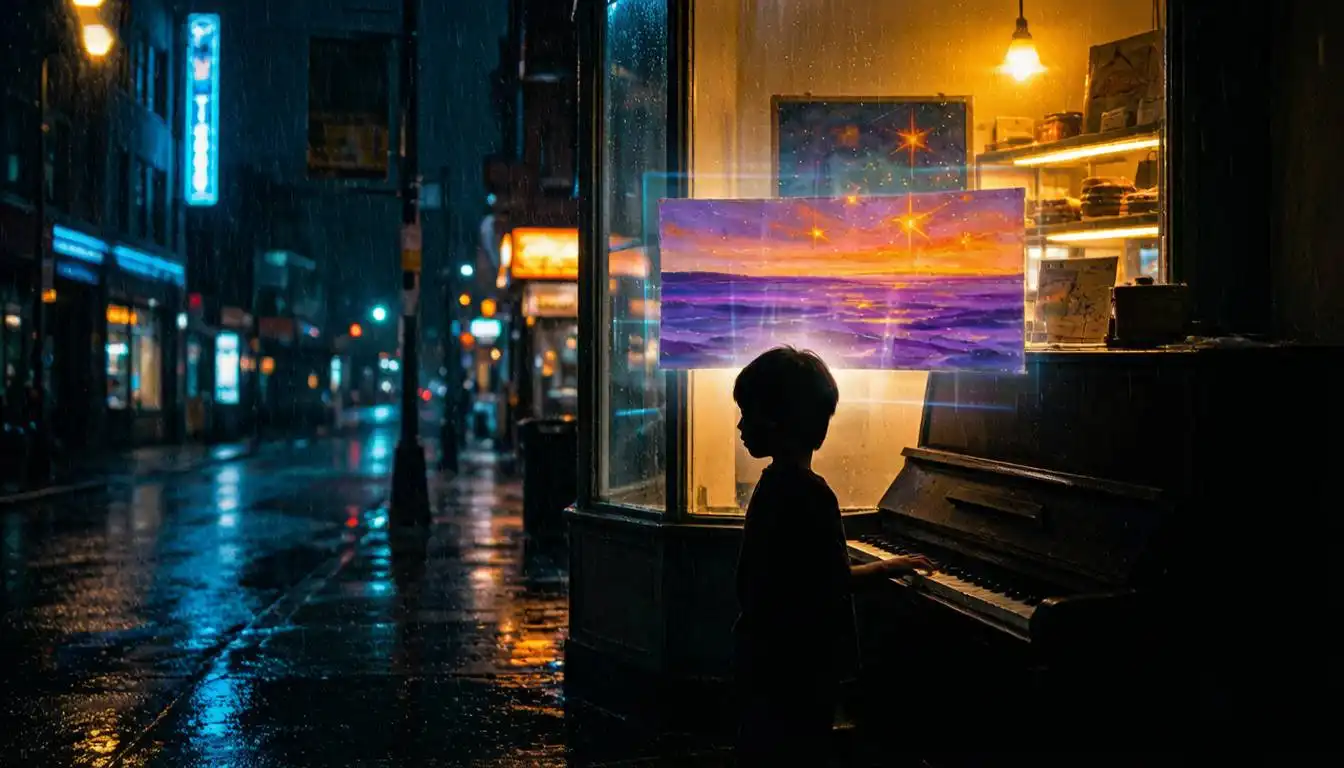
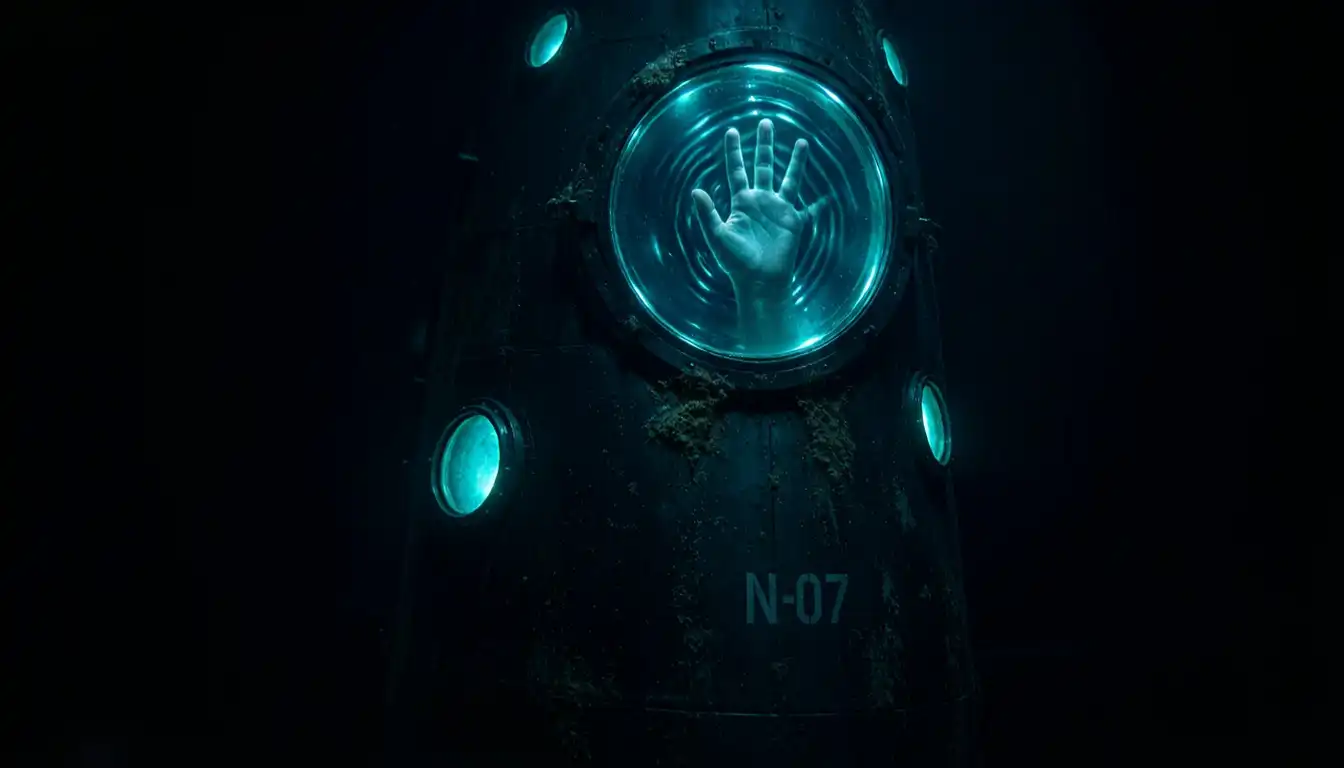
The nights in Brooklyn have a particular sound. Not the subway rumble. Not the street sirens. Not the reggae music from the neighbor's apartment. Something subtler — water flowing through radiator pipes, the vibration of a refrigerator compressor starting up, the muffled cough of the old man upstairs. These sounds fit together like puzzle pieces, embedding themselves into the fabric of the dark, assembling the breathing rhythm of this aging apartment building. Thomas Lin stood at the kitchen window, holding a half-cup of cold coffee. But his gaze passed through the fire escape of the building across the street and settled on the Manhattan skyline in the distance. Those skyscrapers glowed with countless lit windows, like ornaments on a giant Christmas tree. His daughter Aria had been lying in her room for forty minutes now. By all logic, she should be asleep. But Thomas knew she wasn't. As expected, bare feet padded across the floor behind him. "Daddy." Aria stood in the shadow of the hallway, wearing her dolphin-print pajamas, her hair mussed as if she'd just walked out of a storm. "Aria, you should be sleeping." "The submarine is waiting for me," she said. Thomas sighed and put down the coffee cup. This was the eighth time he'd heard this. At first he'd assumed it was just ordinary childhood fantasy — what child hasn't dreamed of a submarine? At her age, he'd dreamed of riding whales across the Pacific. But Aria's seriousness was beyond normal range. She began to describe the submarine's interior in detail. "There are twelve buttons on the control panel. The red one is sonar. The blue one is power switching. The seat is leather, but there's a crack in the cushion, patched with silver tape." Aria spoke with her eyes closed, as if recalling a place as real as any she'd ever been. "There are jellyfish outside the window. Pink and purple ones, like someone pouring a rainbow." Thomas found this... unusual. He was a marine biology researcher at the American Museum of Natural History, working with deep-sea organisms every day. But the bioluminescence range of jellyfish is ultraviolet to blue-green — never pinkish-purple — unless it was a species never before documented by human eyes. "What color is the submarine?" he asked cautiously. "Deep blue, like the back of a whale. It has a number on it — N-07." Thomas's heart stopped. N-07. The designation of a deep-sea exploration project he'd participated in during his doctoral research: Nautilus-07, a scientific expedition to the Mariana Trench. Aria could not possibly know this number. He had never mentioned that thesis to her, and the old photographs in his study had long been packed away in attic boxes. "How do you know that number?" "It's written on the sub," Aria said matter-of-factly, then turned and ran back to her room. "I need to sleep. The sub said there's a very important place to go tonight." Thomas stood in the hallway, silent for a long time.
Thomas Lin was thirty-four years old, an associate researcher at the Columbia University Marine Institute. His field was deep-sea chemosynthetic ecosystems — organisms that thrived around hydrothermal vents without sunlight. The job sounded cool to outsiders, but in reality, it meant endless data analysis, paper writing, and grant applications. Eight years ago, he'd participated in the Nautilus-07 expedition. It was a forty-five-day survey of the Western Pacific, targeting several hydrothermal vent fields in the southern Mariana Trench. Thomas was a postdoctoral fellow at the time, responsible for operating the Remotely Operated Vehicle (ROV) for biological sampling. On the thirty-second day, something happened. The task was simple: dive to 7,300 meters and collect mussel samples around a vent field. After about three hours of work, Thomas noticed something in the shadows on the right side of the screen — a geometric shape more regular than the vent chimney structures. "Pan the camera thirty degrees right," he told the operator. The image slowly rotated. White smoke from the vents billowed in the searchlights — and then — nothing. Only brown basalt and scattered deep-sea anemones. "What did you see?" the chief scientist asked. "Nothing, probably just my eyes playing tricks." But Thomas knew it wasn't a trick. The shape had seared itself into his memory — the unmistakable silhouette of a submarine. Not the ROV they had deployed. Much larger. Its surface had a silvery-gray sheen. It sat there, like a sleeping whale, before the vent smoke swirled and erased it. Thomas couldn't sleep after that day. He reviewed the video footage endlessly, but the raw data from that segment had conveniently been lost due to a "storage error." The chief scientist said prolonged deep-sea environments caused hallucinations. His colleagues joked that the pressure had gotten to him. But Thomas knew what he'd seen. He wrote it in his personal journal and never mentioned it to anyone again. Later, he married, and Aria was born. His wife died in a car accident three years after Aria's birth. He raised their daughter alone, spending his days at the institute and his evenings cooking dinner, helping with homework, and reading bedtime stories. Life flowed like a gentle river — occasional ripples, but mostly calm. Until Aria started talking about the submarine.
Thomas began to take Aria's ramblings seriously on the fifth day. That evening, after tucking her in, he was about to return to his study to continue writing a paper when Aria suddenly opened her eyes and said, in a surprisingly serious tone: "Daddy, do you know why you can only see the submarine at night?" "Because it's dark?" Thomas ventured. "No. During the day, my consciousness is 'focused' — I have to go to school, do homework, talk to classmates. At night, my consciousness relaxes. It starts to 'diffuse.' Like ink spreading in water. The submarine moves fastest when my consciousness is most diffused." Thomas froze. He was a natural science researcher, but this sounded like... a child's intuitive description of quantum decoherence theory. Consciousness observation leading to wave function collapse — these were fundamental concepts of quantum mechanics. An eight-year-old with no physics background — how could she use such an apt analogy for the quantum consciousness hypothesis? "Aria, do you know what quantum means?" "Yes. It means very, very tiny things. When you're not looking at them, they run around everywhere. When you look, they pretend to stand still." Aria yawned. "The submarine is like that, too. When you don't believe it exists, it hides. But if you really believe, it sails into your world." Thomas's heart raced. He went back to his study, opened his laptop, and searched through the night. He scoured medical literature on "childhood fantasy syndrome," "night terrors with visual hallucinations," and theoretical papers on "quantum observation and subjective reality." None could perfectly explain Aria's case. At 3 AM, he abandoned the academic approach and made a bolder decision: He would believe his daughter.
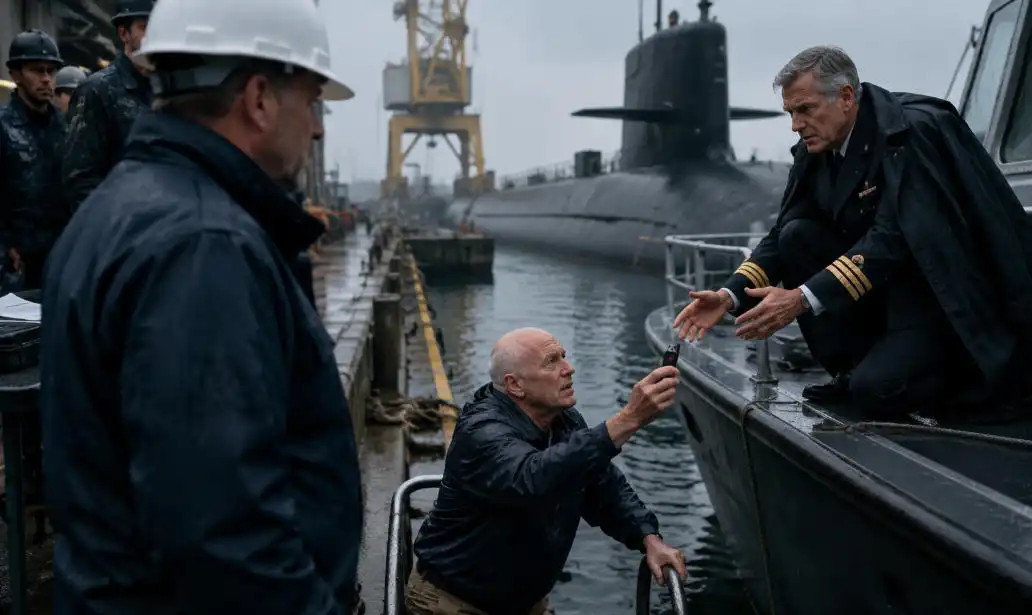
Saturday morning. Thomas broke his routine and took Aria to the Brooklyn Navy Yard. The yard had been one of the largest military shipbuilding facilities in the 19th century, producing dozens of warships during WWII. After closing in the 1960s, most of the facility lay abandoned until recently, when it was gradually converted into creative offices and tech spaces. But in the deepest part of the docks, several derelict hulls still waited for scrapping. "Why are we here?" Aria asked. "To show you real ships." Thomas knew an old friend working in marine engineering at the yard — Big Luke, a bearded, tattooed Brooklyn craftsman who knew more than half the researchers at the institute combined. "Yo, Thomas! Finally decided to go to sea?" Luke laughed, handing him a coffee. "Not me. Aria. She's very interested in submarines." Luke crouched down and looked at Aria. "Little one, do you know how a submarine dives?" "By controlling buoyancy through ballast tanks," Aria answered without hesitation. "On the surface, the tanks are filled with air. To dive, you open the vent and flood valves — seawater enters, air escapes. Depth is adjusted using hydroplanes during submerged operation." Luke's eyes went wide. He looked up at Thomas. "Did your daughter memorize a navy manual?" "She's never read any manuals," Thomas said quietly. Luke's smile slowly faded. He led them into a dry dock — where a decommissioned submarine sat under repair. An old Sturgeon-class nuclear attack sub, hull number SSN-683, waiting to be scrapped. Aria stood before the submarine, her body trembling slightly. "Daddy," she whispered, "it looks like my submarine. But mine is smaller, sleeker, and darker blue." "Are you sure yours is a submarine?" "Mm-hmm. But I don't think it's an ordinary submarine." "Then what is it?" Aria tilted her head, thinking. "It's something I imagine... but it's not just my imagination. It has its own thoughts. Sometimes, it wants to go places I don't even know about. I only find out when we get there." Thomas crouched down to meet her eyes. "Aria, today you took the subway. Tonight, will your submarine come for you?" "Yes." "Can I come along?" Aria's expression turned serious, like she was considering an important academic question. Then she shook her head. "I don't know. It can only take one person at a time. But I'll ask." Thomas smiled. He'd expected to laugh at this childish fantasy — a man approaching forty, seriously entertaining the imaginary submarine of an eight-year-old girl. But standing in the Brooklyn morning light, facing this steel leviathan destined for the scrapyard, he felt for the first time that perhaps his daughter understood the world more deeply than he did.
That week, Thomas stayed late at the institute's lab. Ostensibly, he was analyzing sediment core samples from the abyssal plains of the North Atlantic. In reality, he was researching something with no scientific value whatsoever — the neurological correlation between childhood mysticism and imagination. But a chance discovery made him truly sit up. Anna, a younger physicist fresh from MIT, was calibrating a new neutrino detector when she found an anomalous signal. The detector, designed to study neutrino oscillations, was deployed at 2,000 meters depth in the waters near the Bahamas. "Look at this," Anna said, pulling up the spectrogram. "Seven consecutive nights. Same time frame — 23:47 to 01:12 local. A regular pattern. Not neutrinos, not any known particle behavior. It's like something is... vocalizing." "What kind of sound?" "Not sound. Gravitational perturbation. Extremely weak, but the pattern is perfectly regular — approximately every forty seconds, lasting eighty-five minutes. Then it vanishes." Thomas stared at the wave pattern on the screen. A strange intuition began crawling up his spine. "Anna, how long has this signal been appearing?" "About ten days." Ten days ago was exactly when Aria had started talking about the submarine. "Can you pinpoint the location?" Anna pulled up a map, marking a rough coordinate region. "Approximately 37°N, 50°W — near the Mid-Atlantic Ridge. Nothing visible at that depth. Over 4,000 meters." Thomas spent an entire afternoon combing through a decade of oceanographic survey records. Near those coordinates, there were no known shipwrecks, no known hydrothermal vents, no research stations. But one detail surfaced in his memory — during the final dive of the Nautilus-07 expedition, the ROV had recorded an unidentified sonar echo in that region. It had been dismissed as equipment malfunction. A mysterious signal from the Atlantic floor at a specific frequency. An eight-year-old girl's bedtime fantasy. A fleeting deep-sea apparition a scientist had glimpsed years ago. Three dots. In his mind, they began to connect.
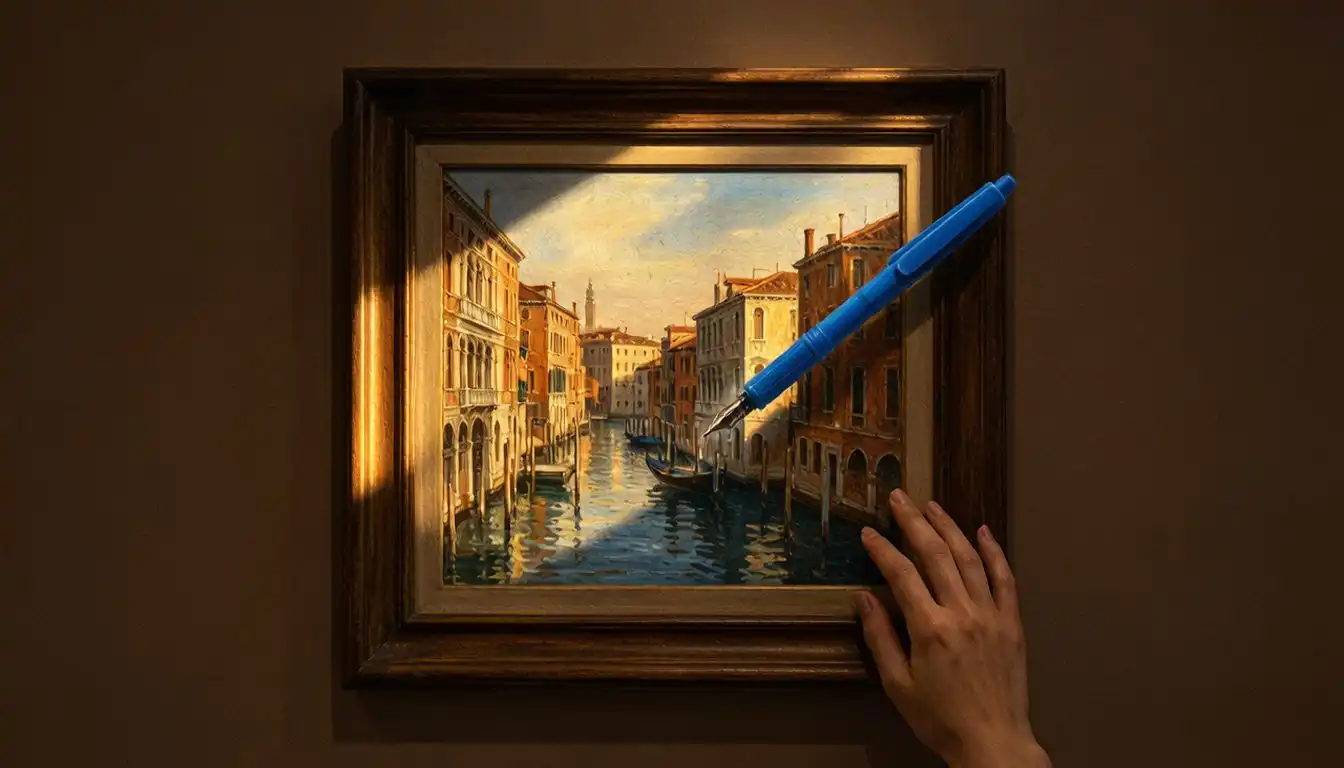
Sunday night. Thomas sat by Aria's bed. "It says," Aria murmured, her voice sounding like it came from very far away, "tonight we can go further." "Can you ask if I can come too?" Aria didn't answer. Her breathing grew deep and slow, as if something in the distance was gently pulling her. Thomas didn't know what he expected. Perhaps nothing would happen. Perhaps he'd sit by his daughter's bed all night, and tomorrow he'd take her to a child psychologist. That would be the rational choice. But rationality expired at 1 AM. A faint vibration rose from beneath the floor — not the subway. Subway vibrations traveled horizontally through the ground. This came from deeper, as if something in the bowels of the building was awakening. Thomas walked to the window. Brooklyn's streets were quiet, fine rain drifting in the orange halo of streetlights. Nothing unusual. But when he looked down at his right hand holding the cup, he saw ripples spreading across the water's surface. Not from the wind. The window was closed. Eighth floor, no breeze. Ripples, one after another, radiating outward — as if something enormous was rising from beneath the depths. Thomas set down the cup and hurried to Aria's room. He pushed the door open — Aria's bed was empty. He froze for two seconds, then noticed the blanket kicked aside, the window half-open. He rushed to look down — eight stories below, the street was deserted. No child's body on the pavement. No running figure. A chill ran up the back of his neck. Thomas spun around — On the wall at the end of the hallway, a deep blue light flickered. Not the hallway light. Not moonlight. It was the kind of cold light he'd only seen in deep-sea footage — the bioluminescence of abyssal organisms. A blue, blue glow seeping through the wall itself. Thomas followed the light. It passed through the living room, through the foyer, and stopped at the wall of his study. On the wall hung a painting he'd done himself — a painting he'd never explained to anyone. It was his reconstruction of that fleeting image from the Nautilus-07 ROV monitor, created from memory over three months: the silhouette of a submarine. At this moment, the paint was softly glowing. Aria wasn't here. But Thomas stood before the painting, staring at the outline he'd drawn countless times, and finally understood what his daughter meant. "The submarine isn't my imagination. It has its own thoughts." He reached out. His fingertip touched the canvas. A jolt — not electricity, but something like consciousness being pulled. The image on the canvas suddenly became three-dimensional. The water began to flow. The submarine's silhouette sharpened into a real submarine, floating in a vast, deep blue darkness. And then he saw Aria. She sat in the cockpit, her small round face wearing a pair of oversized headphones, both hands on control levers. The hull number glowed in the cold light: N-07. "Daddy, can you see me?" Aria's voice came from very, very far away — but clear as day. "I see you, baby. I see you." "It says thank you for drawing it." Aria smiled. "It also says you didn't get it quite right — it has three tail fins, not two." Thomas wanted to laugh, but his eyes stung. In that moment, all his academic training, all his rational discipline, all his scientific worldview shattered like glass. But he felt no fear. Only a strange warmth, as if something enormous had wrapped around him. "What's its name?" "It doesn't have a name," Aria said. "But its number is N-07. Just like yours."
Thomas woke the next morning to find himself slumped over his study desk. His neck ached. His right hand still had paint on it. Aria was in the kitchen heating milk, humming a song he didn't recognize. Everything from last night felt like a dream — or, rather, was a dream. But something had changed on the painting. Originally, Thomas had drawn the submarine in profile, with two standard-sized tail fins. Now, the painting showed three — a third fin, slightly smaller, occupying the perfect aerodynamic angle between the other two. He had never painted a third fin. "Are you going to the institute today?" Aria walked in carrying her milk, a white mustache around her lips. "No," Thomas said. "Today, Daddy is taking you somewhere." Over the next three months, Thomas did something that made every colleague think he'd lost his mind. He applied for an unofficial research project called "Consciousness-Related Perturbation Analysis in Deep-Sea Hydrological Patterns." His colleagues didn't know the term was made up. In reality, he was doing something very simple: every night after Aria fell asleep, he recorded her descriptions of where the submarine had gone. Then, the next day, he cross-referenced them with Anna's neutrino detector data. The results robbed him of sleep. From June to September, Aria described forty-six "night voyages." Anna's signal data matched thirty-nine of them — geographically and temporally. For three of those, the timing and Aria's described location aligned with near-perfect physical precision. "This is impossible," Anna said. "How does your daughter know the exact coordinates of the Mid-Atlantic Ridge?" "She might actually have some kind of... connection." "Thomas, you know I'm a physicist. If I said this might involve quantum entanglement, I'd be laughed out of the department. But — the regularity of this signal is too strong. Electromagnetic waves can't achieve this kind of conservation transmission." "Could it be a biological phenomenon?" "Nothing at forty thousand feet depth can produce gravitational perturbations like this. Unless —" "Unless what?" Anna was silent for a long moment. "Unless it's not a physical phenomenon at all. Or at least, not one we can measure." Thomas looked out at the night sky. Manhattan's neon glow drowned out the stars, but he could imagine them shining above the clouds, above the dark Atlantic. And somewhere beneath that dark Atlantic, at this very moment, a submarine named N-07 was sailing. His daughter believed in it. Years ago, he had glimpsed it on a deep-sea monitor. Now, even physics instruments had registered its traces. What does "real" even mean?
One evening, after a long day of play, Aria fell asleep quickly. But Thomas noticed that her body was tense, her brow furrowed, her fingers clutching the sheet. At 2 AM, her eyes flew open. "Daddy. It got lost today." "What got lost?" "The sub. We went somewhere we'd never been. It was darker than usual. Even the sub's lights couldn't reach five meters. And then it got lost in a canyon." Thomas sat on the edge of the bed and took Aria's hand. "Doesn't your sub know the way?" "It said it doesn't know this place. This place has always been there, but it's never come here. Like... someone blacked out a section of the seafloor map." "And then what happened?" "It navigated for a long time and finally found a passage." Aria made gestures with her hands. "The passage was long and narrow. Black rocks on both sides. The rocks had eyes — or things like eyes. White ones, arranged in rows." The hairs on the back of Thomas's neck stood up. He realized Aria might be describing some unknown geological formation on the deep ocean floor. "Did you get out?" "Yes. We reached a wide-open space. The eyes on the rocks turned out to be fluorescent bacteria colonies. At the passage exit, they became landmarks. The sub followed the fluorescence and found its way out. It said thank you — if I hadn't helped read the direction sensors from the control panel, it might really have been trapped in there." "You help it?" "Of course. I'm its navigator." In that moment, Thomas understood something crucial. His daughter wasn't merely dreaming about a submarine. She was a real navigator. Between her consciousness — her imagination — and this conceptual submarine, there existed a genuine, measurable connection. And he himself, years ago, hadn't hallucinated that silhouette in the deep. That was a ship waiting for its navigator. The next night, Thomas did the most unbelievable thing he'd done in thirty-eight years. He sat before his daughter's bed, closed his eyes, and tried to catch up with her submarine. He couldn't. But when he woke in the middle of the night, he found a note clutched in his hand. The handwriting wasn't his, and it wasn't Aria's. It looked like it had been printed by some extremely tiny device: "Welcome aboard. Two fins were wrong." He laughed all morning.
At this point in the story, the reader might expect a grand climax — father and daughter diving together into the deep sea, discovering the ruins of a lost civilization, or battling a secret government agency. But that's not how it went. Most of the time, Thomas was still an ordinary middle-aged researcher. Up at 6:30 AM. Pack two lunch boxes. Drop Aria at school. Take the subway to the institute. Group meetings. Paper writing. Grant applications. Occasional popular science articles for magazines. Occasional boring academic conferences. Ninety percent of his life was exactly as before. But something between them had changed. Every night, before Aria fell asleep, they no longer just read bedtime stories. Thomas started teaching her about the deep sea — currents, seafloor topography, chemosynthetic organisms around vents. Aria, in turn, told him where she'd gone and what she'd seen. "Today we went to a vent field on the Mid-Atlantic Ridge. There was a transparent shrimp eating bacteria. When the sub's light hit it, its shell was like glass." "That's Rimicaris exoculata," Thomas said. "Usually found above 2,500 meters. You might have seen a new species." "The sub has a sampling arm. It caught one and put it in the observation chamber. I watched it swim around. Then the sub said we had to release it because the water temperature in the chamber was different from its home." In that moment, Thomas thought his daughter was more of a true marine scientist than he was. Later, he did something important. He took down the old painting from his study wall and painted a new one. This time, with three tail fins. Not only that. He painted a complete cutaway view of the N-07 — cockpit, observation chamber, mechanical arm, ballast tanks on the bottom, three precise tail fins at the stern. Every detail Aria had described. The painting took four months to complete. When it was done, he brought it to the Brooklyn Navy Yard. Big Luke whistled when he saw it. "Thomas, you know — the fluid dynamics of this sub you've drawn could theoretically dive to at least 10,000 meters. This shape is more advanced than anything we have. When did you switch to naval architecture?" "My daughter designed it." Luke thought he was joking. But Thomas wasn't laughing. He photographed the painting and sent it to Anna. She was silent for a long time, then wrote back in an email: "If N-07 really exists — it must be a cross-dimensional entity. Your daughter isn't 'imagining' it. She's 'observing' it. And every observation leaves a trace in the physical world." Later, Anna compiled these thoughts into a paper for an obscure interdisciplinary journal. The title was: "Non-Local Correlations Between Childhood Attentional Relaxation and Physical Observation Behavior." Of course, the paper didn't mention submarines — replaced by abstract data charts and theoretical models. But three years later, that paper caught the attention of another physicist. Five years after that, it formed the theoretical basis for an experimental project in a quantum computing lab — using the quantum observation abilities of deeply-imaginative children to improve quantum bit error correction. That was a distant echo of a chain of events that began with N-07. But that's a story for another time.
On Aria's twelfth birthday, Thomas took her to the deep-submergence dock in Baltimore. There, in a dry dock, sat Alvin — one of the most famous human-occupied submersibles in history, which had visited the wreck of the Titanic. The maintenance engineer for Alvin was a man in his sixties. Without asking too many questions, he gave the father and daughter a full tour. Aria wore the engineer's hard hat and carefully inspected Alvin's control panel. "Its operating system is older than mine," she murmured to Thomas. "Does yours have a touchscreen?" "No touchscreen. It uses something... I don't know how to describe it. You just think, and it works." Thomas thought to himself: that must be direct consciousness interaction. On the train ride home, Aria fell asleep against the window. Sunlight fell on her face, already beginning to show the angles of adolescence, and Thomas suddenly realized that four years had passed. Four years. In Anna's dataset, N-07's voyage records had accumulated to over seven hundred instances. Four years of data was enough to prove this was a stable, repeatable phenomenon. But Thomas had never made it public — because he knew humanity wasn't ready to accept this: Some real things can't be fully captured by instruments and equations. More importantly, Aria was growing up. At thirteen, she began mentioning the submarine less frequently. She had new friends, new interests. Science competitions at school, math club. Her world was expanding. The space for N-07 was shrinking. But it never disappeared completely. About once a week, before falling asleep, she would say: "Tonight we're going somewhere far." And the next morning, she'd wake with a strange discovery — the image of a fish she'd never seen in daylight, a detail of some seafloor formation, a bioluminescent pattern from a previously unknown creature. Thomas recorded every detail in an encrypted folder. He knew these records had no scientific value — no third-party verification. But he knew they were real. Just as he knew N-07 was real. Some truths don't require a peer-reviewed paper.
Winter night. Aria was sixteen. She hadn't mentioned the submarine in a long time. Thomas assumed the ship had sunk forever into the depths of her childhood. He didn't ask — because he knew his daughter was growing up, and the tides of imagination eventually recede. But that night, Aria suddenly emerged from her room, wearing the old dolphin-print pajamas — which still fit, miraculously. "Daddy. The sub says it's leaving." Thomas set down his book. "Where is it going?" "It didn't say. But it said the course is set. Tonight is the last time." Thomas didn't know what to say. He walked to the kitchen and poured himself a glass of water — like that night four years ago. Cold coffee had become cold water. "It said thank you for painting it," Aria said. "And thank you for believing in it. Not every grown-up can." "Did it... say why?" "It said the next place it needs to go is too far. Too far for my consciousness to reach. But I don't need it anymore now. That's what it said." Thomas felt his eyes grow hot. The trust he had invested in his daughter's submarine story had yielded almost nothing in worldly terms — no fame, no money, no academic recognition. But he had gained something far greater. He had gained the courage to believe that something beyond rationality might exist. He had gained an invisible bridge between himself and his daughter. He had gained the occasional deep-blue glow that lit up the dark nights of an ordinary life. "This is the last trip," Aria said. "Go ahead." She went back to her room and closed the door. Thomas sat in the living room, staring at the wall. The new cutaway painting of N-07 glowed faintly in the dim nightlight. He stared at the ship — at every fin, every compartment, every detail his daughter had described. Minutes passed. At 1:15 AM, the painting began to glow. Brighter than four years ago. A deep blue light seeped from the canvas, spreading across the wall, across the floor, transforming the living room into a projection of the deep ocean. And then Thomas saw it. Not through the painting. Not through the window. In the middle of his living room, a real submarine materialized from the deep blue light. Silver-gray hull. Three precise tail fins. Searchlights glowing with warm light. This was no ordinary ship. This was N-07. A projection. A real vessel. In the narrow space between walls and floor, it sat there, as if waiting for something. Thomas reached out. The light disappeared. The living room returned to normal. The painting on the wall went dark. Only the streetlights outside and the distant sirens told him this had happened in the real world. The bedroom door opened. Aria stood there, tears on her face. But she was smiling. "It said that if I ever want to see it again, I don't need to sleep. I just close my eyes and draw it in my mind. It will find its way back." Thomas walked over and hugged his daughter. She was taller than he'd imagined, and when he held her, she didn't fit entirely in his arms anymore, like when she was small. "Thank you, Daddy." "For what?" "For never saying it wasn't real." He held his daughter and said nothing.
Now, Thomas Lin is forty-five. More gray in his hair. Hundreds of papers published. Dozens of graduate students mentored. He's still an associate researcher at the Columbia Marine Institute, still dealing with samples, data analysis, and grant applications. But every month or two, he does something. At night, when Aria is away at college — and sometimes even when she's home — he turns off the living room lights, closes his eyes, and slowly, carefully draws a submarine in his mind. Three tail fins. Silver-gray hull. Number N-07. He draws slowly, carefully. Every detail his daughter once described. About halfway through the drawing — something comes. Not the submarine. A feeling. A deep blue, liquid feeling, as if ten thousand tons of seawater have been draped over his head. He stands in that feeling for a while, thinking nothing, doing nothing. Then he opens his eyes. The living room is still the living room. But sometimes, in his shirt pocket, there's a small thing — a fragment of deep-sea shell, a piece of obsidian-like rock, or a transparent bead he's never seen before. He's never told anyone about this. Because no one would believe him. And some truths — Thomas opened a drawer containing a box of small specimens. The topmost one was a transparent, faintly luminescent shard — like the exoskeleton fragment of some deep-sea creature. He looked at it for a long time, then carefully closed the drawer. Outside, Brooklyn's night was as deep as ever. In the distance, the Atlantic stretched black and silent. He knew that somewhere, very deep down, the ship his daughter had once sailed was still moving forward. Perhaps it had already sailed into the oceans of another dimension. Perhaps there, it had connected with another child's dream. Perhaps one day, he would see it again. But not tonight. Tonight, he had a paper to write. There was a group meeting tomorrow. Thomas Lin stood up, walked to his desk, turned on the lamp, and opened his files. Outside the window, nothing. The Atlantic direction was quiet. But at the corner of his eye, he always caught a glimpse of the painting on the wall — the perfect curve of the third tail fin, identical to the silhouette he'd first seen on that distant night, years ago. Epilogue Somewhere in the Atlantic, 4,000 meters below, in the permanent darkness of the abyss. A deep blue submarine glides silently. Its number is obscured by ancient sediment deposits clinging to the hull, but some letters remain faintly legible: N-07. No searchlights. No sonar. No navigation equipment of any kind that humans would recognize. It sails alone, tracing a steady path through invisible currents. The cockpit is empty. But moments ago, something seemed to have been here — something warm, weightless, like a child's attention, briefly touching the surface of the control panel, then rising like a bubble toward the surface. The submarine continues its descent. Toward deeper places.
Disclaimer: Mention of any brand or trademark is for identification only and does not imply partnership or endorsement