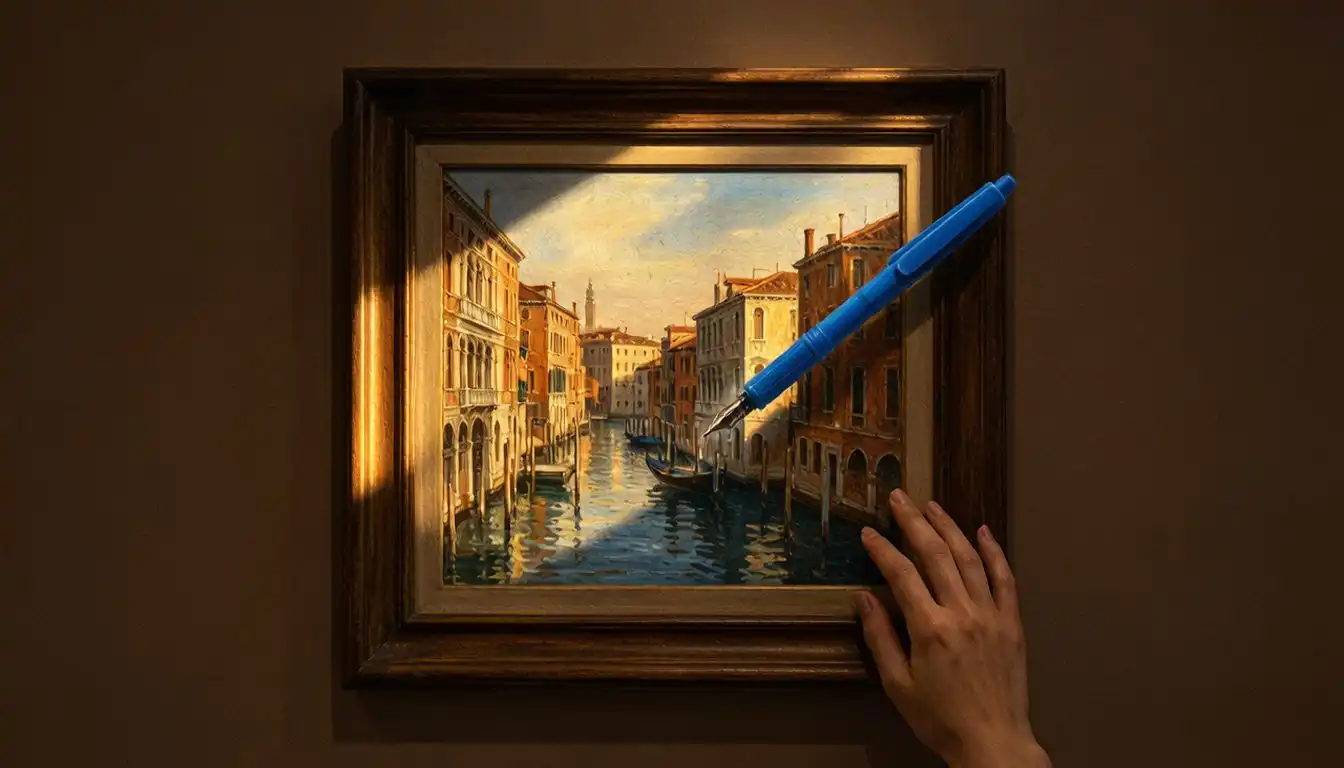
My name is Tariq Shafiq. Professor of Archaeology at Cairo University, specializing in the Fatimid period. I lived in this city for fifty-seven years and never traveled more than two hundred kilometers from the banks of the Nile. That changed in the summer of my fifty-sixth year. In July 2023, the Grand Egyptian Museum was in its final phase of artifact organization. I was in a storage room on the fourth basement level, numbered D-4-37 — a space that had hardly ever been opened, buried deep in the escalator system, above it the cafeteria, below it the groundwater system, to its left the air conditioning plant room. It was an utterly ordinary room. Concrete floor. Fluorescent tubes. Metal shelves. The temperature was kept at a constant 18 degrees Celsius, humidity at 45 percent, because next door was a climate-controlled cabinet for papyrus documents. The room contained approximately three hundred unregistered artifacts — pottery shards from the Pharaonic period, coins from the Ptolemaic era, glass vessels from the Mamluk Sultanate. They were packed in standardized plastic storage bins, each with a yellow label reading "Pending Identification." I spent the afternoon cataloging a batch of Fatimid-period painted pottery excavated from a construction site in Old Cairo. The excavation team had spent three months extracting them from the ground. Around four o'clock, I had registered over a hundred and twenty pieces. My wrist ached, my eyes were dry. I decided to rest. That was when I noticed a storage bin on the lowest shelf that was slightly different from the others. Its yellow label did not say "Pending Identification." It said, in handwritten Arabic: Muhmal. Overlooked. The handwriting was hasty, the ink faded — it looked as though it had been written many years ago. I crouched down and pulled open the lid. The bin was stuffed with bubble wrap and old newspapers, the newspapers dated 1972. At the very bottom of the packing material, my hand touched something. Round. Cold. Glass. I lifted it out.
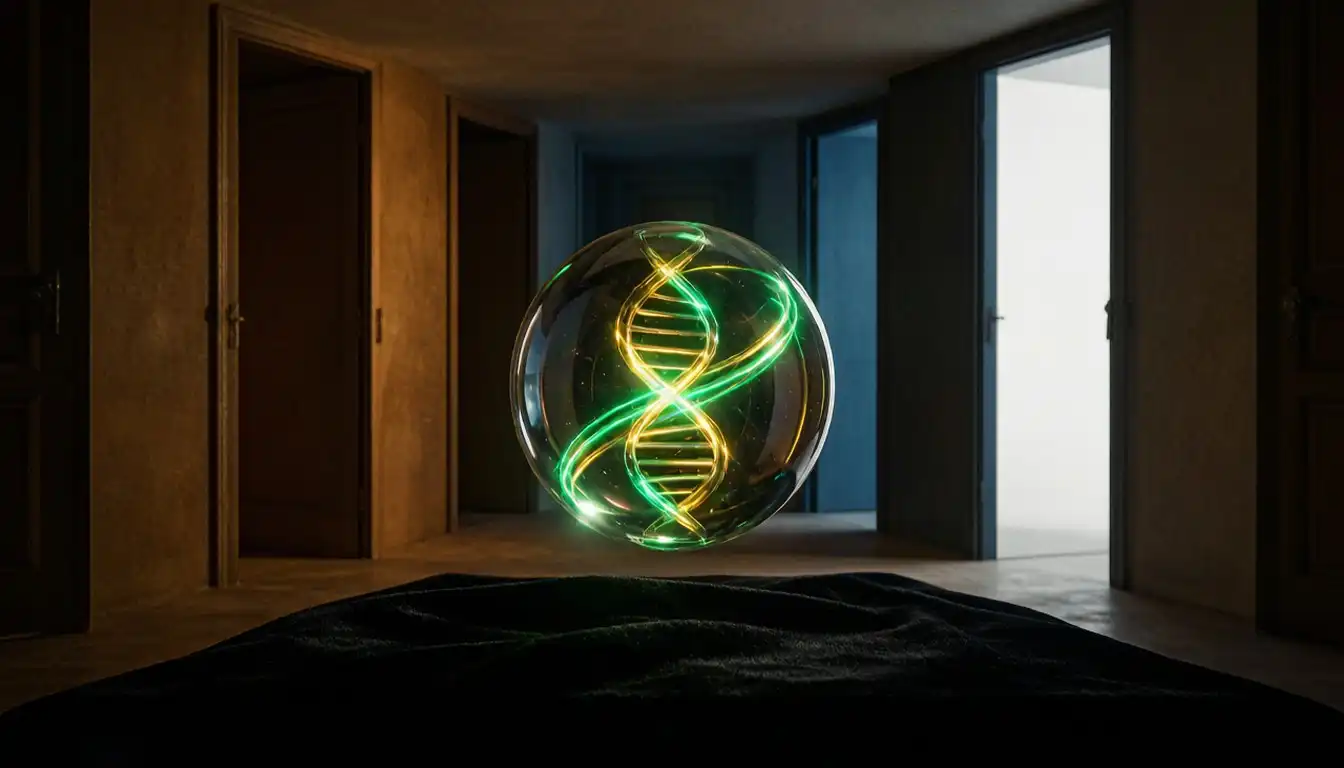
It was a glass sphere about eight centimeters in diameter. No — not ordinary glass. Its texture was somewhere between glass and quartz. Its surface bore irregular polishing marks — as though it had been meticulously burnished by hand, but without achieving uniform curvature. Under the fluorescent light, it showed a strange dark green, like the color of deep desert groundwater in moonlight. Inside the sphere, two parallel spiral lines rose from the bottom, intertwining as they ascended, meeting at the top. They resembled the double helix of DNA — but not exactly. The lines were not regular geometric patterns. They looked more like some ancient writing system, melted into the glass itself. I tapped it gently with my fingernail. The sound was not the clear ring of glass. It was a dull resonance, as though I were not tapping a solid sphere but something hollow — something enormous, echoing from some vast interior space. The sound unsettled me. I turned the sphere over and saw a faint mark on its bottom — if it was a mark at all. It looked like several Arabic letters superimposed on one another, but I could not identify a single recognizable word. It was like text deliberately blurred, hovering between existence and absence. I did what any archaeologist would do: I placed it in my archive bag, intending to take it to the lab for carbon-14 dating, spectral analysis, and X-ray diffraction. There was one thing I told no one. In the instant I lifted it from the bin, the moment it touched my palm — I felt it vibrating. Not physically. Not the kind of vibration measurable by the hand. Something deeper, something beyond description. Like standing at the mouth of a vast cave and feeling the air moving from its depths. I told myself it was because I had been in an air-conditioned room too long, that my fingers were numb. I did not believe that explanation. I never did.
That night, I did not go home. I took the sphere to the university laboratory — a windowless room on the second basement level of the archaeology building, its walls lined with sound-absorbing foam, the air conditioning unit of the adjacent plant room humming constantly through the partition. I spread a piece of black velvet on the workbench. I placed the sphere on it. I examined its surface with a high-power microscope. No bubbles. No scratches. No micro-cracks from age-related weathering. For a glass object supposedly predating 1972, this was impossible. Any glass, even the most stable man-made variety, develops microscopic surface changes after decades in storage. But this sphere — its surface was as perfect as if it had been made yesterday. I switched off the microscope and tried an ultraviolet fluorescence lamp, a standard tool for antique authentication. Under UV light, the sphere emitted no fluorescence at all. That in itself was unusual — most ancient glass shows a pale green or yellow fluorescence under UV. But this sphere absorbed all ultraviolet light, like a tiny black hole. I sat at the table, staring at it for a long time. The only sounds were the low-frequency hum of the air conditioning unit and my own breathing. Then I made a decision — a foolish, irreversible, life-altering decision. I turned off all the lights. The room fell into complete darkness. Not like nighttime darkness outdoors — which still has starlight and the distant glow of the city — but underground, absolute, all-consuming blackness. After a few seconds, the sphere began to glow. Not bright light. Not the harsh glare of a lamp. An extremely faint luminescence, like bioluminescence in deep-sea creatures — a greenish-gold color emanating from within the sphere. Then I saw.
I am not certain how I should describe what I witnessed. Language is linear. Words follow one another in sequence. But what the sphere presented to me was not linear. It was a simultaneous, infinite-dimensional collection containing all spaces and all moments of time. I saw Cairo. Not the Cairo of 2023. All the Cairos of every age, spread across a single plane. I saw the walls of the Fatimid city being built, and simultaneously saw them torn down by Saladin's army, and simultaneously saw them become tourist ruins. I saw the Nile in flood, and simultaneously saw the Aswan Dam cutting off its flow. I saw the shadow of the Muhammad Ali Mosque's minaret in the morning light, and simultaneously saw the same minaret's entirely different shadow in the dusk of seven hundred years earlier. What I saw exceeded vision. I could feel temperatures, smell scents, hear sounds — every scene came with complete sensory experience. I saw workers hauling stone blocks on the Giza Plateau in 2500 BC, and simultaneously smelled their sweat and stone dust, and simultaneously heard, twenty-five centuries later, the engines of tourist buses and the clicking of camera shutters in the same spot. I saw my mother cooking lentil soup in the kitchen, and simultaneously saw the same kitchen thirty years earlier — different wallpaper, different stove position, but the same mother doing the same thing in the same place. I saw the seafloor off Alexandria, the ruins of Ptolemaic palaces crumbling into powder under time's erosion, seahorses swimming among the colonnades. I saw the interior of Hagia Sophia in Istanbul — no, not the Hagia Sophia of today. The building that Sultan Mehmed the Conqueror entered in 1453, when the mosaics on the walls were still intact images of Christ, and the air still carried the frankincense of the last Eastern Orthodox liturgy. I saw Ibn Rushd (Averroes) in his study in Cordoba, transcribing his commentary on Aristotle, the reed pen scratching across parchment with a faint whisper. I saw myself. In the same room. At the same table. Facing the same sphere. But it was me from another timeline — wearing a different shirt, my beard slightly shorter, a more bewildered expression on my face. All of this, simultaneously. Not sequentially. Not mutually. All at once. All. In that moment, I understood why the Sufi poet Rumi wrote: "You are not a drop in the ocean. You are the entire ocean, contained in a drop."
I had to tell someone. The next morning, I went to the old quarter of Cairo — Al-Muizz Street — and climbed to the second floor of a six-hundred-year-old building, where I found Mr. Khalid's antiquarian bookstore. Mr. Khalid was eighty-two. He had spent most of his life collecting and trading Islamic-period manuscripts and artifacts. From the outside, his shop appeared as a narrow storefront, but inside, it was a labyrinth — rooms leading into rooms, shelves crowded against shelves, some passages so narrow you had to turn sideways to pass. He was the librarian of intellectuals, the secret consultant of scholars, the free coffeehouse of wandering literati. I pushed open the shop's glass door. A wind chime rang. Mr. Khalid sat behind his counter, reading. He wore metal-rimmed glasses. His silver beard was neatly trimmed. Above his head, an old-fashioned desk lamp cast light onto the open pages before him. "Tariq," he said without looking up. "You look like you haven't slept all night." "I haven't." He closed his book and looked at me. His eyes were light brown, carrying that particular clarity that comes with age. "What did you find?" I did not answer. I took the glass sphere from my bag and placed it on his counter. Mr. Khalid looked at it for a long time. Then he reached out — his hand was thin, the knuckles prominent, his fingernails cleanly trimmed — and touched the surface of the sphere with his fingertips. "Cold," he said. "It's always cold." "How cold?" "Not a temperature cold. Another kind of cold." Mr. Khalid removed his glasses, wiped them with a cloth, and put them back on. "You're right," he said. "Not a temperature." He held the sphere up to the desk lamp, squinting at the spiral lines within. "Do you know what this is?" "No." "Then let me tell you a story."
Mr. Khalid set the sphere back on the counter and leaned back in his chair. "Have you ever heard the legend of the Infinite Room?" "No." "It is not a common legend. I read about it in a fifteenth-century Persian manuscript — written by a former Sufi ascetic named Mortaza. In his book, he repents of having once come into contact with 'something that should not be touched.'" Mr. Khalid stood up, walked to the depths of his shelves, and retrieved a manuscript bound in brown leather. The cover bore no title. The spine had gilded geometric patterns. He opened it to a page, pointed at a passage in Persian, and translated: "'They say that at the border between the City of Light and the City of Darkness, the wise Hassan ibn al-Sabbah kept a fragment of a star. Not a star that fell from the sky, but a sliver peeled from the edge of infinity itself. Smaller than the smallest grain of sand, yet containing all known and unknown worlds. Whoever gazes upon it will see the essence of all things. But the price is — you will never again see this world with ordinary eyes.'" Mr. Khalid closed the manuscript. "What happened after?" I asked. "After? No one knows. The legend of this star fragment became an internal code within Sufism — 'Searching for the Infinite Room' became a metaphor for those mystics seeking union with the Divine. No one believed it actually existed." He looked at me. "At least, no one believed it still existed today." "Do you believe it?" "I believe nothing, Tariq. I only believe in evidence. And you have just placed the evidence on my counter."
That afternoon, I returned to the laboratory. I drew the curtains. I locked the door. This time I was prepared. I brought a notebook and a voice recorder. I wanted to record — even if only one ten-thousandth of what I saw. I placed the sphere in the center of the workbench. Took a deep breath. Turned off the lights. Darkness. The sphere glowed. And I was swallowed again. But this time, I had learned to choose. Or rather, the sphere had learned to respond to my will. I concentrated: Istanbul. Instantly, I stood in Constantinople of the Byzantine Empire. Not visually — I was there in full presence. I could smell the salt of the sea mixed with the scent of spices, hear Greek, Latin, Arabic, and Italian weaving together in the same marketplace, feel the uneven cobblestones beneath my feet. I saw Emperor Justinian standing before the unfinished Hagia Sophia, turning to his architect and saying: "Solomon, I have surpassed you." I saw waves breaking against the foundations of the Theodosian Walls, saw the tents of the Ottoman army stretching endlessly beyond the walls, saw the Conqueror riding a white horse through the Gate of St. Romanus into the city of his dreams. I saw a young Egyptian student — 1952 — wearing an ill-fitting suit, standing on the Galata Bridge, holding a novel by Naguib Mahfouz, watching the sunset over the Golden Horn. His eyes held something — that particular anticipation of youth looking toward the future. That student was my father. I almost cried out. But I controlled myself. I continued watching. I saw a Byzantine merchant ship sunk at the bottom of the Bosphorus, its amphorae still containing olive oil from two thousand years ago. I saw the interior of the Süleymaniye Mosque's dome, the architect Sinan's signature carved into the gaps between marble panels, nearly invisible. I saw a girl — eight or nine years old, wearing a faded dress, running through a narrow street in old Istanbul. She ran through a flock of pigeons, and as they rose, she laughed like an angel. I did not know who she was, but her smile filled me with a strange sadness, as though I had known her for a very long time. I do not know how much time passed. Perhaps minutes. Perhaps hours. When I turned on the lights, I found that the voice recorder's batteries had died — it had recorded nine hours of white noise. Nine hours of the basement's air conditioning, my breathing, and some low-frequency hum I could not identify. But I had no sense of those nine hours having passed. To me, it was merely the interval between closing my eyes and opening them. Two minutes? Or eternity? I did not know.
A week later, I noticed the first change. I was walking across the main campus of Cairo University when a student caught up from behind: "Professor Shafiq, how did you know I was at the clinic in Zamalek this morning?" I froze. Because I did know. That morning, while quickly scanning through a fragment of Cairo in the sphere, I had seen this student in a clinic in Zamalek, having blood drawn. I had not paid attention at the time. There was too much information. But my brain seemed to have remembered it all, like a hard drive filled to capacity. "I guessed," I said. "You guessed too accurately." From that day on, similar things kept happening. I stepped into an elevator and knew which colleague I would meet — because I had "seen" him leaving his office three minutes earlier. I opened my mailbox and knew what letters it contained — because I had already "read" them in the sphere. I waited for a taxi on the street and knew when the next empty one would arrive — because I had "seen" its trajectory at the next intersection. This was not predicting the future. It was more like my consciousness had detached itself from the constraints of linear time. Past, present, and future were no longer three separate drawers to me. They were cards scattered across the same table. I could see them all simultaneously. I became quiet. Not because I did not want to speak. But because when you know too much, language becomes a burden. Once, I was lecturing on the architectural features of the Fatimid period when I suddenly "saw" the girl sitting in the third row — her father would die of a heart attack in a month. I looked at her face. She was taking notes earnestly, completely unaware of what was coming. Could I tell her? No. I was not even sure that what I saw would definitely happen — or perhaps "had already happened" was a more accurate way of putting it. That night, I sat in my room, sealed the sphere in an aluminum safe, and locked it with three padlocks. It did not help. The sphere was locked away. My mind was not.
Three weeks later, I visited Mr. Khalid's bookstore again. This time, I did not bring the sphere. It stayed in the safe. But I brought a question. "How do I make it stop?" Mr. Khalid put down his book. "Why stop?" "Because it has changed how I see the world. I now see everything as... simultaneous. My wife spoke to me yesterday. I looked at her and saw her as she was fifteen years ago, as she might be fifteen years from now, a moment when we were arguing — all versions of her coexisting in my field of vision. I could barely conduct a normal conversation." Mr. Khalid was silent for a long time. "Do you know what Mortaza finally did?" "What?" "He burned his manuscript. He destroyed his sphere — it reportedly took him three years to find a way to do it. Then he spent forty years as a teacher in a village, teaching children to read." "Destroy it?" "Yes. Because he discovered that infinity is not a gift. It is a burden. The human mind was not designed to contain the infinite. You may glimpse infinity occasionally, just as you may dive to the bottom of the deep ocean. But you cannot live there permanently. The pressure will crush you." "How do I destroy it?" "I do not know. Mortaza's manuscript did not record the method. But I can tell you another thing —" He paused, looking out the window. Evening light filtered through the blinds, casting fine stripes across the bookshelves. "Do you know why people pursue infinity?" "Because of the thirst for knowledge." "No. Because of fear." "Fear of what?" "Fear of finitude. Fear of choice. Fear that once you choose one path, you will have forever lost the other. Infinity is seductive because in infinity, you do not need to choose — you possess everything. But real life, Tariq, is about making choices within finitude." He searched among his shelves for a moment and pulled out a thin booklet. "This is a Persian poem I translated thirty years ago. The author is unknown. Take it." I opened the first page. The handwriting of the translation was neat and restrained. The gist of the poem: I walked in the desert and met an old man. I asked him: "What are you seeking?" He said: "Truth." I asked: "Did you find it?" He said: "I did." I asked: "Then why do you still walk?" He said: "After finding the truth, I learned not to gaze at it. Because gazing is not possessing."
January 2024. Winter in Cairo — not cold, but dry. The Nile was lower than usual, which reminded me of the future scenes I had seen in the sphere: Cairo in 2050, more crowded, with less water, hotter air. I no longer looked at the sphere every day. In fact, I had not opened the safe in two weeks. I returned to being an ordinary person — at least on the surface. I taught my classes normally. I wrote my papers normally. I argued with my wife and made up normally. No one noticed anything unusual. Only I knew that somewhere in my brain, a background program was running that could never be shut down. Even without looking at the sphere, I could still "feel" those parallel timelines. They were like the neon lights of a distant city — if you do not look directly at them, they are just part of the background. But you know they are there. I remembered what Mr. Khalid said. Choice within finitude. I chose my wife. I chose my daughters — they were the two most certain things in my life. In the infinite world, they were only two nodes among countless possibilities. But in this finite world, they were my everything. I thought again about the blurred mark at the bottom of the sphere. I had tried countless times to decode it — it looked like the Arabic letters meem, haa, baa, but they never formed a word I could recognize. Until the last time. That night, I opened the safe, took out the sphere, and gazed at it one final time. Not to see anything new. Just to confirm it was still there. As I held it in my hand, the spiral lines flowed within the sphere, as though alive. My gaze passed through them and settled on the mark at the bottom. This time, I understood. Not because I had learned to identify it. But because, having seen the infinite, I had finally learned to read the finite. The word was not Muhmal — "Overlooked." It was Mahbub. "Beloved." All time. All space. All life. All beloved. I closed the safe. That night, I dreamed of the old man from the Persian poem. He stood in the desert, his back to me. I asked him: "Why don't you turn around?" He said: "Because I am looking at finite things." "Like what?" "Like the dew on tomorrow morning's grass. Like the ashes of tonight's campfire." "And the infinite?" "The infinite does not need to be looked at. The infinite is always there. True wisdom is living the infinite within the finite." He turned. His face was my face. I woke to a Cairo sunrise. The call to dawn prayer rose from a distant mosque, clear and long, cutting through all the noise of the city. I went to the kitchen. My wife was making tea. My daughter was eating bread. "Are you going to the museum today?" my wife asked. "No. Staying home today." She looked at me — after all these years, she could tell with a single glance whether I was lying. But she did not press. She simply nodded. "Then come home for lunch." "All right." I sat by the window and watched Cairo's streets gradually come to life. A man pushed a breakfast cart past the window, steam rising from the pancakes on it. A stray cat sat on the wall across the street, slowly licking its paw. A little girl ran past the corner with a backpack — she reminded me of the girl I had seen in the sphere, the one in Istanbul, the one who laughed like an angel. Perhaps she was the same person. In a different city, a different timeline. Perhaps she was my daughter. In another version of the universe. Perhaps none of that mattered. Within finitude, I had chosen the ones I loved. That was enough.
Disclaimer: Mention of any brand or trademark is for identification only and does not imply partnership or endorsement