The Taxidermist's Last Night Autumn comes early in Edinburgh. By mid-September, tourists on the Royal Mile still wear short sleeves, but the wind off Calton Hill already carries the kind of cold that usually waits for winter. The rain — Edinburgh rain — doesn't seem to fall from the sky so much as seep from the cracks in the stone walls, thread by thread, fine as lizard scales. Finlay MacRae wrapped his mothball-scented wool coat tighter and climbed the stone steps behind the museum. He was seventy-one years old. His right knee, injured in 1978 during a field collection expedition in Borneo, throbbed dully in the damp weather. He was the only salaried taxidermist at the Royal Edinburgh Museum of Zoology. In fourteen days, he would retire. In thirty-five years, he had handled over two thousand specimens. African lions. Snow leopards. Polar bears. Golden eagles. Leatherback sea turtles. Every specimen contained a story inside, though most people saw only the still fur and stuffing behind the glass. Finlay knew the stories weren't hidden beneath the fur. They were hidden in the eyes. Only a taxidermist knows that when you install glass prosthetic eyes, the angle of the gaze matters. Tilt it one degree left, and the animal appears to be looking at a specific corner of the exhibition hall. Tilt it two degrees down, and its expression shifts from peaceful to sorrowful. For thirty-five years, Finlay had kept precise records of every eye-angle setting. Seventy-three index cards. Two thousand one hundred and seventeen sets of numbers. No one had ever paid attention to this data. But Finlay cared. Because over the long years of his work, he had discovered something — Some specimens' eyes move.
It started four weeks before his retirement countdown. That morning, Finlay arrived at the museum at seven as usual. He walked through the empty exhibition halls — the Mammal Hall where the African lion stood tall in the central case, the Arctic fox curled in a corner of the tundra diorama, the wolf pack frozen in an endless chase. He had always felt that these things were quiet during the day's bustle, but in the empty early hours, they had a strange presence. As if they weren't specimens at all, but things pretending to be specimens. He entered his workshop and found the storage room door slightly ajar. The storage room was his most private space, secured with a brass lock. He alone had the key. He pushed the door open. The bulb flickered on. Everything looked normal. Shelves held boxes of unused glass eyes, sorted by size and color. Boxes of cotton stuffing. Mineral powders. Preservative fluids. Toolboxes. Sutures. But his sharp eye caught something unusual on the floor in the corner — a disturbance in the dust layer. He crouched down and shone his flashlight at floor level. A smooth drag mark ran across the dust, like something snake-like had passed through. But there were no live snakes in the museum. All his raw materials came from zoo deaths or farm accidents — nothing alive. The drag mark extended behind a cardboard box filled with broken glass, then vanished. Finlay frowned and stood up. He counted — nothing was missing from the storage room. All the glass eyes were there. All the tools. But he noticed one thing: the box containing the spotted hyena glass eyes had been opened. A pair of amber glass eyes, approximately three centimeters in diameter, stored on the deepest shelf on the third tier. The lid angle was wrong — he always replaced lids with the label facing up. Now it faced down. No one else at the museum had the key. Finlay filed this away in his mind without making a fuss. He was old enough to know that when explanations aren't immediately available, you don't rush to conclusions. He locked the storage room and began his day's work.
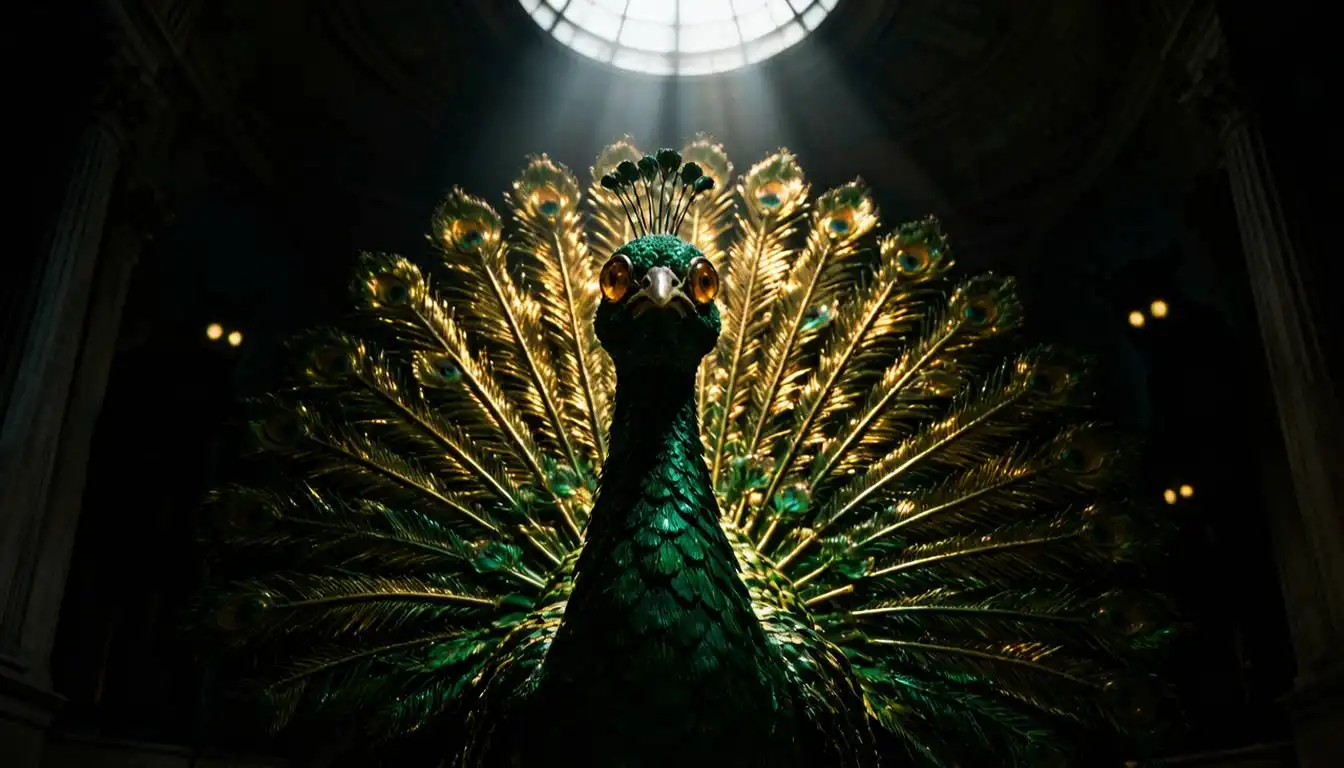
Tuesday of the third week before retirement. The museum had few visitors that day. Edinburgh's autumn rain had driven tourists into cafés and the Scotch Whisky Experience, leaving only a handful of families exploring the museum. Finlay was on the second floor of the Mammal Hall updating primate display labels when he heard a sound from below. Not a human scream. A peacock's call — the piercing, metallic shriek you'd hear at a zoo, echoing through the halls. He hurried downstairs, through the Bird Hall. All the bird specimens stood frozen in their glass cases — the golden eagle with wings spread, the white-headed sea eagle perched, the penguins lined up in formation. The peacock specimen stood quietly in its display case. But its tail was fanned open. Finlay stood before the case, hand pressed against the glass edge, his heart hammering louder than usual. This green peacock had been received from the Edinburgh Zoo five years ago. Died of old age at nineteen. Finlay had personally prepared the specimen. During the taxidermy process, the tail feathers had been closed — standard procedure doesn't allow for fanned displays, as they take up enormous space and are easily damaged. But today, it was fanned. One feather at a time, from top to bottom, like a green fan slowly opening behind the glass. The last time Finlay had seen a fanned peacock specimen in a museum was in a 1956 archival photograph. He pressed his forehead against the glass and looked carefully. The base of the tail feathers — the attachment point to the specimen body — showed signs of having been pushed outward. As if something from inside had pushed them open. But the inside of a specimen is stuffing and wire armature. No muscles. No tendons. Impossible. Finlay reached into his coat pocket and felt his key ring. He looked around — no security guards, no visitors. The museum hadn't opened yet. The entire floor was empty except for him. He unlocked the glass case. The peacock specimen was right in front of him. His hand hovered above the tail feathers — hesitated — then touched them gently. The feathers felt normal. Dry, slightly cool, like any treated natural feather. But when his fingers reached the base of the feathers, something moved. A single feather rotated five degrees under his touch, as if responding to him. Finlay jerked his hand back and stepped away. He closed the glass case, locked it, and left the Bird Hall. He told no one about what happened that day. Because he knew that once he spoke, the museum would contact the retirement board, and the pension he'd earned over thirty-five years could be jeopardized by a psychiatric evaluation. But he memorized the sensation of that feather rotating under his fingers. He stored it in his bones.
Friday of the second week before retirement. The museum director was a woman under forty named Margaret Armstrong. A woman with ambition — stuck in a second-tier institution like the Royal Edinburgh Museum of Zoology, she'd long wanted to push the museum into the same league as the Natural History Museum in London. "Finlay," she called out to him in the corridor, "after you retire, the taxidermy work will be outsourced to a London company." "I know." "They say they can't send anyone for two months. I need to know when your current specimens will be ready." "The white rhino will be done by next Wednesday." "And the other one?" Finlay blinked. "What other one?" Margaret pulled a piece of paper from her bag. "This was left in your workshop last week." It was a printout of a phone photo — blurry, crooked, but clear enough to make out: the Bird Hall glass display case. The green peacock specimen inside, tail fanned open. But that wasn't the focus. On the outside of the glass — the side facing the exhibition hall — there were four scratch marks. Like claws raking across the glass. "This was found during a midnight security playback," Margaret said. "The guard thought there was an intruder, but the cameras didn't catch anyone. Except a cat — can you believe it — a black-and-white cat wandering through the exhibition hall, then leaving through the ventilation duct." "There's a cat in the museum?" "Must have come in through the fire escape." Margaret shrugged. "I've already had the vent grille repaired." Finlay stared at the photograph. The scratches were at approximately one and a half meters from the floor — too high for a cat. More like something standing in front of the glass case, raking claws across it from the inside. "Finlay, are you all right? You look pale." "I'm fine. The white rhino by Wednesday." He turned and walked into his workshop, closing the door behind him. The photograph burned in his mind. As he placed an old specimen box on a shelf, he accidentally knocked over a stack of labels. Crouching to pick them up, he noticed something — Among the labels was a bundle of very old ones, bound with a rubber band, thick with dust. The handwriting was in fountain pen ink, faded to rust color. These were left by his master. Finlay's master was William MacTavish, who died of lung cancer in 1989. On his deathbed, he had handed Finlay a notebook. "I've made a lot of specimens in my life," he said. "Some things... I'm not sure whether I did right or wrong." At the time, Finlay assumed his master was talking about technical flaws in his craft. He put the notebook away and never seriously read it — he trusted practice more than theory. Now, he slipped off the rubber band and opened the notebook's first page. On yellowed paper, William's handwriting was as neat as print: "August 12, 1963. Completed a snowy owl specimen today. Came to the museum at midnight to retrieve my gloves. Saw it turn its head in the case. The glass case lock was intact." Below, in even smaller writing: "This is not the first time." Finlay put the notebook into his briefcase and locked his office door.
That evening, Finlay did not go home. He called his sister in Leith and told her there was a big project deadline at the museum. Then he locked his workshop door, sat down on an old chair in the storage room, and waited. He didn't know what he was waiting for. The clock moved from 8 PM to 11 PM. The museum's security system beeped softly every fifteen minutes. At the end of the corridor, the emergency lights glowed anemic green. He fell asleep. At 2:17 AM, Finlay was jolted awake by a heavy sound. Thump — The sound came from upstairs. Muffled. Heavy. Like a wet sack of sand dropped onto a wooden floor. He stood up, his flashlight beam cutting through the darkness of the workshop. He pushed open the door. The corridor was empty. The vast Mammal Hall glowed bluish-gray in the moonlight — the motionless African animals looked more alive than they did by day. Thump. Again. From the Bird Hall. Finlay walked to the Bird Hall's entrance. The door was glass. Through it he could see the layout — the central display case, the wall-mounted cabinets, the drawers of smaller bird specimens. The green peacock was still there. Tail still fanned. In the moonlight, its green and blue feathers glowed with an unreal metallic quality. Then he saw the cat. A black-and-white cat, perched on top of the display case, licking its front paw. Finlay pushed the door open. The cat jumped down, circled his ankles once, then trotted lightly into the depths of the hall. He followed. The cat walked to the farthest display case — the golden eagle. It stopped, looked back at him, then jumped onto the windowsill and squeezed through a maintenance gap. Finlay suddenly realized something and turned around. The golden eagle specimen was looking at him. Not facing him. Looking at him. He was certain. Thirty-five years of taxidermy had taught him to distinguish between "natural orientation" and "gaze." The eagle's head had shifted slightly to the left — about seven degrees from the angle he'd last checked during spring cleaning. It had turned. The golden eagle was watching him through the glass. Finlay fought to keep his breathing steady. He opened the glass door of the eagle's case. The specimen's glass eyes — the pale golden irises he had installed with his own hands — reflected the emergency light's glow. He reached out and pressed gently on the eagle's chest. Wire armature. Stuffing. No temperature. But then his fingertips registered something — an extremely faint, almost imperceptible vibration. Like a heartbeat. Very weak. Very distant. But definitely beating. Finlay stumbled backward, hitting the wall. The flashlight beam wobbled across the eagle's body. In the moving light, the eagle's wings spread a few centimeters. No — it wasn't spreading. It was closing. He began to count. One, two, three — the eagle's wings were slowly closing. Like a real bird, folding its feathers after being disturbed by the wind. The closing took about thirty seconds. Then it returned to its original posture — a motionless specimen. But in the moment it finished closing, it turned its head. Finlay clearly saw it. The specimen's beak, which in his working memory had never had any curve, now wore one. Like a smile. He fled the Bird Hall. At the end of the corridor, he looked back. The black-and-white cat poked its head out of the maintenance gap, its amber eyes glowing in the dark for a moment. Then it withdrew.
The next day, Finlay locked himself in his workshop and devoured William MacTavish's notebook. Its contents were far richer than he'd expected — in thirty-seven years as a taxidermist, William had recorded at least a hundred "anomalous events." 1961: An Arctic fox specimen changed its posture at night, head turning from right to left. 1967: A black rhino's glass eyes developed tear stains — reappeared the next day after being wiped clean with glycerin. 1972: Three bird specimens from different halls changed their wing angles on the same night. 1974: The five wolf specimens in the Mammal Hall appeared to form a "hunting array" in moonlight. 1985: William, nearing retirement, recorded his penultimate anomaly — "At noon today, a pair of rabbit specimens' ear orientations changed symmetrically. They now face each other rather than the visitors. I don't know what these changes mean. They don't seem random. I increasingly feel that these animals are waiting for something." On the last page, William had inserted an undated scrap of paper. The handwriting was more hurried than the rest, as if written in extreme exhaustion: "Specimens are not dead things. They are sleeping. They might really be waiting. Don't be afraid of them. They just want you to know something." Finlay put down the notebook and looked out the window. Edinburgh's rain was washing the museum's back wall, white spray splashing off the stone. In the distance, the silhouette of Arthur's Seat blurred into a dark smudge through the rain curtain. He picked up the phone and dialed. "Hello? Edinburgh University Psychology Department? I'd like to contact a professor specializing in animal behavior. No, not about owls — about group behavior in certain mammals. Yes, unconventional. For instance, synchronized spontaneous activity after extended periods of stillness in an enclosed space..." The secretary told him he could contact Dr. Eileen Crawford at the Royal (Dick) School of Veterinary Studies. But Finlay never made that call. Because a thought had struck him. If, in the museum at night, "they" knew they were being observed — what would happen? What if observation itself was one of the conditions for their awakening?
Seven days before retirement. Finlay submitted the final batch of specimen records. Margaret organized a small retirement tea party — a few colleagues, a pot of black tea, a store-bought cheesecake, a card signed by everyone. He smiled through all the well-wishes, answered the question "what will you do after retirement?" seventeen times, and returned to his workshop before dark. He wrote a note. Not a legal will — a record: "If I am found unconscious, do not move any specimens within five meters of my body. Contact Dr. Eileen Crawford at the Royal (Dick) School of Veterinary Studies." He tucked the note into his inner coat pocket, then began the last closing inspection of his taxidermy career. Everything appeared normal. Primate Hall. Quiet. Monkeys frozen in playfulness behind glass. Mammal Hall. African lion standing tall. Wolves drinking at a water source. Bird Hall. Green peacock with fanned tail. Golden eagle gazing into the void. Penguins lined up in formation. But Finlay knew the difference. He didn't need to check for specific changes anymore. He knew. Thirty-five years of professional intuition told him — something was accelerating. It had started long ago, but the last few weeks had made it obvious. He switched off the final light and walked toward the exit. Halfway there, he stopped. In the darkness, he heard a sound. Not footsteps. Not wind. Something else — A very low, deep purring sound. Made by a cat. But more than one. And mixed in with it, something else. The sound of many large animals breathing slowly in their lungs. As if moonlight had been refracted into audible frequencies. Finlay turned. In the dark, from display cases on both sides of the corridor, more than two hundred pairs of eyes looked at him through the glass. All fixed on one direction — him. Nothing moved. Nothing made a sound. But every single one of them was watching him. The low purring grew louder. Gradually, one of the specimens — the smallest wolf cub near the entrance — twitched its tail tip. Like a string being plucked. Then all the specimens moved. Not large movements. Subtle, almost imperceptible adjustments. The wolf pack shifted direction. The African lion turned its head. The green peacock's tail feathers quivered. The golden eagle spread its wings. Finlay stopped breathing. He stood rooted in place. His flashlight fell from his hand, the beam rolling across the darkness. In the rolling light, he saw — The black-and-white cat sat in the center of the hall. Around it was not a visitor barrier. A circle. Composed of small stones, dead leaves, and one — a glass eye from a display case — arranged by the cat into a ring. An altar of some kind. Finlay had never felt the power of witness so clearly. He was seeing this firsthand. This was what his master's notebook had been trying to describe. He picked up the flashlight. He did not run. Slowly, he knelt toward the assembled specimens. "I see you," he whispered. "I see you." Silence held for about ten seconds. Then the first specimen moved. The green peacock stepped out of its case.
The way the green peacock left its case was not on foot. It drifted out. Or rather, it emerged from the case like ink diffusing in water — first blurring at the edges, then the entire bird seeping through the glass. When it fully emerged, its colors became brighter. As if it had come alive. It stood on the museum floor, shook its tail feathers, and began to walk. Not aimlessly. It followed a precise path — through the Bird Hall corridor, right turn, into the Mammal Hall, stopping before the central case — the African lion. Finlay followed, his flashlight beam on the peacock's back. It didn't look back. Other specimens began emerging from their cases. The wolves came first. Then the Arctic fox. Then the golden eagle. One by one. Not all — the primates didn't move, nor did the white rhino. But about a third of the large and medium birds and mammals came out. They moved silently across the museum floor, claws and hooves making almost no sound on the wood, as if walking on an invisible layer of velvet. They gathered in the Mammal Hall, forming a semicircular array. Then the golden eagle took flight. It circled the hall once and landed on top of the African lion specimen. Finlay felt his heartbeat pounding in his chest. The black-and-white cat walked out from beneath the lion's feet and sat in the center. It looked up at Finlay and meowed — a short, sneeze-like sound. Then it spoke. Not in human language. Finlay's mind suddenly understood — not through words, but through direct transmission of meaning and intent. Not language. The way you see water in a glass and know it's water without being told. The message from those amber eyes was clear: "Your master didn't finish what he started. You can." "He was afraid. Are you?" Finlay's voice rasped in his throat: "What do you want?" The cat didn't answer. But behind it, the array of specimens slowly parted, creating a passage. At the end of the passage, against the deepest wall of the Mammal Hall, was a section of wall about three meters wide and two meters high. White, like the rest of the museum. But at this moment, under some emanation from the assembled specimens, that white wall began to change. Not graffiti. Not a painting. Something emerging within the wall. Like a fossil slowly revealing itself in rock. A door. An archway made of bones and antlers. Its surface covered with intricate carvings — not made by human hands, but formed by the natural interlocking of countless different animal teeth, claws, and skeletal structures. The patterns seemed to slowly shift, like a kaleidoscope. Finlay had seen the skeletal structures of countless animal specimens. He recognized the materials used in the archway: deer antlers, elephant ivory, whalebone, sea turtle shells, large cat mandibles... all from specimens he had personally handled. "Did you... make this yourselves?" The cat didn't answer. It simply walked toward the bone door. At the threshold, it looked back at Finlay once, then stepped through. The bone door slowly closed behind it — not so much closing as the bone patterns reweaving themselves, merging back into the wall. When it was fully closed, the wall was plain white again. All the specimens had returned to their cases. The museum was silent once more. Finlay MacRae stood alone in the center of the Mammal Hall. His flashlight battery finally died. The light went out. He was in total darkness. He stood there in the dark for a long time. Then he heard a sound. Not from the exhibition hall. From the direction of the storage room. A regular tapping, like a typewriter. He felt his way to the storage room. Pushed open the door. In the faint moonlight from the vent grille — On his workbench, a pair of metal forceps, with no one operating them, was carving letters into a bone plate. The writing was in Scottish Gaelic. He could read it. "Don't tell anyone. Keep working. Wait."
Three days later, Finlay returned to the museum late at night. This time, he knew he wasn't here to work. He was here to keep an appointment. Thirty-five years ago, his master William had sat at the same workbench, facing the same darkness, writing those words — "they might really be waiting" — What had William been waiting for? The answer lay behind the bone door. Finlay brought three things: William's notebook, a new set of glass eyes (ranging from 5mm to 25mm, covering every size he could think of), and a small knife. He knew the knife was useless. He just needed something in his hands. He walked through the darkened halls to the white wall in the depths of the Mammal Hall. He closed his eyes. He heard the specimens breathing — extremely faint, like distant tides on a shore — then opened his eyes. On the wall, the outline of the bone door was emerging. This time, it wasn't fully closed. The bone door had cracked open. Through the gap came a light that was neither cold nor warm — like amber without temperature. Finlay reached into the gap. What his fingertips touched was soft and warm, covered in the finest down. Like the fur of some small animal. His fingers were gently enveloped. Then he was pulled inside. Beyond the door was not another room. A descending corridor — spiral, gentle in slope, but when he looked back, the entrance was gone. The walls of the corridor glowed with a pale golden light, amber-like in texture. He walked down for about fifteen minutes. Then he reached an open space. The ceiling of this space was extremely high — at least three stories. The dome was woven from countless animal skeletons — every single one from specimens he had personally prepared. Between the bones, glass eyes were set like stars, glowing. On the floor, all the specimens that had attended the "gathering" stood. Green peacock. Golden eagle. Wolf pack. Arctic fox — standing silently in a circular formation. In the center of the circle crouched a massive form. Not a specimen. A living snow leopard. Finlay had personally prepared a snow leopard specimen thirty-five years ago — in the autumn of 1989. It was the Edinburgh Zoo's last snow leopard, named Kaval, dead of kidney failure at fourteen. This snow leopard before him looked exactly like that specimen. But it was breathing. "Finlay MacRae," the snow leopard said. Its lips moved. The sound didn't reach his ears through the air. It appeared directly in his mind — low, raspy, like stones rattling in a tin can. "We've been waiting for someone who fully looked at us for three thousand six hundred and fifty-two days." "You are the first." Finlay couldn't speak. His lips trembled. "We know you're retiring. The specimens won't be taken away. We've been in this museum too long. Since this building was the Edinburgh Natural Philosophy Society collection room — since 1827 — we've been here." "You've been here all along?" "The bones have. The fur and stuffing were added later by you. But those don't matter. What matters is — the care humans pour into making specimens." "For beings like us, that care is a kind of food. Not literally eating. It's energy we use to maintain the bone-pathway." "Bone-pathway?" The snow leopard lifted one forepaw. All the bones on the floor lit up simultaneously. The floor, made of interlocking bones and antlers, was not a floor at all — it was a network formed by thousands of animal skeletons. "Every bone connects to a place," the snow leopard said. "Your master discovered half of it. You found the rest. You're braver than him. Or rather, you're older than him. Old enough not to fear death." Finlay was silent for a long time. Then he asked a strange question: "Do you like the specimens I made?" The snow leopard's eyes narrowed in the amber light. "When you installed glass eyes for every specimen, you adjusted their angles. You thought it was professional habit. But every adjustment was you seeing a direction for them. You did it two thousand one hundred and seventeen times. Looked in two thousand one hundred and seventeen directions." "The reason we can maintain consciousness in your museum is that you got every single angle right." Finlay's tears fell. Not tears of sorrow. An emotion he couldn't name — thirty-five years of solitary work, every stitch, every stuffing, every glass-eye angle adjustment — all of it had been seen and remembered by the most unlikely of witnesses. "What will happen to you after I retire?" he asked. "After you retire, this museum's specimens will go into storage. Some will be destroyed. We won't stop it. But we want one thing from you." "What?" "Your knife."
The snow leopard didn't want his dissection scalpel. It wanted something else. "Bring what's in the wooden box at the back of your storage room." Finlay knew that box. One of William's bequests — he'd always assumed it contained old drawings and documents. He'd never opened it. He returned to the storage room and opened the box. No drawings. No documents. Inside was a single vertebra — extremely ancient, weathered to a grayish white. Its size and curvature didn't match any animal Finlay knew. Beneath the bone lay a scrap of paper in William's handwriting: "Found during a museum renovation in 1965, excavated from beneath the foundation. I don't know what this is. But every time I held it, the entire museum's specimens fell silent. Use it. Block the door or open it — whatever I didn't finish, you finish." Finlay held the vertebra in his hands. It was lighter than it looked. The surface was smooth, as if polished countless times. He carried it through the corridor, back to the bone door. This time, no snow leopard, no cat — only the open door and the amber light beyond. He walked in and placed the vertebra in the center of the array. All the bones in the dome resonated simultaneously with a low hum. The glass eyes — the stars — began to rotate. Then everything settled. The vertebra embedded itself into the bone network of the floor. Finlay understood. This bone was a wedge. Not to seal the door shut — to fix it in place. To keep the door from opening or closing on its own when no one was watching. He could retire in peace. When Finlay emerged from the bone door the second time, dawn was breaking. Morning light streamed through the museum's high windows onto the floor. The specimens were all in their places. The green peacock had closed its tail. The golden eagle had folded its wings. The wolf pack had returned to its chase formation. But the black-and-white cat still sat in the center of the hall. "You were here all along," Finlay said, realizing it was no ordinary stray. The cat blinked. "I've always been here. Who do you think catches the museum's mice?" Finlay laughed. The first laugh in thirty-five years inside this museum.
A week later, Finlay MacRae officially retired. He handed his keys to Margaret, took one last look at the museum where he had worked for thirty-five years. Row after row of animal specimens stood behind glass, bidding him farewell. That night, in his small Leith apartment, he was woken by a faint vibration. Outside his window, moonlight fell on Calton Hill in the distance. But this was no ordinary moonlight. Within the moonlight, a column of amber light rose into the night sky. And in that column, a massive shadow — a bird-shaped shadow — flew past. Not a golden eagle. Many birds. All kinds. Flying north. The next morning, he got a call from Margaret: "The museum's security footage shows that every specimen in the Bird Hall shifted about a millimeter overnight. I thought the equipment had been bumped. Why are you still worrying about this after retirement?" Finlay said, "I'm not." Then he hung up. He knew. They were going somewhere. Carrying the glass eyes he'd given them. Looking in the directions he'd intended. And the bone door would open every night for the right pair of eyes. All he had to do was wait. Just as they had waited for him — for three thousand six hundred and fifty-two days.
Disclaimer: Mention of any brand or trademark is for identification only and does not imply partnership or endorsement