
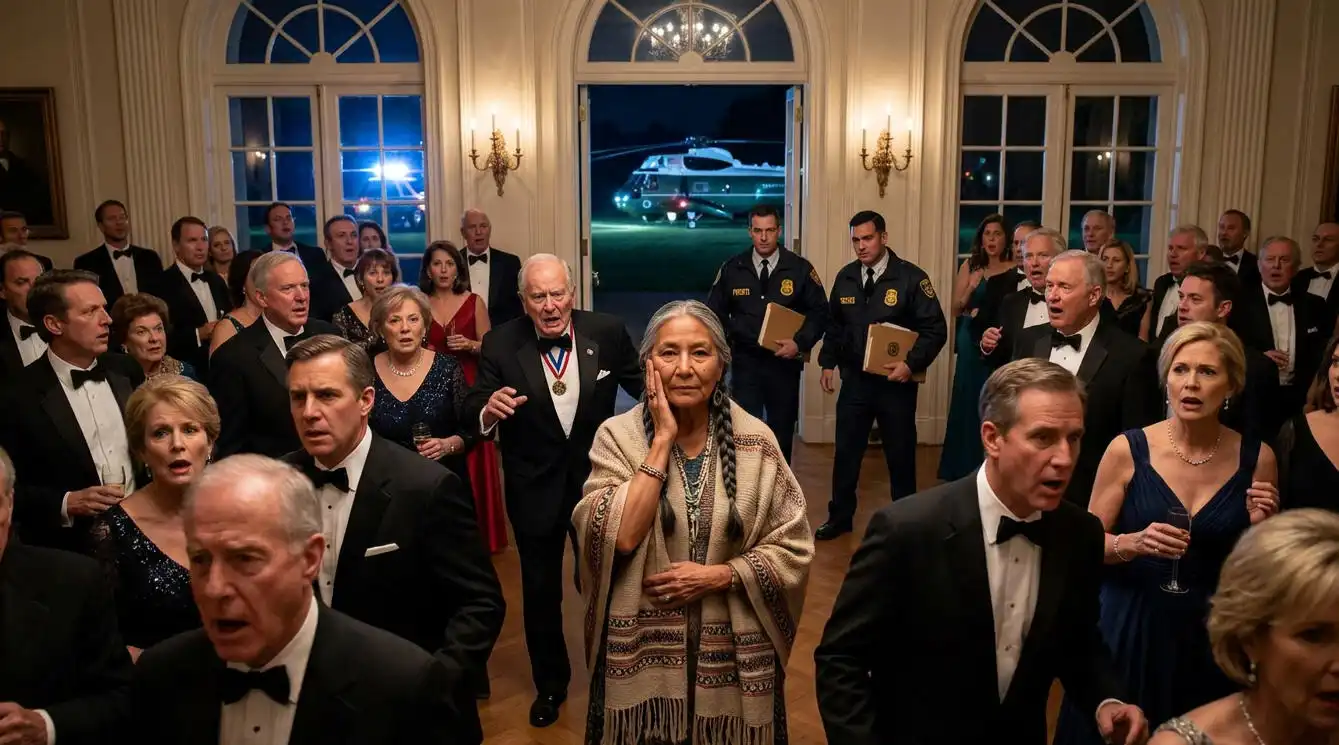
“By order…” the man from the Department of the Interior began, and the entire ballroom seemed to stop breathing.
I could still feel the sting on my cheek.
Not because Constance Whitaker had hit me hard.
She had not.
It was because she had done it smiling.
In front of three hundred people.
In front of judges, donors, museum board members, town councilmen, county reporters, and every person in that room who had spent all night congratulating themselves for “honoring history.”
My grandmother’s shawl sat heavy on my shoulders.
Cedar brown.
River blue.
Red like clay after rain.
My grandmother had woven it the winter before she died. She told me every thread remembered something.
That night, in that gold-covered ballroom, I understood what she meant.
Constance Whitaker stood ten feet away from me, her pearls trembling at her throat.
She was the president of the Whitaker County Historical Society. Her family name was carved into half the plaques in town. Her grandfather had a statue in the courthouse square. Her father had chaired the bank. Her husband’s portrait hung in the country club library.
And because of all that, Constance believed she owned the past.
She believed history was something she could serve with champagne.
She believed Native people belonged in glass cases, not standing onstage with legal documents in a beaded handbag.
The man from the Interior Department held up a red folder sealed with a federal stamp.
“By order of the United States Department of the Interior,” he continued, “and pursuant to the completed review of trust boundaries, treaty records, and federal land patents, this property is hereby recognized as part of Red Willow tribal reservation land.”
A woman near the front dropped her wineglass.
It shattered like a gunshot against the marble floor.
Constance whispered, “No.”
Harold Pritchard, the owner of Silver Crest Country Club, shoved through the crowd.
“This is private property,” he barked. “You can’t walk in here and make some theatrical announcement during a donor event.”
The federal official did not look impressed.
He was tall, gray-haired, and calm in the way men are calm when they have already read every page twice.
“Mr. Pritchard,” he said, “you have received three notices by certified mail.”
Harold’s face tightened.
“I receive a lot of nonsense.”
“You also refused two scheduled meetings,” the official said.
Constance turned on Harold.
“You told me this was handled.”
Harold hissed, “It was.”
I had not moved.
That seemed to bother Constance more than anything.
She wanted me crying.
She wanted me ashamed.
She wanted me to step backward and become the quiet little decoration she had assumed I was.
But I was not decoration.
I was Chairwoman Mara Red Willow of the Red Willow Nation.
And I had been quiet for a reason.
Six months earlier, I had sat across from Harold Pritchard in his private office.
He had kept me waiting for forty-five minutes.
When he finally opened the door, he did not apologize.
He sat behind his polished desk, beneath an oil painting of his great-grandfather, and glanced at my folder like it smelled bad.
“Mrs. Red Willow,” he said.
“Chairwoman Red Willow,” I corrected.
He smiled as if I had told a cute joke.
“Of course.”
I placed copies of the land records on his desk.
“These are federal boundary records,” I said. “They show that Silver Crest Country Club was built on land taken from our people without lawful transfer.”
He leaned back.
“Taken?”
“Yes.”
“That is a very dramatic word.”
“It is also the accurate one.”
Harold tapped one manicured finger on the folder.
“This property has been in private hands for over a century.”
“Wrongfully.”
He laughed.
Not loudly.
Worse.
Softly.
Like I was a child asking for the moon.
“Chairwoman,” he said, “do you understand how many families depend on this club? How many events? How many jobs? How many scholarships our foundation funds?”
“I understand exactly what has been built here.”
“Good. Then you understand we are not handing over a multimillion-dollar institution because of some old tribal grievance.”
Old tribal grievance.
I remember those words.
I wrote them down when I returned to my truck.
I had learned long ago that people reveal themselves when they think you have no power.
Harold offered me coffee.
I refused.
Then he offered what he called a “community partnership.”
A small annual donation.
A plaque in the lobby.
Maybe a Native heritage exhibit near the coat room.
“Something tasteful,” he said.
I looked at him and asked, “Do you mean a display case?”
His eyes warmed with relief.
“Exactly.”
“No.”
His smile disappeared.
“No?”
“This is not a request for a display case. This is a lawful claim.”
He leaned forward.
“Let me give you some advice. People in this town respect patience. They respect gratitude. If you come in swinging legal papers, you will embarrass yourself.”
“I brought evidence.”
“You brought a story,” he said. “And around here, Mrs. Red Willow, stories don’t beat deeds.”
He was wrong.
Some stories are deeds.
Some stories are treaties.
Some stories are maps with signatures.
Some stories survive because grandmothers keep repeating them until a granddaughter is old enough to understand the courthouse records.
I left his office with the folder under my arm.
I did not argue.
I did not threaten.
I did not post about him.
I went home and called our legal team.
Then I called two elders.
Then I drove to my cousin Daniel’s house because he had the old trunk from his mother’s attic, the one no one opened unless they were ready to cry.
Inside were letters.
Ledger pages.
A church map.
A county survey from 1907.
A photograph of Red Willow families standing beside the river, right where the ninth hole now curved around a fountain.
And there was one more thing.
A handwritten note from a federal land agent, acknowledging that the relocation line had been “adjusted for convenience of local development.”
Adjusted for convenience.
That was how they said stolen without saying stolen.
Over the next months, we did everything correctly.
No shouting.
No spectacle.
No revenge fantasy.
We filed.
We documented.
We waited.
And while we waited, Constance Whitaker began planning the Heritage Gala.
The invitation arrived printed on thick cream paper.
“Celebrating the Founding Families of Whitaker County.”
I almost threw it away.
Then I saw the program.
There would be a tribute to “the pioneers who preserved this land.”
There would be a silent auction of “Native-inspired” jewelry made by a designer from Dallas.
There would be a stage display titled: Forgotten Tribes of the Valley.
Forgotten.
I sat at my kitchen table, staring at that word until my coffee went cold.
My granddaughter Lily, who was sixteen, looked over my shoulder.
“Are you going?” she asked.
“Yes.”
“Are you going to yell at them?”
“No.”
“Are you going to sue them?”
“We already did the legal part.”
She smiled a little.
“Then what are you going to do?”
I touched my grandmother’s shawl hanging over the back of the chair.
“I’m going to stand where they can see me.”
The night of the gala, I arrived alone.
That was intentional.
Our attorney wanted to come.
Daniel wanted to come.
Half the council wanted to come.
I told them no.
Not because I was brave.
Because I knew people like Constance.
If I arrived with lawyers, she would perform innocence.
If I arrived with elders, she would perform respect.
If I arrived alone in my grandmother’s shawl, she would perform herself.
And she did.
The ballroom glittered like a jewelry box.
Gold curtains.
White flowers.
Crystal glasses.
A string quartet playing something soft and expensive near the fireplace.
The walls were covered in portraits of men who had named roads after themselves.
At the entrance, a young volunteer checked names.
When I gave mine, she looked down at the list, then back at me.
“Oh,” she said.
That one little word told me plenty.
Constance had put me on the list.
But she had not expected me to come as myself.
I stepped inside.
Conversations dipped as I passed.
A man in a navy blazer looked at my shawl and whispered, “Is she part of the entertainment?”
His wife elbowed him, but not hard enough.
I saw Harold by the bar, laughing with two county commissioners.
When he noticed me, his smile froze.
Then he recovered.
He walked toward me holding a glass of bourbon.
“Well,” he said. “You made it.”
“I was invited.”
“I suppose you were.”
He looked at my shawl.
“That’s quite a statement.”
“It is.”
He lowered his voice.
“Tonight is not the night for politics.”
“Land is not politics when you build on someone else’s.”
His jaw flexed.
“You need to be careful.”
“Do I?”
He stepped closer.
“People here are generous. But they don’t like being accused.”
“I noticed they prefer being celebrated.”
His eyes sharpened.
Before he could answer, Constance swept in like a queen arriving at court.
She wore a silver gown and enough diamonds to light a hallway.
“Mara,” she said, stretching my name like she was trying to make it foreign.
“Constance.”
“I’m surprised you came.”
“I was invited.”
“Yes, as a courtesy.”
She looked me up and down.
Then she smiled for the room.
“And what exactly are you wearing?”
“My grandmother’s shawl.”
“How rustic.”
The people around us pretended not to listen while listening with their whole bodies.
Constance knew it.
She loved an audience.
She touched the edge of the shawl with two fingers, like it might stain her.
“Is it part of the program?”
“No.”
“Then I’m afraid it may confuse the theme.”
“The theme is heritage.”
Her smile thinned.
“The theme is refined heritage.”
A few guests laughed.
Harold cleared his throat, but he did not stop her.
He wanted this.
He wanted me embarrassed enough to leave before the federal officials arrived.
Yes.
By then, I knew they were coming.
Not the exact minute.
But I knew the order had been finalized that morning.
Our attorney had called at 11:14 a.m.
“Mara,” he said, voice shaking, “it’s done.”
I closed my eyes.
For a moment, I was back at my grandmother’s table.
Her hands guiding mine.
Over, under.
Pull the thread.
Do not rush what must hold.
At the gala, Constance moved closer.
“You know,” she said, “many people here have worked very hard to preserve the dignity of this county.”
“Dignity belongs to truth.”
“That sounds lovely on a poster.”
“Or in a court filing.”
Her expression flickered.
Only for a second.
But Harold saw it.
He quickly said, “Constance, the program is starting.”
But she had already tasted blood.
She turned toward the room and lifted her voice.
“Ladies and gentlemen, before we begin, I want to acknowledge that we have a guest tonight wearing what appears to be a very… personal interpretation of history.”
People turned.
Phones came up.
Someone near the back whispered, “This is awkward.”
Constance gestured toward me.
“While we welcome everyone, we must remember that heritage is not costume. It is not grievance. It is not an excuse to disrupt a formal evening.”
My face burned.
Not from shame.
From effort.
It takes effort to stand still when someone is using a microphone to make you small.
A younger man near the stage muttered, “Leave her alone.”
His mother grabbed his sleeve.
Constance heard him.
She laughed.
“Oh, I am being kind.”
Then she stepped down from the stage and came straight to me.
The room opened for her.
That is what power looks like in small towns.
People move before it asks.
She stopped close enough for me to smell her perfume.
“You should have worn something appropriate,” she said.
“This is appropriate.”
“For where?”
“For stolen land.”
The words landed.
The room went dead quiet.
Harold’s glass stopped halfway to his mouth.
Constance’s eyes widened.
Then hardened.
“You ungrateful woman,” she said.
There it was.
Not hidden.
Not polished.
Not buried under charity language.
Just the old truth in a silver gown.
“You sit here enjoying our hospitality,” she said, “in our club, at our event, under our roof, and you insult us?”
“Your roof sits on our land.”
Her hand moved before anyone could stop it.
The sound cracked across the ballroom.
My head turned slightly.
My cheek stung.
Someone gasped.
Someone else said, “She hit her.”
A phone camera light blinked red.
Constance’s hand shook at her side, but she lifted her chin.
“This old rag,” she said, grabbing the shawl again, “does not make you important.”
She let the edge fall.
“This is embarrassment.”
Harold pointed toward the doors.
“Security. Get her out.”
Two security men stepped forward.
One looked uncomfortable.
The other looked at my cheek and hesitated.
I reached into my handbag.
Constance flinched as if I might throw something.
I pulled out one folded paper.
Not the order.
Not yet.
Just a copy of the old survey.
I held it against my chest.
“You should answer one question before they escort me out.”
Harold snapped, “No one is answering your questions.”
I looked at Constance.
“Who wrote the historical society’s exhibit about the founding families?”
“I did,” she said.
“Did you include the relocation records from 1907?”
Her face changed.
Tiny.
But enough.
“I don’t know what you mean.”
“Yes, you do.”
Harold barked, “This is over.”
Then the windows began to tremble.
Thump.
Thump.
Thump.
At first, people looked upward, thinking the sound came from the ceiling.
The string quartet stopped playing.
A waiter froze with a tray of desserts in both hands.
The sound grew louder.
Thump.
Thump.
Thump.
Outside, light swept across the lawn.
The tall windows filled with wind.
White tablecloths rippled.
Someone ran to the glass.
“It’s a helicopter.”
Constance turned pale.
Harold whispered, “They wouldn’t.”
I looked at him.
“They did.”
The helicopter landed beside the fountain, flattening the roses Constance had bragged about during cocktail hour.
The doors opened.
Two Interior officials stepped down first.
Behind them came federal agents in dark jackets.
Not storming.
Not shouting.
Just walking with the calm weight of paperwork that has finally become action.
The ballroom doors opened.
Cold night air rushed in.
The man in the navy coat entered with the red folder.
“Good evening,” he said.
No one answered.
He looked at me first.
“Chairwoman Red Willow.”
I nodded.
Constance’s mouth fell open.
Chairwoman.
The word traveled through the room like a lit match.
A woman near the dessert table whispered, “She’s the tribal chairwoman?”
Another said, “Constance slapped her?”
Harold tried to recover.
“This is a private event.”
The official ignored that.
He opened the folder and read the order.
Every sentence struck harder than Constance’s hand.
The land beneath Silver Crest Country Club had been included in a federal trust boundary.
The 1907 adjustment had been unlawful.
The county filings used by Harold’s family had relied on an invalid transfer.
The historical society’s archive contained records proving dispute notice as early as 1923.
And Silver Crest had continued operating after receiving federal notice.
Constance shook her head.
“No. Our archives preserve history. We don’t hide it.”
I finally spoke.
“You locked the Red Willow files in a storage room under the west stairwell.”
Her eyes snapped to mine.
The official looked down at his notes.
“During the review, a volunteer archivist provided photographs of restricted boxes labeled ‘Indian Land Correspondence.’ Those boxes were not included in the public catalog.”
People turned toward Constance.
She pointed at me.
“This is a setup.”
“No,” I said. “A setup is when you invite me here to humiliate me before donors while knowing your own records support our claim.”
Harold lunged into the conversation.
“I never knew about those boxes.”
Constance laughed once.
A sharp, ugly sound.
“You liar.”
The room shifted again.
Now they were turning on each other.
That was the thing about false nobility.
It looked solid until consequence entered the room.
Then every polished person searched for someone lower to push under the wheel.
Constance faced Harold.
“You told me if we kept the archive sealed, their petition would die.”
A man near the front said, “Oh my Lord.”
Harold snapped, “Shut up, Constance.”
But she was panicking now.
Her diamonds flashed as she waved her hands.
“You said the club’s attorneys had influence. You said the Interior review was political theater. You said that woman had no standing.”
That woman.
Even then, she could not say my name.
The official closed the folder.
“Mr. Pritchard, Ms. Whitaker, you are both named in the referral documents.”
Harold swallowed.
“Referral to whom?”
“Federal investigators.”
Constance grabbed the back of a chair.
“For what?”
“Concealment of relevant records, false statements during a federal land review, and continued occupation after formal notice.”
A murmur rose.
The kind of murmur that becomes tomorrow’s town before midnight.
Reporters moved forward.
Phones lifted higher.
Harold’s wife covered her face.
The mayor stared at the floor.
One of the county commissioners quietly stepped away from Harold as if distance could erase photographs.
The official continued.
“Effective immediately, Silver Crest Country Club is closed pending transfer and compliance review. All guests must leave in an orderly manner. Staff will be compensated through the transition fund established in the federal settlement.”
Harold exploded.
“You can’t close my club.”
The official looked at him.
“It was never fully yours.”
That sentence did what no shouting could have done.
It emptied Harold.
His shoulders dropped.
His mouth opened, but no sound came.
Constance, however, still had pride left to burn.
She turned to the crowd.
“You all know me,” she cried. “You know what my family has done for this county.”
A man in the back said, “We know what you just did.”
Another voice added, “On camera.”
Constance touched her pearls.
Her gaze darted across the room, searching for loyalty.
She found silence.
That was the first real punishment.
Not the agents.
Not the headlines.
Not the investigation.
The silence.
For years, people had laughed when she laughed.
Moved when she moved.
Clapped when she clapped.
Now they looked away.
The two federal agents approached her.
“Ms. Whitaker,” one said, “we need you to come with us to answer questions.”
She recoiled.
“Here? In front of everyone?”
The agent said nothing.
Of course in front of everyone.
That was where she had chosen to strike me.
Harold tried to slip toward a side hallway, but another agent stopped him.
“Mr. Pritchard, you too.”
“This is outrageous,” he said.
But his voice was thin now.
The kind of thin that comes when a man realizes his name cannot open the door he needs.
As they led Constance past me, she stopped.
For one second, I thought she might apologize.
Not because she was sorry.
Because cameras were there.
Instead, she looked at my shawl and whispered, “You people ruin everything.”
I stepped closer.
The agent paused.
I spoke softly, so only she and the nearest cameras could hear.
“No, Constance. We remember everything.”
Her face broke.
Not into tears.
Into rage.
But rage had nowhere left to go.
They walked her out through the same doors she had wanted security to use on me.
Outside, the helicopter lights washed the lawn white.
Inside, guests stood among melting ice sculptures and abandoned plates of prime rib.
The gala was over.
But the real history lesson had just begun.
The next morning, every local channel carried the story.
Not the version Constance would have written.
The real one.
The slap.
The hidden archive.
The federal order.
The closed country club.
The historical society board called an emergency meeting at 8 a.m.
By noon, they voted to suspend operations.
By Friday, the state historical commission announced a full audit of their collections.
By the following week, the Whitaker County Historical Society was ordered dissolved and reorganized under an independent public trust.
Its private donor wing was frozen.
Its restricted archive was opened.
Boxes came out that had not seen daylight in decades.
Letters from Native families asking about burial grounds.
Survey maps.
Complaints.
Receipts.
Warnings.
Every “lost” document had been sitting there, waiting for someone honest enough to read it.
Constance resigned before she could be removed.
It did not save her.
Federal investigators took her statement.
Then another.
Then Harold’s.
Then the club attorney’s.
The truth came out the way truth often does.
Not as one thunderclap.
As a hundred small doors opening.
Harold’s grandfather had known the land transfer was disputed.
Constance’s father had helped move the files out of public view when the first tribal petition was filed in the 1970s.
The country club had quietly paid for “archive preservation” every year, but the money had strings.
Certain boxes stayed closed.
Certain names stayed out of exhibits.
Certain stories stayed “forgotten.”
And the gala?
That was supposed to be their victory lap.
They planned to raise enough money to expand the club’s west wing and build a “Founders Legacy Center” directly over the old river road where our families had once gathered.
That was why Harold was so nervous when I arrived.
That was why Constance needed me mocked before I could speak.
They were not defending history.
They were burying evidence under flowers and champagne.
Three months later, I returned to Silver Crest.
But it was not Silver Crest anymore.
The sign had been removed.
The fountain was dry.
The golf flags were gone.
The ballroom doors stood open.
Not for donors.
For elders.
For families.
For tribal council members.
For federal workers carrying clipboards.
For local schoolteachers who wanted to know what they had never been taught.
My granddaughter Lily walked beside me.
She wore jeans, sneakers, and the small beaded earrings my sister had made her.
She looked up at the chandelier.
“This place feels smaller now,” she said.
“It was always smaller than it pretended to be.”
She smiled.
In the ballroom, folding tables had replaced the gala decorations.
On one table sat the recovered archive boxes.
On another sat photographs from Red Willow families.
Not as props.
Not as decoration.
As record.
Daniel stood near the fireplace with two elders, laughing softly.
When he saw me, he touched his heart.
I touched mine back.
The Interior official was there too.
No red folder this time.
Just a cup of coffee and tired eyes.
“The transfer process will take time,” he told me.
“Most things worth repairing do.”
He nodded.
“We’ve also confirmed the staff transition fund. No employees will lose wages during the closure period.”
That mattered to me.
Because revenge that crushes innocent workers is not justice.
Justice knows where to aim.
Harold had tried to use employees as a shield.
We would not use them as casualties.
The kitchen staff stayed through the transition.
The grounds crew was rehired.
The old ballroom became a public cultural center.
The west wing expansion was canceled.
The land near the river was fenced off, surveyed, blessed, and protected.
A year later, we held the first Red Willow Heritage Supper there.
Not a gala.
A supper.
No champagne tower.
No velvet rope.
No portraits of men pretending they discovered a place already loved.
Just long tables.
Corn soup.
Fry bread.
Roasted vegetables.
Blueberry cobbler.
Children running between chairs.
Veterans talking near the door.
Elders telling stories while teenagers pretended not to listen and secretly recorded every word.
I wore my grandmother’s shawl again.
When I walked into the ballroom, the room stood.
Not because I demanded it.
Because they understood what the shawl carried.
Lily came to my side and adjusted one corner of it.
“Grandma,” she whispered, “are you nervous?”
“Yes.”
“Still?”
“Especially now.”
She frowned.
“But you won.”
I looked around the room.
At the elders.
At the opened archives.
At the river photographs.
At the place where Constance had once stood with her microphone and her diamonds and her borrowed authority.
Then I looked at my granddaughter.
“No,” I said. “We were remembered. That is better than winning.”
Later that evening, a woman approached me near the dessert table.
She was older, maybe in her seventies.
I recognized her from the gala.
She had been sitting two tables away when Constance slapped me.
She held a paper plate in both hands like she needed something to steady her.
“Chairwoman Red Willow,” she said.
“Yes?”
“I need to tell you something.”
I waited.
“I laughed that night.”
I remembered.
She looked down.
“I told myself it was because I was uncomfortable. But that is not the truth. I laughed because everyone else did. Because Constance laughed. Because I was afraid not to.”
Her eyes filled.
“I am sorry.”
I studied her face.
There was no performance in it.
No camera nearby.
No audience.
Just an old woman holding cobbler and shame.
“Thank you,” I said.
She nodded, wiped her cheek, and whispered, “My grandson asked me why I didn’t stand up. I didn’t know what to tell him.”
“Tell him the truth.”
“That I was a coward?”
“That you learned.”
She breathed out like I had handed her something heavy but possible.
Across the room, Lily watched us.
Later, she asked, “Do you forgive her?”
“I accept her apology.”
“That’s not the same.”
“No,” I said. “It isn’t.”
She thought about that.
Then she nodded.
Good.
I wanted her to know the difference.
Healing does not mean pretending harm was small.
Forgiveness is not a performance for people who want to feel comfortable.
And dignity is not something another person gives you after they are done humiliating you.
Dignity is what remains when the room tries to take everything else.
Constance never returned to public life.
Her name came off the society letterhead.
The statue of her grandfather did not come down right away, but a new plaque went beside it.
A truthful one.
It told the whole story.
Not cruelly.
Not dramatically.
Completely.
Harold sold two vacation homes to cover legal costs.
The club’s old board dissolved.
Several donors who had funded the “Founders Legacy Center” asked for their names to be removed from the project records.
Funny how quickly people stop loving history when it starts telling on them.
But the best part did not happen in court.
It happened on a Tuesday morning.
A school bus pulled up outside the new Red Willow Cultural Center.
Fourth graders poured out wearing backpacks and bright sneakers.
Their teacher led them inside.
I stood near the entrance in my grandmother’s shawl.
One little girl looked at the woven patterns and asked, “Is that old?”
I smiled.
“Yes.”
“Is it famous?”
I thought of Constance calling it a rag.
I thought of Harold smirking at the bar.
I thought of my grandmother’s hands.
Then I bent down and said, “It is loved.”
The little girl nodded like that made perfect sense.
And maybe it did.
That evening, when the building emptied, I walked alone to the tall windows overlooking the lawn.
The fountain was gone now.
In its place, young cedar trees had been planted in a circle.
The sunset touched the glass.
For a moment, I could almost see the gala again.
The chandeliers.
The raised phones.
The slap.
The silence.
Then the helicopter lights.
The red folder.
The truth walking in through the front door.
I touched my cheek.
The sting was long gone.
But I kept the memory.
Not because I wanted bitterness.
Because memory is a boundary.
It says: this happened.
It says: they tried.
It says: we are still here.
My grandmother used to say a shawl is not just worn.
It carries you when your knees want to bend.
That night, in a room built to erase us, her shawl carried me.
And when the truth finally arrived, I did not have to shout.
I only had to stand.
So pick a side and say it plainly: stand with the woman who protected her people’s history, or stand with the “society queen” who thought a title and a ballroom made her untouchable. Share this if you believe truth should never have to ask permission.
Disclaimer: Mention of any brand or trademark is for identification only and does not imply partnership or endorsement