
CHAPTER 1 — THE CHALLENGE
Still smirking, Mason shoved the unzeroed rifle into Frank’s oil-slick hands and said, “Go ahead, old man—show them what you think that scope can do.”
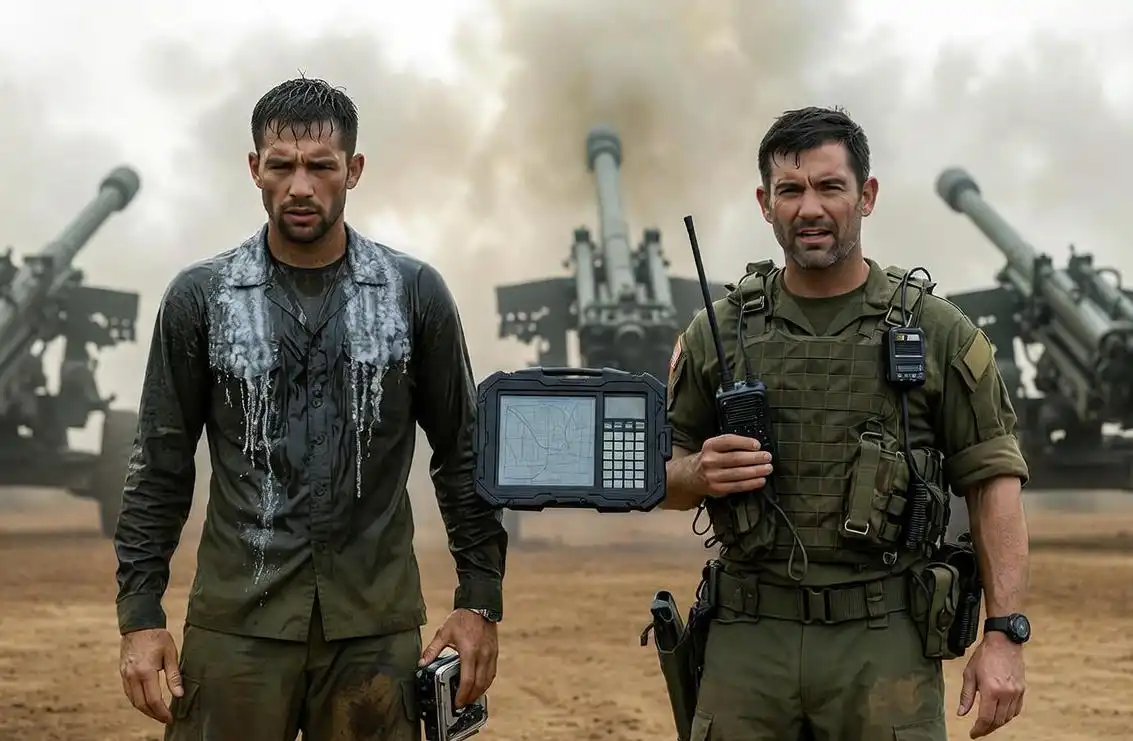
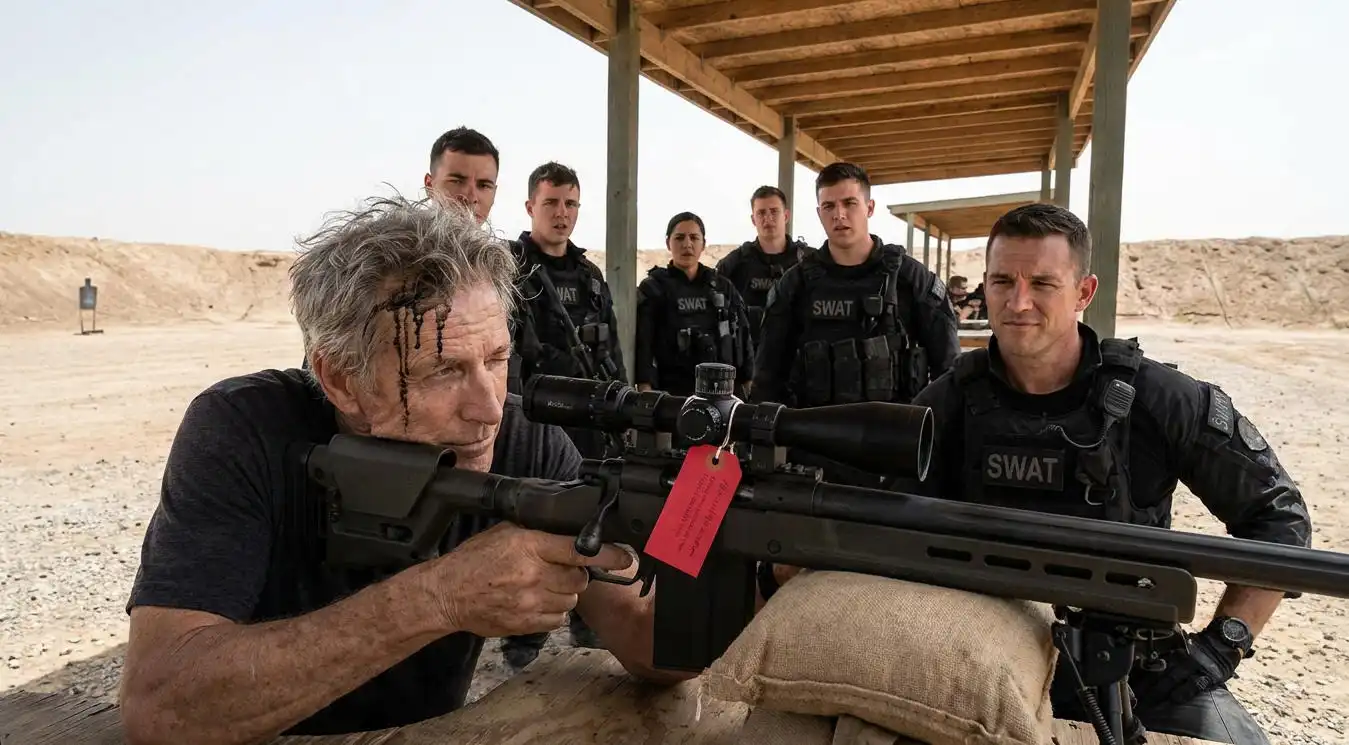
Frank’s fingers closed around the rifle while oil continued dripping from his jaw. His right eye stayed fixed on the red maintenance tag stretched across the scope turrets. Behind him, the last trace of laughter died along the firing line.
Far downrange, the coin-sized steel target continued moving.
Frank lowered the rifle instead of immediately raising it.
He checked the chamber, the safety, and the muzzle direction with the same patient movements he had used before Mason poured oil over him.
Mason spread his arms.
“What’s wrong?” he asked. “Need another hour to clean it?”
Nobody laughed this time.
Frank inspected the scope without touching either adjustment turret.
“The optic took an impact,” he said. “The point of aim and point of impact are no longer aligned.”
“I already told you it’s fine.”
“No,” Frank replied. “You told me you wanted it returned.”
Mason’s jaw tightened.
He had an advanced qualification assessment scheduled the next morning. If the rifle remained tagged, he couldn’t use it. And without that rifle, he risked losing his position as the team’s primary sniper.
That was why he had been pressuring Frank all morning.
Mason turned toward the other officers.
“Listen to him,” he said. “He thinks a red tag makes him important.”
Frank glanced toward Leonard Briggs, the armory supervisor.
“Is the target rail running at standard speed?”
Briggs looked startled by the question.
Then he nodded.
“Standard speed. Thirty-eight yards of lateral travel.”
Mason laughed again, but it sounded forced.
“What are you planning to do, estimate it to death?”
Frank wiped one last stream of oil from the corner of his eye.
“You challenged me in front of your team,” he said. “I’m making sure they understand the conditions.”
Mason stepped into his space.
“The condition is simple. Either you hit it, or you admit you don’t know anything about precision shooting.”
Frank looked at the officers who had laughed.
Then he looked at the supervisor who had been too afraid to speak.
Finally, he looked at Mason.
“If I take this shot,” Frank said, “the target keeps moving. Nobody touches the rail controls.”
Mason folded his arms.
“Fine.”
“And you agree the scope remains exactly as I received it.”
“I don’t need your excuses.”
Frank turned toward the firing line.
He placed the rifle against his shoulder.
He didn’t adjust the scope.
He didn’t request a test round.
Briggs took one slow step forward.
“Frank,” he said quietly, “you don’t have to prove anything to him.”
Frank settled his cheek against the stock.
“No,” he answered. “But somebody has to teach him why that tag matters.”
His finger moved toward the trigger.
“Don’t stop the target.”
CHAPTER 2 — ONE SHOT
The rifle cracked.
The sharp report rolled across the range and struck the concrete walls of the armory.
For half a second, nothing moved except the target rail.
Then the coin-sized steel plate snapped backward with a bright metallic ring.
The entire firing line went silent.
Frank kept the rifle pointed downrange. He engaged the safety, opened the action, and placed the rifle carefully on the bench.
He still had not touched the scope turrets.
Mason stared at the distant target.
“No,” he said.
Briggs picked up the range binoculars.
A clean impact mark sat nearly in the center of the tiny moving plate.
One of the younger officers whispered, “He hit it.”
Another shook his head.
“With an unzeroed optic.”
Mason grabbed the binoculars from Briggs.
He looked once.
Then again.
“That was luck.”
Frank began wiping oil from the rifle stock.
Mason slammed the binoculars down.
“You knew where the scope was off.”
“I knew the rifle,” Frank said.
“That’s the same thing.”
“No. It isn’t.”
Mason stepped toward the bench and reached for the weapon.
Frank moved his hand between Mason and the rifle.
“Don’t touch it.”
The calm warning stopped Mason more effectively than a shout.
Mason’s face reddened.
“You don’t give orders to me.”
Frank lifted the red maintenance tag.
“This does.”
The tag contained the rifle’s serial number, the reported impact damage, the inspection time, and Frank’s signature. It clearly stated that the optic had not been recalibrated and that the weapon was restricted from operational or qualification use.
Mason had seen it before pouring the oil.
He had ordered Frank to remove it.
When Frank refused, Mason decided to humiliate him in front of the team.
Mason pointed at the tiny target.
“One lucky shot doesn’t give a bench worker authority over an operator.”
Briggs suddenly stepped between them.
“That’s enough.”
Mason turned on him.
“You stayed quiet before. Stay quiet now.”
Briggs flinched.
For years, Mason’s scores and reputation had protected him from criticism. He was the unit’s best-known marksman, the man commanders requested for demonstrations and difficult deployments.
Briggs had learned that arguing with him usually ended badly.
But the rifle on the bench was still tagged.
Oil still covered Frank’s head and shirt.
And six officers had watched Mason ignore a safety restriction, assault a contracted armorer, and pressure him to clear a damaged optic.
Briggs straightened his shoulders.
“This firing line is closed to you,” he said.
Mason stared at him.
“You can’t close my line.”
“I just did.”
“I’m the primary sniper.”
“Not while that rifle is under restriction.”
Mason laughed bitterly.
“So we’re all pretending the old man’s trick shot changes the chain of command?”
Briggs looked at Frank.
Then he looked back at Mason.
“Do you have any idea who you just poured gun oil on?”
For the first time that afternoon, Mason had no quick answer.
CHAPTER 3 — THE NAME THEY NEVER ASKED ABOUT
Mason looked Frank up and down.
“I know exactly who he is,” he said. “He’s a maintenance contractor.”
“That’s his current job,” Briggs replied.
Frank quietly removed the rifle’s magazine and placed it beside the red tag.
Briggs continued.
“His name is Frank Mercer.”
One of the older SWAT officers lifted his head.
The name meant something to him.
Mason noticed.
“What?” Mason demanded.
The officer hesitated before answering.
“Mercer wrote part of the long-range judgment course.”
Mason frowned.
Briggs nodded.
“Master Sergeant Frank Mercer. Retired Army sniper and instructor. Twenty-seven years of service. He trained military and federal teams before most of us had ever touched a precision rifle.”
The younger officers looked from Briggs to the oil-soaked man beside the bench.
Frank did not smile.
He did not stand taller.
He simply continued protecting the rifle Mason had treated like a prop.
Mason shook his head.
“That doesn’t prove anything.”
Frank finally looked at him.
“You’re right.”
Mason blinked.
Frank tapped the red maintenance tag.
“My past does not decide whether this rifle is safe today. The inspection does.”
He pointed toward the scope.
“The rifle was dropped hard enough to shift the optic. I measured the error during inspection. I hadn’t finished correcting it when you demanded the weapon.”
Mason’s expression changed.
Only slightly.
But everyone saw it.
Frank continued.
“You didn’t want an inspection. You wanted my signature.”
Mason turned toward the officers.
“He’s twisting this.”
Briggs spoke before anyone else could.
“Did you order him to remove the maintenance tag?”
Mason said nothing.
Briggs looked at the first officer.
The man swallowed.
“Yes. He did.”
Another officer stepped forward.
“He told Frank to sign the clearance sheet and fix the scope after qualification.”
Mason’s eyes narrowed.
“You were laughing with me.”
The officer looked ashamed.
“I was. I shouldn’t have been.”
A third officer spoke.
“You said no bench cleaner was going to cost you the primary slot.”
The words hung over the firing line.
Frank had remained silent during the humiliation because he wanted Mason to keep talking. Not because Frank needed revenge, but because a man like Mason could always deny a private warning.
He couldn’t deny six witnesses.
Mason pointed at Frank.
“He deliberately kept the rifle tagged because he wanted to embarrass me.”
Frank’s voice stayed level.
“I tagged it before you entered the armory.”
Briggs picked up the tag and checked the written inspection time.
It had been completed forty-three minutes before Mason arrived.
The evidence chain was simple.
The rifle had arrived damaged.
Frank had documented the problem.
The red tag had made the restriction visible.
Mason had seen the restriction and demanded that it be ignored.
When Frank refused, Mason publicly attacked and humiliated him.
Briggs faced Mason.
“Under range policy, intimidation of maintenance staff and unauthorized handling of a restricted weapon require immediate removal from armed duty pending review.”
Mason’s posture stiffened.
“You won’t do that.”
Briggs took Mason’s range credential from the edge of the bench.
“I already have.”
CHAPTER 4 — THE RULE MASON COULDN’T OUTRANK
Mason stared at the credential in Briggs’s hand.
“That position belongs to me.”
“It belongs to whoever can be trusted with it,” Briggs said.
Mason looked toward his teammates, expecting at least one of them to defend him.
Nobody did.
He turned back to Frank.
“You set me up.”
Frank slowly removed his oil-soaked outer shirt and laid it beside the bench.
“No. I told you the scope was damaged.”
“You knew I had qualification tomorrow.”
“That didn’t change the condition of the rifle.”
“You could have cleared it.”
“I could have lied.”
Mason stepped closer.
Frank didn’t move.
The difference between them was obvious. Mason was younger, stronger, armed, and publicly celebrated. Frank looked like an exhausted older technician with oil in his hair.
But Mason was the one losing control.
“You think one trick shot makes you better than me?” Mason asked.
“No.”
Frank pointed toward the red tag.
“Respecting that makes me safer than you.”
Mason’s nostrils flared.
Briggs opened the armory’s procedure binder already resting on the workbench. The policy had not appeared from nowhere. Every officer had signed it before receiving range access.
Briggs read the relevant section aloud.
“A weapon marked restricted may not be removed, loaded, transferred, or presented for qualification until cleared by an authorized armorer. Attempting to force, threaten, or improperly influence clearance results in immediate suspension.”
Mason glanced at the officers.
“You’re going to let him destroy my career over a tag?”
Frank shook his head.
“The tag didn’t pour oil on anyone.”
Mason froze.
“The tag didn’t grab a restricted rifle,” Frank continued. “It didn’t order a false clearance. And it didn’t challenge a maintenance worker to fire an unsafe weapon just so the team could laugh.”
Every consequence had come from Mason’s own choices.
His pressure had created witnesses.
His humiliation had exposed his motive.
His challenge had placed the tagged rifle in Frank’s hands in front of everyone.
Even the shot Mason called “luck” proved Frank had understood the exact defect Mason wanted ignored.
Mason looked toward the distant steel plate.
His voice dropped.
“How did you hit it?”
Frank studied him for a moment.
“I trusted what the rifle told me more than what the scope showed me.”
Mason waited for more.
Frank gave him nothing else.
That answer hurt more than boasting would have.
Briggs placed Mason’s credential inside his pocket.
“You are suspended from armed duty. The commander will receive statements from every person here.”
Mason’s face went pale.
“My assessment—”
“Canceled.”
“My primary position—”
“Vacant.”
Mason clenched his fists.
“You can’t take my position because of one old man’s word.”
Briggs looked around the firing line.
“Not his word.”
He pointed to the officers who had watched Mason’s behavior from beginning to end.
“Your own orders, spoken in front of your entire team.”
CHAPTER 5 — THE POSITION HE THREW AWAY
Mason stood alone beside the firing bench.
Minutes earlier, he had expected the officers to laugh whenever he laughed.
Now they avoided his eyes.
Briggs requested statements one at a time.
The first officer confirmed that Mason had demanded a clearance signature before the inspection was complete.
The second repeated Mason’s exact words:
“Remove the tag. I outrank a bench cleaner.”
The third described the oil being poured over Frank’s head.
Another admitted Mason had grabbed the rifle after Frank warned him that the optic was not calibrated.
No one exaggerated.
They didn’t need to.
The facts were enough.
Mason listened as the position he had spent years earning disappeared piece by piece.
When the final officer finished, Mason removed the lead-sniper patch from his equipment bag.
He held it for several seconds.
Then he placed it on the bench beside his suspended credential.
“I won’t sit behind a desk while you investigate me,” he said.
Briggs watched him carefully.
“What are you saying?”
“I’m resigning from the primary position.”
His voice cracked on the final word.
Nobody celebrated.
Frank picked up the patch and held it out to Mason.
“Don’t leave that here.”
Mason stared at him.
“Why do you care?”
“Because throwing away a patch doesn’t take responsibility.”
Mason slowly accepted it.
Frank continued.
“A sniper can miss and retrain. Equipment can fail and be repaired. But when you believe your status makes safety rules optional, everyone around you is in danger.”
Mason looked down at the patch.
For the first time, he seemed less angry than ashamed.
“I really thought you were just trying to delay me.”
“You never asked.”
“You could’ve told me who you were.”
Frank’s expression remained calm.
“You shouldn’t need a man’s résumé before deciding whether to treat him with dignity.”
Mason had no answer.
He left the range without his credential and without the position he had believed no one could take from him.
After he disappeared inside the armory, Briggs turned toward Frank.
“I should have spoken sooner.”
“Yes,” Frank said.
Briggs absorbed the answer.
No excuses softened it.
Then Briggs pulled a folded instructor proposal from his office clipboard. He had prepared it weeks earlier but had never found the courage to offer it. The unit needed someone who could teach judgment, patience, equipment discipline, and precision under pressure.
The proposed salary was more than twice Frank’s armory contract rate.
“Three years,” Briggs said. “Lead precision-rifle instructor. Full authority over equipment clearance and qualification standards.”
Frank read the page.
The officers waited.
“I have one condition,” he said.
Briggs nodded.
“No officer uses rank, a patch, or a weapon to humiliate anyone working under them. Not an armorer. Not a custodian. Not a new recruit.”
Briggs held out his hand.
“Agreed.”
Frank looked at the oil stains covering the concrete.
Then he shook it.
CHAPTER 6 — WHAT THE TEAM LEARNED
The following morning, Frank returned to the same firing line.
His hair was clean.
He wore a fresh armory shirt, and the instructor agreement was signed inside Briggs’s office.
The damaged scope had been properly recalibrated during the night. The red maintenance tag now rested inside the rifle’s service record, preserving the complete chain of what had happened.
Origin: the rifle had arrived after a hard impact.
Visibility: Frank had documented the defect and physically restricted the scope with a red tag.
Meaning: the weapon could not be used until an authorized armorer cleared it.
Consequence: Mason’s demand to ignore the restriction, followed by the public assault and unauthorized handling, had triggered his suspension and cost him the primary position.
Nothing had appeared at the last second.
Nothing depended on Frank secretly holding power over the unit.
Mason had been defeated by the rule he knowingly violated and by the people who heard him violate it.
The SWAT officers assembled in front of Frank for their first class.
The men who had laughed now stood silently.
Frank placed the repaired rifle on the bench.
“We’re not starting with shooting,” he said.
One officer glanced toward the distant targets.
Frank tapped the maintenance record.
“We’re starting with judgment.”
He explained that precision did not begin when a finger reached the trigger. It began when someone accepted that equipment, conditions, and procedures mattered more than pride.
“A bad shooter may miss a target,” Frank told them. “An arrogant shooter may ignore the warning that prevents a tragedy.”
Briggs stood behind the group and listened like everyone else.
At the end of the class, the youngest officer approached Frank.
“I’m sorry I laughed.”
Frank looked at him.
“Why did you?”
The officer lowered his eyes.
“Because everyone else did.”
“That answer should bother you more than the apology comforts me.”
“It does.”
Frank nodded.
“Then remember it next time someone is standing alone.”
The officer offered Frank a clean shop towel.
Frank accepted it.
Across the bench, the repaired rifle waited for its next inspection. The scope was aligned, the service record was complete, and no one touched it without permission.
Mason’s name was removed from the primary schedule that afternoon. He remained eligible to apply for another assignment after the formal review, but he would have to rebuild trust from the beginning.
Frank did not ask for Mason to be ruined.
He asked for the rules to be enforced.
That was enough.
By the end of the month, Frank’s classes had become mandatory for every precision-qualified officer on the base. The officers learned the techniques they expected from a legendary retired sniper, but the lesson they repeated most often had nothing to do with marksmanship.
Never confuse silence with weakness.
Never mistake a person’s current job for the full measure of their experience.
And never demand respect while refusing to give it.
Frank had entered the range as the man Mason believed cleaned rifles for important people.
He left it as the instructor trusted to decide who was ready to carry one.
Was Frank right to let skill, witnesses, and official rules answer Mason’s humiliation—or should Mason have been permanently removed from the unit? Comment your choice, and share this story with someone who believes respect should come before rank.
Disclaimer: Mention of any brand or trademark is for identification only and does not imply partnership or endorsement