
CHAPTER ONE — HOLD YOUR FIRE
Harlan’s thumb froze over the radio’s transmit switch.
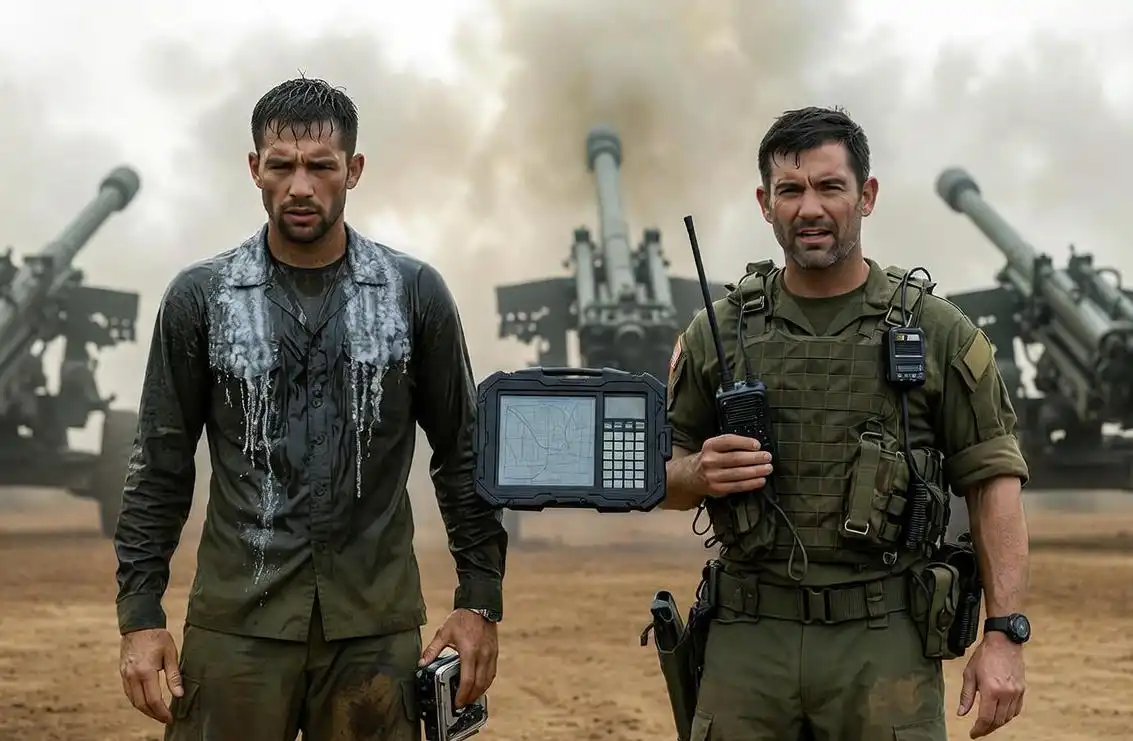
Colonel Ward held Daniel’s tablet between them, its red impact box glowing over the blue friendly position. Daniel stood with ice water dripping from his sleeves and range dirt covering one knee. Behind them, the gun chiefs had stopped moving.
For the first time that morning, Major Brent Harlan had no immediate answer.
Then he laughed.
“It’s a modeling error,” he said. “Mercer has been pushing that homemade algorithm for months.”
Daniel did not react to the insult.
Ward kept her eyes on the screen.
“Did you verify his warning?”
“I verified the approved coordinates.”
“That wasn’t my question.”
Harlan’s face tightened.
The field radio crackled in his hand.
“Command post, gun line,” a voice said. “Standing by for fire order.”
Harlan lifted the handset again.
Ward took it from him.
“All batteries, this is Colonel Ward,” she said. “Hold fire. Do not load additional rounds. Do not transmit firing data until released by me.”
The gun crews answered one after another.
“Battery One holding.”
“Battery Two holding.”
“Battery Three holding.”
Harlan stared at her.
“Ma’am, this exercise is already twelve minutes behind schedule.”
Ward handed the radio to a member of her inspection team.
“A delayed exercise can be corrected,” she said. “A round landing on American soldiers cannot.”
Harlan pointed at Daniel.
“He is exaggerating the risk because I rejected his experimental system.”
Daniel finally spoke.
“My system did not move the friendly observation team, sir.”
A few gun chiefs looked toward him.
Daniel continued calmly.
“The exercise update moved them six hundred meters northeast. The target coordinates in the original fire plan were never recalculated after that change.”
“I ordered a manual adjustment,” Harlan snapped.
“You ordered the original coordinates restored.”
“I ordered the mission completed.”
Ward raised the tablet.
“Staff Sergeant Mercer, where did these two coordinate sets come from?”
“The first set came from the certified survey completed before sunrise. The second set was entered under command authorization after I submitted the correction.”
“Can you identify which person authorized the change?”
Daniel looked directly at Harlan.
“Yes, ma’am.”
Harlan stepped forward.
“Be careful, Sergeant.”
Daniel’s voice did not change.
“The tablet keeps an audit trail.”
The silence around the firing line became heavier.
Ward touched the screen and opened the log.
Two timestamped entries appeared.
One was Daniel’s corrected firing solution.
The other had replaced it seven minutes later.
Ward studied the authorization field.
Then she looked at Daniel.
“Show me exactly what he overrode.”
CHAPTER TWO — THE ORDER IN THE LOG
Daniel took the tablet without looking at Harlan.
He expanded the morning survey map.
“This black line is the certified gun position,” he explained. “The green box is the authorized target zone. The blue marker is the friendly observation team after the exercise update.”
Ward pointed to a yellow symbol.
“And this?”
“The first-round impact prediction using the corrected coordinates.”
The yellow symbol sat safely inside the target area.
Daniel tapped the second coordinate set.
A red impact pattern appeared.
It crossed the boundary and covered the blue marker.
Several gun chiefs quietly cursed under their breath.
The forward observer who had been staring at his boots finally looked up.
Harlan heard him.
“You have something to report?” the major demanded.
The observer hesitated.
Ward turned toward him.
“You will answer honestly. Was Staff Sergeant Mercer’s warning communicated to the command post?”
“Yes, ma’am.”
“When?”
“Before the guns received final data.”
“How many times?”
“Twice.”
Harlan pointed at the observer.
“He reported uncertainty. He did not report a confirmed danger.”
The observer swallowed.
“I said the new coordinates placed the probable impact area close to our position.”
“Close is not the same as inside.”
Daniel tapped the tablet again.
“The first report used the standard safety estimate. I ran the full calculation after receiving the latest wind and elevation data.”
“And what did that show?” Ward asked.
“That the center of impact would shift farther toward the friendly position.”
Harlan scoffed.
“Based on his algorithm.”
“Based on measured wind, verified elevation, barrel wear, and the updated position report,” Daniel said. “The algorithm only processed the data.”
Harlan moved close enough that their shoulders nearly touched.
“You are still refusing to obey a lawful order.”
Daniel looked at the loaded guns.
“An order to fire knowingly unsafe coordinates is not lawful.”
The sentence landed harder than the shove had.
Harlan’s cheeks reddened.
He turned to Ward.
“You are allowing an enlisted technician to question a battalion commander in front of his own soldiers.”
“No,” Ward said. “I’m allowing the person holding the evidence to explain it.”
She scrolled farther down the audit log.
The corrected coordinates had been entered at 09:14.
At 09:21, they had been replaced.
The replacement entry carried a command authorization code.
Ward read the code twice.
Harlan reached toward the tablet.
“That log doesn’t prove who physically touched the system.”
Daniel pulled up the authentication details.
The authorization required both a personal command code and a biometric confirmation.
Ward rotated the tablet toward Harlan.
A fingerprint verification icon appeared beside his name.
She tapped the authorization line.
“Major Harlan, is this your code?”
CHAPTER THREE — WHAT THE WATER COULD NOT ERASE
Harlan did not deny it.
Instead, he changed the argument.
“I authorized the coordinate set because Mercer’s recommendation would have forced us to resurvey the mission. That would have delayed the exercise by at least forty minutes.”
Ward’s expression hardened.
“So you received his warning.”
“I received his opinion.”
“You replaced his calculation after receiving it.”
“I exercised command judgment.”
Daniel glanced at the damaged survey instrument lying in the dirt.
Harlan noticed.
“Don’t pretend that equipment is the issue,” he said. “A little water didn’t destroy anything.”
Daniel crouched beside the instrument.
He did not try to turn it on.
“The instrument stored the original field measurements,” he said. “It synchronized them to the tablet after each survey point.”
Ward understood immediately.
“The tablet contains an independent copy.”
“Yes, ma’am.”
Harlan’s confident expression slipped again.
The water had damaged expensive equipment.
But it had not erased the survey.
It had not erased the timestamps.
And it had not erased his authorization.
Ward asked Daniel to display the data from the beginning.
Daniel showed the certified reference point.
Then the gun positions.
Then the original target coordinates.
Then the updated message moving the observation team.
Finally, he displayed the correction he had submitted.
Every step had a time.
Every entry showed its source.
Every change remained visible.
“This is the evidence chain,” Ward said. “Original survey, updated friendly position, corrected solution, command override.”
Harlan folded his arms.
“There was still no guarantee a round would strike them.”
Daniel looked at him.
“That is why we use safety limits, sir. We don’t fire and hope the math is wrong.”
One of the cannon chiefs slowly nodded.
Another looked toward the observation marker on the tablet.
They had been seconds from pulling lanyards on loaded weapons.
They had trusted the command post to protect them from an unsafe mission.
Harlan had treated that trust as an inconvenience.
Ward turned to the forward observer.
“If the fire command had been transmitted, would your team have had enough warning to leave the predicted impact area?”
“No, ma’am. We were under cover waiting to observe the first round.”
“How many soldiers?”
“Eight.”
The answer traveled across the firing line.
Eight soldiers.
Harlan had known the position was disputed.
He had known Daniel had submitted a correction.
He had restored the old coordinates anyway.
Then he had publicly assaulted the man trying to stop the mission.
Harlan tried one last time to regain control.
“Colonel, we can debate procedure after the exercise. Right now, I need to complete the firing schedule.”
Ward raised one hand toward every gun pit.
“Nobody fires until I say so.”
Then she looked at the damaged instrument, Daniel’s wet uniform, and the authorization log.
“And Major, you are no longer the person making that decision.”
CHAPTER FOUR — RELIEVED
Harlan stared at her.
“You cannot remove me in the middle of my own battalion exercise.”
“I can relieve an acting commander who knowingly endangered friendly personnel,” Ward said. “Effective immediately, you are relieved of command pending investigation.”
The gun line remained completely silent.
Harlan looked toward his officers.
No one moved to defend him.
“Ma’am, not one round was fired.”
Ward stepped closer.
“Because Staff Sergeant Mercer refused to let you fire it.”
“I was correcting insubordination.”
“You poured water on government equipment and shoved an NCO to the ground in front of witnesses.”
“He challenged me publicly.”
“He warned you privately first.”
Harlan looked toward the gun chiefs.
Their faces confirmed what he already knew.
They had heard Daniel’s first warning.
They had watched Harlan dismiss it.
They had seen the cup of ice water.
They had seen the shove.
Harlan pointed at Daniel.
“He created this situation.”
Daniel shook his head.
“I created the correction.”
Ward ordered two members of her oversight team to stand beside Harlan.
“Major, surrender the command radio.”
Harlan tightened his grip on it.
For a moment, Daniel thought he might refuse.
Then Harlan saw every set of eyes on him.
He handed it over.
Ward appointed the senior qualified artillery officer on the firing line to continue the exercise under her supervision.
Then she turned back to Daniel.
“Can your corrected data be verified against the original survey?”
“Yes, ma’am.”
“How long?”
“Eight minutes.”
“You have eight minutes.”
Daniel moved to the command table.
Nobody laughed now.
The same gun chiefs who had been afraid to speak gathered around him. They compared his reference points with their own data. The forward observer confirmed the blue position marker by radio.
Every number matched.
Daniel generated a corrected firing solution.
Ward reviewed it.
The red danger pattern disappeared.
The new predicted impact area sat fully inside the target zone, separated from the observation team by the required safety margin.
Ward authorized one verification round.
The mission moved through the gun line.
“Quadrant set.”
“Deflection set.”
“Ready.”
Daniel looked once more at the friendly marker.
“Data confirmed.”
Ward gave the order.
“Fire.”
The howitzer struck the air with a violent crack.
Seconds later, a distant column of dirt rose from the center of the target zone.
The forward observer’s voice came through the radio.
“Direct impact. Friendly position safe.”
Relief moved through the crews, but Ward did not celebrate.
She turned toward Harlan.
“That round landed safely because we used the coordinates you ordered Sergeant Mercer to erase.”
CHAPTER FIVE — THE MILITARY HAMMER
The exercise continued under controlled conditions.
Every firing solution passed through Daniel’s tablet and a second manual verification.
Every round landed inside the authorized target area.
The friendly observation team remained safe.
Harlan stood away from the command table under supervision, watching the mission succeed without him.
Each accurate impact destroyed another part of his defense.
He could no longer claim Daniel’s method was unreliable.
He could no longer say the delay had endangered the exercise.
And he could not deny that his own coordinates had placed soldiers inside the projected impact area.
Colonel Ward began the formal process before the final volley.
She ordered the tablet preserved as evidence.
She ordered the damaged survey instrument tagged and secured.
She directed every gun chief, observer, and command-post soldier who had witnessed the argument to provide a statement.
Harlan’s face went pale.
“This has become completely disproportionate.”
Ward looked at him.
“You attempted to transmit an unsafe firing order after being shown corrected data.”
“I made a command decision.”
“You overrode verified safety information to protect an evaluation schedule.”
“No one was hurt.”
Daniel turned toward him.
“Eight soldiers were not hurt because the order was stopped.”
Harlan glared at him.
Ward stepped between them.
“Major Harlan, the preliminary allegations will include dereliction of duty, reckless endangerment of friendly forces, assault on a subordinate, and damage to military equipment.”
Harlan’s mouth opened, but Ward continued.
“Your command authority is suspended. Your access to firing systems is revoked. You will be placed under formal investigation pursuant to the Uniform Code of Military Justice.”
The words were not dramatic.
They were worse than shouting.
They were official.
Harlan’s title had protected him when everyone around him was afraid to speak.
Now that same command structure was closing around him.
“You’re going to destroy my career over a calculation?” he asked.
Ward pointed to the distant observation position.
“No. Your career is in danger because you knew American soldiers were standing there and decided your schedule mattered more.”
Harlan looked at Daniel one last time.
“You planned this.”
Daniel’s answer was quiet.
“I planned where the rounds would land.”
The final fire mission was transmitted.
The guns fired in sequence.
Each impact struck the approved target area with precise spacing.
The exercise, which Harlan had nearly turned into a disaster, ended successfully.
The command radio announced completion.
Ward signed the relief order on the tablet.
Then she read it aloud.
“Major Brent Harlan is relieved of command, effective immediately, pending formal military investigation.”
Two members of the oversight team escorted him away from the firing controls.
For the first time all day, nobody was afraid to report the truth.
CHAPTER SIX — THE MAN WHO REFUSED
By sunset, the firing line was quiet.
The final target report showed that every round fired under Daniel’s corrected data had landed safely inside the authorized zone.
No soldiers were injured.
No friendly position was struck.
The exercise received a successful completion rating.
But nobody on the range talked about the score.
They talked about the moment Daniel had been standing in the dirt with water dripping from his uniform while a superior officer threatened his career.
He could have obeyed.
He could have entered Harlan’s coordinates and told himself the commander carried the responsibility.
He could have remained silent like everyone else.
Instead, he had protected eight soldiers who might never know how close the rounds had come.
One of the gun chiefs approached him after the equipment was secured.
“I should have spoken up earlier,” the man said.
Daniel looked at him.
“You spoke when Colonel Ward asked.”
“I watched him push you.”
“So did everyone.”
The gun chief lowered his eyes.
Daniel did not humiliate him.
“Next time,” Daniel said, “don’t wait for someone with more rank to arrive.”
The man nodded.
“Yes, Sergeant.”
Colonel Ward joined them carrying Daniel’s tablet.
“The data has been copied for the investigation,” she said. “You can keep the operational unit.”
Daniel accepted it.
“What about the survey instrument?”
“It will be replaced. The damaged unit is evidence.”
She paused.
“Your correction model will also receive a full technical review. Not because of what happened to Harlan. Because it worked.”
Daniel looked toward the safe impact area.
“That’s all I wanted it to do.”
The investigation later confirmed the entire sequence.
Daniel had submitted the correct coordinates.
The observer had warned the command post.
Harlan had used his personal authorization to restore the unsafe data.
He had then tried to force the mission forward before the oversight team could examine it.
Harlan remained permanently relieved from command duties while the military pursued disciplinary action under the UCMJ. His promotion eligibility was suspended, and the investigation was referred for possible court-martial proceedings.
Daniel received no secret fortune and no sudden powerful title.
He remained what he had always been—a trained artillery surveyor who trusted verified measurements more than a commander’s pride.
But after that day, nobody on the gun line called him “just a surveyor.”
Weeks later, his calculation system passed its formal review and entered expanded field testing.
More important to Daniel, the eight soldiers at the observation post went home safely.
Before leaving the range, Daniel stood beside the gun crews as the flag was lowered.
The gun chief who had apologized raised his hand in salute.
One by one, the others did the same.
Daniel returned it.
He had been shoved down in front of all of them.
He had stood back up without shouting.
And when the moment came, the truth in his tablet spoke louder than rank ever could.
Did Major Harlan deserve to lose his command for ignoring the warning and endangering friendly troops? Comment YES or NO—and share this story if you believe real leadership means protecting lives, not protecting pride.
Disclaimer: Mention of any brand or trademark is for identification only and does not imply partnership or endorsement