


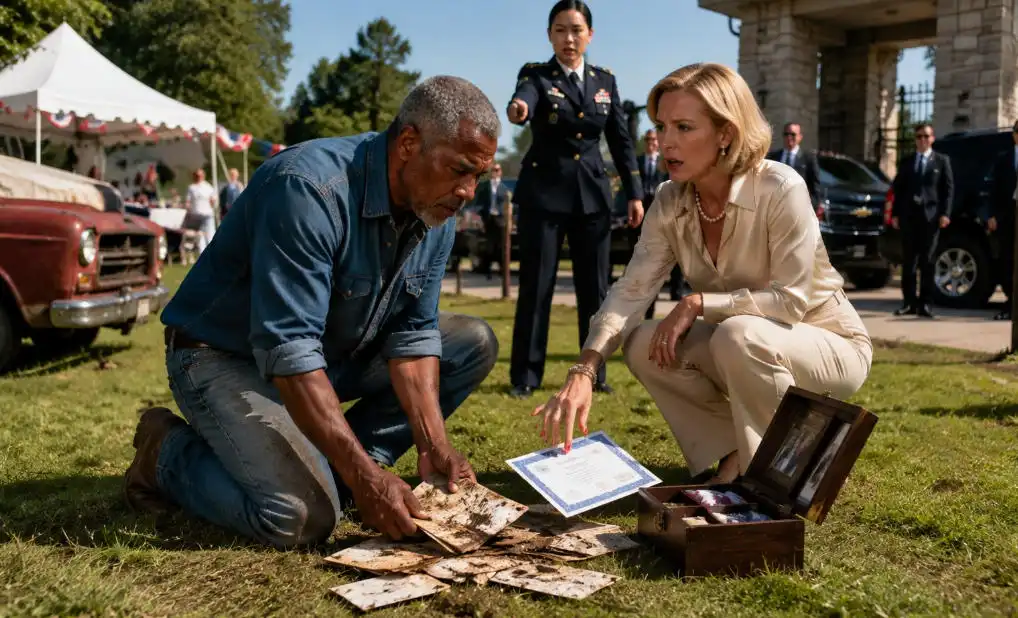
Cynthia jerked upright, pointed at Earl, and shouted that he was trespassing as the first IRS agent stepped onto the lawn.
“Remove him,” she ordered. “He forced his way into a private military community.”
Earl remained on his knees beside the open walnut memorial box. Mud soaked through his worn jeans, and pain burned from his shoulder to his wrist, but both arms stayed folded over Daniel’s scattered letters.
The blue-bordered confirmation lay beneath his left hand.
The lead agent crossed the grass without looking at Cynthia.
“Ma’am, step away from those documents.”
Cynthia drew herself taller. Her pearls rested perfectly against her ivory blouse, as if the afternoon were still her party and the agents were merely uninvited guests.
“You don’t understand,” she said. “I chair the military families committee. That man has no right to be here.”
Lieutenant Maya Chen moved around Cynthia and stopped beside Earl.
“He was authorized to enter,” she said. “I escorted him.”
Cynthia’s face tightened.
“Then you exceeded your authority, Lieutenant.”
Earl looked toward the stone gatehouse. Two security officers had arrived, but neither moved toward him. Behind them, committee volunteers stood beneath the white tents, holding paper plates and glasses they had forgotten to set down.
A few minutes earlier, they had followed Cynthia onto the lawn without question.
Now they waited to see whose authority was real.
The lead agent crouched several feet from Earl, leaving enough space that Earl would not feel surrounded.
“My name is Special Agent Marcus Reed with IRS Criminal Investigation,” he said. “Mr. Dawson, are you injured?”
“I’ll manage.”
“Did that box belong to your son?”
Earl looked at the brass corners, the cracked latch, and Daniel’s name engraved into the walnut lid.
“Yes.”
“And are these his papers?”
“Yes.”
Cynthia cut in.
“They’re committee property. His son’s benefits were administered through our family support program.”
Lieutenant Chen turned toward her.
“That is not what you said at the gate.”
“I said he wasn’t authorized to wander through residential property.”
“You said his belongings were trash.”
For the first time, Cynthia glanced toward the silent party guests.
“Lieutenant, be careful.”
The warning in her voice was soft, but Earl heard it clearly.
So did Reed.
He stood.
“Mrs. Vale, do not threaten anyone at this scene.”
“I’m not threatening her. I’m reminding her that military careers can be damaged by reckless accusations.”
Earl felt Lieutenant Chen’s hand hover near his shoulder without touching him.
She had spent the entire drive from the legal office treating the memorial box as if Daniel himself were still inside it. She had never rushed Earl. She had never asked him to explain why he needed several minutes before carrying the box out of her vehicle.
Now Cynthia was trying to make her afraid.
Chen did not step back.
“Mr. Dawson is Daniel Dawson’s legal next of kin,” she said. “The transfer order is in my case file. I personally received the sealed effects from casualty affairs this morning.”
Reed looked at her.
“You can verify the chain of custody?”
“I can verify the transfer from sealed military storage to Mr. Dawson. I can also identify that blue-bordered sheet as an official beneficiary-change confirmation.”
Cynthia moved one foot closer.
“It’s a photocopy.”
“No,” Chen said. “It isn’t.”
That was the first thing anyone had proven.
Not what the document meant.
Not what Daniel had discovered.
Only that the page Cynthia had tried to reach was an authentic military record taken from Daniel’s sealed personal effects.
But the small fact changed the lawn.
One committee volunteer slowly removed her name badge.
Another lowered his phone and stepped away from Cynthia.
Earl noticed her crimson fingernails curl into her palms.
Reed put on gloves.
“Mr. Dawson, may I secure the exposed document so it isn’t damaged?”
Earl did not move.
The agent waited.
Daniel had been eight years old the first time he made his father promise never to open his mail.
He had ordered a birthday gift for Earl with money earned stacking feed sacks at a neighbor’s barn. The package arrived early, and Earl had teased him about peeking.
Daniel had planted both hands on his narrow hips.
“A promise counts most when nobody can stop you from breaking it.”
Years later, before his final deployment, Daniel had repeated the same idea.
If anything happens, bring my letters home. Don’t let anyone decide they don’t matter.
Earl had promised.
Now one of those letters was trapped beneath his muddy elbow, and a federal agent was asking permission to take the paper Daniel had hidden with them.
Earl lifted his left hand just enough for Reed to slide the confirmation onto a clear evidence sleeve.
The blue border was streaked with mud, but the page itself remained intact.
Cynthia exhaled sharply.
“There,” she said. “You have your paper. Now escort him out.”
Reed studied the document without reading its contents aloud.
“Lieutenant Chen, what does this form confirm?”
“One fact,” Chen answered. “Staff Sergeant Dawson successfully corrected a beneficiary designation on a supplemental military insurance policy.”
“Corrected from what?”
“I would need the authorization and the full policy file before answering that.”
Cynthia gave a short laugh.
“So this whole performance is about a clerical correction?”
Earl saw some of the party guests relax. A paperwork error sounded ordinary. Harmless.
Cynthia saw it too.
She stepped toward the tents and raised her voice.
“Military forms are corrected every day. My husband helps families solve these problems constantly. This man arrived angry, damaged committee property, and created a scene because he doesn’t understand the system.”
Earl finally pushed himself upright.
The movement sent a hard stab through his shoulder. His knees nearly gave way, but Chen caught his elbow.
Cynthia pointed at the open memorial box.
“He drove through our gate in that filthy truck and scattered private records across our lawn. Look at the mess he made.”
Earl stared at her.
“You pushed me.”
“You lost your balance.”
“You grabbed my hair.”
“You became aggressive.”
The lead agent looked toward the security officers.
“Did either of you witness the initial contact?”
One officer shook his head.
The other looked toward the stone gatehouse.
“The entrance camera covers the vehicle lane, not this part of the lawn.”
Cynthia smiled faintly, as though the missing angle had restored the world to its proper order.
Then Reed said, “We aren’t here to investigate a lawn dispute.”
Her smile disappeared.
He held up the evidence sleeve.
“We’re here because the account identifier associated with the prior beneficiary designation matches an account in an active federal financial investigation.”
The party went silent again.
Earl did not understand every word, but he understood Cynthia’s reaction.
She turned toward the house beyond the tents.
For one second, he thought she might run.
Instead, she reached for her phone.
Reed held out his hand.
“Do not contact anyone yet.”
“You cannot take my phone.”
“I’m instructing you not to interfere with an active evidence collection.”
“I am calling my husband. He manages the committee’s relief accounts. He can explain this.”
“That is exactly why you will wait.”
Cynthia’s voice rose.
“You came onto military property because of a number on an old insurance form?”
“No,” Reed said. “We came because Lieutenant Chen notified us that Staff Sergeant Dawson’s sealed effects had been released today. Our office had already traced a series of survivor-benefit transfers to a committee-linked account. We did not know whether his original records still existed.”
Earl looked at Chen.
“You knew they were coming?”
“I knew they needed to inspect anything connected to Daniel’s beneficiary record,” she said. “I didn’t know what was inside his letters. They were sealed, and they belonged to you.”
Cynthia stepped between them.
“This is absurd. Families voluntarily assign benefits to support funds all the time.”
“Not without authorization,” Chen said.
“You have verified nothing except a correction.”
“That’s true,” Reed replied. “So let us verify the rest.”
Cynthia looked down.
Three cream envelopes still lay near her shoes.
One had opened slightly when the box struck the ground. Earl could see the corner of Daniel’s handwriting inside.
Cynthia saw it too.
She moved without warning.
Her hand shot toward the open envelope.
Earl dropped back to his knees and folded his body over the letters.
Pain tore through his injured shoulder so sharply that his vision flashed white.
Cynthia’s fingers caught the edge of the envelope, but Earl held it beneath his chest.
“Let go!” she shouted. “Those contain protected committee information.”
Two agents seized her arms before she could pull again.
The envelope slipped from her crimson nails and remained beneath Earl.
“Do not touch the evidence,” Reed said.
“Evidence of what?” Cynthia demanded. “You haven’t proven a crime.”
“No one said we had,” Reed replied. “But you just tried to take documents after being ordered to step away.”
“I was protecting private families.”
Earl slowly raised his head.
“No,” he said. “You were protecting yourself.”
Cynthia stared at him as if she had forgotten he could speak.
Reed helped Earl sit upright.
“Mr. Dawson, the confirmation gives us an account identifier,” he said. “But the letters may contain private communications between you and your son. We will not open them with your consent unless you authorize it. We can seek legal process, but that takes time.”
“How much time?”
“I can’t promise.”
Earl looked toward the letters.
Mud clung to the envelopes Daniel had touched. One was dated three months before his death. Another had been mailed from an overseas base. A third had never been stamped at all.
Daniel had probably placed it in the box himself.
Those letters were all Earl had left that still sounded like his son.
If he gave them to the agents, strangers would read them. They would copy them, number them, discuss them in offices, and possibly show them in court.
Cynthia seemed to understand his hesitation.
Her voice softened.
“Think carefully, Mr. Dawson.”
The sudden kindness felt more insulting than her shouting.
“Your son wrote those words for you. Once the government takes them, they stop being private. Whatever Daniel thought he saw, you can still take him home with dignity.”
Earl looked at her cream slacks, now marked by a single line of mud where she had bent toward the letters.
“You called them trash.”
“I was angry.”
“You told me he didn’t belong here.”
“I said you didn’t belong here.”
“That’s the same thing to you.”
Cynthia glanced at the agents.
“You don’t know what was happening inside your son’s life. Maybe he was confused. Maybe grief or stress made him suspicious. Do you really want his private fears turned into a public accusation?”
For one painful second, Earl wanted to close the walnut box, put it in his pickup, and drive home.
He wanted Daniel’s last words untouched.
He wanted the promise to mean he could protect every private sentence from people who had never loved his son.
Then he remembered what Daniel had actually said.
Don’t let anyone decide they don’t matter.
The promise had never been about keeping the letters hidden.
It had been about bringing them safely to the person Daniel trusted to decide what happened next.
Earl gathered the envelopes with both hands.
His shoulder shook from the effort.
He placed them in Reed’s open evidence container.
“All of them,” Earl said.
Cynthia’s face went pale.
Earl added the unopened letter that had been beneath his chest.
“You read what you need to read. But when you’re done, they come back to me.”
Reed nodded.
“We’ll preserve the originals and return them when the legal process allows.”
Cynthia pulled against the agents holding her.
“He does not understand what he is authorizing.”
Earl looked directly at her.
“My son trusted me to finish what he started.”
That choice moved the investigation forward.
The agents set a clean folding table beneath the nearest white tent. The party guests were asked to step back, and the security officers closed the lawn entrance.
Lieutenant Chen photographed the condition of the memorial box and each envelope before the agents opened anything. She recorded the transfer number from her legal file and confirmed that the box had remained sealed until Earl received it.
Her job was not to accuse Cynthia.
Her job was to make sure no one could later claim the documents had been planted or altered.
The first letter contained no accusation.
Daniel wrote about rain, bad coffee, and the way Earl’s old pickup always leaned toward the driver’s side.
Earl turned his face away while Reed read silently.
The second letter mentioned the insurance problem.
Daniel had noticed that a confirmation notice listed a beneficiary account he had never approved. He assumed it was a routine error and contacted the benefits office.
The third letter contained a claim reference and a date.
The fourth contained another.
Daniel had written that every correction led him back to the same committee-linked account.
Cynthia spoke from several yards away.
“Those numbers prove nothing. Thomas handles donations, emergency loans, scholarships, and voluntary family transfers. Of course his account appears in military paperwork.”
Reed removed a small secure tablet from his case.
He did not show the screen to the crowd. He entered the account identifier from the blue-bordered confirmation and compared it with records his office had already obtained.
His expression did not change.
But he asked another agent to begin photographing every page.
That was the corroboration.
Daniel’s letters did not create the financial trail.
They explained it.
For months, IRS investigators had followed survivor payments that left official benefit channels and entered what looked like a family-support reserve. From there, the money had been split into smaller transfers and used for expenses controlled by Thomas and Cynthia Vale.
The investigators had the bank movement.
What they had lacked was proof that at least one beneficiary designation had been changed without authorization and that someone inside the military-family system knew families were being misled.
Daniel’s confirmation supplied the first part.
His letters supplied the second.
He had recorded dates, claim references, and the names of offices he contacted. Each time, someone connected to the committee had discouraged him from filing a formal complaint.
One letter described Cynthia personally telling him that challenging the account would “hurt families who knew how to be grateful.”
Earl closed his eyes.
Now he understood why Cynthia had looked at him with such contempt before he had said a word.
She had not merely seen a country mail carrier in a dirty truck.
She had seen Daniel’s father arriving with the one box she could not control.
Cynthia stopped arguing about trespassing.
Instead, she said, “Thomas may have made administrative mistakes. I don’t manage account transfers.”
Reed looked toward her.
“Your name appears in Staff Sergeant Dawson’s notes as the person who directed him not to contact casualty assistance.”
“Anyone could write a name in a letter.”
“That is why we corroborate evidence.”
He turned to Chen.
“Can the base legal office confirm whether Sergeant Dawson made a complaint?”
Chen opened her case file.
“He requested a review of an unauthorized beneficiary change. The request was logged. The follow-up was closed after the committee reported that the matter had been resolved directly with the family.”
Earl looked at Cynthia.
“No one resolved anything with me.”
Chen nodded.
“That is now part of the record.”
The lead agent gave instructions quietly.
One team secured the letters and confirmation. Another contacted the federal prosecutor assigned to the existing financial case. A third prepared to serve the already-approved search authority covering the committee’s financial office and electronic records.
There was no dramatic speech.
No one declared Cynthia guilty on the lawn.
The rules worked more slowly than anger—but once the chain was complete, they gave her fewer places to hide.
The committee-controlled relief account was placed under an emergency preservation order that afternoon. No money could be moved while investigators and military casualty-assistance officials compared the committee’s records with survivor claims.
Cynthia was separated from the volunteers and told she could not contact Thomas until the agents completed their initial steps.
When she tried again to approach the evidence table, the agents restrained her hands behind her back.
She was not handcuffed because Earl had insulted her.
She was restrained because she had ignored repeated instructions and attempted to seize documents in an active federal investigation.
The party guests finally began to move.
Not toward Earl.
Away from Cynthia.
One volunteer removed a committee binder from beneath the tent and handed it to an agent.
Another said she had been instructed to redirect grieving spouses to Thomas whenever they questioned delayed payments.
A third asked for permission to speak privately.
Earl listened, but he felt no triumph.
Every new statement meant another family had stood where he stood—confused, embarrassed, and told the system was too complicated for them to question.
Lieutenant Chen knelt beside him.
“You should have that shoulder examined.”
“After the letters are safe.”
“They’re being logged now.”
“After they’re safe,” he repeated.
She seemed to understand the difference.
Six weeks later, the military families committee was formally dissolved.
The audit found that survivor payments intended for several families had been diverted into the committee-linked reserve. The account records showed that Thomas Vale controlled the transfers.
Cynthia had used her position to discourage complaints, approve false resolutions, and keep affected families from reaching the offices that could correct the payments.
Daniel’s beneficiary confirmation was not the entire case.
It was the missing bridge between the money investigators had traced and the human beings who had never authorized the transfers.
His letters showed how the scheme worked from the victim’s side.
Lieutenant Chen’s transfer record proved where the originals had been from the moment Daniel’s effects were sealed until Earl surrendered them on the lawn.
The families received corrected claim reviews and restitution procedures through casualty assistance.
Thomas and Cynthia were charged through the federal process after prosecutors presented the financial records, Daniel’s documents, committee files, and witness statements.
Months later, both were convicted for their roles in diverting and concealing survivor funds.
Their residence was forfeited after investigators traced diverted money to expenses tied to the property.
The prison sentences came later.
So did the headlines.
Earl read none of them.
He returned to his rural mail route with a shoulder that still ached in cold weather and Daniel’s walnut box on the passenger seat.
The letters eventually came home in protective sleeves.
Some contained evidence.
Most did not.
Most were simply Daniel.
He wrote about terrible food, missed birthdays, his first broken nose, and the embarrassing way Earl cried at his basic-training graduation.
The final unstamped letter was only two pages long.
Daniel wrote that he knew Earl would want to keep family matters private.
Then he wrote that privacy should never become a hiding place for people who harmed other families.
Earl read that sentence three times.
At the bottom, Daniel had added:
A promise isn’t just holding on, Dad. Sometimes it’s knowing when to let go.
When Earl thought about justice after that, he did not picture the courtroom or the seized house.
He pictured the lawn.
Lieutenant Maya Chen was kneeling in the mud beside him, gathering Daniel’s cream letters one by one and placing them back inside the walnut memorial box.
She closed the cracked lid, rose in her dark service uniform, and gave Earl a formal salute.
Behind her, Cynthia stood in handcuffs as an agent guided her toward a black government SUV.
Earl held his son’s box against his chest.
For the first time that day, no one looked at his rusted pickup.
They looked at the father who had kept his promise.
FINAL ENGAGEMENT
Was Earl right to surrender Daniel’s private letters to investigators—or should he have kept his son’s final words sealed?
Disclaimer: Mention of any brand or trademark is for identification only and does not imply partnership or endorsement
A One-Legged Veteran Came to Return Dog Tags—His Ex Tried to Keep Him Offstage
An Oil-Soaked ARMORER Was Humiliated by a SWAT Sniper—But He Had NO IDEA What the Red Tag on That Rifle Meant 😱
The Battalion Commander DUMPED ICE WATER on a Surveyor’s Equipment and Shoved Him Down — He Had NO IDEA What the Tablet Had Already RECORDED 😱