

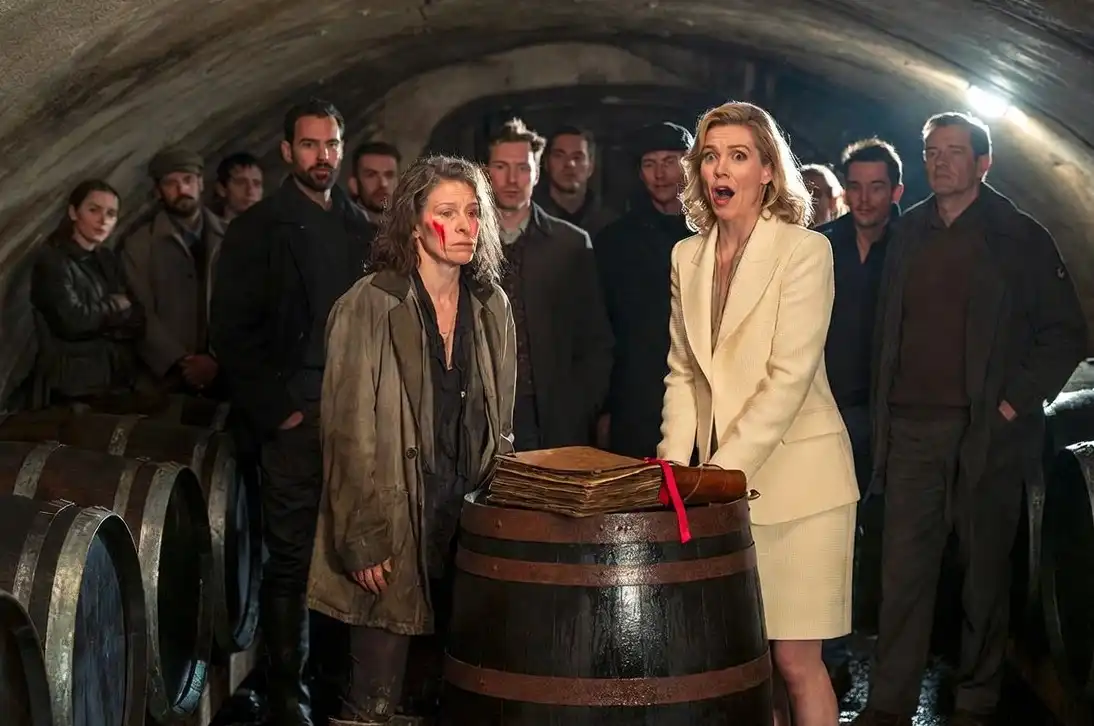
Lydia’s hand stayed frozen on the old leather pruning ledger. The association director stared at the faded seal on the cover. Clara stood beside the oak barrel with her cheek still red, her eyes calm enough to make the whole cellar uneasy. Lydia tried to laugh again, but this time it came out thin. “These old papers don’t own my winery,” she said, pushing the ledger toward the buyers. “Go ahead, read the ghost story.” No one laughed. The lead buyer, Martin Hale, looked at the director. “Is that an official estate document?” he asked. Lydia snapped her head toward him. “It’s sentimental junk,” she said. “This place is full of it. Old barrels, old vines, old workers who don’t know when to leave.” Clara took one slow breath. The slap had left a clear mark across her face, but she still didn’t touch Lydia. She didn’t need to. The bank officer whispered to the man beside him, “Was that recorded?” A cellar worker lifted his phone just a little. Lydia saw it and pointed at him. “Put that down.” The young man swallowed. But he did not lower it. The association director, Mr. Vaughn, stepped closer to the barrel. “Ms. Carlisle,” he said, “open the ledger.” Lydia’s eyes hardened. “You don’t give orders in my cellar.” Mr. Vaughn did not move. “No,” he said. “But I do certify whether this estate can use protected old-vine origin labeling. And you invited me here to approve that label before the sale.” That finally shut her mouth. For one second, the only sound was water dripping somewhere behind the barrels. Then Lydia pulled the ribbon loose with a sharp jerk. The leather cover opened. Inside were old vineyard maps, pruning dates, grafting notes, frost records, and signed cellar logs written across decades. Clara’s handwriting was everywhere. Lydia flipped through the pages too fast. “See?” she said. “Farm notes. Nothing more.” Mr. Vaughn reached over and stopped her hand on a folded cream page tucked into the back cover. “Read that one.” Lydia’s jaw tightened. “I don’t have to perform for you.” The buyer stepped forward. “You do if you want us to buy this brand.” That hit harder than the slap. Lydia unfolded the page. Her face changed before she spoke. Clara saw it. So did everyone else. The document was a notarized clause from the late owner’s will, signed fifteen years earlier, witnessed by two attorneys and filed with the estate records. Lydia tried to fold it back up. Mr. Vaughn caught her wrist. “Out loud, please.” Lydia yanked her hand away. Clara finally spoke. Her voice was quiet, but it carried through the cellar. “I can read it.” Lydia turned on her. “You don’t get to speak here.” Mr. Vaughn looked at Clara. “Mrs. Bennett, go ahead.” Clara picked up the page. Her hands were rough from years of pruning, cleaning barrels, and tying vines in bad weather. But they did not shake. “The century mother vine, including all cuttings, cultivation rights, propagation rights, and old-vine designation use, shall remain under the sole stewardship of Clara Bennett,” she read. “No commercial bottling, label claim, brand sale, vineyard expansion, or derivative use of the mother-vine name may proceed without her written consent.” The cellar went dead quiet. The buyers looked at Lydia. The bank officer looked at the debt folder under his arm. Lydia’s face flushed. “That clause was about vineyard care,” she snapped. “Not ownership.” Mr. Vaughn took the page and examined the seal. “It’s about protected designation use,” he said. “And it’s very clear.” Martin, the buyer, stepped back from Lydia. “Your sale packet said the brand included exclusive use of the century mother-vine label.” “It does,” Lydia said too quickly. Mr. Vaughn closed the ledger. “No, it doesn’t.” Lydia’s lips parted. Clara stayed still. She had waited years for someone in that family to ask the right question. No one had. They only saw the farmhouse. The old coat. The woman who still checked soil at sunrise and touched the barrel heads like they were living things. Lydia pointed at the locked chamber behind the iron gate. “Those vines are on Carlisle land.” Clara looked at her. “The roots are.” That simple sentence made Martin’s eyes narrow. Mr. Vaughn nodded. “The physical vines remain on the estate land,” he said. “But the legal right to propagate, cultivate, and commercially claim the mother-vine line belongs to Mrs. Bennett. Without her stewardship and consent, you can sell wine, Ms. Carlisle. You cannot sell this old-vine identity.” One of the buyers muttered, “Then the valuation is wrong.” Lydia spun toward him. “No, it isn’t. You’re buying history.” Martin’s expression turned cold. “We were buying protected history. You sold us a story you didn’t control.” The bank officer opened his folder. “Ms. Carlisle,” he said carefully, “the pending offer was the foundation of your refinancing plan.” “Don’t you dare discuss my finances in front of staff,” Lydia hissed. “You made the sale presentation public,” he said. “And you represented that the old-vine designation was transferable.” Lydia looked trapped for the first time. So she did what cruel people often do when facts corner them. She attacked the person who had the truth. “This is ridiculous,” Lydia said, pointing at Clara. “She’s bitter because my father gave her too much attention. She slept in that vineyard during storms like some kind of stray dog, and he felt sorry for her.” Clara’s face tightened. Not with shame. With grief. Mr. Vaughn’s eyes moved to Clara. “Is that why this clause was written?” Clara looked down at the ledger. Then she turned one page to an old entry dated twenty-three years earlier. The ink had faded, but the words were still there. “That night, the hail came after midnight,” Clara said. “The young grafts were split. The drainage failed. Mr. Carlisle had gone down to check the lower slope and slipped in the washout.” The cellar workers listened harder. Even Lydia stopped moving. Clara continued. “I found him by the stone wall. He had a broken ankle and he was going cold. I tied the vines with my coat strips, covered the grafts with barrel cloth, and stood there until dawn yelling every few minutes so he wouldn’t fall asleep.” Martin looked from Clara to the ledger. Clara tapped the page. “He wrote this entry himself after the hospital. He said the mother vine lived because I refused to leave it. He said the estate lived because I refused to leave him.” Lydia swallowed. For once, she had no pretty answer ready. Then she forced one. “So he thanked you. Fine. That doesn’t give you the right to ruin my deal.” Clara closed the ledger softly. “I didn’t ruin your deal.” She looked at the buyers. “You did, when you tried to sell what you never had.” That landed. Hard. The cellar hand’s phone was still recording. Lydia noticed again and lunged toward him. “I said put it down.” Clara stepped between them. Not fast. Not dramatic. Just steady. The bank officer raised his voice. “Ms. Carlisle, don’t.” Lydia froze. The buyers had seen the slap. They had heard the insult. They had watched her dismiss the legal document, misrepresent the label rights, and threaten an employee in the same room where she wanted a multimillion-dollar rescue deal. Martin closed his briefcase. “Our offer is withdrawn.” Lydia’s eyes widened. “You can’t withdraw. We had terms.” “We had terms based on your representations,” Martin said. “Those representations were false.” “It’s still a valuable winery,” she snapped. Martin looked around the damp cellar, then at Clara’s ledger. “Not at the price you asked.” He turned to his team. “If there is no protected mother-vine designation, no exclusive propagation right, and no consent from Mrs. Bennett, the brand loses its premium position.” One of his analysts checked a tablet. Martin looked back at Lydia. “At best, we would revisit at ten percent of the original valuation.” Lydia stared at him like he had slapped her back. “Ten percent?” The bank officer’s face told everyone that ten percent would not save her. Mr. Vaughn added the final blow. “Until this is resolved, I am suspending approval of any century mother-vine label claim from this estate.” Lydia gripped the barrel. “You can’t do that.” “I just did,” he said. The room shifted. Not loudly. No cheering. No shouting. Just the quiet sound of power leaving one person and returning to the one she had humiliated. Lydia turned to Clara, her voice lower now. “Sign the consent.” Clara looked at her. “No.” “You’ll destroy everything my family built.” Clara’s eyes sharpened. “Your father built this place with patience. Your sister kept the books clean. The cellar workers kept the barrels alive. I kept the vines alive.” She glanced at the stainless production brochures Lydia had brought for the buyers. “You tried to turn a hundred years of soil into a logo.” Lydia’s face twisted. “You live in a broken farmhouse.” Clara nodded. “I do.” Then she picked up the old ledger. “But the vines still know my hands.” That was the first time one of the cellar workers smiled. Small. Careful. But real. The legal consequences came fast after that. The buyer’s withdrawal triggered Lydia’s loan default. The bank reviewed the sale documents and found she had pledged projected brand value tied to rights she did not control. The appellation association opened a formal review. The recording of the slap and Lydia’s own words became part of the complaint. Not because Clara wanted revenge through gossip. Because the video showed intent. Lydia had known the ledger existed. She had dismissed it in front of buyers. She had tried to sell around it anyway. Within weeks, the bank began liquidation of Lydia’s personal holding company. The winery land was placed under receivership. Her planned mass-production contract collapsed. Her glossy celebrity-label launch disappeared before the first bottle ever shipped. And the most painful part for Lydia was not the money. It was that the old cellar workers refused to follow her out. They stayed with the vines. The receiver asked Clara to oversee the mother-vine chamber until the estate could be stabilized. Mr. Vaughn personally signed the temporary stewardship order. No crown. No secret fortune. No sudden miracle. Just an old promise, a valid clause, clean records, and a woman who had done the work when nobody clapped for it. Months later, the first traditional vintage under Clara’s stewardship was bottled. No fake shine. No mass-market label. Just a deep red wine made from carefully approved cuttings, aged slowly in the cold cellar where Lydia had slapped her. The release sold out in three days. At the small tasting, Clara wore the same muddy boots. Someone asked why she didn’t buy new ones. She smiled and said, “These know the vineyard.” The cellar workers raised their glasses. Mr. Vaughn raised his. Even the bank officer, who had seen plenty of people lose everything, quietly bought two bottles for his anniversary. Clara walked to the oldest barrel wall and placed a fresh wreath there. This time, nobody laughed. Nobody called her moldy. Nobody told her she didn’t belong. The young cellar hand who had recorded the slap came over and said, “Mrs. Bennett, I’m sorry none of us stopped her sooner.” Clara looked at him kindly. “You told the truth when it mattered.” He nodded, eyes wet. Then Clara touched the old ledger resting on the barrel beside her. For thirty-two years, people had called her quiet. That day, they finally understood. Quiet was not weakness. Quiet was discipline. Quiet was memory. Quiet was a woman waiting until the truth had witnesses. Lydia lost the brand she tried to sell. Clara saved the vines she had always loved. And every bottle after that carried the one thing Lydia could never manufacture. Respect. So tell me honestly: was Clara right to refuse Lydia’s consent after that public slap, or should she have saved the winery for the family anyway?
Disclaimer: Mention of any brand or trademark is for identification only and does not imply partnership or endorsement