
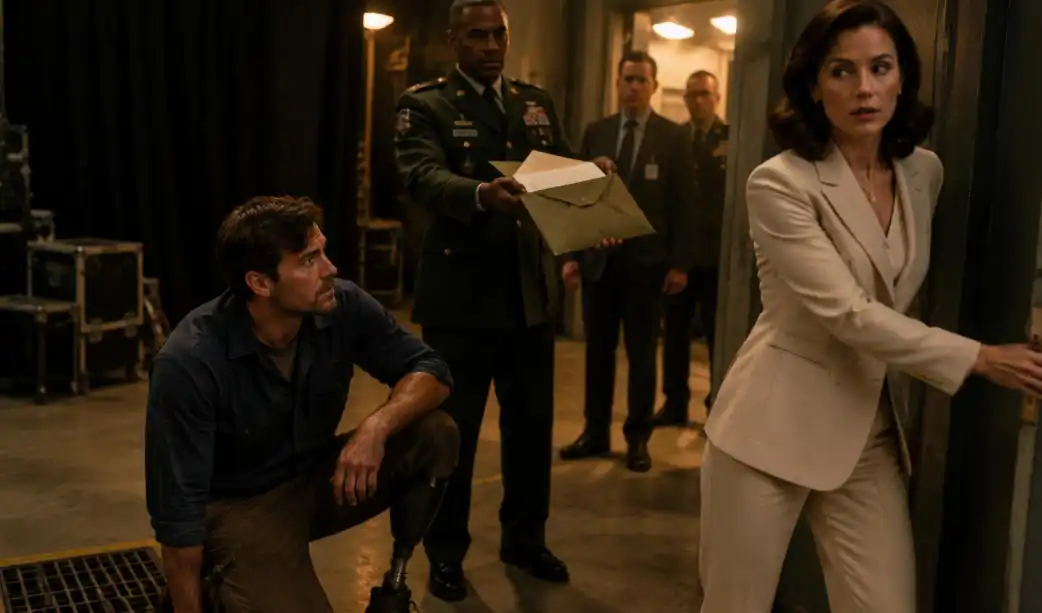
The FBI investigator completed the turn of the service-door lock while the CID investigator stepped around Vanessa and placed himself between her and me.
The click echoed through the backstage corridor.
Vanessa immediately pointed at me.
“This man is unstable,” she shouted. “He is obsessed with me. He has been harassing me since our relationship ended.”
She turned toward the two base security officers near the black curtain.
“Remove him before he ruins the ceremony.”
Neither officer moved.
One of them looked at the investigator beside the door. The investigator gave a small shake of his head.
Vanessa’s gold watch flashed as she raised her hand again.
“I am the public affairs director. This is my event.”
“Not anymore,” the CID investigator said. “Step away from Mr. Cole.”
Her face tightened.
I remained beside the drainage grate, one knee on the concrete and my carbon-fiber leg angled beneath me. My teammate’s dog tags were still visible through the narrow steel slots.
The scratched maroon medal case lay open near my hand.
General Hale stood behind my right shoulder, holding the worn olive-drab envelope.
Vanessa stared at the Purple Heart inside the case.
Then she looked at me.
“You kept that?”
Her voice was quieter now.
I remembered another room seventeen years earlier.
A hospital room.
Vanessa had stood beside my bed while the bandages around my left leg were still clean and white. She had held my hand until the surgeon explained that the leg could not be saved.
Three days later, she stopped touching me.
Two weeks after that, she said she could not spend the rest of her life “taking care of someone broken.”
Now she was looking at the same medal as if it were the thing that had betrayed her.
General Hale removed one sheet from the envelope.
He did not show it to the crowd gathering near the curtain. He showed it only to the FBI investigator.
“This is a certified award order,” Hale said. “Issued through the Department of Defense records division.”
Vanessa folded her arms.
“A medal doesn’t prove his accusations.”
“I haven’t made an accusation,” I said.
That seemed to frighten her more than anger would have.
The FBI investigator crouched beside the open medal case without touching it.
“Mr. Cole, may I read the number on the reverse?”
I nodded.
He used gloved fingers to tilt the medal enough to see the engraving. General Hale read a number from the certified order.
The investigator compared them twice.
Then he looked at me.
“The serial number matches.”
That was all he verified.
Not the mission.
Not Vanessa’s publicity campaign.
Not the reason investigators were already waiting backstage.
Just one fact.
The Purple Heart belonged to me, and it had been issued for wounds suffered during the operation Vanessa had spent years describing as her husband’s finest hour.
The people near the curtain stopped whispering.
Vanessa gave a sharp laugh.
“So he was wounded. Everyone knows that. It doesn’t make him a hero.”
General Hale slid the award order back into the envelope.
“No,” he said. “The medal alone does not.”
She seemed relieved for half a second.
Then Hale continued.
“But it places him at the exact location you removed from the official presentation materials.”
Vanessa’s eyes shifted toward the service doors.
The FBI investigator noticed.
“You’re not leaving,” he said.
“I wasn’t trying to.”
“You looked at the exit.”
“I’m running an awards ceremony. I’m allowed to know whether my exits are open.”
The CID investigator spoke into a small radio clipped to his vest.
“Secure the exterior side as well.”
Vanessa stepped toward him.
“You cannot lock down a military ceremony because a bitter ex-boyfriend brought an old medal backstage.”
I pushed myself upright, using the edge of an equipment case for balance.
“I didn’t bring it for you.”
“Then why are you here?”
I pointed toward the grate.
“For him.”
The silver chain beneath the slots caught the overhead light.
Vanessa looked down.
For one moment, something close to panic crossed her face.
The CID investigator saw it.
“What is under the grate?” he asked.
“My teammate’s identification tags,” I said. “She took them from my hand and threw them.”
“That is a lie,” Vanessa snapped.
Three camera operators spoke at once.
“We saw it.”
“She threw them.”
“They slid straight through.”
The officers did not need a dramatic confession. They had witnesses standing ten feet away.
The CID investigator raised one hand.
“No one touches the grate until it is photographed.”
Vanessa’s voice rose.
“You are turning a private disagreement into a federal spectacle.”
“No,” the FBI investigator said. “Your actions did that.”
General Hale removed a second document from the envelope.
This one had a red authentication stamp in the lower corner, though the text faced away from us.
“Mr. Cole,” he said, “the award order confirms your presence. I need your permission before we go further in front of these witnesses.”
Vanessa cut him off.
“Permission for what?”
Hale did not answer her.
He kept his eyes on me.
The old general had once been the kind of man who could silence a room just by walking into it. That day, he did something more important.
He waited for my decision.
Before I could answer, Vanessa pointed toward my prosthetic.
“He has memory gaps,” she said. “Trauma episodes. He was confused after the explosion. Ask anyone who treated him.”
My hands went cold.
She knew exactly where to strike.
For years, I had protected those records more fiercely than I protected my reputation.
They contained the worst hour of my life.
The blast injuries.
The emergency amputation.
The debrief where I could not finish a sentence without shaking.
The names I repeated because I was terrified someone would forget them.
Vanessa had once sat outside one of those sessions.
She had heard me wake up screaming in the hospital.
Now she was using that pain as evidence that I could not be trusted.
“She’s right about one thing,” I said.
Everyone looked at me.
“I had trauma symptoms.”
Vanessa smiled.
“There. He admits it.”
“I said I was injured. I didn’t say I was wrong.”
General Hale’s jaw tightened.
Vanessa moved closer, though the CID investigator kept himself between us.
“Ethan, stop this now,” she said. “Walk away, and no one needs to see those reports.”
Her voice had changed.
It was the voice she used when we were young and she wanted me to believe a decision had already been made for both of us.
“You don’t want strangers reading what happened to you,” she continued. “You don’t want reporters discussing your breakdowns. Think about your family. Think about the men whose families might hear details they were never told.”
That was the first real threat.
Not losing the ceremony.
Not being called unstable.
She was offering me the silence I had lived inside for seventeen years.
All I had to do was let her keep the lie.
General Hale lowered the envelope.
“We can move this review to a private room,” he told me. “The records remain sealed unless you authorize their release.”
Vanessa nodded quickly.
“That is the responsible choice.”
I looked through the grate again.
My teammate’s tags lay in dust and darkness beneath our feet.
He had been twenty-six.
He had carried a photograph of his little girl inside his vest. After the explosion, I had promised his wife that his name would never be turned into a slogan.
Yet that was exactly what Vanessa had done.
She had turned the mission into a clean, polished success story.
No confusion.
No fear.
No abandoned position.
No dead teammate.
No one-legged technician crawling back toward a secondary device because the evacuation route was still live.
She had erased everything that made the truth difficult.
I closed the medal case.
Then I handed it to the FBI investigator.
“Unseal my records.”
Vanessa stepped back.
“Ethan.”
“All of them,” I said. “The medical reports. The trauma debrief. The survivor statements. Whatever is necessary.”
“You’ll regret that.”
“I regret staying quiet.”
General Hale held my gaze for another second.
Then he nodded.
“Authorization witnessed.”
The FBI investigator recorded the time.
The first document Hale removed after that was not my medical report.
It was a radio-log extract.
He passed it to the CID investigator, who checked the certification mark and compared it with a numbered index inside the envelope.
“This verifies a transmission from the bomb-disposal channel,” the investigator said.
Vanessa shook her head.
“Radio logs can be misunderstood.”
“Then let us understand it carefully,” Hale replied.
He read only the relevant entry.
“Cole reported a secondary pressure device on the western evacuation route. Cole ordered the remaining unit to hold position.”
A camera operator near the curtain covered her mouth.
Vanessa looked toward the stage entrance, where the ceremony music was still playing beyond the black drape.
Her entire career was waiting on the other side.
The polished video.
The speech praising the “perfect operation.”
Her husband seated in the front row.
The CID investigator turned to me.
“Did you make that call?”
“Yes.”
“What happened next?”
“I moved toward the device.”
“After you had already been injured?”
“The first blast had damaged my leg, but the route behind us wasn’t clear.”
Vanessa interrupted.
“You were disoriented. That is exactly what I’m saying.”
General Hale removed another certified page.
“This is the time-stamped bomb-disposal report completed by the recovery team,” he said. “The device was located where Cole reported it.”
The investigator examined the page.
“Same route. Same coordinates. Detonator rendered safe before evacuation resumed.”
That was corroboration.
The radio call was not a damaged man’s confused memory.
The device had existed.
It had been exactly where I said it was.
And the survivors had escaped because it was cleared.
Vanessa’s shoulders stiffened.
“That still does not prove he cleared it.”
“No,” Hale said. “It proves the first part.”
She hated those words.
The first part.
Because they meant there was more.
The CID investigator knelt beside the grate and photographed the dog tags from several angles.
Vanessa watched his hands.
Then she suddenly dropped to her knees.
She drove her fingers beneath the edge of the grate and pulled.
The steel lifted less than an inch before the investigator caught her wrist.
“Do not touch the evidence.”
“I was retrieving them!”
“You denied throwing them thirty seconds ago.”
“I was trying to help.”
She twisted against his grip and reached with her other hand.
The FBI investigator stepped in, pulled her away from the grate, and placed her against the side of an equipment case.
“You were ordered not to interfere.”
“They are dog tags, not evidence.”
“They connect the deceased service member to the operation under investigation.”
Her face went blank.
She had finally understood why the tags mattered.
The identification number on them matched the casualty record inside Hale’s packet.
They placed my teammate in the same unit, on the same route, during the same operation Vanessa had repackaged for public consumption.
CID removed the grate using a maintenance tool brought by base staff.
The investigator lifted the chain with gloved fingers and placed the tags inside a clear evidence sleeve.
For the first time since Vanessa threw them, I could see the stamped name clearly.
My throat closed.
General Hale noticed.
“We will return them when processing is complete,” he said.
I nodded because I could not speak.
Vanessa tried another direction.
“This proves nothing about me,” she said. “I did not write operational reports. I was given a story and promoted it.”
The FBI investigator turned toward her.
“That is the question we are examining.”
“I relied on my husband.”
Hale opened the packet’s document index.
“The archived drafts were submitted from your office account.”
“Staff members use that account.”
“The edits removing Ethan Cole’s name were made under your individual credentials.”
“Credentials can be shared.”
“The system recorded your authentication token.”
Vanessa looked at me with open hatred.
“You planned this.”
“No,” I said. “You planned a ceremony around a lie. I just stopped protecting it.”
The investigator displayed a printed archive log without exposing the full text to the crowd.
It showed dates, submission identifiers, and authenticated revisions.
The original draft described a bomb-disposal specialist who identified and neutralized the second device.
A later version removed the specialist’s name.
Another replaced “unit member left assigned position during emergency” with language praising her husband for “coordinating the withdrawal.”
The final publicity package transformed retreat into leadership.
It transformed my teammate’s death into a sentence about sacrifice.
And it transformed me into no one.
Vanessa stared at the archive history.
“My husband told me the report was politically motivated.”
“Your husband was not the approving authority,” Hale said.
“He said Ethan froze.”
The general’s expression hardened.
“I reviewed the survivor statements myself.”
Vanessa laughed, but the sound cracked.
“Survivors protect each other.”
“They did not agree on every detail,” Hale said. “That is why their agreement on the essential facts matters.”
The CID investigator opened the sealed section authorized by my release.
One statement described me dragging myself toward the device while another soldier applied pressure above what remained of my lower leg.
Another described my instructions over the radio.
A third confirmed that Vanessa’s husband had left his assigned position before the evacuation route was cleared.
He had not coordinated the withdrawal.
He had run.
The deeper truth settled over the room piece by piece.
Vanessa had not simply repeated a misunderstanding.
She had been shown records that contradicted her husband’s story.
She had used her access to remove the names and facts that threatened the life she wanted.
The successful husband.
The flawless operation.
The rising communications executive who could turn military pain into patriotic television.
My disability had not disgusted her only because it was inconvenient.
It was evidence.
Every time she saw me, she saw the person whose body contradicted the story she sold.
The FBI investigator removed her base credential from the clip on her jacket.
“Your access is suspended under the commanding officer’s authorization pending the criminal and administrative reviews.”
Vanessa reached for it.
“You cannot do that.”
“He can,” General Hale said. “The authorization was issued before we entered this corridor.”
She turned toward the security officers.
“Open the curtain. The ceremony is starting.”
Neither man obeyed.
The officer who had looked ready to remove me minutes earlier stepped away from the curtain controls.
“The program is paused,” he said.
Vanessa’s last piece of authority disappeared with that sentence.
The CID investigator informed her that she was being detained for attempting to interfere with physical evidence and for obstructing the secured review.
When he brought her hands behind her, she screamed my name.
“You destroyed my life!”
I looked at the clear sleeve holding the dog tags.
“No. I stopped letting you build it on theirs.”
The formal consequences did not happen in a single afternoon.
CID spent weeks comparing the original mission records with the altered publicity files. Investigators documented the archive timestamps, authentication history, witness statements, medal order, radio logs, casualty report, and the attempted recovery of the tags.
Federal prosecutors later charged Vanessa with falsifying official records, making false statements during the investigation, and attempting to destroy or interfere with evidence.
Fort Ashford removed her permanently from the public affairs position.
Her husband’s commendation was withdrawn while his conduct during the operation was referred for formal military review. The base published a correction naming the people who had actually served, the man who had died, and the bomb-disposal specialist whose actions reopened the evacuation route.
For the first time, my name appeared without Vanessa’s permission.
I expected the release of my trauma records to feel like another explosion.
Instead, the reports showed what I had spent years trying to hide: I had been terrified.
I had cried.
I had needed help learning how to stand again.
None of that erased what I had done.
It made the polished lie look even smaller.
That afternoon, after the initial records were secured and the ceremony program was corrected, the black curtain opened again.
I did not change clothes.
I walked onto the stage in my faded navy work shirt and oil-stained brown pants, the carbon-fiber prosthetic visible beneath the lights.
General Hale stood in front of me with the Purple Heart.
Beside us was a framed photograph of my fallen teammate. His recovered dog tags rested below the frame after CID finished documenting them.
Vanessa was being led through the service corridor behind the stage, her wrists secured as she continued shouting at the investigators.
I did not turn toward her.
General Hale pinned the medal above my heart.
The room stood.
I reached past the medal and placed two fingers against the cool silver dog tags.
For seventeen years, I had believed silence was how I protected the dead.
Standing beneath those lights, I finally understood something else.
The truth could protect them too.
FINAL ENGAGEMENT
Was Ethan right to release his private trauma records to expose the lie—or should he have protected his privacy and walked away?
Disclaimer: Mention of any brand or trademark is for identification only and does not imply partnership or endorsement
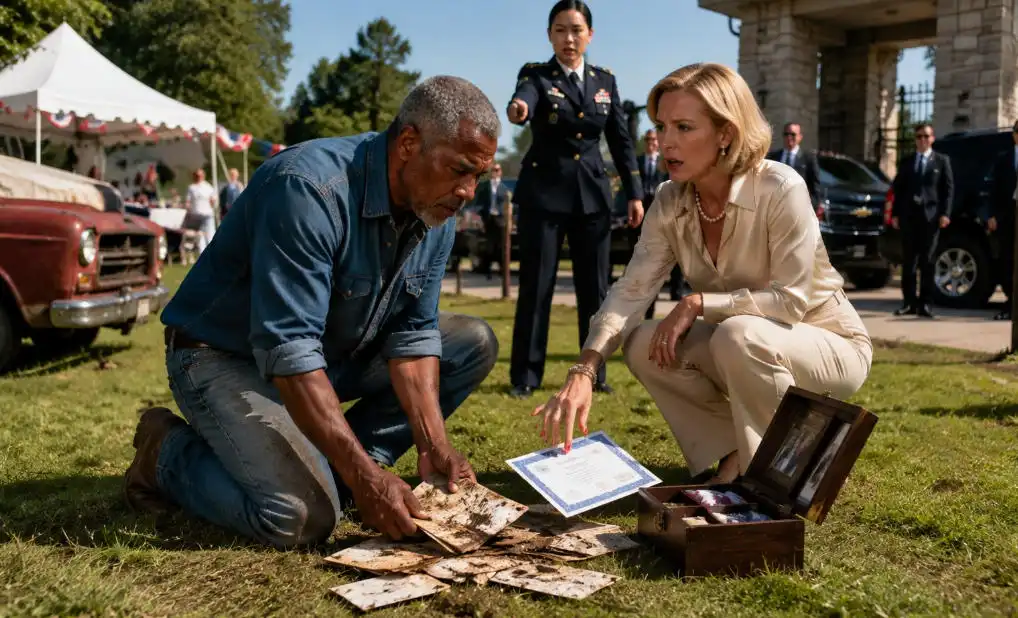
A Grieving Father Was Shoved Into Mud—Then One Letter Changed the Gate
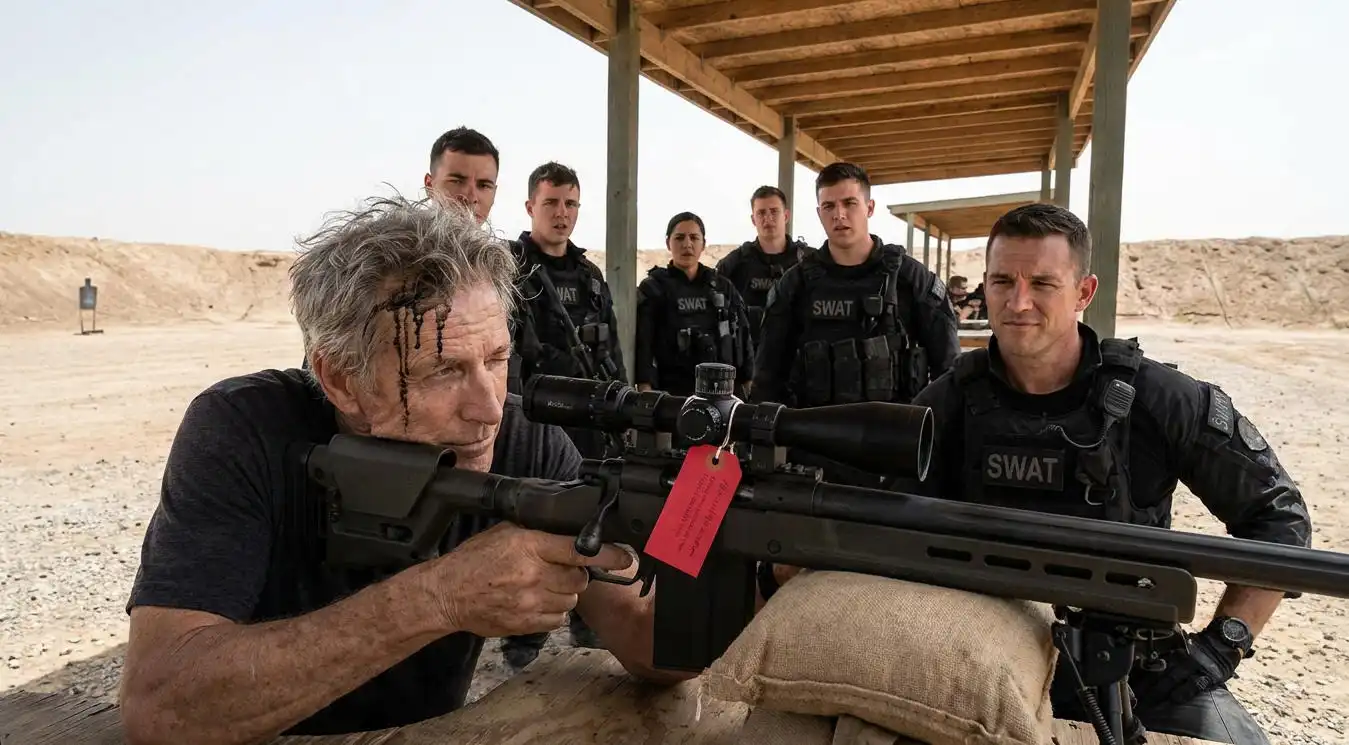
An Oil-Soaked ARMORER Was Humiliated by a SWAT Sniper—But He Had NO IDEA What the Red Tag on That Rifle Meant 😱
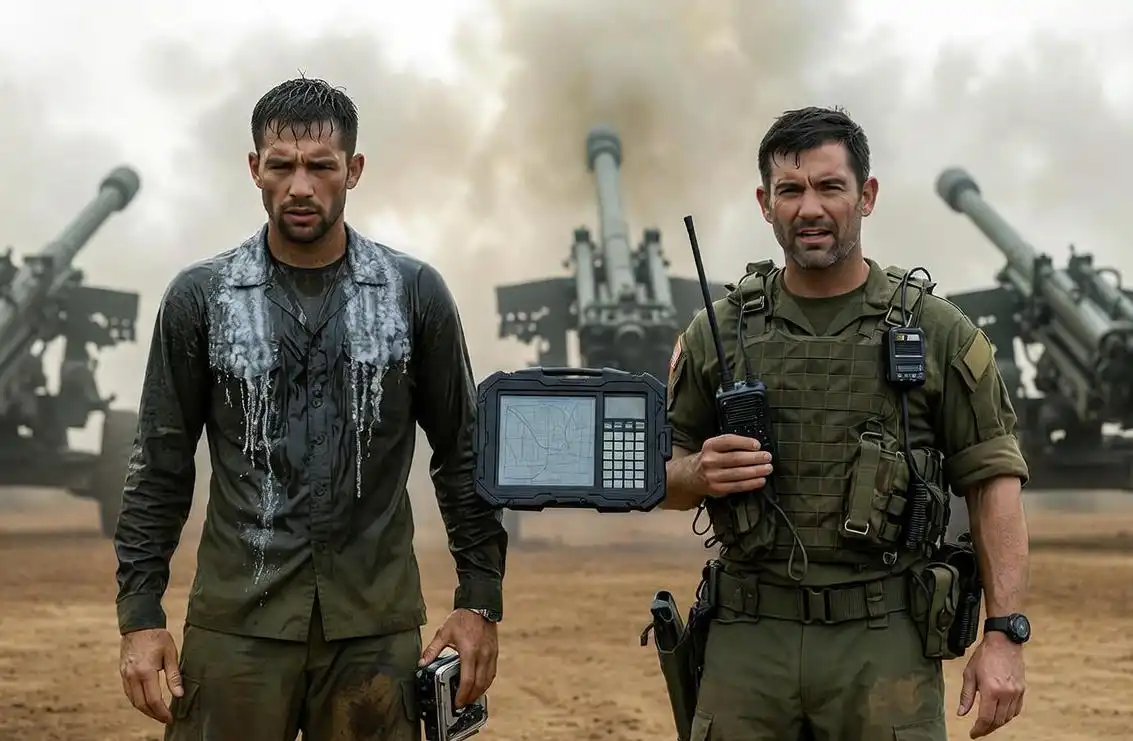
The Battalion Commander DUMPED ICE WATER on a Surveyor’s Equipment and Shoved Him Down — He Had NO IDEA What the Tablet Had Already RECORDED 😱