
He did it like she wasn’t human.
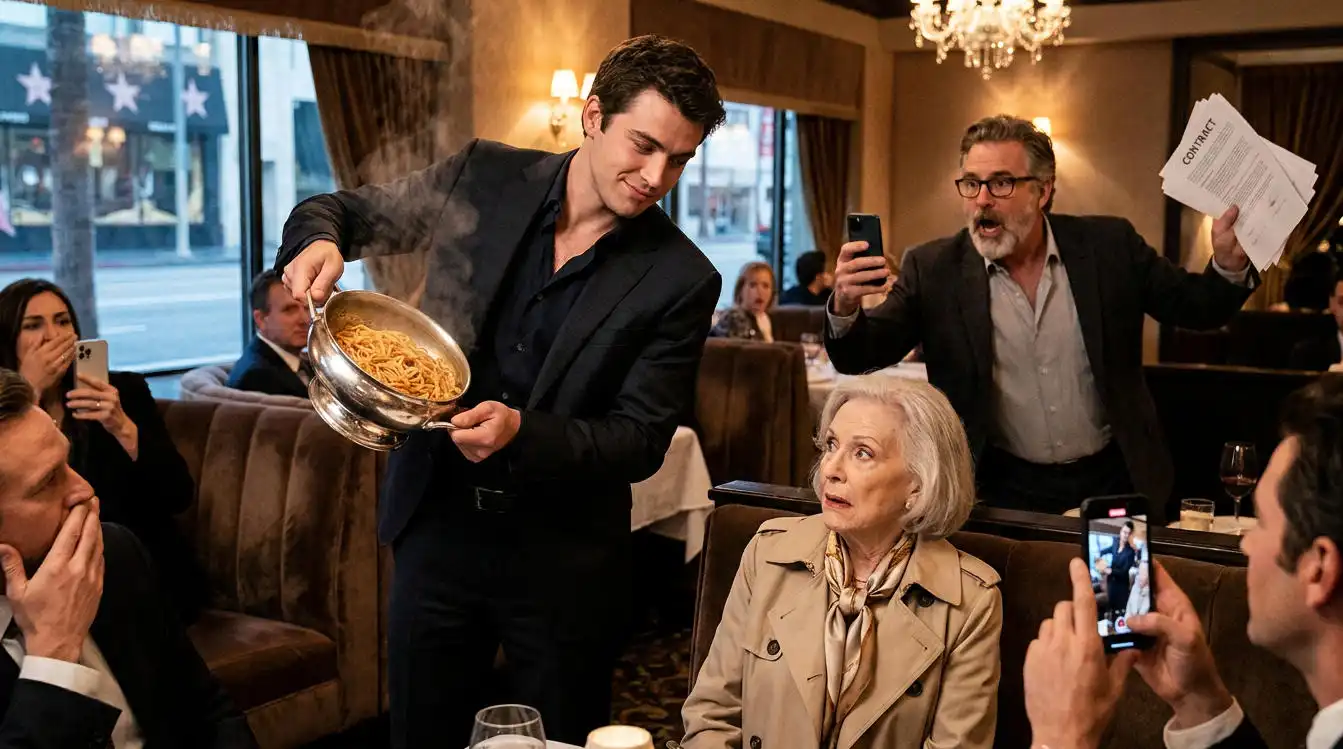
One second, Mrs. Evelyn Carter was sitting quietly at a corner table, trying to cover a cough with her napkin.
The next second, a plate of steaming pasta and sauce slid over her silver hair, down her scarf, and onto the front of her old beige coat.
The whole restaurant froze.
Forks stopped halfway to mouths.
A waiter’s tray trembled in his hands.
And Preston Vale Jr., son of one of Hollywood’s richest entertainment moguls, stood above her with a smile that made people feel smaller just by looking at it.
“This is a Michelin restaurant,” he said, loud enough for the room to hear. “Not a clinic.”
Evelyn did not shout.
She did not curse.
She did not even stand.
She only closed her eyes for a moment as sauce dripped from the edge of her scarf.
“I’m sorry,” she whispered. “I didn’t mean to disturb anyone.”
That made Preston laugh.
Not a loud laugh.
Worse.
A soft one.
The kind of laugh that says, I own the room, and everyone here knows it.
His date, a young actress in a silver dress, looked down at her plate. She clearly wanted to disappear, but she said nothing.
The manager rushed over, pale.
“Mr. Vale, please—”
Preston raised one finger.
The manager stopped.
That single finger had more power than any apology in that restaurant.
Because Preston Vale Jr. was not just another spoiled rich man with a famous last name.
His father owned pieces of studios, streaming platforms, talent agencies, production funds, awards campaigns, and distribution deals.
Preston had grown up around red carpets, private jets, and people who laughed at jokes that were not funny because his family could change their careers with one phone call.
That night, he had come to the restaurant with his date to celebrate his first major independent film slate.
Three movies.
Forty-eight million dollars invested.
A flashy crime drama.
A political thriller.
A prestige awards-season film that Preston kept telling everyone was “going to make people take me seriously.”
His table had been loud all night.
He spoke over the waiter.
He mocked the wine list.
He called an older busboy “grandpa” when the man moved too slowly.
Nobody challenged him.
Not the manager.
Not the agents at table five.
Not the actor by the window pretending to check his phone.
Hollywood people knew how to recognize danger.
Sometimes danger looked like a man in a tailored black suit with a famous father and a phone full of lawyers.
Evelyn Carter had come alone.
She had saved for three months to eat there.
Not because she cared about Michelin stars.
Not because she wanted to be seen.
But because her late husband, Thomas, used to walk with her past that restaurant when they were young and broke, back when Hollywood still felt full of impossible dreams.
He would squeeze her hand and say, “One day, Evie. One day, I’m taking you inside.”
He never got the chance.
Thomas had died eight years earlier.
So on what would have been their fiftieth anniversary, Evelyn wore her best old coat, pinned her hair, put on the pearl earrings Thomas bought from a pawn shop in 1979, and took herself to dinner.
She asked for the cheapest entrée.
She ordered hot tea.
She sat by the wall and looked out toward the lights of Hollywood Boulevard.
Then the cough started.
It was not dramatic.
Not dangerous.
Just the lingering cough of an old woman who had spent too many winters volunteering in places with bad heat and worse ventilation.
She covered her mouth every time.
She apologized twice.
The first time, Preston rolled his eyes.
The second time, he slammed down his glass.
“Can somebody move her?” he said.
The waiter tried to calm him.
The manager tried to offer him another table.
But Preston wanted a scene.
Some people want comfort.
Some people want respect.
Preston wanted witnesses.
He wanted everyone in the room to understand that his irritation mattered more than her dignity.
When Evelyn began to gather her purse and leave, Preston stood.
“No,” he said. “People like you always do this.”
Evelyn blinked up at him.
“People like me?”
“Old, sick, broke-looking people who wander into places they can’t afford and ruin the atmosphere for everyone else.”
A few guests gasped.
One woman whispered, “That is awful.”
Preston heard it and smiled wider.
“What?” he said. “We’re all thinking it.”
Then he picked up Evelyn’s plate.
The waiter reached out.
“Sir, please don’t—”
But Preston tipped it anyway.
The food slid over Evelyn’s head and shoulders.
Not enough to injure her.
Enough to humiliate her.
Enough to make the whole room understand the message.
You do not belong here.
Someone at the bar began recording.
Then another phone rose.
Then another.
Preston saw the phones and did not care.
Maybe he even liked it.
That was his mistake.
Because at the back booth sat Nathan Reed.
Hollywood’s quiet kingmaker.
Not the loudest producer in the room.
Not the richest.
But the one whose name could make a studio greenlight a project in an afternoon.
Nathan Reed had produced three Oscar-winning films, two billion-dollar franchises, and the kind of small, emotional dramas people watched with tissues and remembered for years.
He had been sitting with two distribution executives and a senior awards strategist, reviewing paperwork for Preston’s slate.
Preston did not know that.
Preston had been too busy showing off to notice who was at the back table.
But Nathan noticed Evelyn.
At first, he only heard the cough.
Then the insult.
Then the gasp.
Then he looked up and saw the old woman covered in food.
His face went still.
He stood so suddenly his chair scraped the floor.
One executive said, “Nathan?”
Nathan did not answer.
He walked toward Evelyn like the noise of the restaurant had disappeared.
When he reached her, he whispered one word.
“Evelyn?”
The old woman looked up.
For a second, she did not recognize him.
Then her tired eyes widened.
“Nate?”
That name hit him harder than any award speech ever had.
Nobody in Hollywood called him Nate anymore.
To everyone else, he was Nathan Reed.
Producer.
Winner.
Power broker.
Survivor.
But before all of that, he had been a trembling twenty-three-year-old addict in a county-funded recovery center behind a laundromat in Van Nuys.
Back then, he had no career.
No family willing to take his calls.
No money.
No future.
He had slept on plastic chairs.
He had stolen from people who loved him.
He had written half a screenplay in a notebook, then thrown it away because he did not believe he would live long enough to finish it.
And every Tuesday night, Evelyn Carter came to that recovery center as a volunteer.
She was not a counselor.
She was not paid.
She brought coffee, cheap cookies, clean socks, and an old cassette player that played gospel songs and Motown when the room got too heavy.
But mostly, she listened.
Not the fake kind of listening.
Real listening.
The kind where a person looks at you like you are still worth saving even after you have made a mess of your own life.
Nathan remembered one night in particular.
Rain hammered the windows.
He had been shaking so badly he could barely hold a paper cup.
He told Evelyn, “I think I ruined my life past repair.”
She sat beside him and said, “Then write about a man who thinks that. But don’t you dare end the story there.”
He laughed bitterly.
“I’m not a writer.”
She tapped the notebook in his lap.
“Then why do you carry that like it’s your last breath?”
That sentence saved him more than she ever knew.
For six months, Evelyn sat with him.
She read pages from his messy script.
She told him when he was lying to himself.
She told him when a scene had truth in it.
When he wanted to quit recovery, she called him stubborn.
When he said nobody would ever hire him, she said, “Then become too honest to ignore.”
The day he left the center, she handed him a small blue notebook.
Inside the front cover, she had written:
Nate, you are not the worst thing you ever did. Finish the story.
He still had that notebook.
Locked in a drawer in his office.
Beside his first Oscar.
And now the woman who once cleaned coffee spills off recovery center tables was sitting in a Hollywood Michelin restaurant with food in her hair while a billionaire’s son smiled down at her.
Nathan took off his jacket.
It was custom-made.
Dark navy.
Expensive.
The kind of jacket people borrowed for magazine covers.
He knelt on the floor in front of everyone and began wiping sauce from Evelyn’s coat.
A server hurried forward with towels.
Nathan took one and worked carefully.
“I’m so sorry,” he said.
Evelyn’s lips trembled.
“Nate, please stand up.”
“No,” he said. “Not yet.”
Preston scoffed.
“Oh, come on. Is this supposed to be touching?”
Nathan slowly turned his head.
Only then did Preston recognize him.
His expression shifted from arrogance to surprise.
“Nathan Reed,” Preston said, forcing a laugh. “Wow. Didn’t realize you were here.”
Nathan said nothing.
Preston tried again.
“Look, this got a little out of hand. She was coughing all over the room. You know how these places are.”
Nathan stood.
He was not tall in a threatening way.
He did not raise his voice.
But the entire restaurant leaned toward him because calm power is louder than shouting.
“You poured hot food on an elderly woman because she coughed,” Nathan said.
Preston spread his hands.
“Hot is dramatic. It was warm. She’s fine.”
Evelyn whispered, “I’m alright.”
Nathan looked at her gently.
“You don’t have to protect him.”
That line landed.
The room felt it.
Because everyone had seen people like Preston get protected.
By money.
By silence.
By managers who smiled through cruelty.
By employees who could not afford to lose jobs.
By guests who told themselves it was none of their business.
But Nathan was not done.
He looked back at Preston.
“You asked who she was to me.”
Preston’s jaw tightened.
Nathan’s voice dropped.
“She is the reason I lived long enough to become someone you wanted to do business with.”
The date’s hand flew to her mouth.
An agent at the next table whispered, “Oh no.”
Preston blinked.
For the first time that night, he did not have a clever line.
Nathan reached into his pocket and pulled out his phone.
The two distribution executives from his booth had already stood behind him.
One of them, Margaret Ellis, had gray hair, black glasses, and the expression of a woman who had spent thirty years watching arrogant men underestimate paperwork.
“Nathan,” she said quietly, “do you want legal looped in?”
“Yes,” Nathan said.
Preston’s face hardened again.
“Legal?” he said. “For a restaurant scene? You people are insane.”
Margaret opened the folder she had carried from the booth.
That was when Preston saw the top page.
Morality Clause Addendum.
Conduct Warranty.
Distribution Risk Review.
His smile faltered.
Nathan held up his phone.
“David. It’s Nathan. I need you to pause all bookings connected to the Vale Jr. slate pending conduct review.”
Preston’s eyes widened.
“Wait.”
Nathan kept talking.
“Yes. All three titles.”
Preston stepped closer.
“You can’t do that.”
Nathan turned away slightly and made another call.
“Marian, I’m sending you a video. I need awards screenings held until legal reviews reputational exposure.”
Preston’s date stood up.
“Preston…”
He ignored her.
He pointed at Nathan.
“My father will bury you.”
A few people gasped again.
But Nathan did not react.
He made the third call.
“Alan, check whether your chain has a behavioral integrity trigger in the co-marketing agreement. Yes. Tonight.”
Preston looked around.
Suddenly the phones bothered him.
“Stop recording,” he snapped.
Nobody stopped.
That was the strange thing about public cruelty.
The cruel person loves the audience until the audience becomes evidence.
The restaurant manager came forward again, voice shaking.
“Mr. Vale, perhaps we should move this conversation privately.”
Nathan turned to him.
“No. This happened publicly.”
Then he looked at the room.
“If anyone recorded what Mr. Vale did, please send it to my office or to the restaurant’s incident report. No editing. No exaggeration. Just the truth.”
A server near the bar nodded.
“I have the whole thing.”
Another guest said, “Me too.”
Preston’s face flushed.
“You’re really going to ruin three films over some old lady coughing?”
Evelyn flinched at “some old lady.”
Nathan saw it.
His face changed.
Not louder.
Colder.
“No,” Nathan said. “You ruined them when you showed every distributor, investor, and partner exactly how you behave when you think someone has no power.”
That sentence cut deeper than anger.
Because it was true.
Preston had not lost control.
He had revealed control.
He had shown what he believed power was for.
Within twenty minutes, the private dining room became a legal command center.
Not because Nathan wanted revenge without rules.
He knew better.
Hollywood was a town built on contracts, not feelings.
And Preston’s projects were full of contracts.
The distribution agreements included morality provisions.
The financing partners had reputational-risk clauses.
The marketing deals required key executives to avoid public conduct that could cause “material damage to public perception, brand safety, or exhibitor relationships.”
Preston had signed every one of them.
Probably without reading.
Probably because people like him thought clauses were for people beneath them.
Margaret Ellis sat at a small side table with her laptop open.
The restaurant preserved security footage.
The manager filed an incident report.
The server who had tried to stop Preston gave a statement.
Two guests emailed their videos.
One actress posted nothing publicly, but sent her recording to legal because, as she told Margaret, “I’m tired of watching men like this get protected.”
Preston called his father.
Everyone could hear pieces of it.
“Dad, this is being blown out of proportion.”
Pause.
“No, I didn’t assault anyone.”
Pause.
“It was food. She coughed on us.”
Pause.
“Because Nathan Reed is making it personal.”
Then Preston stopped talking.
His father was shouting so loudly the people nearest him could hear the muffled rage through the phone.
For the first time all night, Preston looked small.
Nathan did not watch him crumble.
He sat beside Evelyn.
The restaurant had moved her to a private alcove, but she insisted the door remain open.
“I don’t want to hide,” she said.
Nathan nodded.
A server brought warm towels, fresh tea, and a clean shawl from the lost-and-found closet.
The young waitress who brought the shawl had tears in her eyes.
“My grandmother used to volunteer at a shelter,” she told Evelyn. “I’m sorry nobody stopped him sooner.”
Evelyn touched her hand.
“You tried.”
The waitress cried harder.
Nathan looked at Evelyn’s coat.
“It may not clean completely,” he said softly.
Evelyn smiled sadly.
“It was old.”
“Was it important?”
She looked down at the stained fabric.
“My husband liked this coat.”
That broke something in Nathan.
He pressed his fingers to his eyes for a moment.
“What were you doing here tonight?” he asked.
Evelyn hesitated.
“Our anniversary.”
Nathan’s throat tightened.
“Thomas?”
She nodded.
“Fifty years, if he were still here.”
Nathan looked away.
For all his success, for all the awards and money and power, he suddenly felt like that shaking twenty-three-year-old again.
The one Evelyn had sat beside when nobody else would.
“Did you ever get my letters?” he asked.
“I did,” she said. “For a while.”
“I should have kept writing.”
“You were living,” she said. “That was the point.”
He laughed once, but it came out broken.
“You told me to finish the story.”
“And you did.”
“No,” Nathan said. “I think I’m still working on it.”
Across the room, Preston was still trying to negotiate with reality.
He offered to pay for Evelyn’s meal.
Nathan refused.
He offered to send a private apology.
Evelyn said nothing.
He offered a donation.
That was when Nathan finally stood again.
“You don’t get to buy silence from the woman you humiliated.”
Preston’s voice cracked.
“What do you want from me?”
Evelyn looked at him for a long moment.
Not with hatred.
That might have been easier for him.
She looked at him with disappointment.
The kind only an elderly woman who has seen too much pain can carry.
“I want you to understand something,” she said.
The room quieted again.
“When I volunteered at the recovery center, I sat with men and women who had lost homes, families, jobs, and health. Some were angry. Some were ashamed. Some had done terrible things. But I never once believed any of them deserved to be treated like trash.”
Preston swallowed.
Evelyn’s voice stayed gentle.
“You looked at me tonight and saw an inconvenience. A cough. An old coat. Someone beneath your table.”
She touched the stained scarf.
“But someday, if life is long enough, everyone becomes fragile in public.”
No one moved.
Even Preston’s date was crying now.
Evelyn continued.
“And when that day comes for you, I hope someone kinder than you is standing nearby.”
That was the line that made the restaurant silent in a different way.
Not shock.
Shame.
The next morning, Hollywood woke up to a storm.
The video leaked before sunrise.
Not from Nathan.
Not from Evelyn.
From a diner at the bar who posted only the moment Preston dumped the food, then Nathan kneeling beside her.
The caption was simple:
Hollywood heir humiliates elderly woman. Producer kneels to help her.
By 8 a.m., every entertainment outlet had it.
By 10 a.m., Preston’s name was trending.
By noon, the first theater chain announced it was “pausing engagement” with all projects connected to Preston Vale Jr. pending review.
The language was careful.
Legal.
Cold.
The second chain followed.
Then a streaming partner.
Then an awards consultant resigned from the campaign.
Then the lead actress in Preston’s prestige film posted a statement saying she would not participate in promotion until “the dignity of every person involved in our industry, visible or invisible, is respected.”
Preston’s father tried damage control.
His office released a statement calling the incident “a private misunderstanding.”
That lasted nine minutes.
Then the restaurant’s incident report surfaced through legal channels.
Then the waiter’s statement.
Then a longer video showing Preston’s insults before the food was dumped.
“This is a Michelin restaurant, not a clinic.”
“People like you ruin the atmosphere.”
“Bring her another pair of lungs.”
There are sentences money cannot clean.
By the end of the week, Preston’s three-film slate was frozen.
Not canceled by one angry producer.
Frozen by the rules he had signed.
Investors invoked conduct provisions.
Insurers requested risk reassessments.
Distributors delayed release calendars.
Marketing partners refused to attach brand funds.
The forty-eight-million-dollar slate became a pile of legal meetings.
Preston’s father did not defend him publicly again.
Two weeks later, Vale Entertainment announced that Preston Vale Jr. would be “stepping away from active production responsibilities to pursue personal growth.”
Everyone in Hollywood understood what that meant.
He had been benched.
Privately, people said worse.
Family offices stopped returning his calls.
Directors who used to laugh at his jokes suddenly had scheduling conflicts.
The same restaurants that had once held corner booths for him now offered him “takeout availability.”
He had not gone to jail.
He had not been destroyed by gossip.
He had been stopped by contracts, witnesses, and the one thing powerful people fear most:
A public record.
But Evelyn’s story did not end in humiliation.
Nathan made sure of that.
A month after the incident, he visited her small apartment in Glendale.
She fussed over the tea.
He fussed over the broken heater.
She told him not to be dramatic.
He ignored her and had it replaced.
On her coffee table sat old photographs.
Thomas in a brown suit.
Evelyn in a yellow dress.
Young volunteers outside the recovery center.
And there, tucked into a frame, was a grainy picture of Nathan at twenty-three, thin and tired, holding a paper cup and trying to smile.
“I forgot this existed,” he said.
“I didn’t,” she said.
Nathan looked at the picture for a long time.
Then he took out the blue notebook she had given him all those years ago.
The cover was faded.
The corners were soft.
Evelyn touched it like it was a living thing.
“You kept it?”
“I built my life around it,” he said.
Inside, her old handwriting was still there.
You are not the worst thing you ever did. Finish the story.
Nathan looked at her and said, “Let me tell yours.”
Evelyn shook her head immediately.
“No.”
“Why not?”
“I’m nobody.”
Nathan smiled.
“That’s exactly why people need it.”
She resisted for weeks.
She said there were more important stories.
He said dignity was important.
She said she did not want to be famous.
He promised she would not have to be.
He did not make a movie about the restaurant incident.
That would have been too small.
Too ugly.
Too easy.
Instead, he made a film about a woman who spent forty years volunteering in forgotten rooms.
Recovery centers.
Shelters.
Church basements.
Hospital waiting areas.
Places where people came when life had stripped them down to shame and need.
A woman who brought coffee.
Sat in silence.
Remembered names.
Told broken people they were still people.
The film was called The Tuesday Room.
Evelyn hated the title at first.
Then she cried when she saw the first cut.
Not because the actress looked exactly like her.
She didn’t.
Not because the film made her seem perfect.
It didn’t.
She cried because, for the first time, she saw the kind of quiet love she had given others reflected back at her.
At the premiere, Nathan did not invite Preston.
But he did invite every surviving person he could find from that old recovery center.
Men with gray beards.
Women with grown children.
People who had become nurses, mechanics, teachers, counselors, parents, and grandparents.
Some had not seen Evelyn in twenty years.
One by one, they found her in the lobby.
“Mrs. Carter?”
“Evie?”
“You used to bring the oatmeal cookies.”
“You sat with me after my sister died.”
“You told me to call my son.”
“You said I was still worth the hard part.”
By the time the theater doors opened, Evelyn had cried through half her makeup.
Nathan walked her down the red carpet.
She wore a new navy coat.
Simple.
Elegant.
Paid for by Nathan, chosen by Evelyn, approved only after he promised it was not “too Hollywood.”
Reporters shouted Nathan’s name.
He stopped them.
“Tonight is hers,” he said.
Evelyn tried to hide behind him.
He gently pulled her forward.
At the microphone, she looked terrified.
Then she saw the old recovery center group standing near the front.
She took a breath.
“I don’t know much about movies,” she said.
People laughed softly.
“But I know this. Nobody becomes whole alone. If someone sits beside you in your worst hour, remember them when you get to your best one.”
The applause began slowly.
Then rose.
Then became a standing ovation.
Nathan stood beside her, crying openly.
The film won awards.
Real ones.
Not because Hollywood felt guilty.
Because the story was honest.
It reminded people that heroes are not always soldiers, billionaires, or celebrities.
Sometimes they are elderly women in worn coats who show up every Tuesday with coffee and patience.
The restaurant where Preston humiliated Evelyn quietly placed a small framed note near the entrance months later.
No photo.
No publicity stunt.
Just a sentence:
Dignity is part of the service.
Evelyn returned there one year later.
This time, not alone.
Nathan took her.
So did three people from the old recovery center.
The same young waitress served them.
The manager personally apologized again, though Evelyn had already forgiven him.
At dessert, Nathan raised a glass of tea.
“To Thomas,” he said.
Evelyn smiled.
“To Thomas.”
Then he added, “And to the woman who told me not to end the story in the dark.”
Evelyn looked at him for a long time.
“You listened,” she said.
Nathan shook his head.
“Eventually.”
As for Preston Vale Jr., he did eventually issue a public apology.
It was polished.
Reviewed.
Carefully worded.
Evelyn read it once and put it down.
Nathan asked if she believed him.
She thought about it.
“I believe consequences are a beginning,” she said. “Not a transformation.”
That was Evelyn.
Merciful.
But not foolish.
Preston lost his slate.
His family pushed him out of active production.
His name became a warning in meetings about behavior clauses.
And years later, whenever a young executive acted too cruel in a restaurant, someone would say:
“Careful. Remember Preston Vale.”
But Evelyn Carter did not spend her remaining years talking about him.
She spent them doing what she had always done.
Showing up.
Sitting beside people.
Listening.
And once a month, Nathan Reed visited her with a notebook.
They talked about scripts.
They talked about Thomas.
They talked about recovery.
They talked about how the world often notices cruelty faster than kindness, but kindness lasts longer when someone finally tells the story.
So choose a side:
A) Nathan was right — public cruelty deserves public consequences. B) Preston deserved a private apology chance after what he did.
Share this if you believe no elderly person should ever be humiliated for simply existing in public.
Disclaimer: Mention of any brand or trademark is for identification only and does not imply partnership or endorsement