
Grant Whitmore had never been good at hearing the word no.
When the entertainment screen on his first-class seat went black for the third time, he tapped it impatiently, called for a flight attendant, and demanded that something be done.
Then he turned to the woman sitting beside him.
“Switch seats with me.”
Dr. Claire Bennett looked up from the brain scans on her tablet. “I'm sorry, but I need to stay here.”
“Your seat has a working screen. Mine doesn't.”
“I understand. But I need to rest before we land.”
Grant gave her an incredulous laugh. “Rest? You're sitting on a plane.”
Claire took a slow breath.
At forty-one, she was seven months pregnant and one of the country's leading cerebrovascular neurosurgeons. She had been called to Mayo Clinic in Rochester, Minnesota, to operate on Henry Whitmore, a billionaire whose ruptured cerebral aneurysm was bleeding dangerously close to the brainstem.
The surgery was extraordinarily difficult. Claire had spent most of the previous night reviewing the scans and refining the operative plan with the team in Rochester. Her particular experience with this kind of aneurysm made her the surgeon they needed, and the remaining window for intervention was narrowing.
She had barely slept.
Her custom medical case was secured beneath the seat in front of her. Her tablet contained Henry's scans, surgical notes, and the plan she intended to follow when they landed.
“I have an emergency operation waiting for me,” she explained. “I need a little quiet. I'm not switching seats.”
Grant stared at her as if she had insulted him.
“You're making excuses.”
“No. I'm telling you I can't.”
A few passengers glanced over. A flight attendant approached and offered to look into another seat for him, but Grant waved her away.
He had asked Claire. She had refused. That, apparently, was the real problem.
“You people always have some reason why the rules shouldn't apply to you,” he muttered.
Claire returned her eyes to the tablet.
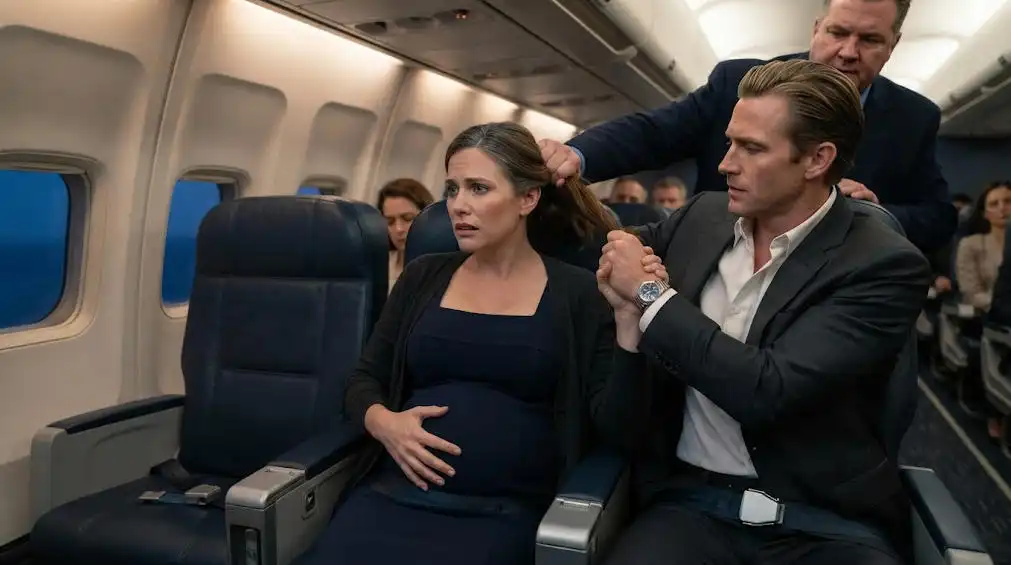
That was when he reached across her.
Grant's right hand closed around the hair at the back of her head and jerked hard, pulling her head backward against the seat.
“Get to the back. I paid more than your whole family will earn in a lifetime!”
Pain shot across Claire's scalp. Her left hand flew to his wrist while her right arm instinctively covered her abdomen.
“Let go of me!”
She fought to pry his fingers loose, struggling against the angle of the pull without twisting her pregnant body.
Before Grant could tighten his grip again, a federal air marshal came up the aisle.
The marshal seized Grant's forearm, forced his hand away from Claire's hair, and pushed him back into his seat. When Grant tried to protest and pull forward, the marshal restrained his wrist and ordered him to remain seated.
“Sir, stop resisting.”
“He attacked me?” Grant shouted. “She refused to move!”
“That does not give you permission to put your hands on her.”
The marshal secured Grant and took statements from two passengers who had seen the assault. A flight attendant recorded what she had witnessed as well.
Claire sat motionless for several seconds.
Her scalp hurt. Her heart was pounding. The sudden violence had left her feeling exposed and furious, and a troubling tightness had formed across her abdomen.
She placed her palm over her belly and waited.
A small movement answered beneath her hand.
The relief was immediate, though it did not erase the fear.
“Doctor, are you hurt?” the flight attendant asked quietly.
“I'm angry,” Claire replied. Her voice shook slightly, but she met the woman's eyes. “Please make sure he stays away from me.”
“Of course.”
Grant continued complaining about the broken screen and the money he had spent on his ticket. No one argued with him. No one offered to trade seats.
Claire returned to her tablet, but the scan on the screen blurred for a moment before she could focus again. She took several careful breaths and forced herself to think about the operation waiting in Rochester.
Henry Whitmore had no time for her to lose.
Neither did she.
Thirty minutes later, the cabin changed.
At first, Claire heard a strange, high-pitched wheeze from Grant's direction. Then came a series of harsh coughs.
He leaned forward, clutching his chest.
A flight attendant crouched beside him. “Sir, can you breathe?”
Grant tried to answer, but only a thin, broken sound emerged.
He fumbled inside his jacket for his rescue inhaler. His hands were shaking so badly that he nearly dropped it. He managed two desperate puffs, waited, and tried again to draw air into his lungs.
It wasn't working.
His face lost color. The muscles in his neck tightened with each effort to breathe. He looked suddenly much younger, stripped of the arrogance that had filled the cabin half an hour earlier.
“Is there a doctor on board?” the flight attendant called.
Claire looked up.
Grant was fighting a severe asthma attack. His breathing was becoming ineffective, and his pulse was weakening.
For one brief moment, she remembered the pain in her scalp, the force of his hand, and the fear that had shot through her when he pulled her head backward.
She could remain in her seat.
No one would have blamed her for refusing to help.
Then Grant's eyes rolled upward, and his body began to slump.
Claire unlatched her medical case.
“Get the oxygen, the AED, and the bag-valve mask,” she told the flight attendant. “Clear the aisle. I need room to work.”
She looked directly at the air marshal.
“And keep him from grabbing me.”
The marshal moved immediately, releasing Grant's restraints under supervision and helping the crew lower him onto the cabin floor. The flight attendants cleared the surrounding space and brought the emergency equipment.
Claire knelt beside him, positioning herself carefully so that her abdomen was not pressed against his body.
Her custom case opened beside her knee. Inside were compact airway instruments and emergency equipment she had packed for the trip.
The captain was informed of the medical emergency and requested priority handling for landing. At the same time, he instructed the cabin crew to verify the identity of the physician taking charge.
Claire showed her hospital identification and credentials. Through the airline's ground medical service, the captain obtained confirmation of her identity and professional affiliation with Cleveland Clinic. The verification came back while she was already assessing Grant.
His breathing had nearly stopped.
Claire checked his pulse and directed a flight attendant to begin oxygen-assisted ventilation. Another crew member brought the automated external defibrillator and placed its pads as instructed.
As Grant's jacket was adjusted, his phone slipped onto the floor. Its emergency medical information screen lit up.
Emergency contact: Henry Whitmore, Father.
Claire glanced at the name.
For a fraction of a second, the cabin seemed to fall away.
Henry Whitmore.
The name at the top of the scans on her tablet. The billionaire waiting at Mayo Clinic. The man whose brain was bleeding and whose operation could not be delayed.
Grant was his son.
The realization landed hard, but Claire did not stop working.
There would be time to understand the connection later. If Grant died now, there might never be another opportunity.
His pulse disappeared.
“Start compressions,” she ordered.
The flight attendant followed her directions while Claire prepared the airway equipment. The AED analyzed Grant's heart rhythm and announced, “Shock advised.”
“Everyone clear!”
Claire delivered the shock.
Grant's body jerked against the floor, but his circulation did not immediately return. Claire resumed the resuscitation, her voice sharp and controlled as she directed the crew.
The aisle was narrow. Her pregnant body made kneeling difficult, and the pressure on her knees and lower back was becoming painful. Sweat gathered at her hairline.
She kept working.
Using the compact laryngoscope from her medical case, she secured Grant's airway with an endotracheal tube. The flight attendant assisted with ventilation while Claire confirmed that air was moving into his lungs and that the tube was positioned correctly.
The AED advised another shock.
Claire checked that everyone was clear.
The second shock was delivered, followed by further resuscitation and assisted ventilation.
Seconds passed.
Then Grant's heart rhythm organized, and a pulse returned.
“Keep the oxygen going,” Claire said. “Watch his pulse. Don't let the tube move.”
The cabin seemed to exhale all at once.
Claire remained beside Grant, monitoring his condition while the crew secured the equipment. Her hands were steady, but when she tried to shift her weight, her legs trembled.
She had just saved the life of the man who had assaulted her.
And she was not finished with him.
A short time later, Grant's eyelids fluttered. He remained intubated and unable to speak, but his eyes began to track the people around him.
Claire picked up her tablet.
She opened Henry Whitmore's chart and held the screen where Grant could see it. His father's name appeared above the brain images and surgical notes.
Grant stared at the screen.
Claire watched recognition spread across his face.
“Your father is the patient I'm flying to Mayo to operate on,” she told him. “I'm the surgeon they called because his condition is so critical.”
His eyes widened. The ventilator continued to breathe for him.
Claire held his gaze.
“I will give your father every chance medicine can offer. But understand this: your father's life is in my hands now, too.”
She did not smile. She did not threaten to abandon Henry. She simply let the truth settle between them.
Grant's eyes filled with fear and shame.
For the first time since Claire had met him, he had nothing to demand. He couldn't raise his voice, order someone to move, or use his money to force the world into the shape he wanted.
Claire turned back to check his airway.
“Keep him stable until we land,” she instructed the crew.
Then the pain in her own abdomen sharpened.
She pressed a hand against it and closed her eyes for a moment. The physical strain of kneeling, ventilating, and performing emergency procedures had left her exhausted. She could feel her heart racing, and a tightness low in her abdomen made her fear what the stress might have done to the baby.
She forced herself to sit back carefully.
The flight attendant noticed.
“Doctor, you need help, too.”
“I'm going to need an obstetric assessment when we land,” Claire said. “Please make sure someone is waiting.”
The captain arranged for emergency medical teams to meet the aircraft. The flight crew completed their incident report, including the assault, the witness statements, and the medical emergency.
Grant remained intubated and ventilated for the rest of the flight.
When the plane landed in Rochester, an emergency team boarded and transferred him onto a stretcher. The air marshal handed over the incident documentation to the appropriate authorities.
Grant was too weak to protest. His eyes moved from one uniformed person to another, then toward Claire as she was escorted for her own medical evaluation.
She did not look triumphant.
She looked exhausted.
At the hospital, the obstetric team examined her immediately. The baby's heartbeat was reassuring, and there was no evidence of immediate placental injury. But Claire had developed uterine irritability after the trauma and exertion. Her obstetrician explained that the physical assault, intense stress, and prolonged emergency work had increased the risk of preterm labor and pregnancy complications.
“You need rest and observation,” the physician told her. “If the symptoms worsen, you cannot simply push through them.”
Claire listened carefully.
She had no intention of pretending the danger was insignificant. She agreed to monitoring and a clear plan for stopping if the symptoms returned.
Then she asked about Henry Whitmore.
His condition had deteriorated during the flight. The aneurysm was still threatening his life, and the surgical team was preparing to take him to the operating room.
A second senior neurosurgeon was ready to assist and take over if Claire became unwell.
After her obstetric assessment, Claire was cleared to lead the operation with that support in place.
She changed into surgical scrubs, washed her hands, and stood at the operating-room door for a moment.
The events on the plane returned to her in flashes: Grant's hand in her hair, the sharp pain in her scalp, the pressure of her knee against the cabin floor, the AED announcing that a shock was needed.
She put one hand against her abdomen.
“Just a little longer,” she whispered.
Then she entered the operating room.
Henry's aneurysm lay deep in a dangerous area near the brainstem. The hemorrhage had compromised the surrounding tissue, and the surgical team had little room for error.
Under the operating microscope, Claire worked through the delicate approach. She identified the affected vessels, separated the aneurysm from the surrounding structures, and positioned the clip with painstaking precision.
Every movement had to be controlled.
The operation demanded the concentration she had been trying to preserve before Grant attacked her. Now she had to find that concentration through exhaustion, physical discomfort, and the knowledge that her own pregnancy had been placed at greater risk.
At one point, a tightening sensation crossed her abdomen.
She stopped long enough to assess herself and signal the team. The discomfort eased. Her colleague remained ready to take over, but Claire chose to continue under the agreed plan.
She returned to the microscope.
The final part of the operation was the most delicate. She secured the aneurysm and confirmed that the critical surrounding blood vessels remained open.
When the team completed its checks, the result was clear.
The bleeding had been controlled. The aneurysm was secured. Henry Whitmore had survived the operation.
Claire stepped away from the table, removed her gloves, and sat down before her legs could give way.
Only then did she realize how badly her hands were shaking.
Her obstetric team reassessed her after surgery. The baby's heartbeat remained reassuring, but Claire was kept under observation because the risk had been real, even though no immediate pregnancy complication had been detected.
She had saved two lives in less than a day, one on an aircraft floor and one beneath an operating microscope.
Neither act had come without a cost.
The consequences of Grant's assault continued after he was admitted.
The air marshal's report, the passengers' statements, and the flight attendants' accounts established what had happened in the cabin. The family attorney was informed, and Henry's representatives received the documented account of the attack.
Grant had expected to inherit his father's fortune and the controlling interest in the family business. Henry had not yet finalized the transfer of his estate.
But the incident changed the decision.
When Henry recovered enough to communicate after surgery, his attorney presented him with the official report and the witness statements. Henry reviewed them carefully. He was still weak, but he understood what his son had done.
He had spent years excusing Grant's arrogance as immaturity, believing that another warning or another chance might eventually teach him responsibility.
This time, he made a different choice.
With his attorney present, Henry signed an amendment removing Grant as his heir and redirecting the inheritance and controlling shares to the neurological research foundation he had already supported.
The decision was his own.
Claire had not asked him to make it. She had not withheld medical care, and she had not used Henry's condition to bargain for anything. She had saved Grant because his life was in danger, then saved his father because she was the surgeon responsible for his care.
Grant's assault had cost him the inheritance he had treated as inevitable.
When Grant became alert enough to understand what had happened, he was still dependent on a ventilator. The severe asthma attack and cardiac arrest had left his lungs badly injured, and he could not simply sit up and explain himself.
A member of the family legal team informed him in writing that his father had survived and that the inheritance decision had been finalized.
Grant read the message twice.
His eyes moved across the words, then closed. Tears slipped from the corners of his eyes toward his temples.
He had wanted to reach his father before the operation, convinced that money and family influence would keep his future secure. Instead, he had attacked the very doctor his father needed, nearly died in front of her, and lost the inheritance he had assumed was his birthright.
Claire never celebrated his downfall.
She returned to her patients, followed her own medical team's instructions, and continued to receive obstetric monitoring. Her baby remained stable, though the ordeal had forced her to confront a risk she had never intended to take that day.
Three days later, Grant was still receiving ventilator support. His condition had improved enough for the hospital team to move him on a transport stretcher with a portable ventilator.
Claire had finished a postoperative review and was walking through the corridor in navy scrubs, her white coat folded over one arm.
As Grant's stretcher approached, she stopped beside it.
He was awake enough to follow her with his eyes, but the breathing tube prevented him from speaking. The ventilator continued its steady rhythm.
Claire lifted the white coat and slipped it on, smoothing the lapel over the curve of her seven-month belly.
Grant stared at her, his eyes wide with fear and shame.
He could not command her, could not rise, and could not take back the hand he had put in her hair. He watched her with the desperate, helpless awe of a man who had finally encountered someone his money could not control, someone who had stood between him and death and then walked away to save his father.
As the ventilator breathed for him, Grant looked at Claire Bennett as if she were a god no fortune could command.
Disclaimer: Mention of any brand or trademark is for identification only and does not imply partnership or endorsement
A Cruise Security Chief Cut a Cleaner's Skirt in Front of Terrified Passengers, Then Accused Her of Helping Hijackers, Until a Classified Device on Her Thigh Caught a Security Tycoon's Eye. 🚢

A Millionaire's Wife Shoved Her Ex-Con Sister Into a Cruise Ship Pool, Hoping a Theft Charge Would Silence Her, Until the Ship's Feared Owner Saw the Tattoo Showing Through Her Uniform. ⚖️
The Headmistress Shoved a Mom Into the School Pool for Bringing Her Daughter a Muffin, Then Threatened to Fire Her, Until a Silver Lock Made the Board Chair Freeze. 😳