
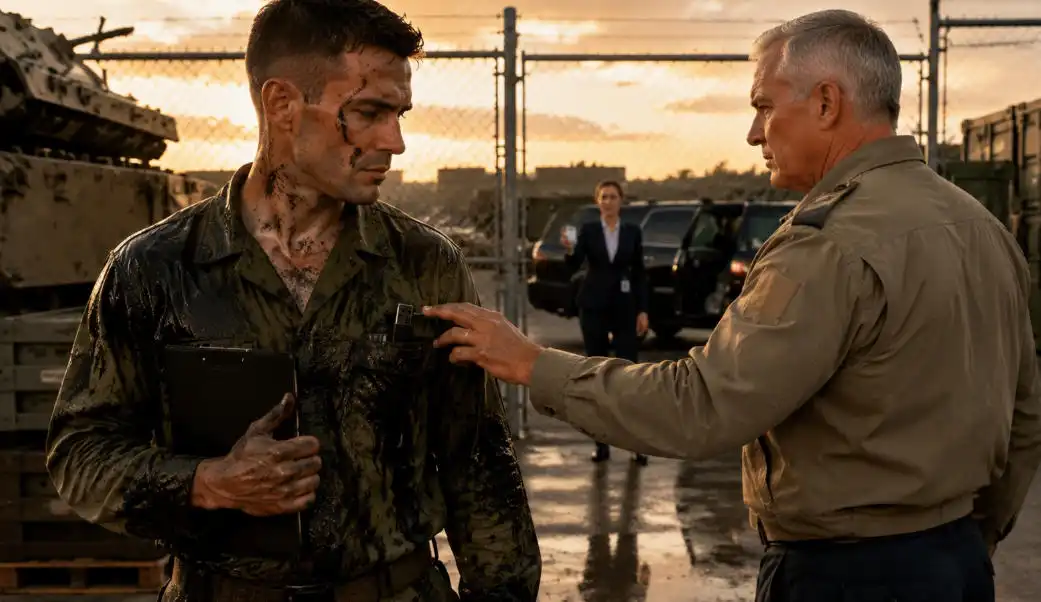
The lead investigator stepped through the opened gate, extended her credentialed hand toward my clipboard, and ordered Colonel Voss to move away from the acceptance sheet.
The matte-black flash drive pressed against my oil-soaked chest as I held the clipboard tighter.
Voss moved first.
He ripped the acceptance sheet from beneath the metal clip, tore it twice, and dropped the pieces into a dark puddle at his boots.
“There,” he said. “No document. No issue.”
The investigator did not look down.
“Colonel, step away from the evidence.”
“This is my equipment yard,” Voss snapped. “You entered a secure installation without reporting through my office.”
One of the investigators behind her raised a phone, but the lead investigator stopped him with one hand.
“No recording,” she said. “Not yet.”
Then she looked at Voss.
“Our arrival was coordinated with installation command, the Department of Defense inspector general, and base legal. You were not included in that coordination.”
His face tightened.
For years, that expression had ended conversations. Officers lowered their eyes when they saw it. Enlisted soldiers found reasons to become invisible.
But the woman in the navy suit did not move.
Neither did I.
Motor oil ran from my hair to my collar. Every breath carried the sour metallic smell of the maintenance pan Voss had emptied over me.
He pointed at the torn paper.
“That was a working draft. Captain Cole misunderstood a routine correction.”
“I understood every word,” I said.
Voss turned on me.
“You are still under my authority.”
The lead investigator stepped between us.
“Not regarding this disclosure.”
Voss’s aides shifted beside the armor pallets. They had laughed when the oil hit me. Now none of them seemed certain where to put their hands.
Voss noticed.
“Lieutenant,” he barked at the nearest one. “Collect Captain Cole’s clipboard and remove him from the yard.”
The lieutenant took one step.
Then stopped.
The investigator crouched beside the torn sheet without touching it.
“Captain Cole, did Colonel Voss remove that document from your possession?”
“Yes.”
“Did he tear it after I identified myself?”
“Yes.”
Voss gave a short laugh.
“You think two scraps of paper prove anything?”
“No,” she said. “I think destroying a document in front of an oversight team creates questions you should have been smart enough to avoid.”
She opened a flat evidence pouch and used gloved fingers to lift the pieces from the oil.
Voss looked at me again.
“You have no idea what you’ve done to yourself.”
That was the part meant to hurt.
Not the oil.
Not the laughter.
My career.
I had spent sixteen years taking the assignments other officers avoided. Overnight inventory checks. Storm-damaged depots. Emergency shipments. Missing serial numbers that had to be traced one crate at a time.
Voss knew what promotion meant to me because he had once encouraged it.
On my first week under his command, he had stood beside a row of supply trucks and told me, “Logistics is how we keep promises to people in uniform.”
I had believed him.
That memory made the oil feel colder.
“You taught me that our signatures mattered,” I said.
His jaw tightened.
“I taught you to understand command.”
“No, sir. You taught me that a shipment isn’t just a shipment.”
I looked at the sealed armor pallets behind him.
“Someone’s son or daughter is going to wear what’s inside those boxes.”
For a second, nobody spoke.
Then the investigator held out the open evidence pouch.
“Captain Cole, place the flash drive inside.”
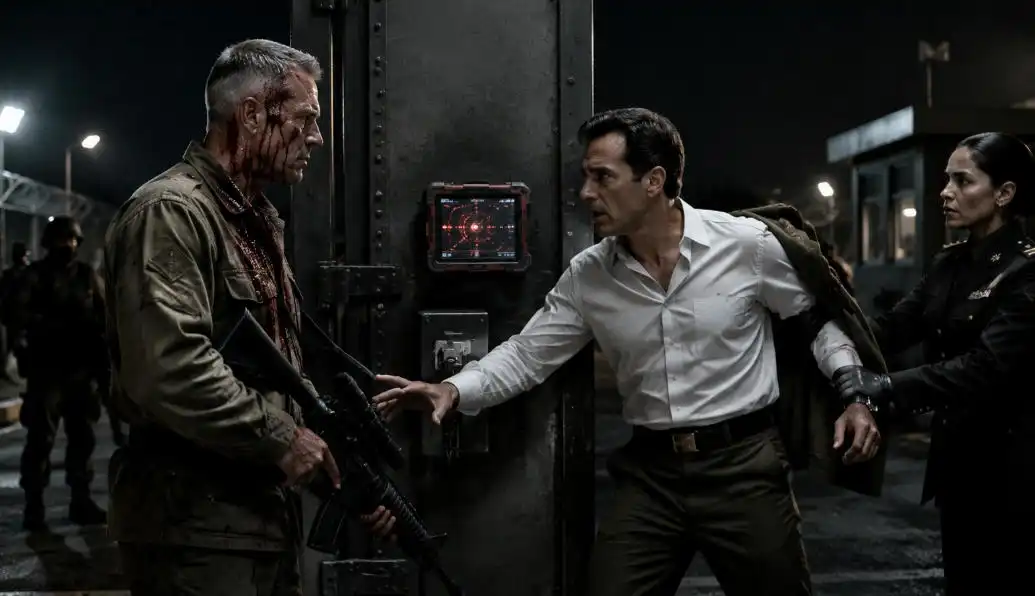
Voss stepped toward me.
“That device contains classified procurement material.”
“It contains an inspection report I was authorized to review,” I said.
“You copied government property.”
“I preserved a government record.”
His eyes flicked toward my chest pocket.
That small movement told the investigator more than his words had.
She saw that he knew exactly what the drive contained.
“Captain,” she said, “do not hand it to me yet.”
Voss almost smiled.
Then she continued.
“Show me the outside only. Do not open it. Do not alter its condition.”
I unfastened the oil-slick pocket flap and removed the matte-black drive between two fingers.
The casing was smeared, but intact.
The lead investigator compared the serial marking on its side with a number stored in her secured tablet.
“That matches the device identified in your protected disclosure.”
Voss’s smile disappeared.
“What disclosure?”
She ignored him.
“Captain Cole, did you use this device to preserve the report before the quality-control center’s original copy was destroyed?”
“Yes.”
“Did you transmit a protected copy through the Department of Defense reporting channel?”
“Yes.”
“When?”
“Two fourteen yesterday morning.”
She turned the tablet slightly toward me. I could see a receipt time, a file fingerprint, and a device identifier.
No report details.
No final conclusion.
Just one fact that Voss could no longer erase.
The file received by the government had come from the same flash drive now in my hand.
“That is our first verification,” she said. “The disclosure existed before today’s confrontation.”
Voss pointed at the tablet.
“A matching identifier proves nothing about the report’s accuracy.”
“You’re right,” she said.
The answer seemed to surprise him.
“It proves only that Captain Cole preserved and transmitted a file before you destroyed the local original. Accuracy will be verified separately.”
For the first time that afternoon, I had a piece of solid ground beneath me.
The full truth was not proven.
But Voss could no longer call the flash drive a last-minute invention.
The investigator opened the evidence pouch again.
I placed the drive inside.
She sealed it, signed across the tamper strip, and asked me to initial beside her signature.
Voss watched every movement.
Then he reached for the radio clipped to his belt.
“All yard personnel, secure Gate Three. No one leaves.”
The aides beside the pallets reacted immediately. One hurried toward the chain-link gate. Another moved in front of the investigators’ vehicles.
The lead investigator raised her credentials again.
“Colonel Voss, do not obstruct this team.”
“You are on a military installation,” he said. “My security rules apply.”
He pressed the radio button.
“Detain the civilians until their authority is confirmed.”
The lieutenant at the gate pulled it halfway closed.
For one ugly moment, the yard returned to Voss.
He had the rank.
He had armed security within minutes of his voice.
I had oil in my eyes, a damaged uniform, and no evidence left in my own hands.
Voss came closer.
“Withdraw your accusation,” he whispered. “Say you misunderstood the report, and I can still contain this.”
The investigator heard him.
She did not interrupt.
That was worse.
She was giving me the choice.
Voss lowered his voice further.
“You think these people will protect you forever? They will take your statement and drive away. I will still be here when they’re gone.”
He looked toward the aides.
“Your evaluation closes next month. Your promotion recommendation crosses my desk.”
There it was.
The real weapon.
Not the oil.
Not the paper.
The years ahead.
I could have said the report required more review. I could have called the dispute a misunderstanding. I could have protected the soldiers without openly accusing the man who controlled my future—or at least that was the lie I wanted to believe.
Then voices came from beyond the gate.
“Leave it open.”
A dozen members of my company stood on the other side of the chain-link fence.
They had not entered the yard. They had not formed a mob. They simply stood shoulder to shoulder in work uniforms, exactly where they were allowed to stand.
The senior noncommissioned officer among them held up an official hotline receipt.
Voss stared at him.
“What is this?”
The soldier answered calmly.
“Our report, sir.”
Voss looked along the line.
One by one, the others raised matching acknowledgment pages.
My throat tightened.
I had known they supported my refusal.
I had not known every one of them had put a name behind it.
The soldier at the front looked at me.
“You weren’t the only one who saw the failed lot numbers, Captain.”
That was his only role in the moment.
He had corroborated what Voss feared most.
I was not a lone officer he could discredit.
The investigator turned to Voss.
“Your detention order has already been referred to installation command.”
His radio crackled.
A voice from the command watch desk came through clearly.
“Colonel Voss, Gate Three remains open. Base security will not detain the congressional team. Stand by for the provost marshal and legal representative.”
Voss pressed the button.
“This is a direct order.”
The reply came without hesitation.
“Your authority over this matter has been suspended pending command review.”
The lieutenant slowly pushed the gate open again.
Voss looked at his aides.
“Close it.”
Neither moved.
“Close the gate!”
The nearest lieutenant stepped back from the chain.
“I can’t do that, sir.”
The balance in the yard changed with that one sentence.
Not because Voss had been punished.
Not yet.
But because his rank no longer made an unlawful command valid.
The lead investigator faced me.
“Captain Cole, we can preserve your disclosure as confidential during the preliminary review.”
I looked at the company behind the gate.
She continued carefully.
“But the immediate referral for retaliation, destruction of records, and attempted false certification will be stronger with a sworn declaration under your name. Once you sign, your identity becomes part of the formal process. There are protections, but I will not tell you there is no career risk.”
Voss seized on that.
“Listen to her, Ethan.”
It was the first time he had used my first name all day.
“You still have a future. Let the inspectors argue about the armor. You don’t have to turn yourself into the face of this.”
He almost sounded reasonable.
That was how power survived. It stopped shouting when shouting failed.
He took another step.
“I can recommend you for the next command slot. I can put this incident behind us.”
The investigator waited.
My company waited.
No one could make the decision for me.
I thought about the promotion file on Voss’s desk.
I thought about the years I had spent building a reputation for being dependable, not difficult.
Then I looked at the armor pallets.
A signature took three seconds.
A failed vest could change a family forever.
“Give me the declaration,” I said.
Voss’s face hardened.
“You are ending your career.”
“Maybe.”
The investigator handed me a secured form and a clean pen.
Oil dripped from my sleeve onto the concrete as I signed my full name.
“But I’m not ending theirs.”
I nodded toward the soldiers behind the gate.
The lead investigator countersigned, sealed the declaration with the flash drive, and contacted the Department of Defense inspector general’s duty office.
That signature triggered the next step.
Not an instant conviction.
Not handcuffs appearing from nowhere.
A formal preservation order.
Within minutes, installation command directed that the body-armor shipment remain untouched. The pallets were marked for quarantine. The acceptance process stopped. Access to the procurement files was restricted, and a military criminal investigative team was assigned to secure the equipment yard, the quality-control records, and Voss’s office.
Voss was ordered to surrender his radio and step away from the shipment.
He refused once.
Then the base legal representative arrived and repeated the order in front of witnesses.
Voss removed the radio from his belt and placed it on a folding table.
His gold ring clicked against the plastic.
That tiny sound stayed with me.
For years, he had filled rooms with his voice.
Now the procedure moved forward without asking his permission.
The first technical review happened that evening in a secured evidence room on the same installation.
The investigators did not treat my flash drive as automatically true.
They made a forensic copy.
They verified that the file had not been altered after the protected transmission.
Then they compared its timestamps and lot numbers with surviving instrument logs from the quality-control center.
The logs showed that the tested armor panels had failed required performance measurements before the original report disappeared.
That was the surface truth.
The armor had failed.
My backup was authentic.
But the investigators still needed to know why the report had been destroyed and why Voss needed my signature so badly.
The answer came from the paper trail Voss had believed he controlled.
The shipment could not be placed into service without acceptance by the responsible supply officer.
My signature would have allowed the failed report to be dismissed as a preliminary error. It would have created an official record stating that the equipment had arrived in acceptable condition.
Voss had already defended the procurement schedule to senior command.
If the shipment failed, every approval and representation he had made would be reviewed.
His promotion, his authority, and the entire procurement operation he managed would be exposed to scrutiny.
He had not poured oil on me because he lost his temper over one form.
He had done it because my refusal blocked the document he needed to protect himself.
The torn acceptance sheet completed that part of the chain.
The hotline reports completed another.
Members of my company gave separate statements describing the same lot numbers, the same pressure to process the shipment quickly, and the same efforts to treat the failed report as if it had never existed.
No single statement carried the case.
Together, they made Voss’s explanation impossible to sustain.
Three days later, the installation commander formally relieved him of logistics authority while the investigation continued.
The defective armor remained quarantined.
None of it reached a soldier.
That mattered more to me than anything else that happened.
The next months were not easy.
I became the officer people whispered about in hallways.
Some called me brave.
Others called me dangerous.
My promotion package stalled while investigators reviewed the retaliation issue. The command slot Voss had promised went to someone else.
There were mornings when I wondered whether he had been right about one thing.
Maybe I had ended the career I thought I wanted.
But every time that doubt grew, I remembered the sentence above the signature box.
Equipment received in acceptable condition.
It had not been true.
That was enough.
The inspector general completed its findings first.
The report concluded that Voss had attempted to force a false acceptance, retaliated against me for refusing, destroyed an official record, and tried to obstruct an authorized oversight team.
The military criminal investigation then referred the supported offenses for court-martial proceedings.
The supplier’s records were seized through the federal procurement investigation. Its facility was suspended from government work and later shut down after investigators confirmed that failed protective equipment had been presented for acceptance.
The national-security consequences went beyond one bad shipment.
Federal prosecutors opened procurement-fraud and obstruction cases and evaluated serious treason-related allegations connected to knowingly placing defective protective equipment into the military supply chain. Those charging decisions followed their own process, but the allegations were no longer something Voss could bury with a signature.
Months later, his court-martial ended.
He was convicted of the offenses the military evidence supported, stripped of rank, and dismissed from service.
The man who had threatened to make my life unbearable lost the authority he had abused to make that threat.
There was no cheering in the courtroom.
I did not need it.
The facts had done what anger could not.
After the proceedings, the lead investigator met me one final time at the equipment yard.
The quarantined pallets were gone. The concrete had been scrubbed, but a faint dark stain remained where Voss had poured the oil.
She handed me a copy of the final evidence-transfer receipt.
“You understand,” she said, “that your promotion case may take time to repair.”
“I do.”
“Any regrets?”
I looked through the chain-link gate.
My company was assembling for morning work. The same soldiers who had stood outside the fence now moved between properly inspected equipment crates.
“No,” I said. “Just one.”
She waited.
“I wish I had known sooner that I wasn’t alone.”
She smiled slightly.
“You usually aren’t. People are just waiting to see who stands first.”
Before she left, she opened a tamper-evident evidence bag for the final transfer.
I was still wearing the oil-stained utility shirt I had kept from that day. I had washed it three times, but the dark marks never completely disappeared.
I took the matte-black flash drive from its temporary storage case and placed it into her evidence bag with my own hand.
My company formed quietly behind me.
Across the yard, Voss—no longer a colonel, no longer in command—sat against an armor pallet under escort, waiting to be transferred from the installation.
He looked smaller without the rank on his chest.
I did not speak to him.
I did not need revenge.
I stood upright in the morning light, oil stains still visible on my uniform, while the investigator sealed the evidence that had protected people Voss had been willing to endanger.
For the first time in months, I felt no fear about what came next.
My career might follow a different road.
But every soldier in that yard had safe armor.
And my signature still meant something.
FINAL ENGAGEMENT
Was Captain Cole right to risk his entire career by becoming a named whistleblower—or should he have protected himself and submitted the evidence anonymously?
Disclaimer: Mention of any brand or trademark is for identification only and does not imply partnership or endorsement