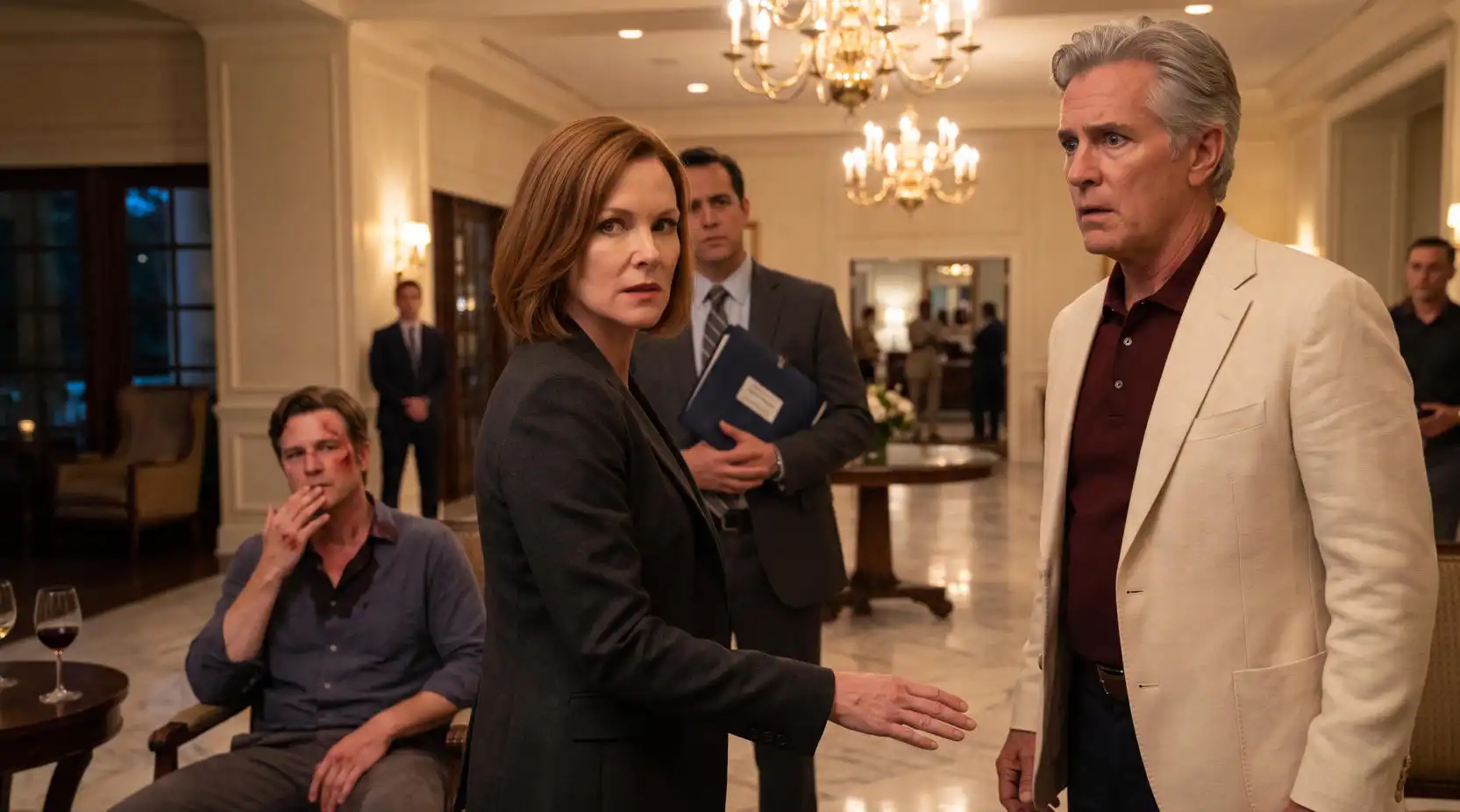
The clubhouse screen froze before anyone could breathe.
Richard’s smile was still there, but only halfway.
The security guard’s thumb hovered over the play button.
And my granddaughter Sophie stood beside me, clutching that trembling little dog like he was the only friend she had left in the world.
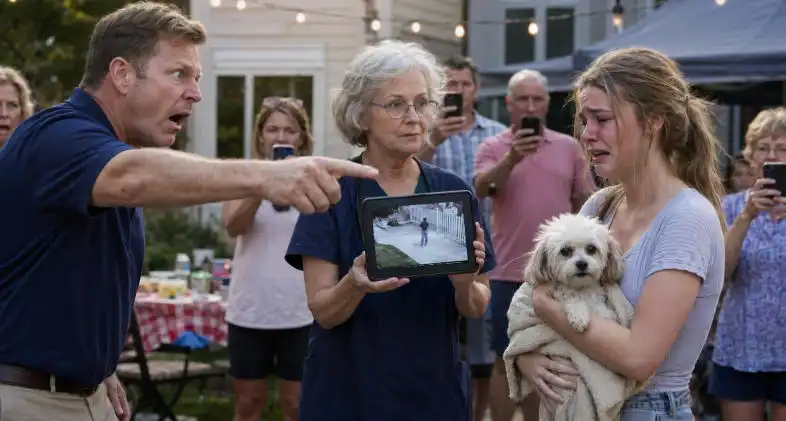
Richard leaned close and whispered, “Margaret, don’t embarrass yourself.”
That was rich coming from a man who had just tried to put handcuffs on an 8-year-old child.
I was only the vet assistant.
That was how people like Richard said it.
Only.
Only the woman who cleaned exam rooms.
Only the grandmother who still worked weekends.
Only the neighbor who brought store-brand lemonade to the annual HOA barbecue because retirement hadn’t exactly made me rich.
Richard, on the other hand, was the president of the homeowners association.
He had the biggest house on Briar Glen Court.
He drove a silver SUV he parked across two spaces.
He had a purebred dog named Winston that he introduced before he introduced his wife.
And he loved rules.
Not the kind that protected people.
The kind that let him feel taller.
That Saturday, the annual community barbecue was supposed to be harmless.
Kids running through sprinklers.
Burgers smoking on the grill.
Old men arguing about lawn fertilizer.
Sophie had come with me because her mother was working a double shift at the hospital.
She wore her favorite yellow summer dress.
By 2:15, it was wrinkled, stained with grass, and covered in dog hair.
By 2:20, Richard was calling her an animal abuser.
I first heard the shouting from the lemonade table.
“Get away from my dog!”
I turned and saw Sophie on her knees near the clubhouse fence.
The little white dog lay on the grass in front of her, limp and panting.
Sophie had both hands on his chest, exactly where I had taught her.
Small compressions.
Careful rhythm.
Mouth closed.
Nose checked.
Tongue clear.
She wasn’t hurting that dog.
She was trying to save him.
But Richard came charging across the lawn like a king whose crown had been touched.
He grabbed the dog’s leash, yanked the towel away, and nearly knocked Sophie backward with his hip.
“Do you have any idea what this dog is worth?” he shouted.
Sophie burst into tears.
“He wasn’t breathing right.”
Richard looked around and realized people were watching.
That was when his performance began.
He straightened his polo.
Lifted his chin.
Made his voice louder.
“This child attacked my dog.”
A few neighbors gasped.
One woman covered her mouth.
One of Richard’s friends, Dale, muttered, “These kids have no discipline anymore.”
Sophie shook her head so hard her ponytail came loose.
“No! He was tied by the fence. He was hot. He fell over.”
Richard snapped, “Enough.”
Then he pointed directly at me.
“You should be ashamed, Margaret. A woman with your job should know better than to let a child play veterinarian.”
A few people laughed nervously.
That little laugh hurt more than the insult.
Because Sophie heard it.
She lowered her head like she had done something dirty.
Like kindness was a crime.
Richard turned to the security guard, a young man named Caleb who looked like he wanted to disappear into his own shoes.
“Call animal control. And the police.”
Caleb swallowed.
“Mr. Whitmore, maybe we should—”
Richard cut him off.
“I said call them.”
Then he looked at Sophie.
“You are not leaving until this is documented.”
My granddaughter whispered, “Grandma…”
I put my hand on her shoulder.
“Look at me, honey.”
She looked up.
Her face was red.
Her cheeks were wet.
The dog was breathing, but weakly.
I knelt and checked his gums.
Pale.
His ears were hot.
His paws were burning against my palm.
Heat stress.
Maybe worse.
I asked Richard, “How long was Winston tied there?”
His eyes flashed.
“That is none of your business.”
That answer told me everything.
So I did what emergency clinics teach you to do.
I stopped arguing with panic.
I started collecting facts.
“Caleb,” I said softly, “does the clubhouse patio camera cover that fence?”
Richard’s head turned.
Fast.
Caleb blinked.
“Yes, ma’am. It covers the grill area and the side fence.”
Richard laughed loudly, too loudly.
“You’re really going to make this about cameras? Fine. Let’s see your little granddaughter assault my dog.”
He said assault.
About a child.
About an 8-year-old girl with grass stains on her knees.
That was the moment the crowd changed.
Not all at once.
But enough.
Mrs. Donnelly from Maple Lane stopped filming and said, “Richard, maybe don’t use that word.”
Dale folded his arms.
Another neighbor whispered, “Why would he be tied out there?”
Richard ignored them.
He was used to people shrinking when he spoke.
He didn’t realize I had spent 26 years standing beside animals that couldn’t speak for themselves.
I had watched owners lie.
I had watched injuries tell the truth.
I had watched frightened children do more good with shaking hands than adults did with perfect speeches.
So I stood.
I looked at Caleb.
“Before anyone calls the police on a child, press play.”
The big screen over the raffle table was normally used for football games and HOA announcements.
That day, it became a courtroom.
Caleb connected the tablet.
Richard stood beside him, arms crossed, lips curled.
Sophie clutched my hand.
The first image appeared.
12:47 p.m.
Richard walking toward the side fence with Winston.
He looked around.
Then he tied the dog’s leash to the metal post beside the trash enclosure.
No shade.
No water bowl.
No fan.
No one beside him.
The crowd went silent.
Richard’s face hardened.
“That proves nothing.”
The video kept playing.
1:03 p.m.
Richard returned with a paper plate stacked with ribs.
He glanced at Winston.
The dog was already panting hard.
Richard did not untie him.
He did not touch him.
He did not offer water.
He walked away.
Someone in the crowd whispered, “Oh my God.”
1:29 p.m.
Two of Richard’s friends walked by.
One of them pointed at the dog.
Richard waved them off from across the lawn.
He was laughing.
Winston was pulling weakly at the leash.
1:52 p.m.
The dog lay down.
He tried to lift his head.
Couldn’t.
2:07 p.m.
Sophie entered the frame.
She had a cup of ice water in one hand and a folded towel in the other.
She stopped when she saw Winston.
You could see it happen.
The moment a child knew something was wrong before any adult did.
She dropped to her knees.
Touched his side.
Looked around for help.
Waved both arms.
No one saw her.
Or no one wanted to.
She poured a little water onto the towel.
Placed it gently against his belly.
Checked his mouth.
Then Winston stopped moving.
Sophie screamed.
The screen had no sound, but every adult there could see it.
She screamed for help.
Nobody came.
Then my granddaughter, my tiny brave Sophie, put her hands on that dog’s chest and started compressions.
The same way I had taught her with a stuffed animal and a metronome app on my kitchen table.
Small.
Steady.
Careful.
Not playing.
Not harming.
Saving.
Richard tried to step in front of the screen.
“Turn that off.”
Nobody moved.
Caleb looked at me.
I said, “Let it play.”
2:12 p.m.
Winston’s legs twitched.
Sophie leaned close.
Checked his breathing.
Then she wrapped him in the towel and lifted his head into her lap.
That was the moment Richard arrived on screen.
Not worried.
Angry.
He grabbed the leash.
Yanked the towel.
Pointed at Sophie.
And then the real-life Richard, standing in front of all his neighbors, went white.
Someone said, “You left him there?”
Another voice said, “In this heat?”
Mrs. Donnelly looked at Sophie and started crying.
Dale, who had laughed earlier, stared at his shoes.
Richard tried to recover.
“She had no right to touch my property.”
That sentence ended him.
Not because it was loud.
Because it was exactly who he was.
He didn’t say Winston.
He didn’t say my dog.
He said property.
I took one step forward.
“Richard, under our state’s animal cruelty statute and emergency aid protections, Sophie had every reason to intervene when an animal was in visible distress.”
He scoffed.
“You’re not a lawyer.”
“No,” I said. “I’m the person who works with the veterinarian your wife called last month when Winston swallowed a peach pit.”
His mouth opened.
I continued.
“And I already texted Dr. Alvarez. He is on his way. So is the county animal welfare officer.”
Richard’s wife, Elaine, who had been standing near the dessert table, suddenly covered her face.
Quietly, she said, “Richard, I told you not to leave him tied up.”
Everyone heard it.
Richard spun on her.
“Do not start.”
But she did.
Maybe because the camera was already speaking.
Maybe because Sophie’s tears finally did what years of his control could not.
Elaine stepped forward.
“He leaves Winston outside when he’s annoyed with him,” she said. “He says dogs need to learn respect.”
The crowd went completely still.
That sentence did not need drama.
It was ugly enough on its own.
Dr. Alvarez arrived seven minutes later.
He examined Winston under the shade of the pavilion while Sophie watched with both hands pressed to her mouth.
He confirmed what I already knew.
Heat exhaustion.
Dehydration.
Possible collapse from prolonged exposure.
Then he looked at Sophie.
“You did the right thing.”
Sophie whispered, “Is he going to die?”
Dr. Alvarez softened.
“Not today, sweetheart. Because of you.”
That was when the applause started.
Small at first.
Then louder.
Not for Richard.
Not for the HOA.
For an 8-year-old girl in a stained yellow dress who had been called a criminal for saving a life.
Richard tried to leave.
But animal welfare had already arrived.
So had two officers, thanks to Richard’s own demand for police.
Only now, the questions were not for Sophie.
They were for him.
The animal welfare officer watched the footage twice.
Took statements.
Photographed the leash spot.
Documented the temperature.
Documented the lack of water.
Documented Dr. Alvarez’s findings.
And then Richard, the man who wanted my granddaughter detained, was informed that the case would be referred for animal neglect and cruelty review.
His face folded in on itself.
For the first time since I had known him, he looked small.
Within a week, the HOA board called an emergency meeting.
Richard was removed as president.
Not politely.
Not quietly.
The same neighbors he used to intimidate voted him out while he sat in the front row, staring at the floor.
The animal protection association filed a formal complaint.
County authorities pursued charges and penalties.
Richard’s name disappeared from the community newsletter.
His friends stopped waving from their golf carts.
His house went up for sale before the end of summer.
And Winston?
That part took time.
Elaine surrendered him legally after admitting she could not protect him while living with Richard.
The vet clinic treated him.
I fostered him.
Sophie visited every afternoon.
She read him library books.
Fed him tiny pieces of chicken.
Slept beside his crate the first night he whimpered during a thunderstorm.
Three months later, in the same clubhouse where she had been humiliated, Sophie stood on a little wooden stage.
The new HOA president handed her a framed certificate.
Community Compassion Award.
Sophie was so nervous she held it upside down.
Everyone laughed gently.
Then Dr. Alvarez walked in holding a blue leash.
Winston trotted beside him, healthy, bright-eyed, tail wagging so hard his whole body wiggled.
Sophie dropped the certificate.
“Is that—”
I nodded.
“It’s official, honey.”
The adoption papers were signed that morning.
Winston was hers.
Sophie sank to her knees, and that dog ran straight into her arms.
The whole room stood up.
Even people who had stayed silent that awful day.
Especially them.
Sophie buried her face in Winston’s fur and cried again.
But this time, nobody laughed.
Nobody pointed.
Nobody called her a liar.
They clapped for her like she was a hero.
Because she was.
Later that night, she asked me, “Grandma, why did Mr. Richard say I was bad when I was helping?”
I told her the truth.
“Sometimes people who do wrong try to make the helper look guilty first.”
She thought about that.
Then she looked down at Winston sleeping across her feet.
“But the camera saw.”
I smiled.
“Yes, baby.”
Then I touched her little hand.
“And so did everyone else.”
Richard wanted a public arrest.
He got a public lesson.
Sophie lost her innocence for a few painful minutes that day.
But she gained something stronger.
She learned that kindness does not become wrong just because a powerful person mocks it.
And our neighborhood learned that the smallest voice at the barbecue might be the only one telling the truth. 🐾
So pick a side:
Was Margaret right to expose Richard in front of the whole community — or should she have protected his reputation after what he did to Sophie?
Share this if you believe a child who saves a life deserves applause, not accusations.
Disclaimer: Mention of any brand or trademark is for identification only and does not imply partnership or endorsement