

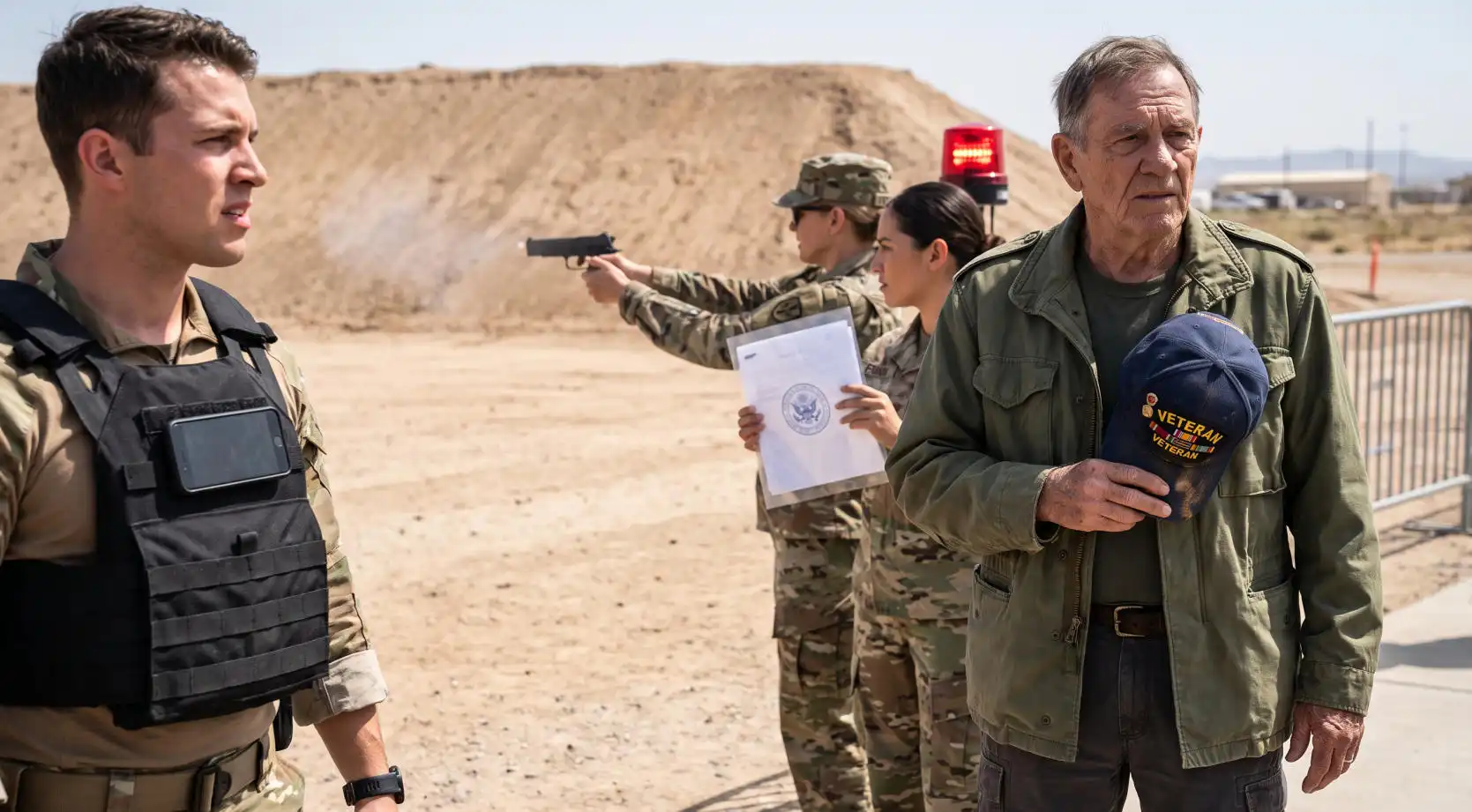
Captain Leah Ortiz slid one finger beneath the seal, tore open the clear sleeve, and unfolded the National Archives report while Brigadier General Mara Ellison lowered her sidearm toward the concrete.
The report crackled in the sudden silence.
Logan moved before Ortiz could read a word.
“That file proves nothing,” he said, stepping toward her with both hands raised. “My unit was classified. You won’t find it in normal records.”
General Ellison turned her head.
“Stay where you are.”
Logan stopped, but only because two range-security soldiers had already shifted between him and the table.
I could still hear the shot echoing inside my skull.
Not the one the general had fired into the berm.
Other shots. Older ones.
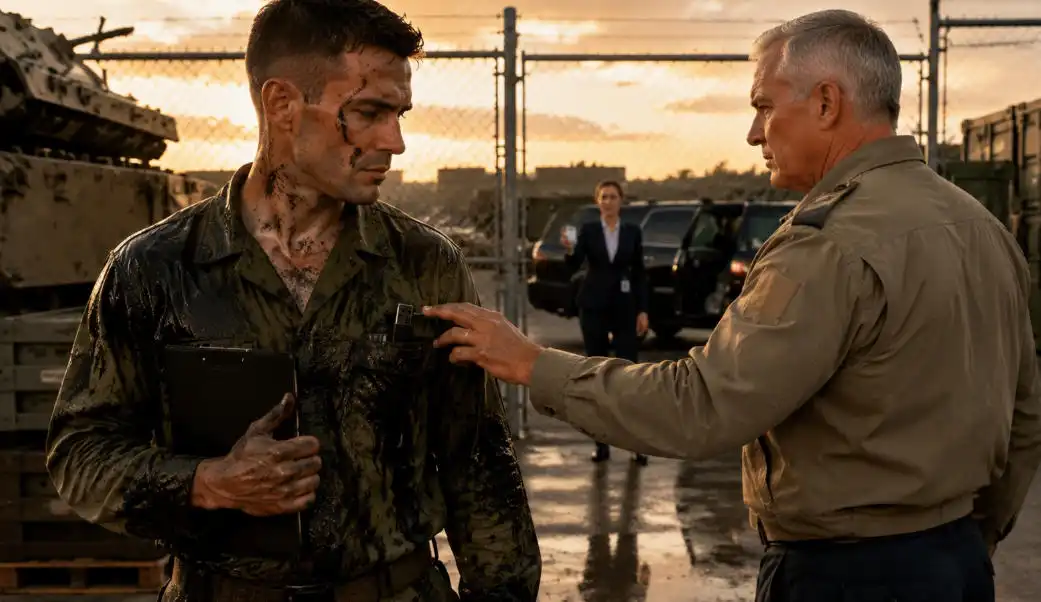
My chest tightened under my stained field jacket. Grease ran behind my ear. I pressed my thumb against the worn ribbon pin on my cap and counted the bolts on the range barrier.
One.
Two.
Three.
Ortiz looked at the first page.
“Mr. Vance,” she said, “this verification was requested using the legal name, birth date, and identification you submitted for your media credentials.”
Logan laughed.
It came out too high.
“I just told you. Classified.”
Ortiz did not argue with him. She read one sentence.
“The National Archives reports no record of service for Logan Michael Vance in any branch of the United States Armed Forces.”
Nobody cheered.
That made it worse for him.
The visitors behind the barrier simply stopped holding their phones toward me and turned them toward him.
Logan looked from face to face as though the crowd had violated an agreement.
“That’s administrative language,” he said. “People who actually served understand how compartmented records work.”
General Ellison holstered her sidearm.
“I understand records.”
“You weren’t in my program.”
“What program?”
His mouth opened.
Nothing came out.
Ortiz held up the page, careful not to expose the personal information printed below the finding.
“The report does not say records are restricted,” she said. “It says there is no record of service.”
“That’s because there can’t be.”
“Then why,” the general asked, “did you put a branch, rank, unit, deployment history, and separation date on your base credential application?”
Logan pointed at me.
“This is what he wanted. He baited me.”
I almost laughed, but my lungs would not give me enough air.
He had dumped food over an old man’s head in front of his own livestream, and somehow I had baited him.
The range smelled like hot dust, gun oil, and sweet barbecue sauce. My knees began to shake.
Logan saw it.
His confidence returned by half an inch.
“Look at him,” he said. “He’s confused. He doesn’t even know where he is.”
That sentence hurt more than the food.
Not because it was true.
Because there had been nights when it almost was.
For years, I had repaired transmissions during the day and woken under my kitchen table at night. I had learned which grocery stores were quiet, which fireworks displays to avoid, and how to smile when people told me the war had happened a long time ago.
The cap in my hand had survived rain, engine grease, and fifty years of being taken off whenever another family received a folded flag.
Logan had knocked it into spilled food because I corrected his rifle grip.
But the real wound was not the cap.
It was watching a man wear sacrifice like a costume and then use my scars as proof that I was the fraud.
General Ellison glanced at me.
“Mr. Delaney, do you need a medic?”
Logan smirked.
I could have taken the exit she offered.
Part of me wanted it.
A medic would lead me away from the noise. Someone else could finish this. Someone younger, steadier, and less likely to lose his breath in front of thousands of strangers watching through Logan’s phone.
Then I saw his thumb move.
He pulled the chest-mounted phone free and turned his back toward the barrier.
The screen flashed white, then blue.
A fundraising dashboard appeared.
Captain Ortiz saw it too.
“Secure the device.”
Logan’s thumb jabbed the screen.
A red confirmation bar appeared near the bottom.
Delete campaign.
A range-security sergeant caught Logan’s wrist before he could press it.
“Let go of me!”
“Take your hand off the screen.”
“That’s my property.”
“And you are attempting to destroy records after receiving an official service verification.”
“I’m closing a private account.”
The sergeant kept Logan’s hand away from the phone while another security soldier disconnected nothing and touched no controls. He simply held the device upright so the active screen remained visible.
Across the top were several campaign thumbnails.
Logan in tactical gear beside flags.
Logan kneeling at a memorial.
Logan shaking hands with older veterans who probably believed every word he said.
I could not read all the titles from where I stood, but I could see the repeated word VETERANS in large block letters.
The livestream was still running.
Comments climbed so quickly that the screen looked like rain.
Logan twisted toward the crowd.
“This is a setup. They’re taking my phone because they don’t want you to hear the truth.”
General Ellison faced the security sergeant.
“Preserve the live session. Do not close the application. Move him away from the device.”
The soldiers guided Logan two steps back.
He did not fight them.
Not physically.
He fought with the only weapon he had left.
His audience.
“You all know me,” he shouted toward the phone. “You’ve watched my missions. You’ve seen the scars.”
A woman behind the barrier called out, “What missions?”
Logan ignored her.
“I’ve raised money for veterans when this base did nothing for them.”
Captain Ortiz looked down at the second page of the report, then at his media application on the range clipboard.
“You requested access by claiming your livestream would benefit three veteran-support campaigns.”
“It does.”
“Where are the beneficiary organizations listed?”
“They’re private partners.”
“Names?”
“My attorney handles that.”
No attorney appeared.
No hidden official stepped forward.
Just Logan, the phone, the federal report, and the questions he had never expected anyone to ask in the same place.
General Ellison looked at me again.
“Mr. Delaney, you made the first correction. Was it only his grip?”
There it was.
My way out disappeared.
If I answered, the cameras would stay on me.
If I remained silent, Logan would turn one missing record into a story about classified heroes and government betrayal. His followers wanted a reason to keep believing him. He was already handing them one.
My fingers were still trembling.
I put the stained cap on the range table.
“No,” I said.
The word came out rough.
Logan’s face changed.
He had expected anger from me. Anger could be edited. Anger could make us look like two men arguing.
Calm details were harder to survive.
I stepped beside the cleared rifle, keeping both hands visible.
“The sling is threaded backward for the way you claimed to carry it,” I said. “Your patches don’t match the unit and period you listed on your credential form. You named one rank in your video introduction and submitted another rank to the base.”
“That’s your opinion.”
“No. Those are your two statements.”
Ortiz placed his application beside the opened pages of the report.
I continued.
“You keep calling the range safety officer a ‘weapons master.’ That is movie language. You attached equipment to your carrier in places that make it hard to reach and easy to lose. And every time somebody asks a direct question, you answer with the word classified.”
A few people behind the barrier lowered their phones.
Not because they had lost interest.
Because they were listening.
Logan pointed at my hands.
“You can barely stand.”
“You’re right.”
The admission seemed to surprise him.
I swallowed until my throat worked again.
“I have trouble with noise. I have trouble with crowds. Some days I have trouble sleeping. None of that makes your story true.”
The red cease-fire light reflected off the clear sleeve.
Captain Ortiz turned to the next verified item.
“Mr. Vance’s application lists eight years of military service,” she said. “The National Archives response verifies zero.”
That was the first solid piece.
No service.
But it was not yet the whole truth.
Logan tried one more version.
“I worked under another identity.”
Ortiz answered immediately.
“You signed the application certifying that the information was complete and accurate.”
“Because it was.”
“Then identify the branch liaison who can verify it.”
“I won’t compromise national security for a publicity stunt.”
General Ellison’s expression hardened.
“You created the publicity stunt.”
That was when the crowd finally reacted.
Not with applause.
With a low sound of recognition.
They had seen the trick.
Every request for proof became proof of secrecy. Every contradiction became evidence that Logan was important. Every questioner became an enemy.
The security sergeant spoke quietly to General Ellison.
“Ma’am, the campaign dashboard is still active. There are incoming donations.”
Logan snapped his head toward the phone.
“Turn that off.”
The general did not look at him.
“Why?”
“Because people’s financial information is exposed.”
“The donor details are not visible from here.”
“You don’t know what you’re doing.”
The sergeant rotated the phone just enough for Ortiz and the general to see the administrator page without showing it to the crowd.
Ortiz’s face changed first.
Not shock.
Professional anger.
“There are multiple campaigns under his control,” she said. “All use military-service claims.”
Logan lunged one step.
Security stopped him.
“You cannot search my account without a warrant.”
“We are not searching it,” General Ellison said. “You opened it. You attempted to delete it. The active screen is being preserved exactly as you left it.”
Captain Ortiz pointed to a campaign image.
“This one uses the same claimed rank and unit listed on your credential application.”
“That money goes to veterans.”
“Which veterans?”
“I told you. Private partners.”
The woman behind the barrier spoke again.
“I donated to him.”
Her voice shook.
“My husband died last year. Logan said the money was paying emergency rent for disabled vets.”
Logan turned toward her.
“Ma’am, don’t discuss donor matters publicly.”
She stared at him.
“You called me every week until I increased my donation.”
The crowd shifted away from him as if he carried heat.
That woman did not solve the case. She did not produce a secret recording or a miracle document.
She did something simpler.
She showed us why the lie mattered.
Logan had not worn the uniform only to feel important.
He had used it to get close to people whose grief made them generous.
Captain Ortiz explained why the report existed.
“When Mr. Vance applied for media access, he advertised himself as a decorated former special operations soldier. Base policy requires public affairs to verify military credentials used to obtain special access. We submitted the request before approving his range segment.”
Logan stared at her.
“You approved me.”
“We gave you conditional access while verification was pending. You were told not to represent the base as endorsing your background.”
“You let me through the gate.”
“And now your credentials are revoked.”
General Ellison removed the laminated media pass from the front of his plate carrier.
It came away with a small plastic snap.
That sound cut deeper than shouting.
Logan watched the pass in her hand as though she had removed a piece of his body.
“You can’t do that.”
“I just did.”
She handed the pass to Ortiz.
“Range security will escort him to the security office. Preserve the phone, livestream, credential application, and the National Archives response. Notify base legal and the federal duty officer.”
Logan’s eyes found me.
“This is on you.”
For the first time, I answered without fear.
“No. This is on the man who pressed delete.”
He looked toward the crowd for support.
There was none left.
Still, he was not finished.
As security moved him toward the gate, he twisted around and shouted, “He’s not a hero. Ask him what he did over there. Ask him why he shakes.”
The old shame rose fast.
My vision narrowed around the edges.
For half a second, I was twenty-one again, trying to restart an engine while someone screamed for a medic.
I gripped the range table.
General Ellison stepped toward me, but I raised one hand.
Not yet.
I had made my choice.
I had stepped in front of the camera, and I was going to finish standing.
“I shake because I remember,” I said.
Logan stopped struggling.
The whole range heard me.
“You shake because you’re afraid people will stop believing you.”
No one said anything after that.
Security led him through the same gate he had entered like a celebrity.
His phone remained behind in the sergeant’s hand, still recording the empty space where he had been.
The first verification ended the performance.
The records that followed built the case.
Two hours later, after base legal sent preservation notices to the fundraising platform and the payment processor, Captain Ortiz met me in a quiet office near the range. My jacket had been wiped clean as well as anyone could manage, but a dark stain remained near the collar.
My cap sat on the desk between us.
Ortiz opened a printed preservation confirmation.
“The platform froze the campaigns,” she said. “They are providing account records to federal investigators.”
“How much?”
“Hundreds of thousands across several campaigns.”
I looked at the ribbon pin on my cap.
“How much reached veterans?”
“We don’t know yet.”
That answer mattered.
She did not exaggerate. She did not promise justice before the records had been traced.
She told me what had been verified and what had not.
The National Archives report proved he had never served.
His own credential application proved he had used that false history to obtain access and promote the livestream.
The active fundraising dashboard tied the same identity to campaigns collecting money.
His attempted deletion gave investigators a reason to preserve the device immediately.
The payment records would show where the money went.
Layer by layer.
No magic.
No rumor.
Just a lie getting smaller every time a real record entered the room.
Before the open house ended, federal marshals arrived at the base security office after the duty prosecutor reviewed the service verification, the preserved livestream, the credential application, and the active campaign records.
They did not drag Logan across the range.
They walked him back past it in handcuffs.
His black plate carrier was gone. His patches had been bagged with the rest of his equipment. Without them, he looked smaller and younger.
The livestream had already been copied.
His followers were still posting clips.
He saw me standing by the barrier and slowed.
“This isn’t over,” he said.
One marshal touched his elbow.
“Keep moving.”
Logan looked at the visitors who had once crowded around him.
Nobody asked for a picture.
Nobody called him by his screen name.
The woman who had donated stood near the gate with Captain Ortiz, giving her contact information for the federal case.
Logan lowered his head.
That was the moment his online character died.
The legal case took longer.
It should have.
Over the next several weeks, investigators traced the campaigns, the payment transfers, the false military claims, and the messages he had sent donors. The platform removed his fundraisers and froze the remaining balances for potential restitution.
Federal prosecutors filed wire-fraud charges and a stolen-valor charge tied to the military claims he had used for financial gain.
His sponsors canceled their contracts.
His channel disappeared under reposted clips of the open-day livestream—the food hitting my jacket, the sealed report, his classified-unit excuse, and his thumb hovering over the delete button.
He had built his career on being watched.
Being watched became the evidence that destroyed it.
I did not celebrate when Captain Ortiz called with the formal update.
I sat at my kitchen table with the phone against my ear and listened until she finished.
Then I asked one question.
“Will the donors get anything back?”
“That is what the restitution process is for,” she said. “It will take time.”
Time, I understood.
Real repair usually did.
A month after the open house, General Ellison invited me back to the base.
I almost refused.
The thought of the range made my palms sweat. For three nights, I woke before dawn with the smell of gun oil in my nose.
But silence had already cost enough people money.
Fear did not get to make every decision for me.
So I returned wearing the same faded olive field jacket.
The stain near the collar had faded, but it had not vanished.
I left it there.
Captain Ortiz met me outside the range. She handed me my cap, professionally cleaned and carefully shaped. The worn ribbon pin was back in place.
“You did not have to fix this,” I said.
“No,” she answered. “We wanted to.”
On the far side of the lane stood a line of active-duty special operations soldiers.
No dramatic music.
No cameras pushed into my face.
No influencer asking them to repeat the moment for a better angle.
They simply came to attention.
General Ellison stood beside them.
“Mr. Delaney,” she said, “these soldiers asked to thank you for protecting something that belongs to every person who served honestly.”
My throat closed.
“I only told the truth.”
One of the soldiers answered, “That is what protected it.”
They raised their hands in salute.
For a moment, I could not move.
The late-afternoon sun touched the edge of the safety berm. The red cease-fire light was dark. Somewhere beyond the buildings, a mechanic started an engine, and the steady sound carried across the base.
I pressed the cleaned navy-blue cap against my chest.
My hands were still trembling.
Maybe they always would.
But no one laughed.
No one called me confused.
No one mistook the shaking for weakness.
I took one slow breath, then another.
And I put my cap back on.
FINAL ENGAGEMENT
Was Frank right to face the cameras despite his PTSD, or should he have protected himself and let the base handle Logan without him?
Disclaimer: Mention of any brand or trademark is for identification only and does not imply partnership or endorsement