

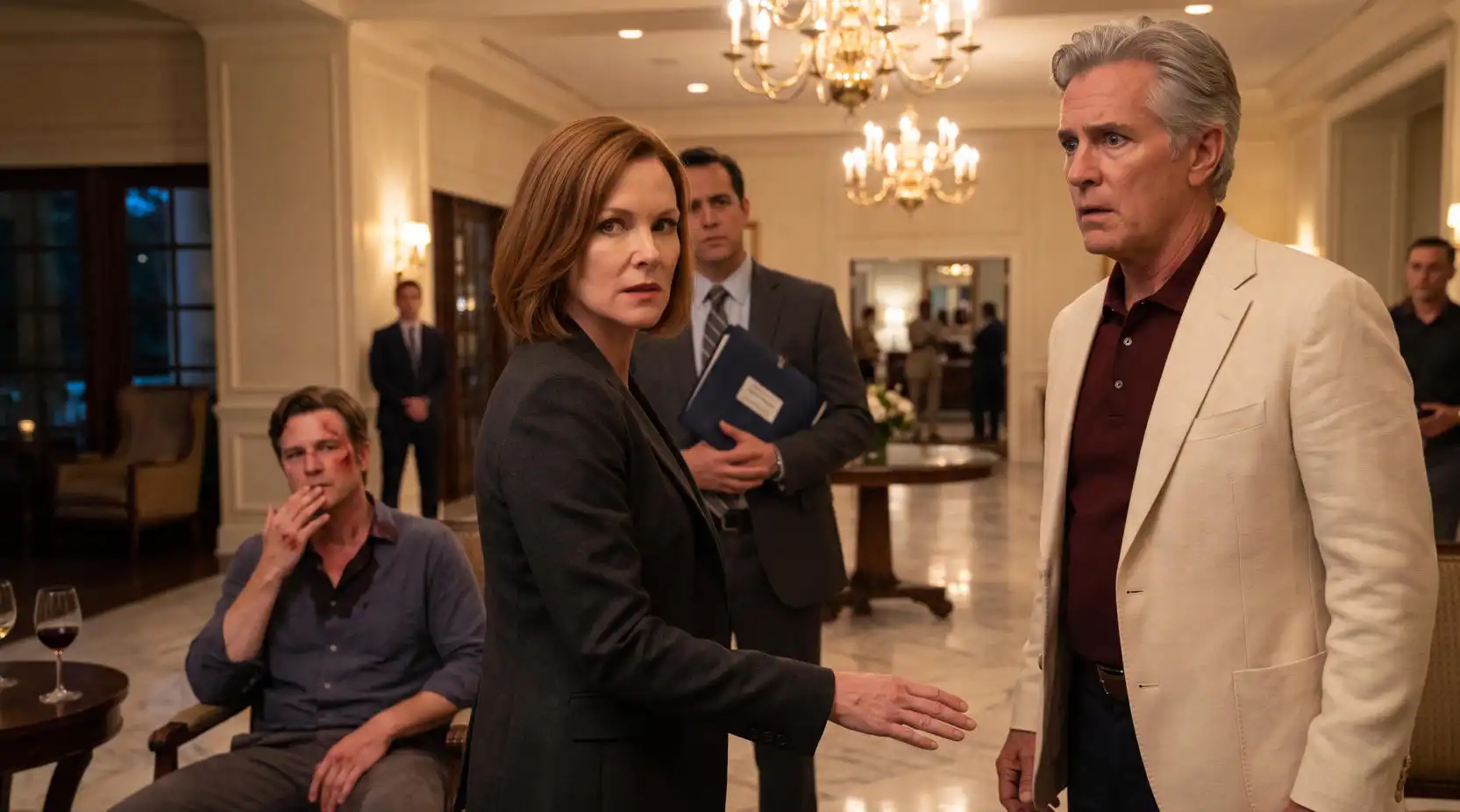
Grant raised one hand to his slapped cheek, turned toward the investigator, and stammered that he had not recognized Daniel.
The sealed navy evidence folio remained against the investigator’s chest. Daniel stayed in the chair to Grant’s left, black coffee dripping from his collar onto the marble floor.
“I didn’t know who he was,” Grant said. “This is being twisted into something it wasn’t.”
Emily stared at her father.
“You threw coffee in his face.”
“It slipped.”
Daniel’s cheek pulsed beneath his palm. The fresh heat felt different from the old burns, but his body did not care about the difference. His breathing shortened. For one second, the chandeliers disappeared behind a wall of smoke only he could see.
Then the investigator stepped forward.
“My name is Marcus Cole. I’m conducting the mayor’s office review connected to Mr. Reeves’s access complaint.”
Grant straightened his cream sport coat.
“This is a private club event. You can’t walk in here and accuse me based on one emotional reaction.”
Marcus looked at the black security camera above the service counter.
“I haven’t accused you of anything yet.”
He turned to the nearest staff member.
“Is that camera recording?”
The young employee looked at Grant before answering.
Grant’s eyes hardened.
“Everyone needs to return to the tasting,” he announced. “Put your phones away. This matter is over.”
No one moved.
Marcus repeated his question.
The employee swallowed. “Yes. It records continuously.”
“Preserve the last ten minutes. Do not delete, overwrite, or export anything until I document the system.”
Grant stepped between Marcus and the counter.
“You don’t have authority over my equipment.”
“The club agreed to preserve relevant records when it received notice of Mr. Reeves’s complaint three days ago.”
Grant’s mouth tightened.
Daniel heard several guests murmur. Until that moment, most of them had probably assumed the coffee attack had come from nowhere—one ugly burst of temper between two men.
Now they understood there had been a history.
Grant turned toward Daniel.
“You filed a complaint against me?”
Daniel lowered his hand from his cheek.
“I asked the club to stop removing my chair, canceling my reservations, and telling employees not to serve me.”
“I was protecting the atmosphere.”
“You were deciding which veterans looked acceptable enough to sit here.”
Grant’s face flushed.
“This club has standards.”
Emily took one step closer to him.
“So did the man who carried me out of a burning building.”
The room went still again.
Daniel’s fingers curled around the edge of his chair.
Emily’s words pulled at a door inside him that he had kept shut for years. Behind it waited the weight of wet gear, the scream of warped metal, and a child’s hand locked around his sleeve.
He had not come to the club to talk about that night.
He had come because he was tired of being treated as though surviving it had made him unfit to be seen.
Marcus placed the folio on an empty tasting table but did not open it.
“First, we deal with what happened tonight.”
He asked the staff member to access the camera system while he stood beside the monitor. Grant continued ordering people away, but his voice had lost its certainty.
“You work for me,” he told the employee.
The employee looked at Daniel’s wet shirt and reddened cheek.
“I work for the club.”
That small distinction changed the room.
The employee pulled up the recording. Marcus asked him to rewind ninety seconds and play it at normal speed.
On the monitor, Grant crossed the lobby carrying the coffee cup.
He did not stumble.
He did not collide with anyone.
He changed direction when he saw Daniel, walked directly to the corner table, stopped, spoke, and drove his arm forward.
The coffee struck Daniel’s face.
Marcus paused the image at the moment Grant’s hand was fully extended.
“That verifies one fact,” he said. “The cup did not slip.”
Grant looked around as though someone might still rescue his version of events.
“It was a gesture. I meant to throw it on the floor.”
“You were three feet from him,” Marcus said.
“The angle is misleading.”
Three guests raised their phones higher.
One woman near the wine table spoke without moving from her place.
“My video shows the same angle from the other side.”
Another guest nodded. “Mine too.”
Marcus did not celebrate. He simply recorded their names and asked them not to alter the original files.
Daniel watched Grant’s authority shrink, not because anyone shouted louder than he did, but because the facts no longer depended on his permission.
Grant saw it happening.
His expression changed.
He grabbed a stack of white cocktail napkins from the tasting table and hurried toward Daniel.
“Fine. Let me clean this up.”
He bent forward with a performance of concern.
“Daniel, I’m sorry you misunderstood. Let me see your face.”
Daniel caught Grant’s wrist before the napkins touched him.
Not hard.
Just firmly enough to stop him.
“Don’t wipe it away.”
Grant froze.
Daniel’s voice shook, but he kept speaking.
“Not until it’s photographed.”
The room blurred at the edges. He hated that everyone could see him like this. He hated the coffee in the seams of his scars and the pity forming on faces that had avoided looking at him ten minutes earlier.
Grant lowered his voice.
“Do you really want photographs of yourself like this going into a public file?”
There it was.
Not an apology.
A threat shaped like concern.
Grant knew exactly where Daniel was weakest. For years, Daniel had declined interviews, ceremonies, and requests to appear in fire-service memorial videos. He had learned to enter restaurants early and leave before crowds. He kept photographs from before the fire in a drawer he rarely opened.
Grant leaned closer.
“You can end this now. I’ll say the cup slipped. You say you accept my apology. No pictures. No hearing. No strangers studying your face.”
For one painful second, the offer tempted him.
Daniel could leave through the side door. He could wash the coffee off in private. He could return to the quiet life he understood.
The price was simple.
Silence.
He looked past Grant at the employees who had watched their manager move his chair, lose his reservations, and turn his membership into a monthly humiliation.
If Daniel accepted the offer, Grant would learn only one lesson: make the next victim more afraid of being seen.
Daniel released Grant’s wrist.
Then he turned his scarred cheek toward Marcus.
“Take the photographs.”
Emily covered her mouth.
Marcus gave Daniel one last chance to refuse.
“Once they enter the review record, they may be examined during the board and licensing proceedings.”
“I understand.”
“You’re certain?”
Daniel looked directly at Grant.
“Yes.”
Marcus photographed the wet collar, the coffee on the floor, the discarded cup, and the fresh redness across Daniel’s cheek. He documented the active camera and asked the staff member to preserve the original recording under the club’s existing retention procedure.
Only when that was finished did Daniel accept a cool, clean cloth from an employee.
Grant stepped away.
“This is absurd,” he said. “He came here looking for a confrontation.”
Daniel pressed the cloth gently against his skin.
“I came here to meet the investigator you already knew was coming.”
Several faces turned toward Grant.
Marcus nodded.
“The appointment was included in the notice sent to club management.”
Grant’s silence answered the next question before anyone asked it.
He had known Daniel would be sitting there.
He had walked across the lobby with the coffee anyway.
That was the surface truth, and it was already enough to cost Grant control of the evening.
But Emily kept staring at the navy folio.
“What else did you bring?” she asked.
Marcus rested one hand on it.
“Documents connected to Mr. Reeves’s complaint and service history.”
Grant moved quickly.
“Those records have nothing to do with this club.”
Emily did not look away from the folio.
“They have everything to do with what you called him.”
Daniel closed his eyes briefly.
He wished she would stop.
Not because she was wrong, but because he knew what came next.
The smoke.
The report.
The old questions.
Why did you go back inside?
Did you know the ceiling was failing?
Do you regret it?
He had spent years learning that survival did not require him to explain himself to every curious stranger.
Tonight, however, the past had been dragged into the room by the man who had benefited from it most.
Marcus looked at Daniel.
“The folio remains sealed because the service record contains personal material. I will not open it publicly without your consent.”
Grant gave a sharp laugh.
“There. Even he doesn’t want anyone seeing it.”
Daniel looked at Emily.
Her eyes were wet, but she did not ask him to be a hero again. She did not demand his pain as proof.
She said only, “You don’t owe me this.”
That made the decision harder.
Daniel could have kept the file sealed. The camera footage had already proved the attack. Grant could be disciplined for what happened that night without the deeper truth becoming public.
But the deepest wound was not the coffee.
It was Grant looking at Daniel’s scars month after month and deciding they made him less worthy of a chair.
Daniel placed the cool cloth on the table.
“Open it.”
Marcus broke the seal.
He removed two organized sets of records. The first contained preserved stills and incident notes from Daniel’s earlier complaints: the moved chair, the denied reservation, and Grant directing staff not to serve him during a previous club event.
The second set was older.
Its paper edges were slightly yellow beneath the certified cover sheet.
Marcus did not read the entire report aloud. He verified its source, date, and identifying information first.
“This is a certified municipal fire-response record,” he said. “It identifies Daniel Reeves as a member of the crew that responded to the Holloway residence fire.”
Grant’s jaw tightened.
“I know there was a fire.”
Marcus continued.
“The report confirms that Mr. Reeves reentered the structure after learning a child remained inside.”
Emily’s shoulders began to shake.
Daniel stared at the marble floor.
The memory came back in pieces.
A hallway collapsing behind him.
A small figure beneath a dining table.
A child coughing too hard to cry.
He had wrapped his protective coat around her and turned his own face toward the heat when part of the ceiling came down.
He remembered reaching the window.
He remembered pushing her toward waiting hands.
He did not remember falling.
Emily spoke softly.
“I was eight.”
Grant looked at her.
“Emily, you don’t need to do this.”
“Yes, I do.”
She faced the guests.
“I remembered his voice before I remembered his name. He kept telling me to hold on to his jacket. He told me not to look back.”
She turned toward Daniel.
“For years, my family said a firefighter saved me. We attended ceremonies. We sent donations. My father told that story whenever it made him look grateful.”
Grant’s face darkened.
“That is not fair.”
Emily pointed toward Daniel.
“What isn’t fair is that you used my rescue as a story at fundraisers, then called the man who saved me a monster because you didn’t like what saving me did to his face.”
No one whispered now.
Grant looked at Daniel for the first time without anger.
The change was not compassion.
It was calculation.
“I didn’t recognize you,” he said.
Daniel nodded once.
“I believe you.”
Grant seemed relieved until Daniel continued.
“That doesn’t help you.”
“What?”
“You shouldn’t need to know who a man saved before deciding not to throw boiling coffee in his face.”
Grant opened his mouth, but Daniel did not let him interrupt.
“You shouldn’t need a heroic story before you let someone sit in a club he has every right to enter.”
The words cost Daniel more than shouting would have.
His chest tightened, and the old instinct told him to retreat before the room could study him any longer.
But he remained in the chair.
“I didn’t file the complaint because I wanted a plaque,” he said. “I filed it because the next scarred veteran who walks through those doors may not have a report that makes people suddenly care.”
Marcus closed the fire-response file.
“That completes the connection between the complaint, the earlier conduct, and tonight’s incident.”
Grant pointed at the folio.
“No. It proves he was a firefighter years ago. It does not give the mayor’s office the right to take my livelihood.”
Marcus answered calmly.
“Your livelihood is not being reviewed because Mr. Reeves was a firefighter. It is being reviewed because you used your management position to deny service repeatedly and then deliberately assaulted him during a licensed event.”
“It was coffee.”
“It was a heated liquid thrown into a guest’s face.”
Grant looked toward the employees.
“End the tasting. Clear the room.”
No one obeyed.
Marcus lifted his phone.
“The club board was notified when the recording was preserved. The chair has reviewed the verified clip and the complaint notice.”
Grant’s voice cracked.
“You sent it without my approval?”
“The club owns the recording, not you.”
A call came through moments later. Marcus placed it on speaker only after receiving permission from the board chair.
The decision was limited but immediate.
Grant was suspended from all managerial duties pending an emergency review. He was ordered to surrender his office keys and club access badge to the senior employee on duty. The wine tasting was terminated, and the incident area was to remain undisturbed until documentation was complete.
Grant stared at his gold club pin.
“You can’t remove me based on ninety seconds of video.”
Marcus looked at the earlier complaint records inside the folio.
“It isn’t only ninety seconds.”
Grant pulled the pin from his lapel and dropped it onto the table.
Then he turned toward Emily.
“You’re really choosing him over your own father?”
Daniel saw the question hit her.
It was Grant’s last piece of power—not the club, the staff, or the room, but the old belief that family loyalty meant protecting someone from the consequences of his own choices.
Emily wiped her cheek.
“I’m choosing the truth.”
“I raised you.”
“And he saved me.”
Grant’s face twisted.
“So this is what I get? One mistake, and my daughter helps strangers destroy my life?”
Emily shook her head.
“This wasn’t one mistake. You spent months trying to make him disappear because looking at him made your guests uncomfortable.”
She glanced at Daniel.
“No. Looking at him made you uncomfortable.”
Grant had no answer for that.
An employee collected his keys and badge. Another brought Daniel clean water and contacted the base clinic for medical guidance. Marcus sealed copies of the newly preserved files separately from the original folio.
Grant remained near the service counter while the process continued, no longer directing anyone.
For the first time that evening, Daniel had the stronger position.
He did not enjoy it.
He watched Grant standing alone beneath the chandeliers and felt no urge to humiliate him back. Revenge would have been easier than what Daniel had chosen. Revenge required only anger.
Accountability required him to remain present.
Before leaving for the clinic, Daniel signed a statement describing the coffee attack and the earlier removals. He refused language that called him helpless.
“Write that I was injured,” he told Marcus. “Not powerless.”
Marcus corrected the sentence.
The club board held its emergency hearing four days later.
Daniel attended by choice.
His cheek was healing, though the fresh burn had left a dark patch across the older scar tissue. Emily sat behind him, not beside the board and not beside her father. She was there only to provide her statement.
Grant appeared with the same explanation he had used in the lobby.
He had not recognized Daniel.
He had been under pressure.
The coffee was meant for the floor.
The club’s atmosphere required difficult decisions.
Each claim met a record.
The camera showed the direction of his arm.
The phone videos showed the coffee striking Daniel.
The complaint notice proved Grant knew an investigator was scheduled to meet Daniel that evening.
Staff statements documented the earlier efforts to move Daniel, cancel his reservations, and deny service.
The fire report did not establish the club violation. It established something more personal: Grant’s claim that Daniel’s appearance threatened the club’s dignity was built on scars Daniel had received preserving Grant’s family.
When the board offered Daniel the final statement, he did not ask them to destroy Grant.
He asked for three things.
“My access is reaffirmed in writing.”
The board agreed.
“Staff receive a clear rule that no manager may deny service because a member’s appearance makes someone uncomfortable.”
They agreed again.
“And the correction should not mention that I saved Emily as the reason I deserve to be here.”
One board member looked surprised.
Daniel continued.
“I deserved equal treatment before anyone opened that fire report.”
That sentence became the center of the board’s written decision.
Grant was permanently dismissed and banned from the club. His removal was based on the repeated denial of service, the deliberate coffee attack, the effort to pressure Daniel into an informal private settlement, and his misuse of managerial authority.
The licensing process took longer.
The municipal commission first suspended Grant’s hospitality operating license while it reviewed the authenticated footage, witness statements, medical documentation, and club findings.
Six weeks later, Grant received a formal hearing.
Daniel testified once.
He did not describe himself as a hero. He described the chair that kept being moved, the reservations that vanished, the employees who were told not to serve him, and the coffee that struck his face after he filed a complaint.
The commission permanently revoked Grant’s license.
The loss was directly connected to the position he had abused. Grant had tried to protect his control, his reputation, and his polished room by excluding the person he considered unpleasant to look at.
He lost the authority to control such a room at all.
Daniel did not attend the announcement.
He was at home repairing the loose hinge on his back gate when Marcus called with the result.
After the call, Daniel stood in his yard for a long time with the screwdriver still in his hand.
There was no rush of triumph.
There was relief.
The kind that arrived quietly when a door you had been bracing against finally stopped pushing.
A month later, the club invited Daniel back for the reopening of the lobby under new management.
He almost declined.
Then he remembered what he had said at the hearing: the next scarred veteran might not have a heroic report.
So Daniel returned.
The brass chandeliers were the same. The marble floor had been polished. The corner table remained where it had always been, but no one had pushed it against the wall.
Daniel wore his faded navy shirt.
He ordered water.
Emily approached after the brief public reading of the club’s new equal-access policy. She did not introduce him as the man who had saved her. She did not ask him to tell the fire story.
She simply sat in the chair across from him.
“I’ve wanted to say thank you for years,” she said.
Daniel looked down at his glass.
“You already did.”
“I slapped my father.”
“That part wasn’t for me.”
A sad smile crossed her face.
“No. It wasn’t.”
They sat quietly for a moment.
Then the new manager announced that the club wished to recognize Daniel.
He started to object.
Emily stood and offered him her hand.
“You don’t have to give a speech.”
Daniel looked around the lobby.
Some of the same guests were there. A few had once stared at his scars and then quickly looked away. Now they waited without pity and without pretending not to see him.
He took Emily’s hand.
She gently helped him rise from the corner chair.
One guest stood.
Then another.
Within seconds, the entire lobby was on its feet.
Daniel touched the edge of his scarred cheek as the applause filled the room.
Not for a victim.
Not because he needed a rescue story to prove he belonged.
But because the marks Grant had called ugly were finally being seen for what they had always been.
Medals.
FINAL ENGAGEMENT
Was Grant’s permanent removal justified, or should the club have given him one final chance?
Disclaimer: Mention of any brand or trademark is for identification only and does not imply partnership or endorsement