


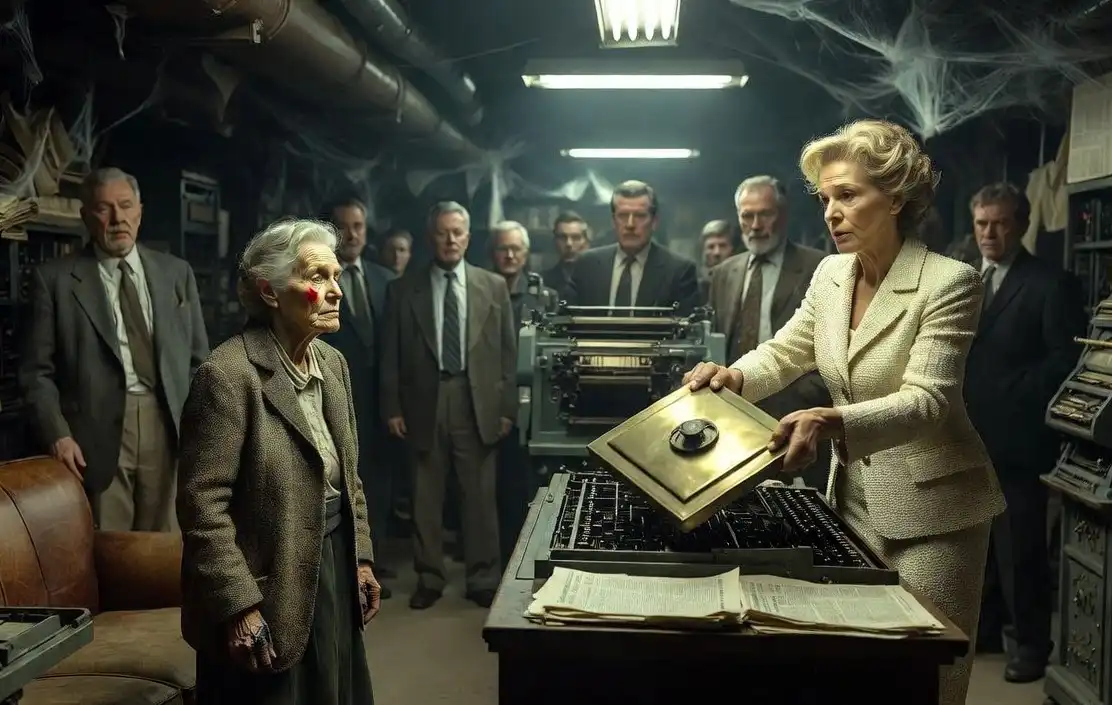
Vivian’s hand stayed on the brass masthead plate as her smile began to crack. Ruth stood beside the old Linotype machine, one cheek red from the slap, her ink-stained hands hanging at her sides. The unsigned sale papers sat inches away from the plate. Mr. Alden Price, chairman of the State Journalists Association, opened his leather folder. Vivian saw him do it and forced a laugh. “What?” she said. “Are we pretending this rusty plate matters now?” No one laughed with her. The basement felt smaller. The reporters stood shoulder to shoulder near the stairs. The retired editors watched from the old proofing table. The gossip media executives stared at the brass plate like it had just grown teeth. Vivian picked it up again. “It’s scrap,” she said. “Old branding. Old ink. Old guilt.” Ruth did not move. Vivian turned to the room. “This is exactly why this paper is dead. You people worship junk.” A young reporter named Claire stepped forward. “Vivian, you hit her.” Vivian snapped, “She put ink on my sofa.” Claire looked at Ruth’s cheek. “That’s your defense?” Vivian’s eyes narrowed. “My defense is that this is my family’s newspaper, my family’s building, my family’s goodbye party, and my sale.” Ruth finally looked up. Not angry. Just steady. Vivian pointed the brass plate at her. “And you,” she said, “are a former basement worker who couldn’t even keep a roof over her head.” The words hit hard. A few people winced. Ruth took the insult without blinking. That made Vivian even angrier. “You think standing there silently makes you noble?” Vivian said. “It doesn’t. It makes you sad.” Mr. Price closed his folder halfway. “Ms. Mercer,” he said, “I suggest you stop speaking for a moment.” Vivian turned on him. “With respect, Mr. Price, you are here to witness a transfer. Not run my building.” “I am here,” he said, “because your father’s estate requested my office be present before any use of the Mercer Ledger masthead changes hands.” Vivian froze for half a beat. Then she smiled again. “My father loved ceremony. That’s all.” Ruth’s fingers brushed the side of the Linotype machine. Old black ink marked her knuckles. Mr. Price looked at the brass plate in Vivian’s hand. “May I see that?” Vivian held it back. “It belongs to the company.” Ruth spoke quietly. “No. It belongs to the paper.” The room went silent. Vivian laughed. “Listen to that. She’s been sleeping in a car and now she’s giving lectures on ownership.” Ruth looked straight at her. “I slept in that car because you cleared the old print annex before the estate review was finished.” Vivian’s face hardened. “That annex was unsafe.” “It had heat,” Ruth said. “And a lock.” One of the retired editors lowered his head. He knew. Vivian waved it off. “You were offered charity.” “No,” Ruth said. “I was offered silence.” The gossip executives exchanged a look. Vivian noticed. That scared her. Not Ruth’s pain. Not the slap. Not the witnesses. Only the buyers’ faces. She placed the brass plate on the press table and flattened both palms beside it. “Let’s be clear,” Vivian said. “This woman does not control anything. She used to set letters on a machine. My family owns the name.” Mr. Price opened his folder fully. “That is not accurate.” Vivian turned slowly. “What did you say?” Mr. Price removed one notarized document. Then another. Then a sealed copy of the will. The basement got so quiet the old machine seemed to breathe. He placed the first page beside the unsigned contract. “Your father’s will gave you operating shares,” he said. “It gave your elder sister archive assets. It gave the building trust maintenance to the board.” Vivian’s mouth tightened. “Yes. I know what it gave me.” Mr. Price pointed to the brass plate. “But the Mercer Ledger’s century masthead trademark rights were separated from the operating company.” One of the gossip executives leaned in. Vivian’s voice dropped. “No.” “Yes,” Mr. Price said. He turned the brass plate toward the light. The old newspaper name shone through the ink. The engraved signature under it was small but clear. R. Bell. Mr. Price continued. “The will states that the masthead may not be licensed, sold, transferred, reproduced, rebranded, or used in promotional material without the personal authorization of Ruth Bell.” Vivian stared at him. Then she laughed too fast. “That is impossible.” “It is filed,” Mr. Price said. “State registry, trademark counsel, estate court, and the Association archive.” The lead attorney for the gossip group picked up his copy of the acquisition agreement. “Our term sheet requires unrestricted use of the historic masthead.” Vivian spun toward him. “You’ll have it.” “No,” he said. “Not without her signature.” Vivian pointed at Ruth. “She is not family.” Ruth looked down at the machine. “No,” she said. “I was the one who kept your family’s paper alive when your family was afraid.” That sentence changed the room. Mr. Price nodded once. “Twenty-eight years ago, the Mercer Ledger printed a front-page investigation exposing Senator Mallory’s bribery network. The presses nearly missed deadline after the composing room was sabotaged.” The retired editors looked up. They remembered. Mr. Price touched the Linotype machine. “Ruth Bell reset the front page by hand on this machine after the plates were destroyed.” Ruth’s eyes filled, but she stayed still. “She worked through the night,” Mr. Price said. “She collapsed right there, beside the machine, after the edition ran.” A retired editor whispered, “She saved the paper.” Ruth said nothing. Vivian’s face turned red. “So my father gave a sentimental reward to a staffer. That doesn’t mean she gets to block progress.” Mr. Price’s voice hardened. “It was not sentimental. It was legal protection.” He opened another page. “Your father wrote that the masthead had become a public trust after that edition. He did not want any heir to sell the Ledger name to anyone who would use it to fake credibility.” The gossip executives stopped pretending. Their attorney looked at Vivian. “You told us the masthead rights were clear.” Vivian swallowed. “They are clear.” “No,” he said. “You told us no living authorization holder existed.” The room shifted. There it was. Vivian’s fatal mistake was not stupidity. It was greed. She had gambled that Ruth was too poor, too tired, and too invisible to matter. Vivian raised her chin. “I was told Ruth Bell was unreachable.” Claire, the young reporter, stepped forward again. “You knew exactly where she was.” Vivian glared at her. Claire’s voice shook, but she kept going. “You had security tow her car last month, then changed your mind when Mr. Price’s office asked whether she had been notified about tonight.” The buyers looked at Vivian. Vivian’s polished face cracked. “That is internal business.” Ruth spoke again. “You sent a driver to bring me here.” Vivian turned sharply. Ruth’s voice stayed calm. “You wanted me visible enough to prove I had notice. But poor enough that no one would listen if I objected.” That hit the room like a slammed headline. The old editors stared at Vivian with open disgust. The reporters looked at one another. The gossip executives looked at their attorney. Mr. Price said, “And then you struck her in front of witnesses.” Vivian pointed at the sofa. “She stained company property.” Mr. Price looked at the ink on Ruth’s hands. “That ink is from the Linotype ribbon.” Vivian frowned. Ruth finally lifted her hand. Black ink marked her palm. “I touched the machine before I came upstairs,” she said. “The ribbon is still wet.” Mr. Price turned to the brass plate. “And the plate carries her engraved authorization mark.” He looked at the buyers. “Origin: the original masthead plate from the Mercer Ledger composing room.” He pointed at the signature. “Visibility: Ruth Bell’s engraved mark, matching the filed authorization records.” He tapped the will. “Legal meaning: the masthead cannot be used or transferred without her personal consent.” Then he looked at Vivian. “Consequence: no buyer can lawfully use the Mercer Ledger name for promotional campaigns, archives, subscriptions, or brand advertising without her signature.” The lead gossip executive slowly closed his briefcase. Vivian saw it and panicked. “Wait. We can fix this.” The attorney shook his head. “Our entire acquisition value was based on the historic masthead.” Vivian stepped closer. “You’re buying the audience, the archives, the brand trust—” “Exactly,” the executive said. “And without the masthead, we are buying debt, a basement, and a scandal.” Vivian’s voice sharpened. “Don’t be dramatic.” He looked at Ruth’s red cheek. “I run gossip brands, Ms. Mercer. Even I know when a scandal is too ugly to monetize.” Then he picked up the contract. Vivian reached for it. He pulled it away. “No.” The room watched. He tore the contract in half. Then again. The sound was small, but Vivian reacted like the floor had dropped under her. “You can’t do that,” she whispered. “We just did,” he said. The second executive added, “We will not purchase a newspaper name we cannot use for false legacy campaigns.” Mr. Price closed his folder. “And I will be reporting tonight’s conduct to the state board.” Vivian whipped toward him. “For what? A family disagreement?” “For misrepresentation during a media acquisition,” he said. “For attempting to transfer restricted trademark rights without disclosure. For documented public assault of the rights holder. And for conduct unbecoming of a publisher seeking Association recognition.” Vivian’s face drained. “You’re threatening my career?” “No,” Mr. Price said. “I’m documenting it.” Ruth looked down. She had not smiled. She had not celebrated. That made the room hurt more. Vivian turned to her. “Sign it.” Ruth did not answer. Vivian stepped closer. “I said sign it. You can name your price.” Ruth looked at the old machine. “This machine printed a truth powerful men tried to bury.” Vivian rolled her eyes. “Spare me the church speech.” Ruth looked back at her. “You tried to bury me.” The room went cold. Vivian’s lips parted, but no clean answer came out. Ruth touched the brass masthead plate. “I will not sign my name so you can turn a century of hard reporting into fake headlines and paid lies.” Vivian’s voice cracked. “You’re going to destroy my family over one slap?” Ruth’s eyes finally filled with tears. “No,” she said. “Your father tried to protect the paper from this exact moment.” That was the first reversal. Not shouting. Not revenge. Just the truth landing where everyone could hear it. The board acted within forty-eight hours. Vivian was removed from the sale committee. The gossip media group issued a public statement saying the acquisition was withdrawn because required masthead rights could not be transferred. Then the story of the farewell party leaked. Not through gossip blogs. Through reporters who had watched Vivian slap an elderly woman for having ink on her hands. The scandal followed Vivian everywhere. Clips from the basement security feed showed the slap, the rag thrown at Ruth’s feet, and Vivian calling old journalists “broken people.” Former staff came forward. Unpaid invoices. Threatened layoffs. A buried memo where Vivian described the Mercer Ledger’s reputation as “a costume we can sell.” That phrase ended her. The State Journalists Association suspended her credentials pending review. Two speaking invitations vanished. A media ethics panel removed her from its board. The family trust froze her access to the paper’s remaining assets. Her own PR team quit after she demanded they smear Ruth as unstable. But Ruth never gave an interview to destroy her. She did not need to. Facts did what insults could not. Vivian had built her sale on pretending Ruth did not matter. The will proved Ruth did. The masthead plate proved why. The Linotype machine proved where the mark came from. The slap proved Vivian knew Ruth was present and still tried to push the transfer through without respect, disclosure, or consent. That was the evidence chain Vivian could not talk her way around. Weeks later, Ruth returned to the basement. The sofa was gone. The party lights were gone. The gossip executives were gone. Only the old Linotype machine remained. Claire and a group of young reporters stood around it, nervous and quiet. Some had been laid off. Some were interns. Some had stayed late for years because they still believed local news mattered. Ruth placed the brass masthead plate on the press table. “I’m not running a newspaper,” she said. Claire looked disappointed. Ruth nodded toward the room. “You are.” No one spoke. Ruth continued. “The masthead stays with the paper. Not with a family name. Not with a buyer. Not with anyone who thinks truth is packaging.” Claire’s eyes filled. “We don’t have money.” Ruth gave a small smile. “You have the archive. You have the trust. You have the name. And now you have time.” Mr. Price helped structure the transfer. The paper became an independent nonprofit newsroom. The masthead license stayed protected under Ruth’s authorization. Young reporters took over daily operations. Retired editors returned twice a week to teach source checking, headline discipline, and how to tell the difference between a rumor and a fact. Ruth kept one desk in the basement beside the Linotype. Not because she had to. Because she wanted the young reporters to hear the machine. One morning, Claire brought down the first new issue. The headline was not flashy. It did not scream. It did not bait. It exposed a county contract scheme that had been quietly draining money from public schools. Claire handed Ruth the proof. Ruth studied the masthead. The ink was clean. The spacing was right. The name still stood. The Mercer Ledger. Ruth pressed her fingers gently against the paper. For years, people had seen ink on her hands and thought it meant she was dirty. Now a room full of young reporters saw the same ink and understood it meant she had built something worth defending. Claire asked, “Is it good?” Ruth looked at the old machine. Then at the young faces waiting for her answer. “It’s honest,” she said. “That’s better than good.” That day, they printed the first issue under the new newsroom. No gossip banner. No fake legacy campaign. No corporate slogan. Just a local paper, still standing, because an old typesetter refused to let a rich heiress sell its soul. And when the first bundle came off the press, Ruth did not cry loudly. She only touched the masthead and whispered, “Deadline made.” So tell me honestly: did Ruth do the right thing by refusing to sign away the masthead, or should she have taken the money after what Vivian did? Share this if you believe truth should never be sold to the highest bidder.
Disclaimer: Mention of any brand or trademark is for identification only and does not imply partnership or endorsement