

D — FULL STORY
Walter’s recorded voice filled the room as the tablet began playing.
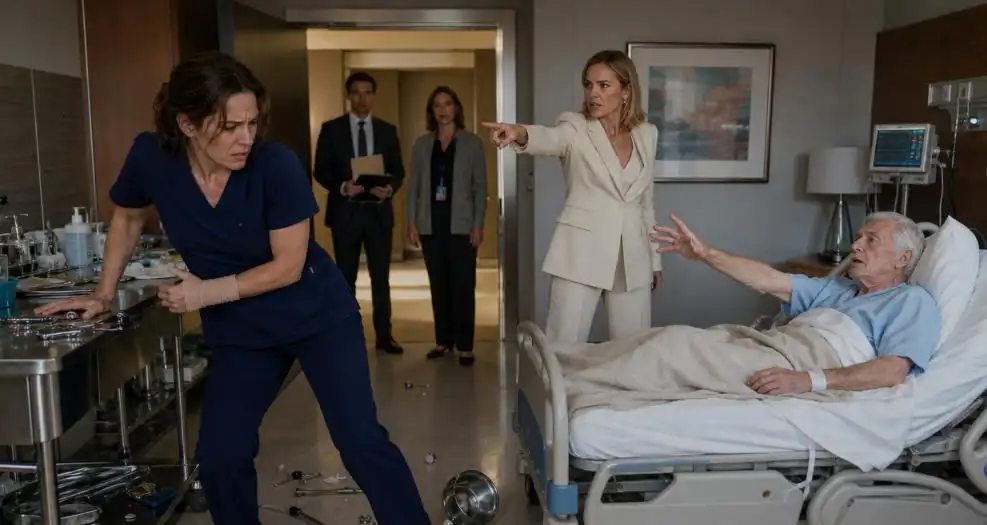
The sealed folder remained tucked against the lawyer’s chest, just beyond Vanessa’s reaching hand. Beside the bed, I kept Walter’s oxygen line steady while my injured wrist throbbed against my navy scrubs.
Vanessa stared at the screen, then spun toward the hospital social worker.
“This is malpractice,” she snapped. “I’ll sue this hospital, the doctor, and every person in this room.”
The social worker, Denise Morgan, did not move.
“You may contact hospital administration,” she said. “But you need to step away from Mr. Hayes’s bed.”
“I am his legal family.”
“You are upsetting the patient.”
Vanessa pointed at me.
“She attacked me first.”
The pain in my wrist sharpened as I tried to stand. Metal instruments still covered the floor around the overturned cart, and Walter’s heart monitor was beating faster than it had ten minutes earlier.
“I never touched you,” I said.
“You were trying to steal from my uncle.”
Walter’s fingers tightened around mine.
On the tablet, his recorded image sat upright in this same hospital room. He wore a pale blue gown, and his voice sounded stronger than it did now.
“My name is Walter Hayes,” the recording began. “I understand that this statement concerns my living trust and my property.”
Vanessa lunged toward the tablet.
The lawyer blocked her with one arm.
“Do not touch the device.”
“You can’t show private family business to a paid nurse.”
Walter tried to speak from the bed, but only a rough breath came out.
I bent closer.
“Don’t force it,” I whispered.
He shook his head and looked at Vanessa.
“Let it play,” he managed.
Those three words changed the room.
Until then, Vanessa had treated Walter like a piece of property that could not speak for itself. She had argued over him, pointed across him, and demanded papers while his monitor sounded beside her.
Now he had given a direct instruction.
The lawyer set the tablet farther from her reach.
“My name is Daniel Price,” he said. “I am Mr. Hayes’s family attorney. This recording was made after a formal medical capacity assessment. The original assessment, the signed trust amendment, and the chain-of-custody record are inside this folder.”
Vanessa laughed, but the sound came out thin.
“He was medicated.”
Daniel looked at Denise.
She spoke calmly. “I was present before and after the assessment. Mr. Hayes was alert, oriented, and able to explain his decisions in his own words.”
“You’re a hospital employee. You’ll say whatever protects the hospital.”
“I am a licensed social worker,” Denise replied. “My responsibility is to the patient.”
The tablet continued playing.
Walter’s recorded voice described the date, the location, the names of the people present, and the purpose of the document. Daniel asked him simple questions about his home, his finances, and the people in his life.
Walter answered each one clearly.
Then Daniel asked, “Was Claire Bennett present when you made these decisions?”
“No.”
“Did she ask you for money or property?”
“No.”
“Did she know you were changing your trust?”
“No.”
Vanessa’s face tightened.
I looked at Walter.
He had never told me any of this.
For nearly four years, I had helped him through appointments, physical therapy, medication changes, and the slow loss of independence that frightened him more than pain ever had. I knew how he took his coffee and which old baseball games calmed him when he could not sleep.
But he had never discussed his estate with me.
That boundary had mattered to both of us.
When he once asked whether my charity needed a larger building, I had told him, “You hired me to care for you. I won’t talk about your money.”
He had smiled and called me stubborn.
Now Vanessa looked at me as if my surprise were another performance.
“You expect me to believe this?”
“I didn’t know,” I said.
“That’s convenient.”
Walter lifted his hand a few inches from the mattress.
“She didn’t know.”
Vanessa turned toward him.
“Uncle Walter, she has been working on you for years. You’re sick. You’re lonely. She made you depend on her.”
His expression changed.
Not into anger.
Into hurt.
“You left,” he said.
The monitor beeped steadily between them.
Vanessa folded her arms.
“I had a life.”
“You had my number.”
“I was busy.”
“For three years?”
Her eyes shifted toward Daniel.
“This has nothing to do with whether the trust is valid.”
“It has everything to do with why I changed it,” Walter said.
I felt his hand trembling in mine.
There had been birthdays when he asked me to leave the curtains open because Vanessa might still visit. There had been holidays when he instructed the kitchen to prepare an extra plate.
Eventually, he stopped asking.
I had never told Vanessa that. It was not my wound to use against her.
But Walter had carried it into every quiet evening she missed.
On the tablet, Daniel asked another question.
“Mr. Hayes, are you changing your trust because anyone threatened you?”
“No.”
“Are you doing this to punish a family member?”
Walter paused in the recording.
“I am doing it because my home should help people who stay when care becomes difficult.”
Vanessa moved toward the bed.
“You’re giving away the house?”
Denise stepped between them.
“Please stay back.”
“That estate belongs in our family.”
Walter’s eyes stayed on hers.
“Family is more than a name.”
Vanessa’s face reddened.
“You think she’s family? She sends you invoices.”
“I paid her to be my nurse,” Walter said. “I never paid her to care whether I woke up.”
For the first time, Vanessa had no immediate answer.
Daniel paused the video.
“This is the first verification point,” he said. “The capacity assessment confirms that Mr. Hayes understood the nature and effect of the trust amendment when he signed it.”
“What amendment?” Vanessa demanded.
Daniel opened the sealed folder but kept the documents in his hands.
He removed the medical evaluation first.
The physician’s signature, date, and hospital verification stamp were visible at the bottom. Denise compared the document number to the secure record on her hospital tablet.
“The assessment number matches the original record,” she said.
Daniel then displayed the notarized signature page without handing it over.
“The trust was updated through the same procedure Mr. Hayes used for his earlier estate documents. I met with him privately. Claire was not in the room, on the call, or copied on any communication.”
Vanessa’s eyes moved rapidly across the page.
“So what did he change?”
Daniel looked at Walter.
Walter nodded.
“The Hayes estate will not pass to you,” Daniel said.
The room became so quiet that I heard a wheel squeak on a cart somewhere in the hallway.
Vanessa stared at him.
“All of it?”
“The estate has been transferred into a charitable trust.”
Her mouth opened, but no words came.
Daniel continued.
“The trust directs the property to the elder-care charity operated by Claire Bennett. The estate is to be used as a residential care and support facility. Claire does not personally inherit the property.”
Vanessa looked at me with pure disbelief.
“You own a charity?”
“I help operate one,” I said.
It was small. We coordinated respite care, meal deliveries, and emergency support for older adults whose families could not manage alone. Most weeks, I spent more time filling out forms than doing anything that felt heroic.
Walter knew about it because I had once missed dinner after helping an elderly woman find temporary care.
He had asked why I looked exhausted.
That was the entire conversation.
“I knew it,” Vanessa said. “This was always about the house.”
“No,” Walter said. “It was about what the house could become.”
She stepped closer to Daniel.
“You said I wasn’t getting the estate. You didn’t say I was excluded.”
Daniel’s silence answered before his words did.
“The amendment specifically excludes you.”
Vanessa’s hand shot forward.
She grabbed the top page and pulled.
Daniel held the folder tightly, but the paper bent between them.
“Let go,” he warned.
“You don’t get to erase me!”
She yanked again, tearing the corner of the copy.
Denise pressed the emergency call button beside the door.
I moved instinctively between Vanessa and Walter.
Pain tore through my wrist.
Vanessa shoved the page toward my face.
“This is what you wanted, isn’t it?”
“Stop,” I said. “You’re frightening him.”
“He should be frightened. He has given his home to a stranger.”
Walter pushed himself higher against his pillows.
“She is not the one who frightened me.”
Vanessa froze.
Daniel took the damaged copy from her and returned it to the folder.
“The originals are secured off-site,” he said. “Destroying this copy changes nothing.”
The threat had failed.
So Vanessa changed tactics.
Her voice softened.
“Uncle Walter, I was overwhelmed. I didn’t understand how sick you were.”
“You didn’t ask.”
“You shut me out.”
“I called you.”
“I couldn’t drop everything.”
Walter looked toward the window.
“You came when you heard the doctors say I might not recover.”
“That is not fair.”
“You asked about the deed before you asked about my pain.”
Vanessa’s eyes filled, but her voice remained hard.
“I am your niece. She is an employee.”
I felt something inside me settle.
For years, I had let people use that word—employee—as though being paid made care meaningless. Vanessa was right about one thing: I had a professional duty.
But duty did not require me to sit beside Walter after my shift ended because he was afraid of dying alone.
It did not require me to remember the anniversary of his wife’s death.
It did not require me to defend his dignity while my own wrist swelled beneath my sleeve.
Still, I did not want his estate.
I wanted him safe.
Two hospital security officers appeared at the doorway.
Denise spoke first.
“Ms. Hayes pushed Ms. Bennett into the medical cart and attempted to seize legal documents. Mr. Hayes has asked that she remain away from his bed.”
Vanessa pointed at me again.
“She fell. I barely touched her.”
The security officer looked at the scattered instruments, the shifted cart, and the red mark forming across my wrist.
“Ma’am, please come into the hallway.”
“I’m not leaving without speaking to my uncle privately.”
Walter looked directly at her.
“I do not want to be alone with you.”
That hurt her more than Daniel’s folder had.
For one moment, she looked less like an angry heir and more like a child who had arrived too late and still expected the door to open.
But instead of accepting what she had done, she reached for control again.
She looked at me.
“Claire, tell them this was an accident.”
I said nothing.
“I’ll pay your medical bills.”
Walter’s eyes narrowed.
Vanessa lowered her voice.
“I’ll cover six months of your salary. You can walk away from this room, this job, and that charity arrangement. No police. No complaints. Everyone moves on.”
Daniel started to speak, but I raised my uninjured hand.
This choice had to be mine.
Six months of salary would have mattered. My charity was always short of funds. I had a mortgage, insurance deductibles, and a wrist that might keep me from working.
Walking away would have been easier.
It also would have left Walter alone with the person who had just pushed me, threatened the hospital, and tried to tear apart his legal decision.
“No,” I said.
Vanessa blinked.
“You haven’t even heard the amount.”
“I heard the condition.”
“I’m offering you a clean exit.”
“I’m not leaving him unprotected so you can call it peace.”
Her expression hardened again.
“You’ll regret making an enemy of me.”
I turned to Denise.
“I want the assault documented. I also want help applying for a restraining order that protects both Walter and me.”
Vanessa laughed bitterly.
“You’re proving exactly what I said. You want control.”
I faced her.
“No. I want a boundary you cannot push through.”
Denise nodded.
“The hospital can begin a safety plan immediately. A court order requires a formal application, but I can help Claire contact the appropriate office and preserve today’s records.”
The security officer asked me whether I wished to make a police report.
My stomach tightened.
Filing meant statements, questions, lost work, and the possibility that Vanessa would accuse me publicly of manipulating Walter. It meant my charity’s board might face calls from donors asking why my name was connected to an inheritance dispute.
Silence would have protected my routine.
It would not have protected Walter.
“Yes,” I said. “I want to make a report.”
Vanessa looked at Walter.
“You’re going to let her do this to me?”
His voice was tired but firm.
“You did this.”
Security escorted her into the hallway.
She did not go quietly.
Her voice carried through the closed door as she demanded the hospital administrator, threatened lawsuits, and insisted the entire trust had been created through manipulation.
Inside, Denise called for a nurse to examine my wrist.
Daniel restarted the recording.
This time, Walter explained the deeper reason for the amendment.
He did not insult Vanessa. He did not call her greedy.
He described years of absence, followed by sudden pressure once his illness worsened. He described conversations in which Vanessa focused on selling the estate, challenged his medical decisions, and dismissed the care he needed as an unnecessary expense.
The social-work file corroborated that concern.
During an earlier hospital review, Walter had reported that Vanessa repeatedly pressured him about his property while he was weak and dependent. The report did not decide his trust. It documented why the hospital had required private interviews and a capacity assessment before any major legal decision was witnessed on its premises.
Daniel had then insisted on meeting Walter without me, Vanessa, or any potential beneficiary present.
The physician evaluated Walter.
A notary witnessed the signature.
Denise confirmed that he understood the consequences.
The video preserved his explanation in his own words.
Nothing depended on a single paper, a single memory, or a single person’s claim.
That was the evidence loop Vanessa had not expected.
Walter had built it because he knew she would accuse someone else rather than face his decision.
On the recording, Daniel asked, “Why did you exclude your niece completely?”
Walter looked into the camera.
“Because when I needed care, she treated me like an obstacle between her and my property. I will not reward abandonment, intimidation, or pressure against an old man who cannot stand without help.”
In the bed beside me, Walter closed his eyes.
I squeezed his hand gently.
“You don’t have to watch the rest,” I said.
“Yes, I do.”
Daniel let the video continue.
Walter explained that the estate would belong to the charitable trust, not to me personally. Independent trustees would oversee the property. The charity could use it only for elder care, caregiver relief, and related services.
If the charity failed to meet those purposes, control would pass under the trust’s written terms—not into my private ownership.
That detail mattered.
Walter had not made me wealthy.
He had protected his home from becoming a prize and turned it into a promise.
When the recording ended, Daniel closed the tablet.
“The trust amendment is valid unless a court rules otherwise,” he said. “Vanessa may challenge it, but the medical assessment, independent representation, notarized documents, social-work records, and video statement all support Walter’s capacity and intent.”
Walter looked at me.
“I should have told you.”
“You had the right to make your decision privately.”
“I didn’t want you to say no.”
“I might have.”
A faint smile touched his face.
“That is why I didn’t tell you.”
I shook my head, but I was smiling too.
Then I became serious.
“The charity will follow every condition you wrote. But this does not buy my loyalty, Walter. You already had it.”
His eyes shone.
“I know.”
A police officer arrived after security reported the incident. He did not arrest Vanessa in some dramatic scene. He separated the witnesses, photographed the cart and my wrist, collected the damaged document copy, and took statements from Denise, Daniel, Walter, and me.
Hospital security preserved the hallway and room-camera footage under its normal incident procedure.
A doctor diagnosed a wrist sprain and ordered me not to lift patients until it healed.
Before I left that evening, the hospital issued Vanessa an immediate no-contact restriction for Walter’s floor while the safety review was pending.
Denise helped me complete the first paperwork for a protective order.
Daniel arranged for another nurse to cover Walter’s physical needs, but Walter refused to let me leave without hearing one thing.
“Claire.”
I stopped at the door.
“You were right not to take her money.”
“I didn’t do it to hurt her.”
“I know.”
He looked toward the hallway where Vanessa had been shouting.
“You did it because peace without safety is not peace.”
Three days later, I filed the full petition for a restraining order.
Vanessa responded by attacking my reputation.
She claimed I had isolated Walter, influenced his medical care, and positioned my charity to receive his estate. Her attorney demanded my work schedules, payment records, and communications with Daniel.
It was the failure risk I had expected.
For two weeks, several charity donors paused their contributions while the board reviewed the allegations. I lost income because my wrist kept me from regular nursing duties.
There were nights when I stared at my bills and remembered Vanessa’s offer.
Six months of salary.
No complaint.
A clean exit.
But every time doubt rose, I remembered Walter saying, “I do not want to be alone with you.”
That sentence had not come from me.
It had come from a sick man finally drawing a boundary with the last relative he had hoped would love him.
The review did not uncover manipulation.
It showed the opposite.
My nursing notes contained no discussion of inheritance. My communications with Daniel began only after the hospital assault. The charity’s financial records showed that I took no personal profit from donated property.
Walter’s physician confirmed his capacity assessment.
Denise confirmed the private interviews.
The notary verified the execution of the documents.
The secured video matched the written record.
Vanessa’s challenge lost its foundation before it ever became a believable case.
Six weeks after the confrontation, the court granted the protective order based on the hospital assault, the witness statements, and Walter’s expressed fear of further pressure.
The county prosecutor also filed a second-degree assault charge arising from Vanessa’s shove and my documented wrist injury.
The charge was not a punishment for being an absent niece.
It was a consequence of using force when she could not control the room.
Her inheritance loss came from Walter’s valid trust decision.
The restraining order came from the safety risk.
The assault charge came from pushing me into the cart.
Each consequence belonged to a choice she had made.
Vanessa received nothing from the estate.
She still had the right to defend herself in court, but she no longer had the right to enter Walter’s room, seize his documents, or pressure him in private.
Walter’s recovery was slow.
He regained enough strength to sit by the window during afternoon therapy, though he still tired easily. My wrist healed more quickly, and I returned first as a visitor, then as his nurse after the hospital cleared the arrangement and another professional reviewed the boundaries.
One afternoon, Daniel came to the hospital with confirmation that Vanessa had withdrawn her trust challenge after the medical and legal records were disclosed.
At the far end of the hallway, Vanessa stood behind the designated boundary with her attorney and a security officer between us.
She was furious.
Even through the closed door, I could hear her insisting that the estate should have remained “in the family.”
Walter heard her too.
His hand moved across the blanket until it found mine.
I sat beside him and held it gently.
Outside, Vanessa argued with a rule she could no longer tear, threaten, or shove aside.
Inside, Walter watched sunlight move across the floor of his VIP room.
“Do you think the house can really help people?” he asked.
“Yes,” I said. “But we’ll do it carefully.”
“No shortcuts?”
“No shortcuts.”
“No special treatment because it was mine?”
“None.”
He smiled.
“That’s why I chose you.”
I adjusted the blanket over his knees.
“And that’s why the charity, not me, will be responsible for it.”
His fingers relaxed around mine.
In the hallway, Vanessa’s voice faded as security escorted her toward the elevator.
Walter did not look toward the door.
Neither did I.
FINAL ENGAGEMENT
Did Claire make the right choice by refusing Vanessa’s money and seeking a restraining order—or should she have walked away once Walter’s trust was protected?
Disclaimer: Mention of any brand or trademark is for identification only and does not imply partnership or endorsement