
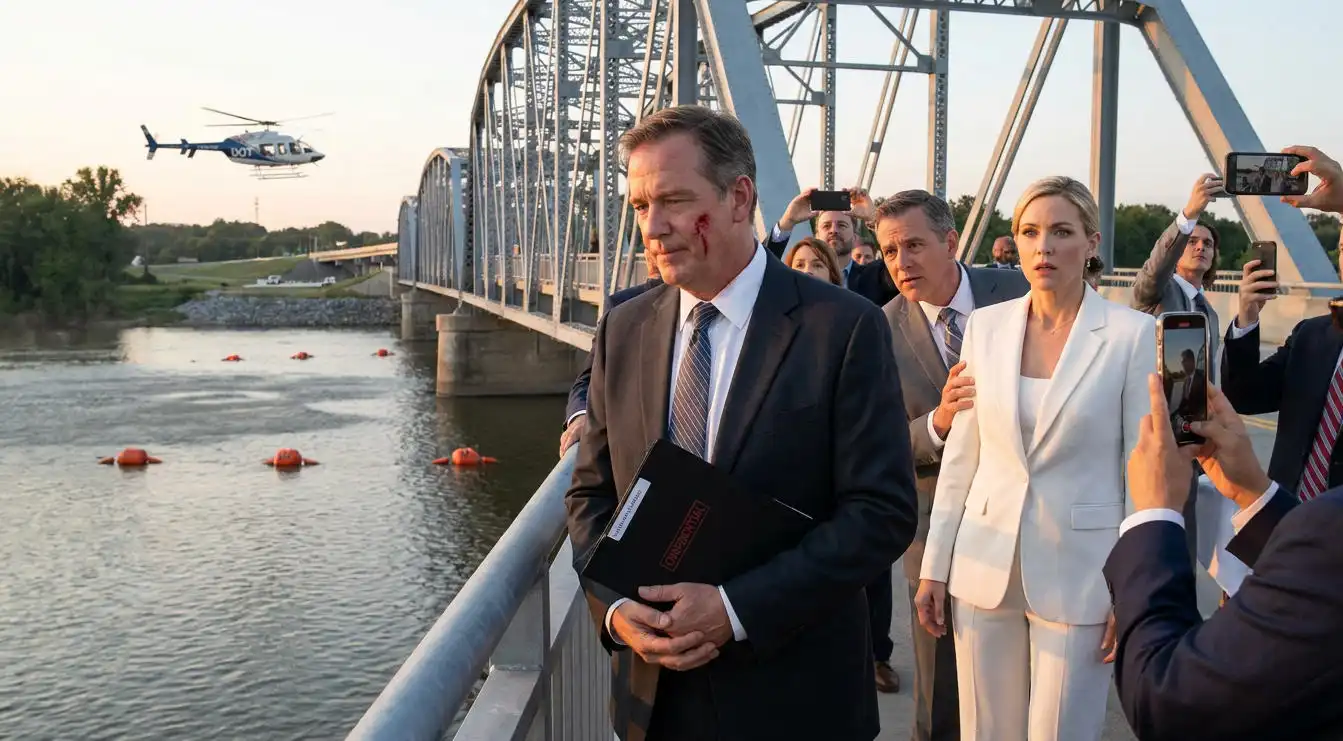
Then the rotor thundered over the river, and I lifted the sealed report for every camera to see.
For the first time all night, Veronica Hale stopped smiling.
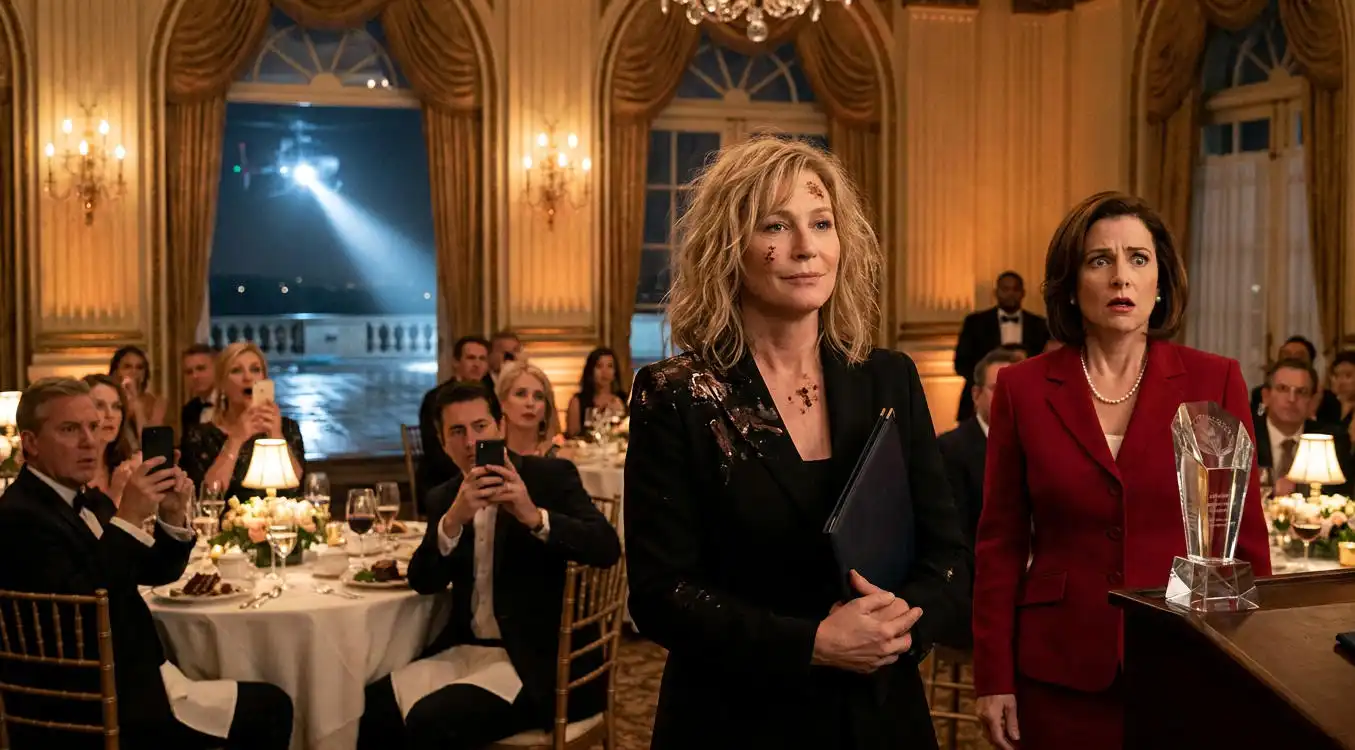
The woman who had just poured wine down my face like I was a waiter who had brought the wrong bottle suddenly looked at the sky like judgment had learned how to fly.
The banquet tent shook from the wind.
Napkins lifted off the white tablecloths.
The gold ribbon stretched across the entrance of the new Hale-Mercer Transit Bridge snapped against its poles.
Behind it, four lanes of fresh black asphalt ran over the river, gleaming under sunset lights, waiting for the first cars.
Families were parked behind the barricades.
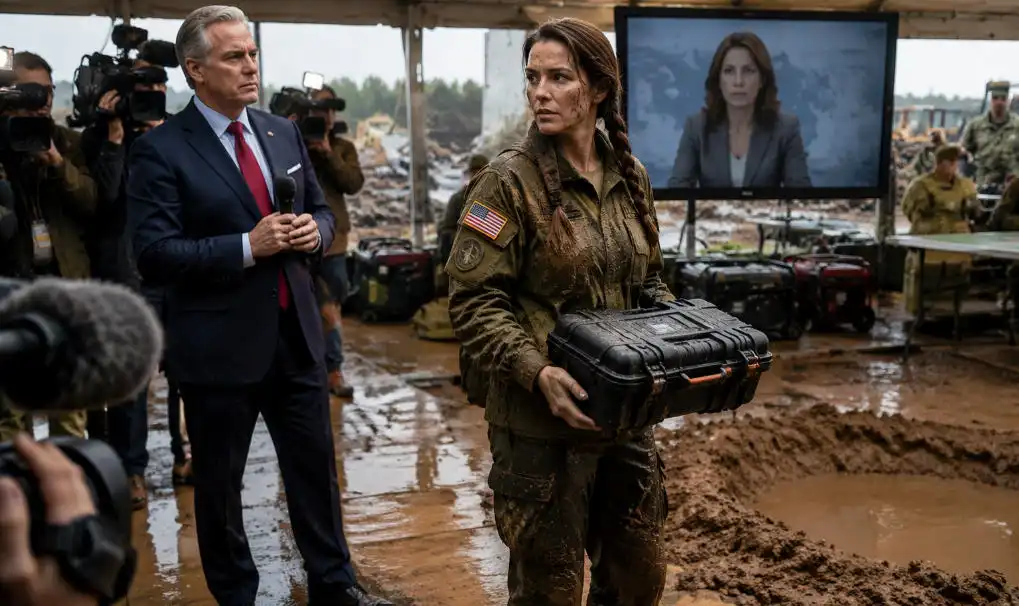
Reporters were standing at the press line.
A children’s marching band from the local high school had already packed up their instruments after playing the opening song.
Everybody had come to celebrate.
And Veronica had come to cash in.
She stood at the podium in her white suit, her diamond bracelet flashing under the cameras, with one hand still wrapped around the empty wineglass.
“Turn that helicopter around,” she hissed.
Nobody moved.
She looked at Deputy Commissioner Martin Albright, the man responsible for signing the final state acceptance documents.
“Martin,” she snapped. “Tell them.”
Albright’s lips parted.
No words came out.
That silence said more than any confession.
I stepped closer to the microphone.
My shirt was soaked.
Wine dripped from my chin onto the polished floor of the temporary stage.
A woman in the front row lowered her champagne glass.
A reporter whispered, “Keep rolling.”
I said, “My name is Daniel Mercer. I’m a special envoy from the United States Department of Transportation, Office of Infrastructure Safety Review.”
The crowd changed in one breath.
The people who had been laughing stopped laughing.
The donors turned to each other.
The mayor’s smile disappeared.
Veronica’s eyes narrowed.
“You’re lying,” she said.
I opened my credentials and held them toward the nearest camera.
The reporter zoomed in.
“No,” I said. “You were hoping I was.”
One of the security guards who had been about to remove me took two full steps backward.
Good choice.
Because the second helicopter was now landing near the east approach, and a convoy of DOT engineering trucks rolled in behind it, yellow lights flashing.
No sirens.
No chaos.
Just authority.
The kind that does not need to shout.
Veronica grabbed the microphone with her free hand.
“This is political harassment,” she barked. “This bridge passed inspection. It passed environmental review. It passed state acceptance. It is scheduled to open tonight.”
I turned to Albright.
“Commissioner, would you like to explain how it passed?”
He swallowed.
Veronica cut in. “He doesn’t have to answer you.”
“He does,” I said. “Because his signature is on a load-rating certificate that references a concrete density test performed three days before the concrete was poured.”
The mayor looked at Albright.
“What?”
I pulled the first page from the folder and held it up.
“Here is the certificate. Dated March 8.”
Then I lifted the second page.
“Here is the batch delivery record. March 11.”
A low murmur moved through the tent.
A man near the back said, “That can’t be right.”
Veronica laughed once. It was sharp and fake.
“Paperwork errors happen on major projects.”
“They do,” I said. “That’s why we ran nondestructive acoustic wave testing at 4:15 this morning.”
The smile left her face completely.
There it was.
The secret she did not know.
She had covered the paperwork.
She had pressured the local inspectors.
She had hosted officials, donated to campaigns, bought dinners, arranged favors, and polished every visible inch of that bridge until it looked like progress itself.
But she had not counted on a maintenance crew calling a federal hotline after hearing hollow resonance under the west span.
She had not counted on a young field engineer named Rebecca Torres refusing to delete her notes.
And she had not counted on me arriving in a cheap suit, without an entourage, looking exactly like the kind of man she thought she could humiliate.
I looked toward the crowd.
“Three weeks ago, an anonymous report came into DOT stating that the west approach pier did not match the approved reinforcement schedule.”
Veronica pointed a shaking finger at me.
“Anonymous complaints are not evidence.”
“No,” I said. “But steel scans are.”
I turned another page.
“Pier W-4 is missing thirty-two percent of the required vertical reinforcement.”
A gasp broke out.
The mayor whispered, “Thirty-two?”
I continued.
“Core samples indicate inconsistent curing. Acoustic wave readings show voiding across multiple deck sections. The expansion joint housings were modified without federal approval. And the contractor requested opening clearance before the live-load simulation was complete.”
The band director, a gray-haired man in a navy blazer, covered his mouth.
“My grandkids were going to ride across that tonight,” he said.
Veronica heard him.
She spun toward the crowd.
“Do not let him scare you,” she said. “Every large project has adjustments. Every bridge has maintenance issues. That is normal.”
I said, “A maintenance issue is a loose railing. This is a structural integrity failure.”
Albright finally found his voice.
“Daniel, maybe we should step aside and review this privately.”
I looked at him.
“Privately?”
My voice stayed calm, but the microphone caught every word.
“You signed a bridge open for public traffic with falsified test records, and you want privacy?”
People started filming him now.
Phones rose everywhere.
The public pressure settled on his shoulders like a concrete block.
Albright’s face turned gray.
Veronica leaned close to him and whispered, “Don’t say another word.”
But her whisper carried.
The front row heard it.
So did the cameras.
I nodded toward the bridge.
“DOT engineering command has issued an emergency closure. The river channel below is being cleared. Warning buoys are being deployed. The east and west approaches are locked down. No civilian traffic enters that bridge.”
Veronica’s hand clenched around the microphone.
“You cannot do that. This is my project.”
“That,” I said, “is the problem. You thought it belonged to you.”
She stepped down from the podium and walked straight toward me, her heels clicking hard against the stage.
“You have any idea what you just cost me?” she whispered.
“Yes,” I said. “A lawsuit. A contract. And maybe your company.”
Her face twisted.
She tried to keep her voice low, but rage made it rise.
“You pathetic little bureaucrat.”
The old insult.
The safe insult.
The one powerful people use when they discover rules still apply to them.
I did not answer.
For ten months, I had learned not to answer too early.
I had sat in county meetings while Veronica called safety concerns “anti-growth hysteria.”
I had watched Albright rush approvals through late Friday filings.
I had reviewed invoices from shell subcontractors with the same office address.
I had read Rebecca Torres’s field notes at midnight after she risked her job to preserve them.
I had seen the photographs.
Rust-streaked rebar stored uncovered in rain.
Concrete cylinders swapped before testing.
Weld inspection sheets copied from a different project.
And through all of it, I kept quiet.
Because people like Veronica survive arguments.
They do not survive records.
One of the DOT engineers, Captain Ellis, climbed onto the stage and handed me a radio.
“Sir,” he said, “river patrol confirms clearance under the center span. Traffic units report both approaches closed. Engineering team is ready to begin controlled emergency decommissioning sequence when authorized.”
Veronica heard the last word and froze.
“Decommissioning?” she said.
The crowd went dead quiet.
I looked at the bridge.
For a moment, I saw what it was supposed to be.
A clean route across the river.
Twenty minutes off a nurse’s commute.
A safer path for school buses.
A boost for small businesses on both sides of town.
That was the tragedy of it.
The city deserved a bridge.
It just did not deserve this one.
Veronica shouted, “You’re destroying public infrastructure!”
“No,” I said. “You already did.”
Albright wiped sweat from his forehead.
“Daniel, there has to be another option.”
“There was,” I said. “It was called building it correctly.”
The mayor stepped forward, shaking.
“Is there any chance it could stay closed and be repaired?”
Captain Ellis answered before I did.
“Not safely as currently constructed. Based on the voiding and reinforcement failures, the west approach must be taken down under controlled conditions before weather, vibration, or unauthorized traffic turns it into an uncontrolled incident.”
The mayor closed her eyes.
One second.
That was all she allowed herself.
Then she opened them and turned to Veronica.
“You told my office this bridge was ready.”
Veronica lifted her chin.
“It was ready. Your office wanted this ribbon-cutting before election season. Everyone wanted this.”
There it was.
Not remorse.
Not fear for the families waiting in cars.
Not concern for the workers who trusted her plans.
Just blame.
A reporter asked, “Ms. Hale, did you authorize substitution of lower-grade materials?”
“No comment.”
“Did your company falsify density logs?”
“No comment.”
“Did Deputy Commissioner Albright receive payments connected to the project?”
Albright whispered, “Oh God.”
Veronica turned on him like a cornered animal.
“Shut up, Martin.”
That was when two federal agents stepped onto the stage.
No drama.
No shouting.
Just badges, quiet voices, and the end of her performance.
“Veronica Hale,” one agent said, “you are being taken into custody pending charges related to public safety endangerment, fraud involving federally supported infrastructure funds, and conspiracy to falsify inspection documents.”
The crowd erupted.
Some people gasped.
Some shouted.
One older man yelled, “My wife drives this route every day!”
Veronica pulled her arm back.
“Get your hands off me. Do you know who I am?”
The agent said, “Yes, ma’am.”
That answer seemed to hit harder than an insult.
Albright backed away, but the second agent turned to him.
“Deputy Commissioner Martin Albright, you need to come with us.”
He looked at me.
For a second, I saw the man behind the title.
Small.
Tired.
Caught.
“Daniel,” he said, “I didn’t know it was that bad.”
Rebecca Torres, the young engineer who had been standing behind the DOT truck, stepped forward.
Her voice shook, but she spoke clearly.
“Yes, you did.”
Every camera swung toward her.
Albright stared at her.
She held up a copy of an email.
“I sent you the pier discrepancy report six weeks ago. You replied, ‘Do not delay acceptance over theoretical concerns.’ Then my supervisor removed me from the site.”
Albright’s mouth opened.
Closed.
No lie came fast enough.
The mayor looked sick.
Veronica screamed, “She was an unstable employee!”
Rebecca’s eyes filled with tears, but she did not back down.
“I was doing my job.”
I stepped beside her.
“She kept copies,” I said. “And so did the federal audit system.”
That was the legal hammer.
Not revenge.
Not yelling.
Not a fist on a table.
Documents.
Dates.
Measurements.
Signatures.
The boring things arrogant people ignore until they become the walls closing in.
Captain Ellis lifted his radio.
“Final confirmation?”
I looked to the mayor.
She looked at the bridge, then at the families behind the barricades.
“Do it,” she said.
The DOT crew moved with practiced calm.
The helicopters dropped additional warning buoys into the river.
Marine patrol boats pushed the last private vessels clear of the exclusion zone.
Engineers checked the controlled charges already placed at the compromised approach joints earlier that afternoon under emergency authorization, after the acoustic report confirmed immediate danger.
The guests were moved behind the safety line.
Veronica watched from beside the agents, her perfect hair whipping across her face.
“You’ll pay for this,” she said.
I looked at the bridge.
“No,” I said. “You will.”
The countdown came over the radio.
“Five.”
The crowd held its breath.
“Four.”
Rebecca clasped her hands together.
“Three.”
Albright lowered his head.
“Two.”
The red ribbon thrashed in the wind.
“One.”
The west approach dropped in a controlled sequence, clean and contained, folding exactly where the engineers intended.
A deep boom rolled across the river.
Not like destruction.
Like a verdict.
Dust rose.
Concrete fell away from the traffic deck.
The beautiful lie broke open in front of everyone.
Inside the broken sections, even from a distance, people could see the truth.
Gaps.
Thin steel.
Wrong spacing.
Hollow places where strength should have been.
The banquet was silent.
Then the old band director began to clap.
Once.
Twice.
Slow.
Not for the loss of the bridge.
For the lives still standing on the shore.
Others joined him.
The applause spread through the crowd until even some city workers were wiping their eyes.
Rebecca started crying.
I put one hand on her shoulder.
“You saved people,” I told her.
She shook her head.
“So did you.”
“No,” I said. “You spoke first.”
Veronica’s company collapsed faster than her bridge approach.
By Monday morning, Hale Infrastructure’s accounts were frozen under court order.
By Wednesday, federal receivers took control.
Every subcontractor payment was audited.
Every material substitution was traced.
Every official dinner, luxury box ticket, consulting fee, and campaign-adjacent donation went into a public file.
The court ordered forced liquidation of Veronica’s company assets to fund the first stage of rebuilding.
Her waterfront home was listed.
Her private jet share was seized.
Her firm’s downtown headquarters was stripped of its name from the glass doors.
The victims were not theoretical anymore.
The city recovered emergency closure costs.
The displaced workers were paid through a protected fund.
The honest subcontractors who had been squeezed by Hale’s cost-cutting scheme were allowed to testify without retaliation.
And Rebecca Torres was reinstated publicly, with back pay, legal protection, and a new role on the independent rebuild oversight board.
At the next town meeting, she received a standing ovation.
She cried again.
So did half the room.
Albright took a plea and agreed to testify.
He admitted that Veronica’s company had pushed the opening date to secure a performance bonus and unlock a second round of municipal development contracts.
He admitted he had accepted “consulting benefits” through a shell firm.
He admitted he ignored Rebecca’s warning because delaying the bridge would embarrass powerful people.
Veronica never admitted remorse.
At sentencing, she wore navy instead of white.
She said the project had been “mischaracterized by political enemies.”
The judge looked over his glasses and said, “Ms. Hale, this court has reviewed the evidence. What you call a mischaracterization, working families call the road their children might have crossed.”
She received prison time, financial penalties, and a lifetime ban from federally funded infrastructure contracts.
Her company was ordered to cover all eligible reconstruction costs through liquidation, insurance recovery, and clawed-back executive compensation.
The new bridge took eighteen months.
It was not as flashy.
No gold ribbon.
No champagne tower.
No donor wall with Veronica’s name.
Just steel placed correctly.
Concrete tested honestly.
Inspection reports posted publicly.
Rebecca signed the final safety certification.
I stood in the back during the opening.
No microphone.
No wine on my shirt.
Just a cup of bad coffee in my hand and the kind of peace that only comes when a thing is finally done right.
The mayor invited Rebecca to cut the ribbon.
Rebecca looked surprised.
“Me?”
The mayor smiled.
“You earned it.”
The crowd clapped as Rebecca stepped forward with ordinary scissors and trembling hands.
Before she cut, she looked at the families waiting on both sides of the bridge.
Then she said, “This bridge belongs to the people who cross it. Not the people who profit from it.”
The ribbon fell.
Cars rolled slowly across.
A school bus followed.
The driver honked once.
Everyone cheered.
I thought about that night at the banquet.
The wine.
The laughter.
The phones pointed at my face.
Veronica had believed humiliation was power.
She was wrong.
Humiliation is only power when the person being humiliated is afraid of the truth.
I was not afraid.
Rebecca was not afraid.
And because of that, thousands of people got to drive home safely on a bridge that would hold.
So pick a side:
The contractor who wanted the cameras and the payday…
Or the quiet people who stopped the ribbon before families paid the price.
Share this if you believe public safety should never be sold to the highest bidder. 🚁
Disclaimer: Mention of any brand or trademark is for identification only and does not imply partnership or endorsement