
“Stop the announcement.”
Those three words cut through the lobby like a blade.
The champagne trays stopped moving.
The cameras stopped flashing.
And Chase Rourke, the youngest director in the room and the loudest man in Hollywood that morning, froze with one hand still wrapped around the microphone.
Walter Finch stood twenty feet away, soaked from the neck down, holding a yellowed piece of paper in one trembling hand.
Nobody laughed now.
Five minutes earlier, they had treated him like a confused old man who wandered in from the parking garage.
A seventy-two-year-old retired film editor.
Thick glasses.
Brown jacket.
Scuffed shoes.
The kind of man studio executives walked past without seeing.
Chase Rourke, on the other hand, was impossible to miss.
He had his face on magazine covers.
He had a three-picture deal.
He had assistants who carried his coffee like it was holy water.
And behind him, filling an entire wall of the screening lobby, was the poster for his new movie:
PROJECT MERIDIAN.
A massive war epic.
A hundred-and-eighty-million-dollar production.
A film the early critics were already calling “visionary.”
The lobby had been dressed like a coronation.
Gold lights.
Black carpet.
Champagne.
Reporters.
Studio brass.
Influencers.
Actors pretending they had not checked their phones three times in the last minute.
At the center of it all stood Chase, waiting to announce the release date.
Then Walter came in from the archives and ruined the mood simply by existing.
“I need to inspect the original film elements for Project Meridian,” Walter had told the receptionist.
His voice was soft.
Too soft for a room that worshiped noise.
The receptionist looked over his shoulder as if the important person must be standing behind him.
“Sir, this area is closed for an event.”
“I understand,” Walter said. “But this concerns the original negative and the climax reel.”
That was when Chase heard him.
And Chase did what men like him do when someone powerless interrupts their applause.
He turned it into a show.
“Who let the VHS section escape?” Chase said.
The room laughed because Chase was famous, and famous people teach weak people when to laugh.
Walter did not smile.
He only adjusted his thick glasses and said, “Mr. Rourke, I need five minutes with the vault inventory.”
Chase walked toward him slowly, enjoying every step.
He was thirty-four, handsome, polished, and angry in the way rich young men get angry when an old rule still applies to them.
“Do you know what today is?” Chase asked.
“Yes.”
“Then why are you here?”
“Because today is the last moment to stop a mistake from becoming public.”
That made Vanessa Pike step forward.
Vanessa was the producer.
Sharp suit.
Silver earrings.
Smile like a locked door.
She had spent twenty years learning how to sound polite while threatening people.
“Walter,” she said, reading his name from a badge someone had printed that morning. “The archive department was specifically told not to interfere with today’s announcement.”
“I’m retired,” Walter said.
“Then you have even less reason to be here.”
Walter looked at Chase.
“I worked in that archive before your first student film.”
Chase grinned.
“Congratulations. You guarded dust.”
A few assistants covered their mouths.
A young actor near the poster whispered, “Is this part of the event?”
It wasn’t.
But Chase liked having an audience.
He stepped closer until Walter had to tilt his head back to look at him.
“You people from the basement always think the past belongs to you,” Chase said. “But movies are made by visionaries. Not file clerks. Not men with mothballs on their jackets.”
Walter’s cheeks colored.
Still, he did not raise his voice.
“I’m not here about pride.”
“Of course you are.”
“I’m here about footage.”
The word changed the temperature in the room.
Footage.
Not opinion.
Not gossip.
Footage.
Vanessa’s eyes narrowed.
“What footage?”
Walter tapped the folder under his arm.
“The climax sequence.”
Chase laughed too fast.
“Everybody loves that sequence.”
“Yes,” Walter said. “I know.”
Chase turned to the crowd.
“Ladies and gentlemen, apparently this gentleman believes he has a claim on the scene everyone is calling genius.”
The room chuckled again, but not as loudly.
Walter said, “I didn’t say claim.”
“Then what did you say?”
“I said custody.”
For one second, Chase’s face went blank.
It was tiny.
Almost nothing.
But Walter saw it.
Old editors notice frames other people miss.
One frame too long.
One glance too fast.
One lie cut half a beat early.
Vanessa recovered first.
“Security,” she said.
Two guards near the hallway straightened.
Walter didn’t move.
“I mailed the studio legal department twice,” he said. “I received no response.”
Vanessa’s smile tightened.
“Because legal doesn’t respond to retired employees chasing memories.”
That was cruel.
Not loud.
Not vulgar.
Worse.
It had polish on it.
Walter blinked behind his thick lenses.
“My memories have reel numbers.”
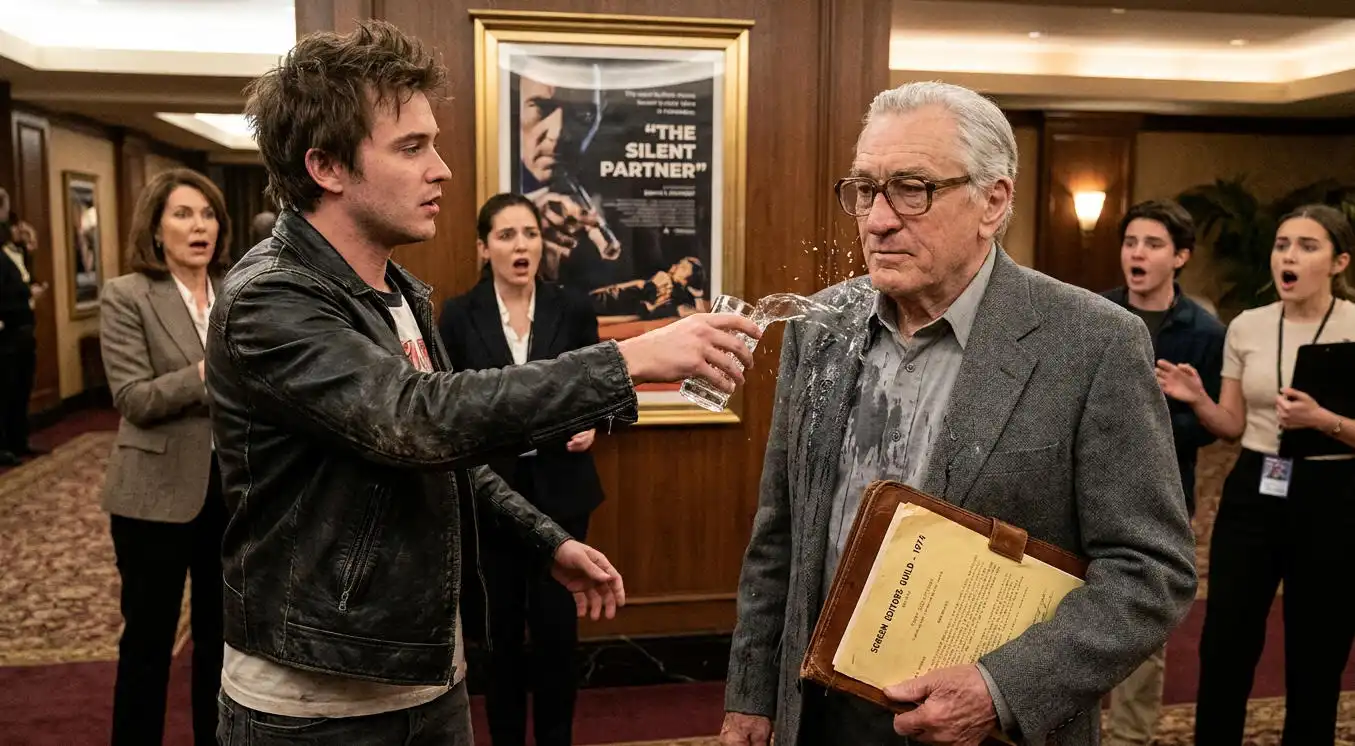
Chase snatched a glass of ice water from a passing tray.
People saw him do it.
No one stopped him.
That was the part Walter would remember later.
Not the water.
Not the cold.
The silence before it happened.
Chase held the glass out like he was making a toast.
“To the archive,” he said. “Where old men go to protect things nobody cares about.”
Then he threw it in Walter’s face.
Ice hit Walter’s cheek.
Water ran down his glasses.
His collar darkened.
A cube bounced off his shoulder and landed on the black carpet.
The lobby gasped.
Someone whispered, “That was too far.”
Chase leaned close.
“Now go dry yourself in the basement.”
Vanessa did not scold him.
She did not apologize.
She looked at the guards and said, “Please remove Mr. Finch before he embarrasses himself further.”
Walter took off his glasses.
His hands shook more now.
But not from fear.
From age.
From cold.
From the simple unfairness of being humiliated by a man who thought youth was proof of ownership.
He wiped the lenses with the same folded handkerchief he had carried since 1978.
Then he put them back on.
And he said the sentence that killed every laugh in the room.
“You should have read the custody receipt before you stole the shot.”
Chase’s smile disappeared.
Vanessa’s did too.
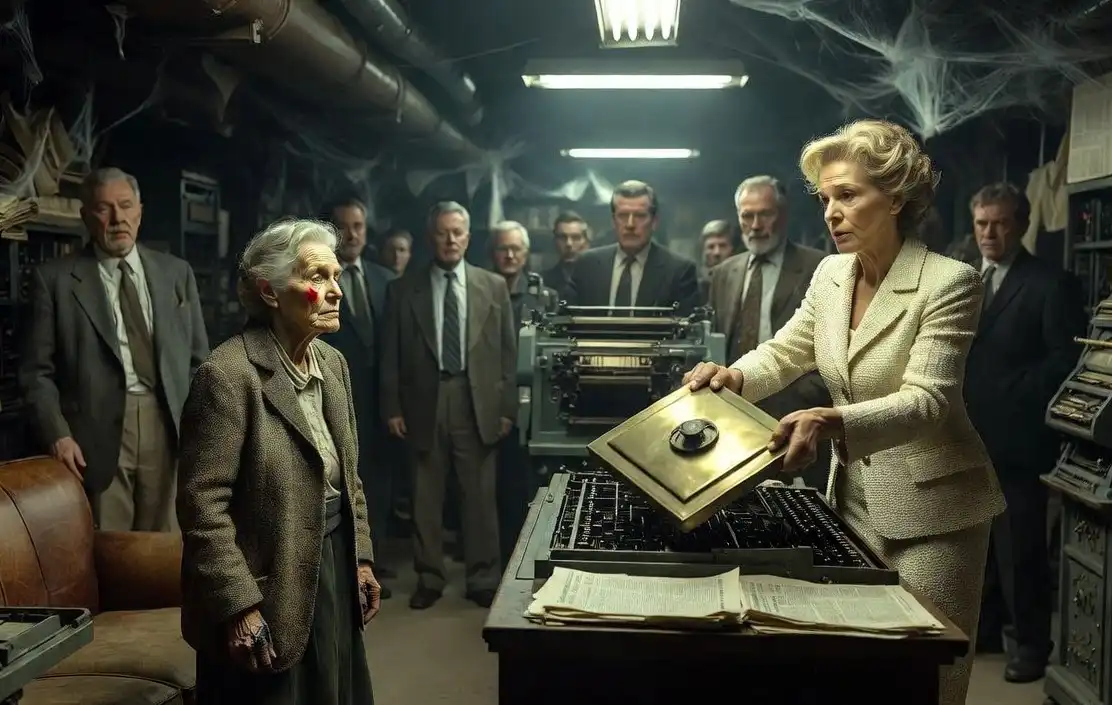
Walter opened his leather folder.
The document inside was old.
Cream-colored.
Stamped.
Signed.
Folded along lines that had softened with time.
At the top were the words:
MOTION PICTURE EDITORS GUILD — ORIGINAL MATERIALS CUSTODY CONFIRMATION.
Below that:
Project Title: THE LAST HARBOR.
Year: 1994.
Status: Unreleased.
Material: Original camera negative, workprint reels, optical effects plates, climax sequence, reels 7A through 9C.
Custodian: Walter E. Finch.
Witnessed by: Studio Archive Office, Editors Guild Representative, Post-Production Legal Liaison.
Walter held it up.
A few phones rose with it.
Chase took half a step forward.
“Put that down.”
Walter didn’t.
Vanessa hissed, “Walter, this is private company property.”
“No,” Walter said. “This is a guild custody record. And today, it is evidence.”
That was when the glass doors opened.
Marian Cho, the studio’s legal counsel, walked in with two assistants behind her.
She did not look amused.
She did not look surprised either.
That told Walter his last email had finally reached someone.
“Stop the announcement,” Marian said.
Chase still held the microphone.
The giant poster of Project Meridian smiled down behind him like a monument built ten minutes too early.
Vanessa crossed the lobby fast.
“Marian, this is not the time.”
“It is exactly the time,” Marian said.
Her voice was calm.
Lawyers with bad news often are.
Chase forced a laugh.
“Are we seriously stopping a release announcement because some old editor brought a scrapbook?”
Walter looked at him.
“It isn’t a scrapbook.”
Marian turned to Chase.
“Mr. Rourke, I need you to step away from the microphone.”
“I’m not stepping away from my own film.”
“That may be part of the problem.”
The lobby went silent in the way only powerful rooms go silent.
Not quiet.
Frozen.
Everyone was calculating what this meant for them.
The assistants.
The actors.
The publicists.
The executives standing near the champagne.
The producer whose smile had finally left her face.
Marian held out her hand.
“Walter, may I?”
Walter gave her the document.
She examined the stamp.
Then the signatures.
Then the reel numbers.
She looked at one of her assistants.
“Pull up the vault intake report.”
The assistant opened a tablet.
Chase pointed at Walter.
“This is insane. That man has had some personal grudge for thirty years.”
Walter answered softly.
“I had a promise.”
“To who?” Chase snapped.
Walter looked past him, toward the poster.
“To a dead director whose movie was buried because the studio ran out of courage.”
Nobody spoke.
So Walter told them.
Thirty years earlier, The Last Harbor had been a war drama directed by Joseph Adler.
Joseph was not famous anymore.
Most of the room had never heard his name.
But Walter had cut his film.
For eleven months, he sat in a dark editing room with Joseph, shaping the climax frame by frame.
A ruined lighthouse.
A storm.
A soldier carrying a wounded child through smoke.
A crane shot over a flooded pier.
The kind of sequence people would have remembered if the movie had ever been released.
But the studio changed leadership.
The budget collapsed.
A lawsuit over music rights froze the picture.
Then Joseph got sick.
The Last Harbor was shelved before the final answer print was struck.
“Joseph knew what would happen,” Walter said. “Unreleased films become rumors. Rumors become storage. Storage becomes theft if nobody keeps the paper trail.”
He paused.
His wet shirt clung to his shoulders.
No one offered him a towel.
“So he asked me to guard the material until the rights were cleared. I signed the custody confirmation with the guild present. The studio signed it too.”
Vanessa folded her arms.
“That does not prove Chase used anything.”
“No,” Walter said. “The paper proves where the original material was held. The rest proves what happened to it.”
Chase laughed again.
But there was no audience left for it.
“What rest?”
Walter looked at Marian.
She nodded to her assistant.
The assistant connected the tablet to the lobby display.
The giant poster went dark.
In its place appeared a spreadsheet.
Vault Access Log — Sub-Basement Archive.
Marian read aloud.
“Original camera negative reels 7A through 9C. Checked out eighteen months ago.”
Vanessa said, “For digitization.”
“By whose authorization?” Marian asked.
The assistant scrolled.
The room watched.
Then the name appeared.
VANESSA PIKE.
A murmur went through the lobby.
Vanessa’s face hardened.
“That was standard preservation.”
Walter said, “Preservation returns to the vault.”
The assistant scrolled again.
Return status: Partial.
Condition: Digitized elements retained in temporary post-production server.
Requested by: C. Rourke.
Chase pointed at the screen.
“That doesn’t mean anything. Directors look at archival material for reference all the time.”
Walter nodded.
“Yes. Reference is legal. Theft is not.”
Marian’s assistant opened a second file.
This one was a split-screen video.
On the left: a grainy, faded workprint from The Last Harbor.
On the right: the polished trailer cut of Project Meridian.
Same lighthouse angle.
Same soldier entering frame from the left.
Same wounded child’s arm falling at the same second.
Same smoke drift.
Same camera move.
Same flare in the lens caused by a damaged filter from 1994.
The lobby stopped breathing.
Someone whispered, “Oh my God.”
Chase’s face went gray.
Walter watched him carefully.
Not with joy.
Not yet.
Because the worst thing about theft is not that someone takes from you.
It is that they expects you to feel honored they found it worth stealing.
Marian said, “There are at least forty-three matching shots in the climax sequence. Our internal review identified identical edge codes on multiple frames.”
Chase spoke through his teeth.
“You ran an internal review without telling me?”
Marian looked at him.
“Walter’s second letter included still frames and reel numbers.”
Vanessa turned on Walter.
“You sent that outside the chain?”
Walter said, “You were the chain I was reporting.”
That landed hard.
A few people looked at Vanessa now.
Not Chase.
Vanessa.
Because that was the second truth in the room.
Chase had stolen the glory.
But Vanessa had opened the vault.
Marian continued.
“Mr. Finch also provided the original cutting notes, lab reports, and the 1994 custody receipt. The estate of Joseph Adler retains unresolved creative rights in the unreleased picture. The studio never acquired clearance to reuse those elements in a new film.”
Chase said, “It’s transformative.”
Walter shook his head.
“You copied the frames.”
“I reimagined them.”
“You cropped them.”
“I built a new story around them.”
“You removed Joseph’s name.”
That one finally broke through.
Chase looked away.
The room saw it.
Everybody saw it.
Walter had spent his life in editing rooms, so he understood the power of a held silence.
He let that silence play.
Then Marian asked the question that made Vanessa close her eyes.
“Mr. Rourke, when did you first see The Last Harbor materials?”
Chase said nothing.
Marian turned to Vanessa.
“Ms. Pike?”
Vanessa’s jaw worked.
“We had an internal development meeting.”
“When?”
“Two years ago.”
“Was Mr. Finch invited?”
“No.”
“Was the Adler estate notified?”
“No.”
“Was the guild custody restriction discussed?”
Vanessa did not answer.
Walter did.
“It was printed on the box.”
Marian looked at him.
Walter explained.
“Every reel can had a red strip. ‘Custody Hold — Do Not Duplicate Without Guild and Estate Clearance.’ I wrote half of those labels myself.”
The assistant brought up a photograph.
A metal film can.
Dusty.
Red strip across the lid.
The words were right there.
Do Not Duplicate.
For a moment, the lobby became something stranger than a lobby.
It became a courtroom without a judge.
And the jury was every person holding a phone.
Chase lowered his voice.
“This is a misunderstanding.”
Walter smiled sadly.
“No. A misunderstanding is when a young editor grabs the wrong reel. A misunderstanding is when a lab mislabels a can. This took planning.”
Marian asked, “What else do you have, Walter?”
Walter pulled one more item from the folder.
A small envelope.
Inside was a printed email.
Chase’s expression changed before Walter even opened it.
Again, one frame too early.
Walter handed it to Marian.
She read it.
Her mouth tightened.
Then she looked at Chase.
“You wrote to the VFX supervisor: ‘Use the old harbor plates as the backbone. Nobody alive will remember the source.’”
The lobby erupted.
Not loudly.
Worse.
With whispers.
Phones lifted higher.
An assistant near the back said, “He actually wrote that?”
Chase lunged toward Marian.
Not violently enough to hit her.
But fast enough that a guard stepped in.
“Give me that,” Chase said.
Walter stepped between them.
Chase shoved past him with his shoulder.
Walter stumbled.
A young production assistant caught his elbow.
For the first time that day, someone helped him.
“Careful, sir,” she whispered.
That nearly undid him.
Not the water.
Not the insults.
Kindness.
At the wrong moment, kindness can hit harder than cruelty.
Chase pointed at Walter.
“You have no idea what it takes to make something at this level. You sat in a dark room your whole life cutting other people’s dreams and called it art.”
Walter looked at him for a long second.
Then he said, “That is exactly what editing is.”
A few older crew members in the lobby nodded.
Walter continued.
“We protect the dream from the ego of the person who thinks he owns it.”
Chase laughed bitterly.
“You think this makes you a hero?”
“No.”
Walter looked at the soaked front of his jacket.
“I think it makes me a witness.”
Marian closed the folder.
“The announcement is canceled. Effective immediately, Project Meridian is on legal hold pending rights review, guild notification, and chain-of-title investigation.”
Vanessa went pale.
“You can’t do that in the lobby.”
Marian looked around at the phones.
“It appears the lobby was chosen before I arrived.”
That was the first time anyone almost smiled.
Chase dropped the microphone onto the carpet.
The thud sounded final.
Within twenty minutes, the champagne was gone.
The cameras were not.
By noon, the studio released a statement saying Project Meridian had been “temporarily removed from the release calendar due to rights review.”
By dinner, the internet had the split-screen.
The lighthouse.
The soldier.
The child.
The smoke.
The same damaged lens flare that Walter remembered from a freezing night shoot in 1993.
By midnight, Chase Rourke’s interviews vanished from three entertainment sites.
The next morning, his agency announced that they were “evaluating the matter.”
That phrase means nobody wants to stand too close to the fire.
But the real reckoning took longer.
It always does.
The guild opened an inquiry.
The studio hired outside counsel.
The Adler estate, represented by Joseph’s daughter, filed a formal claim.
Her name was Emily Adler.
She was forty-one.
She had been eleven when her father died.
When she first called Walter, she cried before saying hello.
“I didn’t know any of it survived,” she said.
Walter sat at his kitchen table with a cup of tea going cold in front of him.
“It survived,” he said. “Your father made sure of that.”
“My mother said he kept talking about the harbor scene near the end.”
“He did.”
“Was it good?”
Walter looked toward the hallway closet where he kept his old editing gloves in a shoebox.
“It was beautiful.”
Emily went quiet.
Then she said, “They showed his work to the world and erased him.”
Walter closed his eyes.
“Yes.”
For the first time since the lobby, his anger felt clean.
Not loud.
Not hungry.
Just clear.
The investigation found what Walter already knew.
Vanessa Pike had authorized the digitization of The Last Harbor under a preservation budget, then routed the files to a development server used by Chase’s post-production team.
Chase had screened the workprint privately.
He had ordered selected plates restored.
Then he had integrated them into Project Meridian’s climactic battle sequence, blending them with new footage and calling the result “a practical homage to old Hollywood craft.”
Except he never called it a homage in the contracts.
He called it original photography.
He never credited Joseph Adler.
He never credited the cinematographer, now living in a nursing home in Oregon.
He never credited the stunt team, two of whom had died before Project Meridian was even written.
And he never credited Walter, whose cutting pattern he had copied so closely that one expert described it as “not inspiration, but replication with upgraded color.”
The legal hammer fell in stages.
First, Project Meridian was pulled from the release calendar.
Then the distributor suspended its marketing spend.
Then the studio removed Chase from active development on his next two films.
Then the directors’ branch ethics committee opened a review.
The guild filed a formal complaint regarding unauthorized reuse of protected archival material.
Vanessa resigned “to pursue independent opportunities,” which fooled nobody.
Chase gave one interview.
Only one.
He said, “The industry is punishing creative risk.”
It was the wrong sentence.
The clip went viral for all the wrong reasons.
Under it, thousands of people wrote the same thing:
“You poured water on an old man and stole from a dead one.”
That was the line that stuck.
Not because Walter wrote it.
He didn’t.
But because ordinary people understand arrogance faster than contracts.
They know what it looks like when someone powerful believes the rules are only for people below them.
Three months later, Walter was invited back to the studio.
Not to the screening lobby.
To the archive.
The same sub-basement Chase had mocked.
The same rows of shelves.
The same metal cans.
Only this time, Emily Adler was with him.
So was Marian.
So were two preservation specialists, one guild representative, and a small documentary crew hired by the Adler estate.
On the table lay the cans for The Last Harbor.
Reels 7A through 9C.
The red labels were fading.
Walter ran one finger along the edge of the lid.
Emily watched him.
“Did my dad really trust you with all this?”
Walter nodded.
“He trusted the work. I was just the man close enough to the shelf.”
“That’s not just.”
Walter swallowed.
Old men do not always cry dramatically.
Sometimes they simply become very still.
The restoration took six months.
The studio, desperate to repair the damage, agreed to fund it under court-supervised terms.
Joseph Adler received full directing credit.
The cinematographer received credit.
The editor received credit.
The estate received compensation.
And Walter Finch received something he had never asked for.
A title card.
Archival Restoration Supervised By Walter E. Finch.
When the restored version of The Last Harbor premiered at a classic film festival, Walter almost did not attend.
He said he had nothing appropriate to wear.
Emily mailed him a navy suit.
There was a note inside.
“My father wore blue to premieres. I thought you should too.”
Walter stood in front of his mirror for twenty minutes that evening.
The suit was a little loose.
His glasses were the same thick ones.
His hands still shook.
But when he arrived at the theater, nobody laughed.
People stood.
Not because he was famous.
Not because he was rich.
Because sometimes a room finally understands who protected the thing everyone else forgot.
Emily walked him down the aisle.
Halfway to their seats, an older man in the front row turned around.
White hair.
Thin face.
Oxygen tube.
Walter recognized him immediately.
“Sam?”
Sam Ortega had been the camera operator on The Last Harbor.
Walter had not seen him in twenty-eight years.
Sam reached for his hand.
“They told me the harbor shot was gone.”
Walter squeezed back.
“Not gone.”
Sam’s eyes filled.
“Joe would’ve liked that.”
Walter nodded.
“Yes, he would have.”
When the film played, the audience was quiet at first.
Old films ask modern people to slow down.
Then the harbor sequence began.
The lighthouse.
The storm.
The soldier carrying the child.
The crane shot over the flooded pier.
The damaged lens flare.
Not stolen now.
Restored.
Named.
Returned to its rightful place.
Walter sat perfectly still.
Emily cried beside him.
At the end, the theater rose in a standing ovation.
Walter did not stand right away.
He looked at the screen as the credits rolled.
Joseph Adler’s name appeared.
Then the cinematographer.
Then the cast.
Then:
Edited by Walter E. Finch.
Walter took off his glasses.
Wiped them with the same folded handkerchief.
This time, they were wet for a better reason.
Later that week, Chase Rourke’s name appeared in the trades again.
Not for a movie.
For arbitration.
He lost his final cut privileges on future studio projects.
His development deal was terminated.
His awards campaign collapsed.
Several collaborators publicly distanced themselves.
And the restored footage could no longer be used in Project Meridian unless the Adler estate approved it, credited it, and was paid.
Emily refused.
Not out of bitterness.
Out of dignity.
She told Walter, “My father’s work doesn’t need to be someone else’s shortcut.”
Walter smiled.
“That sounds like him.”
Project Meridian was eventually recut without the stolen climax.
It tested poorly.
Without the old harbor footage, the “visionary” ending felt hollow.
The studio buried it on a streaming platform with no premiere.
No champagne.
No giant poster.
No microphone.
Just a thumbnail.
That was not revenge.
That was gravity.
Things fall when they were never standing on their own.
A year after the lobby incident, Walter returned to the same studio for a small event celebrating the archive department.
Nothing glamorous.
Coffee.
Foldable chairs.
A banner that someone hung slightly crooked.
Marian spoke first.
Then Emily.
Then the studio president, who looked deeply uncomfortable admitting that the company owed its reputation that year to a retired editor in a wet brown jacket.
Walter was asked to say a few words.
He stood at the front of the room.
The same production assistant who had caught his elbow in the lobby sat in the second row.
Her name was Lily.
She smiled at him.
Walter unfolded a piece of paper, but he barely looked at it.
“I spent most of my life in dark rooms,” he said. “That is where editors work. We are used to being invisible.”
The room listened.
“But invisible does not mean unimportant. Quiet does not mean weak. Old does not mean finished.”
He paused.
His voice thinned slightly.
“People think archives are where movies go to die. They’re wrong. Archives are where promises wait.”
Emily lowered her head.
Walter continued.
“Joseph Adler made a film. The world did not see it when it should have. That was unfair. But unfair is not the same as over.”
He looked toward the young assistants near the back.
“Keep the paperwork. Respect the credit. Read the labels. And never assume the person holding the folder is powerless.”
The room applauded.
Not explosively.
Warmly.
That mattered more.
After the event, Lily approached him.
“Mr. Finch?”
“Walter, please.”
She smiled.
“I applied for a transfer to preservation.”
Walter looked surprised.
“Because of all this?”
“Because when Chase threw that water, everyone froze. Including me.”
Her face tightened with shame.
“I keep thinking I should have done something sooner.”
Walter studied her.
Then he said, “You caught my elbow.”
“That was after.”
“It counts.”
She blinked.
He added, “Most people learn courage one second late. The decent ones use it better next time.”
Lily nodded, eyes bright.
Walter handed her a pair of white cotton editing gloves from his coat pocket.
“They’re old,” he said. “But they still work.”
She took them like they were something sacred.
Maybe they were.
On his way out, Walter passed the screening lobby.
The poster for Project Meridian was gone.
In its place hung a framed still from The Last Harbor.
The soldier.
The child.
The storm.
Under it was a small plaque:
From the restored 1994 film by Joseph Adler. Preserved through the custody records of Walter E. Finch and the Motion Picture Editors Guild.
Walter stood there for a long moment.
He remembered the water.
The laughter.
The ice cube bouncing on the carpet.
He remembered Chase saying, “You basement people don’t own genius.”
Then he looked at the plaque.
No anger rose in him.
Only relief.
Because the truth had not needed to scream.
It only needed to survive long enough to be read out loud.
That night, Emily called him.
“Walter,” she said, “the festival wants to screen The Last Harbor again next month.”
“That’s good.”
“They want you to introduce it.”
He laughed softly.
“I’m not much of a public speaker.”
“You stopped a Hollywood release in a lobby while dripping wet.”
“That was different.”
“How?”
Walter looked at the old leather folder on his desk.
The custody receipt had been copied, scanned, submitted, stamped, and entered into more systems than he could count.
But the original was still there.
Folded.
Yellowed.
Faithful.
He said, “That day I was speaking for someone who couldn’t.”
Emily’s voice softened.
“Then do it again.”
So he did.
And every time he stood before an audience, he told them the same thing.
Not the scandal.
Not the gossip.
Not the humiliation.
He told them about credit.
About promises.
About how art is made by many hands, and stolen by people who think only the loudest name matters.
And he always ended with one line:
“Respect the people who keep the receipts.”
So choose your side:
Share this if you believe Chase got exactly what he deserved.
Comment if you think Walter should have exposed him even sooner.
Disclaimer: Mention of any brand or trademark is for identification only and does not imply partnership or endorsement