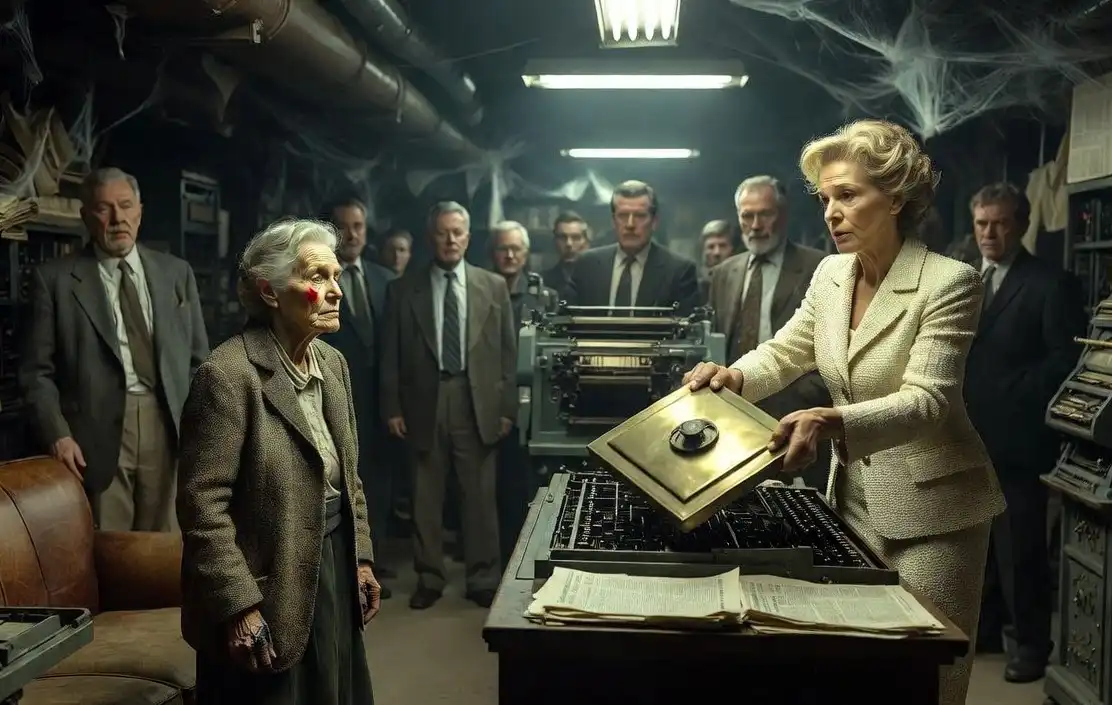




“Now she finally looks dressed for the factory.”
That was the sentence Marlene Whitcomb chose to say after dumping an entire tray of chocolate cake over my head.
In front of four hundred people.
At a Labor Day Recognition Dinner.
Inside the Grand Harrington Hotel ballroom, where the carpets were red, the chandeliers were gold, and every table had little American flags folded beside the silverware.
I stood there with frosting dripping down my cheek.
My black jacket was ruined.
My white blouse clung cold against my skin.
A strawberry slid from my shoulder and landed on the polished floor.
Nobody moved at first.
They just stared.
The mayor held his champagne glass halfway to his mouth.
A local banker lowered his fork.
Two women near the front covered their mouths.
And Marlene Whitcomb, the woman of the evening, the “Outstanding Entrepreneur of the Year,” lifted her chin like she had just corrected a household servant.
She wore a red designer suit, white pearls, and the proud smile of a woman who believed money could turn cruelty into manners.
Her HR director, Diane, stood three feet behind her.
Diane had the kind of frozen face people get when they suddenly understand the floor is about to collapse under them.
Marlene didn’t notice.
She was too busy enjoying herself.
“Well?” Marlene said, raising her voice so the whole ballroom could hear. “Somebody clean this up. And maybe show her the service entrance.”
A few people gave weak, uncomfortable laughs.
Not because it was funny.
Because powerful people train rooms to laugh at ugly things.
I wiped cake from my left eye.
I did not shout.
I did not throw anything.
I did not tell Marlene who I was.
Not yet.
A young server stepped toward me with a napkin, his hands shaking.
“I’m so sorry, ma’am,” he whispered.
Marlene snapped her fingers.
“Don’t apologize to her. She should apologize to the hotel. Look at the mess she made.”
I looked at her.
“Mrs. Whitcomb,” I said quietly, “you may want to stop talking.”
That made her laugh harder.
“Or what?”
She took one slow step closer.
Up close, I could smell expensive perfume and champagne.
“You people always think you can threaten someone once you learn a few official words,” she said. “Let me guess. Some little complaint? Some worker whining about overtime?”
Diane whispered, “Marlene…”
Marlene waved her off.
“No, Diane. I’m tired of it. I built my company from nothing. I employ people nobody else would even look at. And then they cry because they don’t like the hours.”
I could feel every phone in the room rising.
People were recording now.
Good.
Let them.
Marlene pointed at my ruined blouse.
“You look exactly like the women on my cutting floor. Same tired face. Same rough hands. Same attitude.”
A man at table six muttered, “That’s enough.”
Marlene turned on him.
“Excuse me?”
He looked down.
That was Marlene’s gift.
She could turn courage into silence with one stare.
For years, she had done it inside Whitcomb Textiles.
She did it to immigrant seamstresses.
She did it to older women who needed health insurance.
She did it to men who worked twelve-hour shifts and still went home short on rent.
She did it to people who could not afford to fight back.
And she believed I was one of them.
That was her mistake.
I was Evelyn Parker, State Labor Commissioner.
For nineteen months, my department had been investigating Whitcomb Textiles.
We had received the first complaint from a woman named Rosa Delgado.
Rosa wrote in careful English that she had worked seventy-two hours in one week and had been paid for thirty-nine.
At first, it looked like a routine wage claim.
Then came another complaint.
Then six more.
Then a package with no return address arrived at our office.
Inside was a thumb drive.
Video.
A woman crying beside a time clock that had been reset.
A man showing a paycheck that did not match his hours.
Workers sleeping on thin blankets in a locked storage room because the company van that brought them in “wasn’t available” until morning.
A whiteboard in the HR office with names under two columns:
“REAL HOURS.”
“PAYROLL HOURS.”
Diane’s handwriting was on the board.
We had watched the footage three times.
Nobody in the conference room spoke for almost a full minute.
Then I said, “Build the case properly. No shortcuts. No mistakes.”
Because if you strike too early, people like Marlene survive.
They hire lawyers.
They blame middle management.
They cry on television.
They donate to a charity and call it a misunderstanding.
So I waited.
I signed subpoenas.
I sent auditors.
I met workers in church basements and grocery store parking lots.
I listened while grown men stared at the floor and admitted they had been afraid to speak.
I listened while mothers explained how their children thought “overtime” meant coming home after bedtime every night.
I listened while Rosa told me Marlene once said, “Be grateful. Back where you came from, you’d earn nothing.”
That line stayed with me.
So when the governor’s office asked me to attend the Labor Day dinner, I agreed.
When I saw Marlene’s name on the award list, I made one phone call.
Then another.
Then I came to the ballroom in a plain black jacket, carrying a folder with the state seal on the corner.
I did not expect the cake.
But I was not surprised.
Cruelty always reveals itself when it thinks the room belongs to it.
The mayor tapped the microphone.
His face had gone gray.
“Ladies and gentlemen,” he said weakly, “perhaps we should take a short—”
“No,” Marlene said.
She marched toward the stage, heels clicking.
“This is my night. I will not have it ruined by some bitter employee with a folder.”
Diane grabbed her wrist.
“Marlene, stop.”
The whole room heard that.
Marlene jerked away.
“Don’t touch me.”
Diane looked at me.
Then at the folder.
Then at the stage screen.
She knew what was coming.
Outside, a low chopping sound began to grow.
At first, people thought it was thunder.
Then the windows trembled.
A napkin lifted off a table.
Someone shouted, “Is that a helicopter?”
The sound got louder.
Thump-thump-thump-thump.
Every head turned toward the tall ballroom windows.
On the rooftop across the hotel courtyard, lights swept through the night.
Hotel security rushed toward the doors.
The mayor stepped back from the microphone.
Marlene stared at the ceiling.
“What is this?” she barked. “Who authorized that?”
I walked past her and stepped onto the stage.
Cake dripped from my hair onto the polished wood.
The award trophy sat on the podium, bright and ridiculous.
A crystal figure holding a torch.
“Outstanding Entrepreneur.”
I picked it up.
Marlene lunged toward me.
“Put that down!”
I looked at the engraved plate.
Then I looked at the audience.
“Ladies and gentlemen,” I said into the microphone, “my name is Evelyn Parker.”
A murmur passed through the room.
“The State Labor Commissioner.”
The mayor closed his eyes.
Marlene’s mouth opened.
Nothing came out.
Not one word.
Diane whispered, “Oh no.”
I turned toward the AV technician, a nervous young man wearing a black vest.
He looked at me for permission.
I nodded.
“Play the video.”
The screen behind me flickered.
Then the ballroom saw Whitcomb Textiles.
Not the glossy website version.
Not the ribbon-cutting version.
The real one.
A shaky phone video showed the cutting floor at 2:17 in the morning.
Rows of tired workers bent over machines.
A woman rubbing her swollen wrist.
A supervisor walking between tables saying, “No clock-out until section C is done.”
A second clip appeared.
Diane stood beside a desk, speaking to a payroll clerk.
Her voice filled the ballroom.
“Do not enter anything over forty. Marlene said no overtime this month.”
The payroll clerk asked, “But they worked sixty.”
Diane replied, “Then they volunteered.”
Gasps broke out.
Someone said, “That’s Diane.”
Diane covered her mouth.
The next clip showed a locked storage room.
Blankets on the floor.
Lunch containers stacked by a sink.
A man’s voice behind the camera whispered, “They said if we leave, we lose the week’s pay.”
Marlene spun toward me.
“That is edited.”
I said nothing.
The screen changed again.
This time, Marlene herself appeared.
She stood in a factory office wearing the same pearls she wore that night.
A worker, Rosa Delgado, stood in front of her.
Rosa’s voice trembled.
“Mrs. Whitcomb, my check is short again.”
On the video, Marlene smiled.
“Then work faster.”
“I worked seventy hours.”
“No,” Marlene said. “Diane says you worked thirty-nine.”
Rosa held up a paper.
“I wrote my hours down.”
Marlene leaned close.
“Listen to me. You people are replaceable. You want attention from the labor office? Go ahead. By the time they show up, I’ll know who talked.”
The ballroom erupted.
“Shame!”
“That’s disgusting.”
“She was getting an award?”
Marlene screamed over them.
“Turn it off!”
I did not.
The final clip showed the whiteboard.
REAL HOURS.
PAYROLL HOURS.
Names.
Numbers.
A system.
Not an error.
Not a misunderstanding.
A theft.
Then the video ended on Rosa’s face.
She looked into the camera and said, “I just want what I earned.”
The ballroom went silent.
That silence was heavier than any applause could have been.
I set the trophy on the podium.
“Marlene Whitcomb,” I said, “as of 8:42 p.m. tonight, Whitcomb Textiles is under an emergency enforcement order.”
Two uniformed state investigators entered from the side doors.
Behind them came federal labor officers, county deputies, and two auditors carrying sealed boxes.
The hotel doors opened again.
And then the workers came in.
Not all at once.
At first, only Rosa.
She was small, with gray in her hair and her church coat buttoned to the neck.
Then Marcus, a machine mechanic with a limp.
Then Amina, who had sewn hems for eleven years.
Then more.
Dozens.
Then over a hundred.
They filled the back of the ballroom in work jackets, uniforms, Sunday dresses, and tired shoes.
Some still had thread on their sleeves.
Some held pay stubs.
Some held pictures of children.
Marlene backed away like the room itself had turned against her.
Rosa looked at her.
Not with hatred.
With exhaustion.
“Marlene,” Rosa said, “you said no one would believe us.”
Marlene snapped, “You signed agreements.”
Rosa’s voice rose.
“You made us sign blank papers.”
Diane began to cry.
“I told her it was too much,” Diane said. “I told her we couldn’t keep changing the hours.”
Marlene turned slowly.
“You little coward.”
Diane stepped back.
“No. I’m done.”
A deputy moved closer.
I opened the folder.
“Mrs. Whitcomb, our audit found systematic wage underpayment across multiple departments, falsified attendance records, retaliation against workers who complained, and unsafe lodging conditions connected to your operation.”
Marlene folded her arms.
“You’ll never prove intent.”
The back doors opened again.
Two men rolled in evidence carts.
On top were payroll binders.
Time clock backups.
Hard drives.
Handwritten correction sheets.
Diane’s knees almost gave out.
I said, “Your HR director turned over duplicate records this afternoon.”
The crowd reacted like a wave.
Marlene’s face changed.
For the first time all night, she looked afraid.
Diane looked at the floor.
“I kept copies,” she whispered. “I kept them because I knew she’d blame me.”
Marlene hissed, “You were paid well.”
Diane wiped her cheeks.
“I was paid to manage HR. Not to erase people’s lives.”
One of the workers shouted, “She erased my overtime for six months!”
Another yelled, “She fired my wife for asking!”
A third held up a pay stub.
“My son missed surgery because of you!”
The mayor stepped away from Marlene as if shame were contagious.
The banker at table six removed his Whitcomb Textiles sponsorship pin and dropped it on the table.
Click.
Small sound.
Big meaning.
Marlene turned toward the room.
“You all loved me yesterday,” she said. “You begged for my donations. You wanted my factory jobs. You wanted my name on your programs.”
I picked up the trophy again.
“You built your name on unpaid hours.”
Then I threw the trophy down.
It struck the stage and shattered.
Crystal pieces skittered across the wood.
The ballroom gasped.
I pointed at the broken award.
“That is what false honor looks like when the truth hits it.”
Marlene screamed, “You can’t do this to me!”
Rosa answered before I could.
“You did it to yourself.”
The investigators served the papers in front of everyone.
Emergency freeze on business accounts connected to payroll.
Immediate inspection closure of unsafe areas.
Civil penalties large enough to threaten the company’s survival.
Referral for criminal review.
A court petition for restitution.
And a public notice that any factory assets seized or auctioned would be directed first toward unpaid wages.
Marlene read the first page.
Her hands shook.
“This number is impossible.”
I said, “So were the hours you made them work.”
She looked at the workers.
Then at the donors.
Then at the cameras.
Her mask cracked.
“You think they’re innocent?” she shouted. “They would have nothing without me!”
Marcus stepped forward.
He was in his sixties, with oil permanently stained into the lines of his hands.
“We had something before you,” he said. “We had dignity.”
That was when the room finally applauded.
Not polite applause.
Not dinner applause.
Real applause.
The kind that starts with one table and becomes a storm.
Rosa cried quietly.
Amina held her hand.
The young server who had tried to give me a napkin stood near the wall, clapping with both hands.
Marlene tried to leave through the side exit.
Two deputies stopped her.
“Ma’am,” one said, “you need to remain here.”
“I am not a criminal,” she spat.
Nobody answered.
Because sometimes the truth does not need a label.
It only needs witnesses.
In the weeks that followed, Whitcomb Textiles became the story everyone in the state talked about.
Not because of the cake.
Though, yes, the cake video spread fast.
People replayed the moment Marlene smiled.
Then the moment the helicopter lights hit the windows.
Then my frosting-covered face at the microphone saying, “Play the video.”
But the real story was what came after.
The factory was sealed for safety violations within forty-eight hours.
The payroll records confirmed what the workers had said.
Not a few missing checks.
Not a clerical mistake.
A pattern.
Years of shaved hours.
Fake attendance logs.
Threats.
Retaliation.
Diane accepted a plea agreement and testified.
She admitted she forged records under Marlene’s direction.
She handed over emails, handwritten notes, and voice memos.
One memo ended with Marlene saying, “Keep them scared and keep the numbers clean.”
That sentence did more damage than any speech I could have given.
The company’s assets were frozen.
The building, equipment, delivery trucks, and secondary warehouse were eventually sold under court supervision.
Every dollar possible went into a restitution fund.
The first checks went out on a cold Friday morning.
We held the distribution in a union hall with folding chairs and burnt coffee.
No chandeliers.
No white tablecloths.
No crystal awards.
Just people receiving what they had earned.
Rosa held her check with both hands.
She stared at it for so long I thought she might faint.
Then she whispered, “This is my winter heat.”
Marcus looked at his amount and laughed once.
Not because it was funny.
Because relief sometimes comes out strange.
Amina called her daughter on speakerphone and said, “Baby, we can fix the car.”
I stepped outside after the last check was handed out.
The air smelled like rain.
Rosa followed me.
She carried a paper plate with two slices of cake from the union hall kitchen.
Plain yellow cake.
Store-bought frosting.
She held one out to me.
“I thought you deserved cake that wasn’t thrown at you,” she said.
I laughed for the first time in days.
We sat on the steps and ate in silence.
After a while, Rosa said, “When she poured that cake on you, I was angry.”
“I was too.”
“But you didn’t move.”
“No.”
“Why?”
I looked at the parking lot, where workers were hugging, crying, calling families, taking pictures of checks they never thought they would see.
“Because she thought humiliation was power,” I said. “I wanted her to learn what evidence is.”
Rosa nodded.
Then she said, “Thank you for believing us.”
That sentence hit harder than Marlene’s cruelty ever could.
Because the truth was, the workers had done the brave part.
They recorded.
They wrote things down.
They came forward when they were scared.
They trusted the law after being told the law would never come.
I just made sure the room had to listen.
Marlene Whitcomb’s trial lasted six days.
She arrived each morning in expensive suits and left looking smaller.
Former employees testified.
Auditors testified.
Diane testified.
The jury saw the videos.
They heard the memos.
They saw the forged time sheets.
Marlene’s lawyer tried to call it “aggressive management.”
The judge called it what it was.
Wage theft.
Retaliation.
Fraud.
Endangerment.
Marlene was ordered to serve a long sentence under supervision, including confinement, restitution, and years of court-ordered labor compliance service after release.
Not glamorous.
Not televised.
Just consequences.
The kind she had spent her life believing were for other people.
Months later, the Grand Harrington Hotel invited our department back for another Labor Day event.
This time, there was no entrepreneur award.
There was a workers’ recognition ceremony.
Rosa stood at the podium in a navy dress.
Marcus sat in the front row with his grandchildren.
Amina brought her daughter.
The young server from that night had been promoted to banquet manager.
Before the ceremony began, he walked over with a small plate.
One slice of chocolate cake.
He grinned.
“Safe delivery this time, Commissioner.”
The whole table laughed.
I looked across the ballroom.
Same chandeliers.
Same red carpet.
Same stage.
But the room felt different.
Cleaner somehow.
Not because the hotel had changed.
Because the truth had passed through it.
When Rosa accepted her award, her hands trembled.
She looked at the crowd and said, “We were not asking for charity. We were asking for what we earned.”
Everyone stood.
Every single person.
And for once, the applause went to the right people.
So here is the lesson.
Never mistake silence for weakness.
Never mistake a uniform for a lack of power.
And never build your crown out of someone else’s unpaid hours.
Because one day, the person you humiliate in public may be the one holding the evidence.
And when the truth walks into the room, even the richest bully has nowhere left to stand. ⚖️
Share this if you stand with the workers — and comment WORKERS if you believe dignity matters more than money.
Disclaimer: Mention of any brand or trademark is for identification only and does not imply partnership or endorsement